
Prophet Jacob AS Burial Hebron: His Final Years in Egypt & Return to the Cave of Machpelah
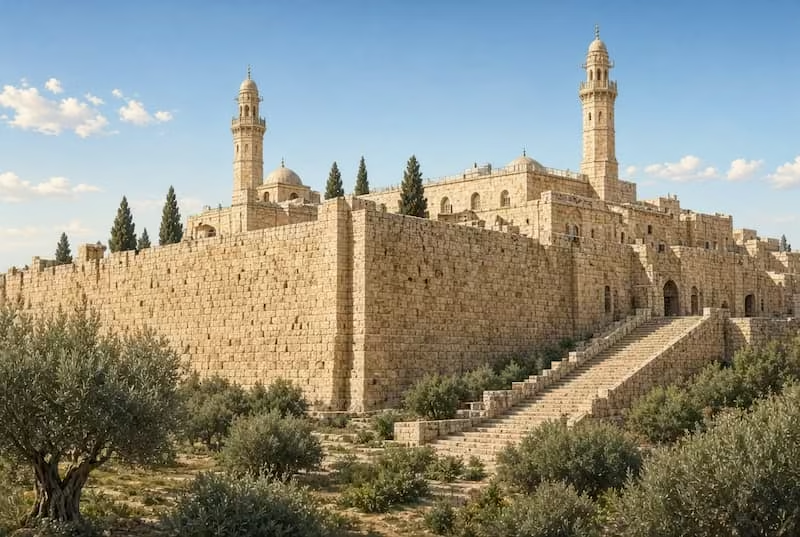
The Cave of the Patriarchs (Ibrahimi Mosque) in Hebron, where Prophet Jacob was buried after his death in Egypt.
Prophet Jacob AS burial Hebron is the quiet ending that gives the whole story its direction. The final chapter of his life is easy to rush past. Readers remember the ladder, the years with Laban, the loss of Joseph, and the reunion. Fewer ask what the last years in Egypt looked like, where the body was taken, and what that ground is called now.
The answer is precise. Prophet Jacob AS (Ya‘qub in the Qur’an) died in Egypt. He was not buried there. His sons carried him back to Canaan and laid him in the cave Prophet Abraham AS had purchased. That is the heart of Prophet Jacob AS burial Hebron. The city is known today as Hebron (al-Khalil). The compound above the cave is called the Ibrahimi Mosque by Muslims and the Cave of the Patriarchs by Jews and Christians.
Egypt had saved the family from famine. Joseph held power second only to the king. Food, honour, and safety were all on offer. Jacob still treated Egypt as a temporary lodging, not a homeland. His last request was a clear return to the field at Machpelah.
The Qur’an records the faith he asked his sons to keep. Genesis records the grave he asked them to reach. Later Jewish, Christian, and Islamic memory meet at the same stone enclosure in Hebron. This is why Prophet Jacob AS burial Hebron remains the fixed point of the narrative.
Prophet Jacob AS Burial Hebron – Why Jacob AS Came to Egypt
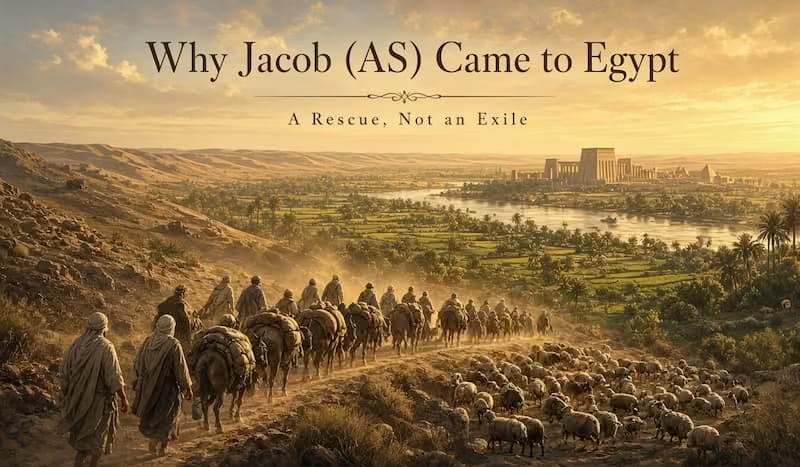
Jacob AS and his family travel to Egypt during the famine to join Joseph AS.
The move was not a conquest and not an exile. It was a rescue. A seven-year famine followed seven years of plenty, exactly as Joseph AS had interpreted the king’s dream. Joseph AS, sold by his brothers and later raised to high office, had stored grain for the whole country. When the brothers came to buy food, he tested them, revealed himself, and sent for his father.
The Qur’an compresses the arrival into a few verses of Surah Yusuf. Joseph AS receives his parents, seats them in honour, and says they may enter Egypt in safety if God wills. The family bows to him. An old dream of stars, sun, and moon is fulfilled as a greeting of rank, not an act of worship.
Genesis supplies the practical details. It uses a royal title that the Qur’an never applies to this king. In Surah Yusuf the ruler is called al-malik. This is not a personal name. It simply means “the king.” The word Fir‘awn does not appear in the surah.
Later Muslim historians often name him al-Rayyan ibn al-Walid and keep the tyrant of Musa AS’s time separate (commonly al-Walid ibn Mus‘ab). The Qur’an itself names neither man.
Jacob AS set out from Beersheba. He was 130 years old when he stood before the king and described his years as few and hard. Through Joseph AS the king settled the household in the best of the land (Goshen / the land of Rameses). The group that entered is listed as seventy in the Torah’s family register.
Islamic reports speak of a large company sent for with mounts and provisions. The exact number matters less than the fact: a household of herdsmen crossed into the Nile valley and stayed for seventeen years.
The decision to leave Canaan was not made lightly. Jacob AS had already received a vision at Beersheba in which God reassured him not to fear the descent into Egypt, promising that he would be brought back and that Joseph AS would close his eyes.
This divine assurance framed the entire sojourn and pointed toward the later Prophet Jacob AS Burial Hebron. What appeared to be a permanent relocation was, from the beginning, understood as temporary.
The whole journey to Egypt was never the final destination. It was a temporary refuge that prepared the way for Prophet Jacob AS Burial Hebron. Jacob AS lived those years knowing the return to the cave in Canaan still lay ahead.
Seventeen Years in the Land of Goshen Before Prophet Jacob AS Burial Hebron
Genesis 47:28 states clearly: “Prophet Jacob AS lived in Egypt seventeen years, and the length of his life was a hundred and forty-seven years.” Islamic sources generally follow the same outline.
The family lived as pastoralists in the eastern Nile Delta, the region called Goshen. Genesis 47:11 adds that Hazrat Yusaf (Joseph) AS gave them a possession “in the best of the land, in the land of Rameses, as the king had commanded.”
The name “Rameses” is almost certainly used by anticipation. The city later built by the Israelites under forced labour (Exodus 1:11) gave its name to the district.
In Prophet Jacob AS’s day the area was simply the best pasture land available—close enough for Hazrat Yusaf (Joseph) AS to supply grain, far enough from the main Egyptian population centres to let the family keep its own way of life.
Life was not idle. The household grew. Herds multiplied. Hazrat Yusaf (Joseph) AS continued to govern the country and to feed his family “according to the number in their families.”
Prophet Jacob AS, now called Israel, lived to see his grandchildren. The Qur’an does not narrate the daily years, yet the deathbed scene in Surah al-Baqarah 2:133 shows a father still teaching tawhid to his sons right to the end.
أَمْ كُنتُمْ شُهَدَاءَ إِذْ حَضَرَ يَعْقُوبَ الْمَوْتُ إِذْ قَالَ لِبَنِيهِ مَا تَعْبُدُونَ مِن بَعْدِي ۖ قَالُوا نَعْبُدُ إِلَٰهَكَ وَإِلَٰهَ آبَائِكَ إِبْرَاهِيمَ وَإِسْمَاعِيلَ وَإِسْحَاقَ إِلَٰهًا وَاحِدًا وَنَحْنُ لَهُ مُسْلِمُونَ |
“Or were you witnesses when death approached Jacob, when he said to his sons, ‘What will you worship after me?’ They said, ‘We will worship your God and the God of your fathers, Abraham and Ishmael and Isaac — one God. And we are Muslims [in submission] to Him.’” Surah al-Baqarah 2:133 |
During these years the twelve sons of Prophet Jacob AS established the foundations of what would become the twelve tribes.
The relative isolation of Goshen allowed the family to preserve its identity while benefiting from Egyptian administrative stability and food reserves.
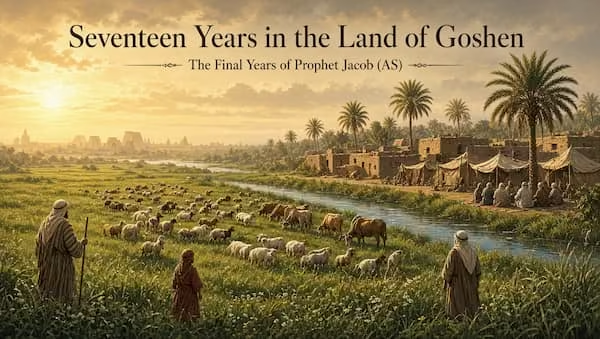
Prophet Jacob AS spent his last seventeen years in Goshen, guiding his sons.
Hazrat Yusaf (Joseph) AS’s position protected them from the worst effects of the remaining famine years and from any local hostility.
Prophet Jacob AS’s advanced age did not remove him from the role of patriarch. He continued to guide the household. The blessings he later pronounced over each son (recorded in Genesis 49) reflect a lifetime of observation and prophetic insight. Those blessings were spoken in Egypt, yet they pointed forward to a future in the land of Canaan.
The Deathbed Testimony of Jacob AS
The Qur’an preserves one decisive moment:
“Or were you witnesses when death approached Jacob, when he said to his sons, ‘What will you worship after me?’ They said, ‘We will worship your God and the God of your fathers, Abraham, Ishmael and Isaac—one God. And to Him we submit.’” (2:133) |
This is not a casual farewell. Prophet Jacob AS required an explicit confession of monotheism before he died. The same verse links him to Prophet Ibrahim (Abraham) AS, Prophet Ishmael AS, and Prophet Ishaq (Isaac) AS. Islamic tradition regards this as the prophetic act that sealed the family’s faith for the next generation.
The question “What will you worship after me?” is deliberate. Prophet Jacob (Yaqub) AS did not assume that upbringing alone would preserve the faith. He demanded a spoken testimony. The sons answered by naming the God of Prophet Abraham AS, Prophet Ishmael AS, and Prophet Isaac AS, affirming pure monotheism and submission. This scene is the Qur’an’s primary record of Prophet Jacob AS’s final days.
The Final Request Leading to Prophet Jacob AS Burial Hebron
As death drew near, Prophet Jacob AS called Hazrat Yusaf (Joseph) AS and made him swear a solemn oath. He said, in effect: Do not bury me in Egypt. Carry me out and bury me with my fathers. Genesis 47:29–31 and 49:29–32 record the words. He named the exact place: the cave in the field of Machpelah, facing Mamre, which Hazrat Abraham AS had bought as a burial site.
The request was deliberate. Egypt had been a place of provision, not of belonging. Prophet Jacob AS wanted his body to rest in the land promised to his grandfather Hazrat Ibrahim (Abraham) AS, his father Hazrat Ishaq (Isaac) AS, and himself. The oath bound Hazrat Yusaf (Joseph) AS publicly. When Prophet Jacob AS finished blessing his twelve sons (Genesis 49), he drew up his feet into the bed and died.
The insistence on leaving Egypt is striking. The family possessed land, grain, and high-level protection. Prophet Jacob AS nevertheless treated the Nile valley as a place of sojourn. His body would not remain there. The same conviction appears in the earlier divine promise that he would be brought back. The Prophet Jacob AS burial Hebron request simply made that promise concrete.
Evidence of the Purchase for Prophet Jacob AS Burial Hebron
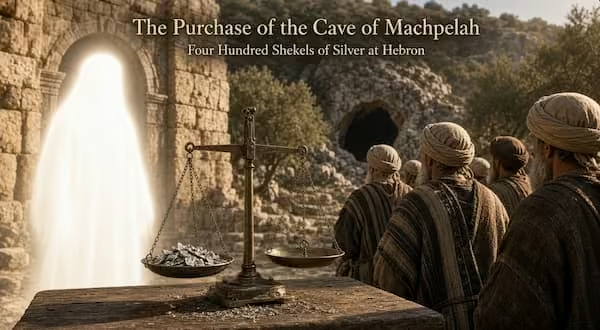
Abraham AS bought the cave of Machpelah for 400 shekels, and Prophet Jacob AS was later buried there.
The legal title to the burial ground is recorded in Genesis 23. After Hazrat Sarah RA died, Prophet Hazrat Abraham AS negotiated with the Hittites at Hebron. He refused a free gift and insisted on buying the cave of Machpelah at the edge of Ephron’s field.
Ephron named the price: four hundred shekels of silver. Prphet Abraham AS weighed out the silver in the presence of the Hittites “according to the weights current among the merchants.”
The field, the cave, and all the trees within its borders were conveyed to him as a permanent possession. The transaction was public, witnessed, and final.
Later generations buried there: Hazrat Sarah RA (first wife of Hazrat Ibrahim AS), Prophet Ibrahim (Abraham) AS, Hazrat Rebekah RA (Arabic: Rafqa wife of Prophet Ishaq AS), Prophet Ishaq (Isaac) AS, Leah RA ((Arabic: Layya / Liya) was one of the wives of Prophet Jacob AS), and finally Prophet Jacob AS. Prophet Yusaf (Joseph) AS himself would later request the same destination. The purchase was not sentimental; it was the first legal foothold of the family in the land of Canaan.
Four hundred shekels was a substantial sum. Prophet Ibrahim (Abraham) AS paid it without bargaining once the price was named, ensuring the sale could not be contested. The deed was executed at the city gate, the ancient equivalent of a public registry. This legal clarity is why Prophet Jacob AS could later name the cave with complete confidence.
The Funeral Journey and Prophet Jacob AS Burial Hebron
Hazrat Yusaf (Joseph) AS obtained permission from the king. The body was embalmed in the Egyptian manner—a process that took forty days. A large procession then left Egypt: Hazrat Yusaf (Joseph) AS, his brothers, the elders of the house, and many Egyptian officials. They travelled to Canaan and arrived at the threshing floor of Atad, where they mourned for seven days.
They carried Prophet Jacob AS burial Hebron and buried him in the cave of the field of Machpelah, exactly as he had commanded. Genesis 50:13 states: “They carried him to the land of Canaan and buried him in the cave in the field of Machpelah, near Mamre, which Prophet Ibrahim (Abraham) AS had bought along with the field as a burial place from Ephron the Hittite.”
Islamic historical reports (including those transmitted by Ibn Jarir al-Tabari and others) confirm the same outline: Hazrat Yusaf (Joseph) AS took his father to the cave Prophet Ibrahim (Abraham) AS had purchased and buried him there. The journey itself is part of the meaning of Prophet Jacob AS burial Hebron. The body left the place of temporary safety and returned to the place of covenant promise.
The scale of the procession is noteworthy. Egyptian officials accompanied the family. The seven-day mourning at Atad was so intense that local Canaanites remarked on it. Only after this public lament did the final burial take place. The event was both a family duty and a visible statement that the patriarch belonged to the land of Canaan.
What the Site of Prophet Jacob AS Burial Hebron Is Called Today
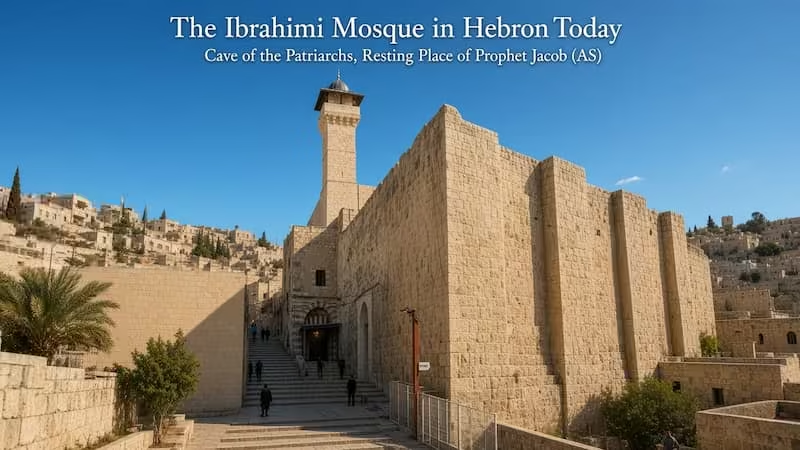
The Ibrahimi Mosque in Hebron stands over the cave where Prophet Jacob AS is buried.
The city is Hebron (Hebrew: Hevron; Arabic: al-Khalil). The compound that stands over the cave is known by several names:
- Cave of the Patriarchs (Jewish and Christian usage)
- Ibrahimi Mosque or Sanctuary of Abraham (Muslim usage)
- Haram al-Ibrahimi
The massive stone enclosure visible today was built by Herod the Great in the first century BCE. Later Muslim rulers added minarets and converted parts of the building into a mosque. The site remains one of the most contested and most revered places in the region. For Muslims, Jews, and Christians it marks the resting place of Prophet Ibrahim (Abraham) AS, Prophet Ishaq (Isaac) AS, and Prophet Yaqub (Jacob) AS and their wives.
Hebron itself is one of the oldest continuously inhabited cities in the world. Today it lies in the West Bank. Visitors can still walk the courtyards and see the cenotaphs that mark the traditional locations of the tombs below.
Archaeological and historical layers are visible throughout the complex. Herodian masonry forms the base. Crusader, Mamluk, and Ottoman additions sit above it. Despite centuries of change, the traditional identification of the site with the patriarchal tombs has remained remarkably consistent across Jewish, Christian, and Islamic sources.
Why Prophet Jacob AS Burial Hebron Still Matters
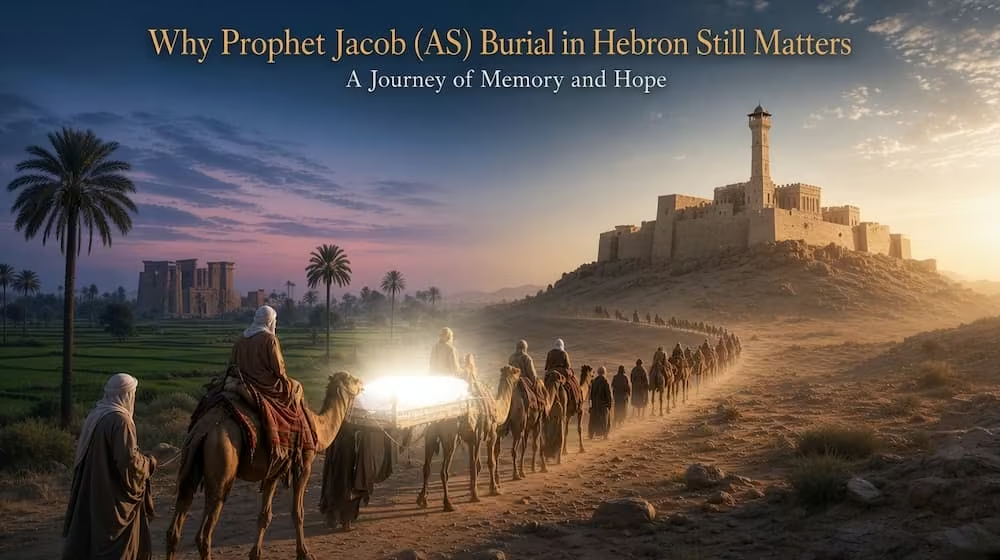
Prophet Jacob AS burial Hebron over Egypt’s comfort, a journey of memory and hope.
Prophet Jacob AS burial Hebron is more than a geographical fact. It is a theological statement. Egypt offered grain, rank, and security. Prophet Jacob AS chose the cave his grandfather had bought with silver weighed in public. The Qur’an emphasises the faith he transmitted; Genesis emphasises the land he claimed. Both traditions meet at the same stone walls.
The seventeen years in Goshen were a mercy. The final journey was an act of memory and of hope. Every generation that visits the Ibrahimi Mosque or the Cave of the Patriarchs stands, in some measure, at the end of that journey.
For readers of the Qur’an the story underscores that temporary prosperity does not redefine a prophet’s ultimate allegiance. For readers of Genesis the same story shows the first permanent legal claim of the family in Canaan being used exactly as intended—as a family burial place. The convergence of both traditions at one location in Hebron gives Prophet Jacob AS burial Hebron its enduring weight.
Frequently Asked Questions About Prophet Jacob AS Burial Hebron
1. Where did Prophet Jacob AS die? | He died in Egypt after living there for seventeen years. His body was then carried to Hebron for burial. |
2. How old was Prophet Jacob AS when he died? | Genesis 47:28 states he was 147 years old. Some Islamic reports give nearby figures; the Biblical number is the most widely cited. |
3. Why is the site called the Cave of Machpelah? | Machpelah means “double” or “split.” It refers to the double cave Prophet Ibrahim (Abraham) AS purchased from Ephron the Hittite for 400 shekels of silver as a family burial place. |
4. Is the king in the time of Prophet Yusuf (Joseph) AS called Pharaoh in the Qur’an? | No. Surah Yusuf consistently uses al-malik (“the king”). The title Fir‘awn appears in other surahs for the ruler of Prophet Musa AS’s time. Later historians sometimes name the king of Prophet Yusuf (Joseph) AS’s era al-Rayyan ibn al-Walid. |
5. What is the modern name of the burial site? | It is the Cave of the Patriarchs or Ibrahimi Mosque (Haram al-Ibrahimi) in the city of Hebron (al-Khalil). |