
The Journey of Hazrat Musa (AS): A Story of Courage, Trust, Gaining Inner Power, and Divine Mercy
The Journey of Hazrat Musa (A.S.): A Story of Courage, Trust, Gaining Inner Power, and Divine Mercy is a remarkable tale of faith and transformation.

The Journey of Hazrat Musa (AS): A Story of Courage, Trust, Gaining Inner Power, and Divine Mercy
The Journey of Hazrat Musa (AS) - A Story of Courage, Trust, Gaining Inner Power, and Divine Mercy
The Journey of Hazrat Musa (AS) begins in one of the darkest periods of oppression. In Egypt, Pharaoh ordered the killing of every newborn Israelite boy out of fear that they would one day challenge his power (see Surah Al-Qasas 28:4–6). It was in this time of fear that Hazrat Musa (A.S.) was born. By Allah’s plan he was raised inside the very palace of his greatest enemy. Later chosen as a Messenger of Allah, his life became a powerful example of courage, trust, and steadfastness against injustice.
The Journey of Hazrat Musa (AS) As A Baby Protected by Allah
The Journey of Hazrat Musa (AS) begins with a mother who was heartbroken and terrified. How could she protect her newborn son when Pharaoh’s soldiers were hunting every Israelite boy?
Yet Allah, in His infinite mercy, inspired her heart with these words: “Nurse him for a while, then place him in a basket and cast him into the river. Do not fear nor grieve; We shall surely return him to you and make him one of the Messengers.” (Surah Al-Qasas 28:7)
Ibn Kathir explains that when the mother of Musa became overwhelmed with fear, Allah placed this guidance directly in her heart. Her house stood near the banks of the Nile. She prepared a small box as a cradle, and whenever danger approached, she would place her baby inside and set it on the water. One day, in her haste, she forgot to tie the rope. The current carried the basket safely until it drifted to the steps of Pharaoh’s palace.
There, Pharaoh’s wife — the righteous Asiya (R.A.) — discovered the child. Her heart softened instantly with love, and she said, “This boy will bring us joy.” By Allah’s perfect plan, Musa’s own mother was later chosen as his wet nurse. Thus, in the early stages of The Journey of Hazrat Musa (AS), the very child whom Pharaoh sought to destroy grew up safely in the palace of his greatest enemy.
The Journey of Hazrat Musa (AS) - A Turning Point when Hazrat Musa (A.S.) Flees to Madyan
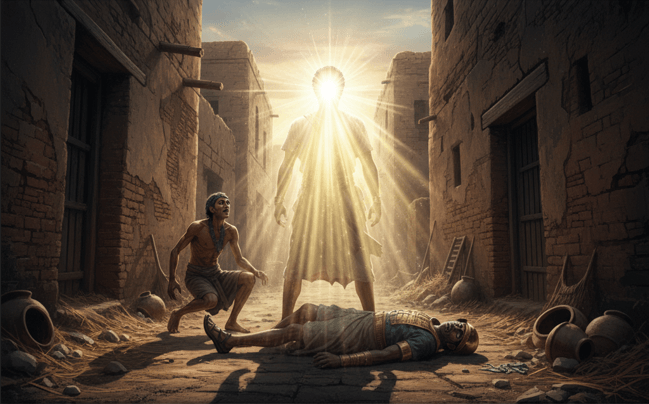
Hazrat Musa (A.S.) – The Divine Light and the Slaying of the Egyptian
As The Journey of Hazrat Musa (AS) continued, he grew into adulthood and felt deep concern for the suffering of the Israelites under Pharaoh’s rule. One day, according to Surah Al-Qasas (28:15), he entered the city and found two men fighting — one from his own people and one from the Egyptians. When the Israelite called for help, Musa intervened and struck the Egyptian with a single blow. The man died at once.
Musa immediately realised the gravity of what had happened. He said, “This is of Satan’s doing,” and turned to Allah in sincere repentance, asking for forgiveness. Classical commentators such as Ibn Kathir note that the act was not premeditated. When word of the incident reached Pharaoh’s court and a plot to kill Musa was formed, he left Egypt in fear and travelled alone toward Madyan.
Upon reaching the wells of Madyan, he saw two women holding back their flock while other shepherds watered theirs first. Moved by compassion, he drew water for them. Their father — traditionally identified as Prophet Shu‘ayb (A.S.) — welcomed him, offered hospitality, and later proposed marriage to one of his daughters in return for eight to ten years of service. Musa accepted and spent those years as a shepherd, living a quieter life far from Egypt while his greater destiny continued to unfold.
The Journey of Hazrat Musa (AS) by The Divine Call on Mount Sinai and The Beginning of Prophethood
Years later, during The Journey of Hazrat Musa (AS), while traveling with his family through the desert at night, he noticed a fire glowing on the side of Mount Sinai (Mount Tur). Hoping to bring some warmth or guidance, he asked his family to wait and walked toward the light.
When he approached, he saw a tree burning brightly yet remaining unharmed. From the sacred valley of Tuwa, a clear voice called out:

Hazrat Musa (A.S.) at Mount Tur – The Call from Allah
“O Musa! Indeed, I am your Lord, so take off your shoes. You are in the sacred valley of Tuwa.” (Surah Taha 20:11–12)
Allah then gave him two clear signs of prophethood. His staff, when thrown down, became a swiftly moving serpent (Surah Taha 20:17–21). When he placed his hand inside his cloak and drew it out, it shone white without any disease (Surah Taha 20:22). Ibn Kathir notes that the hand appeared radiant, free from any illness or blemish, as a pure sign from Allah.
Allah then commanded him to go to Pharaoh, who had become arrogant and oppressive, and to free the Children of Israel. Musa felt fear because of his past and Pharaoh’s power. He expressed his worry, but Allah reassured him:
“Do not fear. Indeed, I am with you; I hear and I see.” (Surah Taha 20:46)
This moment in The Journey of Hazrat Musa (AS) teaches us something practical: even after years of quiet preparation, the call of responsibility can still bring fear. The response is not to pretend the fear does not exist, but to move forward while holding onto the certainty that Allah hears and sees. When we face a difficult duty today, we can remember this scene and take the next step with the same trust.
Standing Before Pharaoh
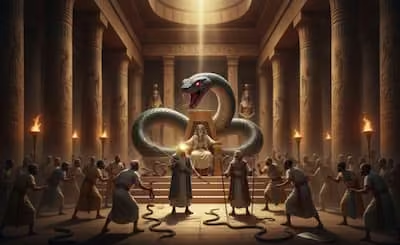
Hazrat Musa (A.S.) stands fearless before the mighty serpent in the court of Pharaoh, demonstrating the divine power and truth of Allah.
A key moment in The Journey of Hazrat Musa (AS) came when he returned to Egypt with his brother Harun (A.S.), carrying Allah’s clear command. Together they stood before Pharaoh and delivered the message: free the Children of Israel and stop the oppression.
Pharaoh rejected the call, mocked them, and accused Musa of sorcery. He gathered the most skilled magicians of his kingdom and ordered them to challenge Musa publicly. The magicians threw their ropes and staffs, which by illusion appeared as writhing snakes (see Surah Taha 20:66 and Surah Ash-Shu‘ara 26:44).
Then, at Allah’s command, Musa threw his staff. It became a real, living serpent that swiftly swallowed all their false creations (Surah Taha 20:69; Surah Al-A‘raf 7:117). Ibn Kathir notes in his tafsir that the magicians immediately recognised this was not magic but a true miracle from Allah, because their own illusions disappeared completely.
In that moment the magicians fell in prostration and declared: “We believe in the Lord of the worlds — the Lord of Musa and Harun” (Surah Ash-Shu‘ara 26:47–48). Pharaoh became furious and threatened them, yet the truth had already taken root in their hearts.
Practical reflection: This scene from The Journey of Hazrat Musa (AS) reminds us that real truth does not need to shout or compete with illusions. When we stand firm with sincerity, Allah can make the truth clear even in the most hostile places. Today, ask yourself: Where in my life am I still afraid to speak or act on what I know is right? Like the magicians, once the truth becomes clear, the right response is immediate surrender to Allah.
The Escape and the Miracle of the Sea

Hazrat Musa (A.S.) raises his staff as Allah parts the Red Sea, creating a miraculous path of safety for the believers while Pharaoh’s army approaches.
Despite the clear signs, Pharaoh’s heart only grew harder. Allah sent successive punishments upon Egypt — floods, locusts, lice, frogs, and water turned to blood — as distinct warnings (see Surah Al-A‘raf 7:133). Yet Pharaoh and his people remained arrogant and refused to free the Israelites.
Finally, Allah commanded Hazrat Musa (A.S.) to lead his people out of Egypt by night. As they departed, Pharaoh pursued them with a massive army. The Israelites soon found themselves trapped between the enemy behind them and the vast sea ahead. Fear spread among them.
In that critical moment of The Journey of Hazrat Musa (AS), he declared with complete trust: “No! Indeed, with me is my Lord; He will guide me.” (Surah Ash-Shu‘ara 26:62)
Allah then inspired him: “Strike the sea with your staff.” (Surah Ash-Shu‘ara 26:63). Musa (A.S.) obeyed. The waters miraculously parted, rising like towering mountains on either side and revealing a dry path.
Ibn Kathir notes in his tafsir that the sea split into paths resembling great mountains, and Allah made the seabed firm and dry so the believers could cross safely.
The believers crossed in safety. When Pharaoh’s army charged after them, the waters collapsed, drowning Pharaoh and his soldiers. Thus Allah saved the righteous and destroyed the oppressor.
Practical reflection: When we feel completely trapped — with no clear way forward and pressure closing in from behind — this moment in the journey of Musa (A.S.) reminds us to speak words of trust first, even before the solution appears. The next time you face a situation that seems impossible, pause and affirm: “My Lord is with me; He will guide me,” then take the next step of obedience that is within your reach.
The Journey of Hazrat Musa (AS) - The Divine Revelation by The Sacred Tablets from Allah
After the miraculous escape from Pharaoh and the crossing of the sea, The Journey of Hazrat Musa (AS) continued to its next great station. Allah commanded him to ascend Mount Sinai (Tur) for a fixed period of forty nights, as mentioned in the Qur’an: “And We appointed for Musa thirty nights and completed them with ten, so the term of his Lord was completed as forty nights” (Surah Al-A‘raf 7:142).

Hazrat Musa (A.S.) ascends Mount Sinai and receives the divine Tablets of the Torah from Allah amid rays of heavenly light.
There, in deep communion with his Lord, Musa (AS) received the Tablets (Alwah) containing the Torah (Tawrat) — a complete book of guidance, law, and mercy for the Children of Israel (see also Surah Al-A‘raf 7:145). Classical scholars such as Ibn Kathir note that these forty nights marked one of the highest moments of divine nearness granted to any prophet after the sea crossing.
This part of Musa’s journey reminds us that true closeness to Allah often comes only after we have first walked through hardship with patience and trust. When we remain steadfast through our own trials, Allah may open doors of guidance and light that we could never have reached otherwise.
In the later stage of The Journey of Hazrat Musa (AS), Allah Himself inscribed the sacred words upon the Tablets (Alwah). As stated in the Qur’an:
“And We wrote for him on the Tablets of everything an instruction and explanation for all things…” — Surah Al-A‘raf 7:145
These Tablets contained clear guidance on righteous living, worship, justice, and moral conduct. They became a shining light and a complete code of life for the Children of Israel.
Classical scholars such as Ibn Kathir note that this was a unique honour: Allah not only spoke directly to Musa (A.S.) but also wrote the revelation with His own command, making the Tablets a lasting source of divine instruction.
Even after receiving this great revelation, trials continued for Musa (A.S.) and his people. Yet he remained steadfast, turning to Allah with humility and complete trust. His example shows that receiving guidance is not the end of the journey — it is the beginning of living by it with patience.
Personal reflection: When Allah grants us knowledge or clarity in our own lives, the real test begins afterward. Like Musa (A.S.), we are called to hold firmly to what we have been given, especially when difficulties arise. Ask yourself: Am I treating the guidance I already have as a living light, or have I set it aside when the path becomes hard?
Morals and Lessons from The Journey of Hazrat Musa (AS)

A powerful symbolic representation of the journey of Hazrat Musa (A.S.): Trust in Allah, Courage against tyranny, and Justice through the divine Tablets.
The extraordinary life of Hazrat Musa (A.S.) continues to offer clear guidance for believers facing fear, hardship, and responsibility. From The Journey of Hazrat Musa (AS) we can draw these seven practical lessons:
1. Trust Allah even when the path is unclear Musa’s mother placed her infant son in the river as commanded in Surah Al-Qasas (28:7). Ibn Kathir notes that this was an act of complete tawakkul — she obeyed despite her fear, and Allah returned her child safely and raised him in Pharaoh’s own palace. Today this means: When you feel forced into a difficult decision with no clear outcome, act with trust and leave the result to Allah. |
2. Hardships prepare us for greater responsibility The years of exile and shepherding in Madyan (Surah Al-Qasas 28:22–28) refined Musa’s character before prophethood. Difficulty was not a delay — it was training. Practical step: View current struggles as preparation rather than punishment. Ask: “What quality is this season building in me?” |
3. Stand against injustice even when it is costly Musa could not remain silent when he saw oppression (Surah Al-Qasas 28:15). His intervention came at great personal risk. Personal reflection: Where in your daily life are you remaining silent when you should speak with wisdom and courage? |
4. True strength comes from faith, not status or power Pharaoh possessed armies and authority, yet Musa stood firm with only divine support (Surah Taha 20:45–46). Reminder: Real power belongs to the one who relies on Allah, not the one who appears strongest in the world. |
5. Allah’s help often arrives from unexpected directions From the basket on the Nile to the parting of the sea (Surah Ash-Shu‘ara 26:63), divine assistance came in ways no one could have planned. Application: Stay hopeful. The solution you cannot yet see may already be on its way. |
6. Miracles still require courage and action Allah parted the sea, but Musa had to strike it first with his staff (Surah Ash-Shu‘ara 26:63). Faith without movement remains incomplete. Action point: When you have prayed, take the next sincere step. Do not wait for the path to appear before you begin walking. |
7. Divine guidance is both a gift and a responsibility The Tablets given to Musa contained light and instruction for an entire nation (Surah Al-A‘raf 7:145). Revelation is not only to be received — it is to be lived and shared. Personal commitment: Cherish the guidance you have been given. Follow it sincerely and pass its benefit to others with gratitude. |
These lessons from The Journey of Hazrat Musa (AS) show that patience, courage, and trust in Allah lead to both outer victory and inner peace. May we carry them into our own trials with the same steadfastness.
✨ A Poetic Reflection on The Journey of Hazrat Musa (AS)
When the tale of longing and divine love was first ordained, When the devotion of the servant met the mercy of the Lord, At the unveiling of the Throne, the heavens must have swayed in awe, |