
Practical Ways to Extend the Life of Forests
A peaceful forest scene showcasing practical ways to extend the life of forests.🌲
How Practical Ways to Extend the Life of Forests?
Forests function as the Earth’s primary living laboratories, offering profound insights into wildlife conservation and the foundations of human health and survival. Practical Ways to Extend the Life of Forests begin with recognizing this vital ecological role.
These complex ecosystems provide indispensable services. They regulate global climate through carbon sequestration, purify air and water, prevent soil erosion, and harbor immense biodiversity. Practical Ways to Extend the Life of Forests protect and enhance these critical functions.
When forests degrade due to unsustainable practices or climate impacts, these benefits diminish and threaten both nature and people. Practical Ways to Extend the Life of Forests help reverse this damage before it becomes irreversible.
Rational, science-driven sustainable forest management offers a proven path forward. Practical Ways to Extend the Life of Forests focus on long-term ecosystem health instead of short-term exploitation.
By prioritizing resilience and biodiversity, we can keep forests productive for centuries. Practical Ways to Extend the Life of Forests ensure these living systems continue supporting human survival and planetary health.
Proven Success Stories from Around the World
Successful models from different continents illustrate how this works in practice. Practical Ways to Extend the Life of Forests rely on proven, long-term approaches that balance use with regeneration.
Germany pioneered scientific forestry with selective logging and planned reforestation as early as the 18th century.
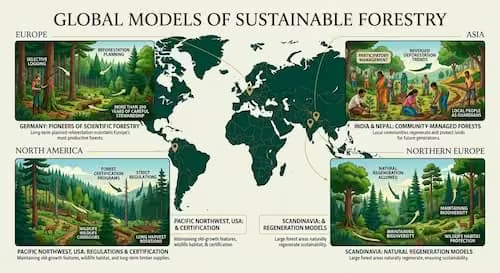
Proven Success Stories from Around the World highlight successful sustainable forestry practices across Europe, Asia, North America and Northern Europe.
Practical Ways to Extend the Life of Forests in this system have kept its woodlands among the most productive in Europe after more than 200 years of careful stewardship.
In India and Nepal, community-managed forests have reversed deforestation trends through participatory management. Practical Ways to Extend the Life of Forests here let local people sustainably harvest resources while actively protecting and regenerating the land for future generations.
Across the Pacific Northwest in the United States and throughout Scandinavia, forest certification programs combined with strict regulations and long harvesting rotations allow forests to regenerate naturally. Practical Ways to Extend the Life of Forests in these regions maintain old-growth features, wildlife habitat, and timber supplies indefinitely.
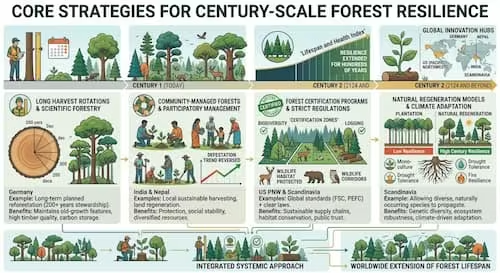
Core Strategies for Century-Scale Forest Resilience from Germany, India, Nepal, USA & Scandinavia.
Core Strategies for Century-Scale Forest Resilience
The following core strategies, drawn from these successes, form the foundation for extending forest lifespan worldwide:
● Selective logging and reduced-impact harvesting techniques protect remaining trees, soil, and understory vegetation, enabling continuous natural regeneration instead of the destructive cycle of clear-cutting. |
● Large-scale reforestation and afforestation programs using diverse, native, and climate-resilient tree species restore degraded lands, boost carbon sequestration, enhance biodiversity, and build resistance to pests and extreme weather events. |
● Empowering local communities and indigenous groups through participatory forest management creates ownership, incorporates valuable traditional ecological knowledge, and aligns economic incentives with conservation goals for lasting results. |
● Independent forest certification systems such as FSC and PEFC set rigorous standards for environmental protection, social equity, and economic sustainability, giving consumers and markets powerful tools to support responsible forestry. |
● Adaptive management based on ongoing scientific monitoring, satellite data, and field research allows forest managers to detect problems early and adjust practices in response to new threats like invasive species, diseases, or shifting climate patterns. |
● Protecting remaining old-growth forests as biodiversity strongholds and restoring critical habitats such as riparian zones further strengthens overall ecosystem resilience. |
Practical Ways to Extend the Life of Forests become highly effective when strategies are implemented together at scale. Forests then shift from vulnerable resources into self-sustaining assets. These assets keep providing clean air, water, carbon storage, wildlife habitat, and economic opportunities for hundreds of years.
The knowledge and successful examples already exist in many parts of the world. Practical Ways to Extend the Life of Forests have been proven through real results on the ground.
Widespread adoption is now required through supportive policies, international cooperation, responsible business practices, and active public engagement. These combined actions make Practical Ways to Extend the Life of Forests possible on a large scale.
Choosing sustainable forest management today secures thriving forests and a thriving planet for centuries ahead. Practical Ways to Extend the Life of Forests offer the clearest path to that long-term future.
focus on extending forest life for centuries:
Stop Unnecessary Cutting of Trees — Uncontrolled logging remains one of the greatest threats to forests. Trees should only be felled when truly essential, following strict regulations that prioritize ecosystem health.
👉🍃 In sustainable forestry practices supported by organizations like the Forest Stewardship Council (FSC), selective logging focuses only on mature or damaged trees while protecting young growth. This approach, applied in certified forests across regions like the Pacific Northwest (USA), maintains forest cover and allows continuous regeneration.
Practice Reforestation and Afforestation — For every tree removed, more must be planted. Reforestation restores degraded areas, while afforestation creates new forests in barren lands.
👉🍃 Costa Rica doubled its forest cover from about 26% to over 52% between the 1980s and 2019 through ambitious national reforestation programs, payments for ecosystem services, and incentives for landowners. This turnaround transformed a once-deforested nation into a global leader in biodiversity and eco-tourism.
Prevent Forest Fires — Fires can devastate vast areas in hours, requiring decades — or centuries — for recovery. Many are human-caused and preventable through proactive measures.
👉🍃 In the western United States, agencies like the U.S. Forest Service use controlled (prescribed) burns, firebreaks, and community education to reduce fuel loads. These strategies have successfully lowered large-scale fire risks in areas like California’s national forests, while mimicking natural low-intensity fires that promote healthy ecosystems.
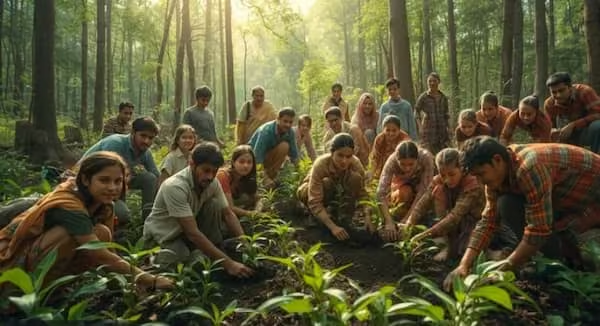
Communities working together to plant trees and protect forests for generations to come.🌲
- Protect Wildlife and Biodiversity —Animals, birds, and insects are essential partners in forest health — dispersing seeds, controlling pests, and maintaining balance. Without them, forests weaken over time.
👉🍃 In the Białowieża Forest (Poland/Belarus), strict protection of wildlife like European bison and birds has preserved one of Europe’s last primeval forests for centuries, allowing natural seed dispersal to sustain diverse tree regeneration without heavy human intervention. - Control Grazing and Human Encroachment — Overgrazing by livestock and illegal settlements destroy seedlings and degrade soil, preventing regeneration.
👉🍃 Regulated seasonal grazing in community-managed areas of Nepal has allowed young trees to establish, contributing to a dramatic increase in forest cover from 26% to 45% between 1992 and 2016. - Use Forest Resources Sustainably — Forests supply wood, medicine, food, and fuel — but overexploitation exhausts them. Sustainable harvesting meets needs without depletion.
👉🍃 In many FSC-certified forests worldwide, communities collect only fallen wood or non-timber products (like fruits and medicines), reducing pressure on living trees while supporting local economies. - Involve Local Communities — Nearby residents become the most effective guardians when empowered with rights, training, and benefits.
👉🍃 Nepal’s Community Forest Program — one of the world’s most successful models — has handed management to over 22,000 community groups. This has not only reversed deforestation but regenerated forests across millions of hectares, improving livelihoods and biodiversity through local patrols, planting, and sustainable use. - Reduce Pollution and Climate Change Impact — Pollution, warming temperatures, and altered rainfall weaken forests, making them vulnerable to disease and drought.
👉🍃 Global efforts like the Great Green Wall in Africa’s Sahel region combat desertification through tree planting, sustainable land management, and carbon sequestration. In countries like Ethiopia and Senegal, community-led restoration has restored degraded lands, stabilized climates, and supported millions of people. - Education and Awareness — Knowledge breeds care — informed people value and protect forests.
👉🍃 School programs and campaigns in Costa Rica and Nepal have fostered generations of environmental stewards, leading to sustained community involvement in conservation.
Forests as Living Signs of Allah’s Mercy: The Prophetic Call to Plant, Protect, and Serve as Khalifah
Forests stand as vital lifelines of our planet—breathtaking in their beauty, resilient in their strength, and utterly irreplaceable in their role. Practical Ways to Extend the Life of Forests begin with recognizing how they oxygenate the atmosphere we breathe, temper global climate patterns, cradle immense biodiversity, and serve as vivid signs of Allah’s boundless mercy and perfect creation.
Without healthy forests, the delicate balance of life on Earth would unravel. Air quality, water cycles, soil stability, and the survival of countless communities that depend on them for food, medicine, and livelihoods would all suffer. Practical Ways to Extend the Life of Forests therefore demand urgent recognition of this interconnected reality.
Safeguarding these precious ecosystems requires decisive action on multiple fronts. We must curb unnecessary deforestation driven by short-term economic interests and champion widespread reforestation of degraded lands. Practical Ways to Extend the Life of Forests also include preventing and controlling the destructive wildfires that ravage millions of hectares every year.
Empowering local communities as true stewards of their ancestral forests is essential. At the same time, sustainable choices must be woven into everyday life through responsible consumption and support for eco-friendly policies. These combined efforts form core Practical Ways to Extend the Life of Forests that deliver lasting results.
Inspiring real-world successes prove that meaningful change is achievable. Costa Rica doubled its forest cover in just a few decades through strong policies, payment for ecosystem services, and national pride in its natural heritage. Practical Ways to Extend the Life of Forests are clearly visible in Nepal’s community-managed woodlands, where local people protect and regenerate forests, increasing tree cover and improving livelihoods.
Large-scale global restoration initiatives further demonstrate what is possible. Protection, renewal, and collective wisdom can reverse decades of damage and create enduring environmental and spiritual transformation. Practical Ways to Extend the Life of Forests continue to be proven through such committed, large-scale efforts worldwide.
The Prophet Muhammad ﷺ captured the spirit of hope and long-term responsibility when he said: “If the Hour were about to be established and one of you held a sapling in his hand, let him plant it.” (Hadith narrated by Anas ibn Malik, Musnad Ahmad). This teaching reminds us never to abandon restoration and mercy. Practical Ways to Extend the Life of Forests include understanding that planting a tree is sadaqah jariyah—an ongoing charity whose rewards continue long after we leave this world as birds, animals, and people benefit from its shade, fruit, oxygen, and shelter.
As Allah’s khalifah on Earth, we are entrusted with the duty to protect and nurture what He has created. Let us rise to this sacred trust with both environmental diligence and deep spiritual reverence. Practical Ways to Extend the Life of Forests mean preserving clean air, harmonious ecosystems, thriving biodiversity, and a hopeful tomorrow for all creation across centuries and millennia.
Saving forests today is far more than an ecological necessity. It is a profound investment in our shared home, a fulfillment of our divine duty as khalifah, and a lasting legacy of mercy for generations to come. Embracing Practical Ways to Extend the Life of Forests ensures this sacred responsibility is fulfilled with lasting impact.
Garden is a nice hobby

A peaceful cottage garden that shows why gardening is such a lovely hobby.