
Stellar Death and Cosmic Renewal: The Cycle of Cosmic Renewal 🌌
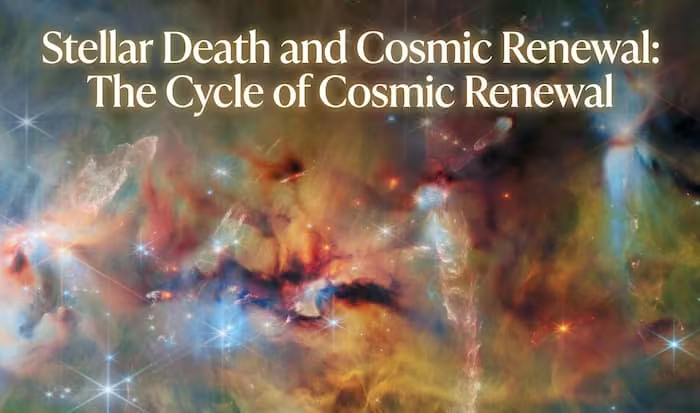
Stunning nebula representing the cycle of stellar death and cosmic renewal.
The end of a star’s life carries the same creative power as its birth. When massive stars exhaust their nuclear fuel, their cores collapse under gravity and trigger one of the most violent events in the universe — a supernova. These explosions forge and scatter heavy elements such as carbon, oxygen, silicon, and iron across the interstellar medium. The enriched gas and dust become the raw material for new stars, planets, and eventually life itself.
Lighter stars end more gently, shedding outer layers and leaving behind white dwarfs. The most massive objects collapse further into neutron stars or black holes. These regions possess extraordinary density where the laws of physics reach extreme limits. This continuous cycle of stellar birth, evolution, death, and renewal reveals the self-sustaining architecture of the cosmos.
Destruction is never final. It serves as the necessary prelude to new creation. Modern astrophysics confirms that the atoms in our bodies originated inside ancient stars. We are quite literally made of stardust recycled across billions of years through repeated cycles of stellar death and cosmic renewal.
The Birth of Stars in Molecular Clouds
Stars begin their lives inside vast, cold molecular clouds of hydrogen and helium. Gravity slowly overcomes internal pressure, causing dense regions to collapse and fragment. Within these collapsing cores, protostars form and begin to heat up. Gravitational energy converts into thermal energy during this process.
When core temperatures reach roughly 10 million kelvin, hydrogen fusion ignites and a star is born. The Orion Nebula and the Pillars of Creation provide vivid snapshots of ongoing star formation. Young stars emerge surrounded by glowing gas and dust. Their intense radiation carves out cavities and triggers further collapse in neighboring regions.
This star formation follows precise physical laws of gravity, magnetism, and thermodynamics. These laws have operated consistently since the early universe. Triggered star formation often occurs when supernova shock waves compress nearby molecular clouds. Such interactions link stellar death directly to new stellar birth in a continuous cosmic cycle. Typical molecular clouds span tens of light years and contain thousands of solar masses of material available for star formation.
The Evolutionary Journey Across Stellar Lifetimes
Once hydrogen fusion begins, stars enter the main-sequence phase. This represents the longest and most stable period of their lives. A star’s mass determines its fate and total lifetime. Low- and medium-mass stars like our Sun burn steadily for billions of years.
They convert hydrogen into helium in their cores through nuclear fusion. As hydrogen depletes, the core contracts while outer layers expand. This transforms the star into a red giant. Massive stars evolve much faster through successive fusion stages.
They burn helium, carbon, neon, oxygen, and silicon in mere millions of years. Each stage produces heavier elements until the core reaches iron. At that point fusion no longer releases energy. The star’s structure becomes unstable and sets the stage for dramatic stellar death. The Hertzsprung-Russell diagram maps these evolutionary tracks clearly for astronomers studying stellar populations.
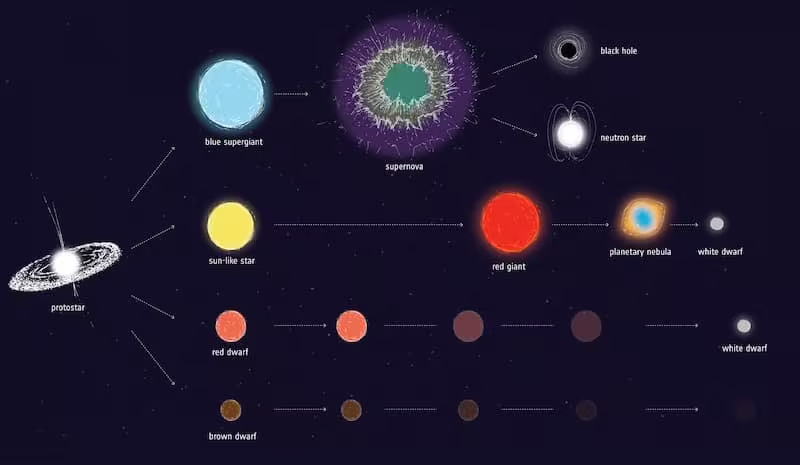
Stellar evolution diagram showing the complete life cycles of stars from birth to their final stages.
The Spectacular Death of Massive Stars — Core-Collapse Supernovae
When a massive star’s iron core exceeds the Chandrasekhar limit, electron degeneracy pressure fails. The core collapses in milliseconds and reaches densities greater than an atomic nucleus. This triggers a rebound shock wave that explodes the outer layers. Speeds reach tens of thousands of kilometers per second during the blast.
The resulting core-collapse supernova releases more energy in seconds than the Sun emits over its entire lifetime. These events synthesize elements heavier than iron through rapid neutron capture, known as the r-process. They disperse these elements into the interstellar medium. The supernova remnant expands and cools over thousands of years while mixing freshly minted elements into the galactic ecosystem.
Historical supernovae such as SN 1054 created the Crab Nebula. SN 1987A provided modern astronomers with detailed observations. Neutrinos carry away most of the explosion energy and were detected on Earth in 1987. These observations confirm models of stellar death and cosmic renewal through element dispersal. Neutrino astronomy now offers a new window into the interior processes of core collapse.
The Quiet Endings — White Dwarfs and Planetary Nebulae
Stars with initial masses between 0.8 and 8 solar masses follow a gentler path. After the red-giant phase they shed outer envelopes in expanding shells of gas. These shells are known as planetary nebulae. The exposed core becomes a white dwarf supported by electron degeneracy pressure.
White dwarfs slowly cool over billions of years. They eventually fade into black dwarfs. They remain important cosmic fossils that preserve the chemical history of parent stars. Type Ia supernovae occur when white dwarfs in binary systems accrete too much mass and explode.
These events serve as standard candles in cosmology. They helped astronomers discover the accelerating expansion of the universe. White dwarf cooling rates provide independent age estimates for stellar populations and galactic components. The first white dwarf discovered, Sirius B, confirmed theoretical predictions of degenerate matter.
Extreme Remnants — Neutron Stars and Black Holes
Stars above 8 to 10 solar masses leave behind exotic objects after supernova explosions. The core may form a neutron star roughly 20 kilometers across. This object has a mass greater than the Sun packed into city-sized volume. Neutron stars possess incredible magnetic fields and spin rates.
Some emit beams of radiation as pulsars and act as precise cosmic clocks. The most massive stars collapse completely into black holes. Their gravitational pull is so strong that not even light escapes the event horizon. These objects warp spacetime and influence surroundings through accretion disks and relativistic jets.
Gravitational-wave detections from LIGO and Virgo have confirmed black-hole and neutron-star mergers. These observations open new windows onto stellar death and cosmic renewal. They reveal how extreme remnants continue shaping the universe long after the initial explosion. A single teaspoon of neutron star material would weigh billions of tons on Earth.
Cosmic Enrichment and Galactic Chemical Evolution
Every generation of stars enriches the interstellar medium with heavier elements. The first stars formed from primordial hydrogen and helium and produced only light elements. Subsequent generations incorporated these metals. This enabled more efficient cooling and formation of smaller, longer-lived stars plus rocky planets.
This process of cosmic chemical evolution explains increasing metallicity in younger stars. It also explains metallicity gradients in spiral galaxies like the Milky Way. Without repeated cycles of stellar death and renewal the universe would lack carbon, oxygen, and heavier elements. These elements are required for complex chemistry and life as we know it.
The Milky Way galaxy we inhabit is the product of countless such cycles. They span more than 13 billion years of cosmic history. Metallicity levels directly influence planet formation efficiency through core-accretion processes in protoplanetary disks. Population I stars like the Sun contain higher metal content than older Population II stars in galactic halos.
We Are Made of Stardust — The Human Connection to Cosmic Renewal
The iron in our blood, the oxygen we breathe, and the calcium in our bones were forged inside stars. These stars lived and died before the Solar System formed. The carbon forming organic molecule backbones shares the same stellar origin. This realization bridges astronomy and biology profoundly.
Life on Earth is not separate from the cosmos. It represents a direct continuation of stellar processes through cosmic renewal. The stardust concept is now a measurable scientific fact. Spectroscopy, meteorite analysis, and nucleosynthesis models all confirm it. Every human carries atoms that once resided in ancient stellar cores.
This links personal existence to the grand narrative of stellar death and cosmic renewal. Elements heavier than helium in our bodies originated almost entirely in stars. Big Bang nucleosynthesis produced only hydrogen, helium, and trace lithium. Carbon, nitrogen, oxygen, and iron essential for life were delivered by previous generations of stellar death and cosmic renewal.
Quranic Perspectives on Cosmic Cycles and Divine Order
The Qur’an repeatedly draws attention to ordered motion and renewal within the universe. One verse states:
| “He merges the night into the day and merges the day into the night, and He has subjected the sun and the moon, each running its course for an appointed term. That is Allah, your Lord; to Him belongs all dominion.” (Surah Fatir 35:13) |
| The Qur’an reflects this same principle of renewal and divine order: |
This description of continuous cosmic rhythm mirrors scientific understanding of stellar and galactic cycles. Just as day and night alternate with perfect regularity, stars form, evolve, explode, and seed new generations. They do so in harmony with unchanging physical laws. The verse emphasizes that these processes operate under precise, appointed terms.
This concept aligns fully with predictable timescales of stellar evolution. Finite stellar lifetimes reflect the appointed terms mentioned in revelation. The continuous merging of day and night parallels the endless cycle of stellar death and cosmic renewal across galaxies. Quranic cosmology presents the universe as dynamic and purposeful rather than static.
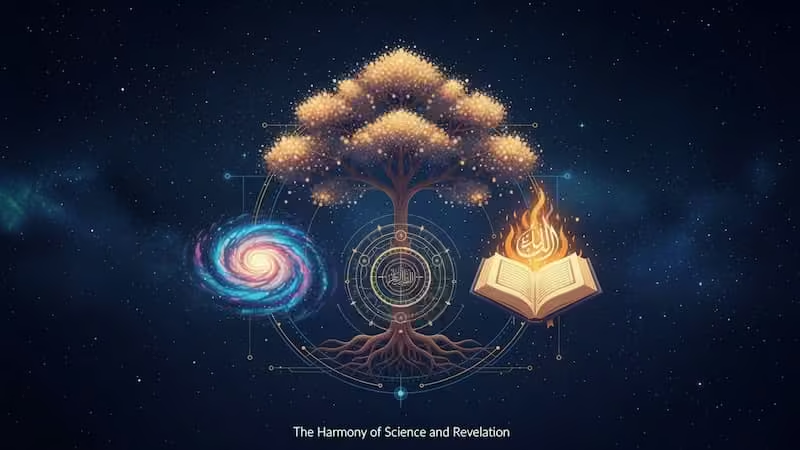
A mystical representation of Quranic perspectives on cosmic cycles and divine order, blending science, revelation, and sacred geometry.
Signs in the Heavens — The Harmony of Science and Revelation
“Indeed, in the creation of the heavens and the earth and the alternation of the night and the day are signs for those of understanding.” Surah Ali ‘Imran (3:190) |
Another verse invites reflection on the cosmos itself: “Indeed, in the creation of the heavens and the earth, and in the alternation of the night and day, are signs for those of understanding.” (Surah Al Imran 3:190)
Modern astrophysics reveals these signs in ever greater detail. We observe life cycles of stars, synthesis of elements, recycling of matter, and emergence of structure from apparent chaos. Science explains the physical mechanisms involved. The Qur’an provides spiritual context that reminds humanity these phenomena are purposeful signs.
These signs point toward the Creator’s wisdom and power. The harmony between empirical discovery and revelation enriches both domains. Observation of the universe deepens appreciation for the precision of divine laws. Scriptural encouragement to reflect on nature inspires continued scientific inquiry. The Quranic call for tadabbur, or deep contemplation, applies directly to studying stellar phenomena and cosmic renewal.
There is no inherent conflict between the two approaches. Each illuminates different dimensions of the same reality. This integration strengthens both faith and understanding of stellar death and cosmic renewal.
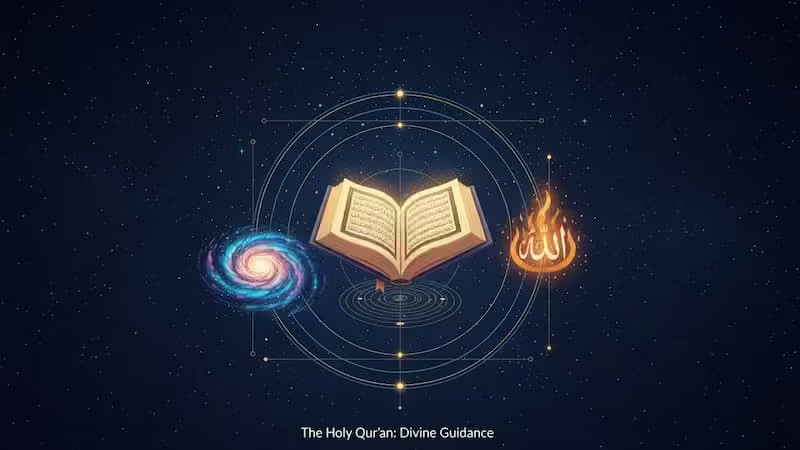
A cosmic representation of Signs in the Heavens, showing the Holy Quran as divine guidance within the harmony of science and revelation.
Integrating Knowledge and Faith in the Study of the Cosmos
Throughout Islamic intellectual history scholars viewed study of the natural world as an act of worship. The same impulse drives modern astronomers to map stellar remnants and model supernova nucleosynthesis. Earlier generations observed the heavens with wonder and rigorous method. Both scientific and spiritual paths lead to greater awe at interconnectedness and purposefulness of creation.
Stellar death and cosmic renewal exemplify this unity clearly. Physical processes that disperse heavy elements enabled formation of Earth and emergence of life. Recognizing this continuity fosters humility and gratitude. It reinforces that knowledge and faith are complementary rather than competing sources of understanding.
Quranic cosmology encourages contemplation of celestial phenomena as signs of divine order. Astrophysics provides detailed mechanisms behind those signs. Together they offer a complete picture of stellar evolution from molecular clouds through supernova explosions to new star formation. This integrated approach honors both empirical evidence and spiritual insight.
Conclusion: Embracing the Eternal Cycle of Stellar Death and Cosmic Renewal
From collapse of molecular clouds to explosive deaths of massive stars and quiet fading of white dwarfs, the universe operates through an elegant self-renewing cycle. Each stage of formation, evolution, destruction, and rebirth contributes to ongoing enrichment of the cosmos. Supernovae scatter elements that build planets and living beings. Stellar remnants mark endpoints of one generation and seeds of the next.
The Qur’an’s emphasis on signs in the heavens and ordered alternation of cosmic phenomena resonates deeply with scientific insights. Laws governing stellar nucleosynthesis and galactic chemical evolution reflect deeper order and purpose. In studying stellar death and cosmic renewal we acquire knowledge while participating in an ancient quest.
We seek to understand our place within a universe that is both physically precise and spiritually meaningful. We are stardust contemplating the stars. Through science we trace physical pathways of cosmic renewal. Through revelation we recognize the signs and their Source. Together they reveal a cosmos of continuous creation where even cataclysmic endings serve greater purposes of renewal. This cycle continues by divine wisdom across the vast expanse of space and time. Future generations of stars will continue this process until the universe reaches its final state, yet the legacy of stellar death and cosmic renewal will remain embedded in all matter.
Page 3