
The Secrets of the Night Sky
The Secrets of the Night Sky
The secrets of night sky has fascinated humankind for centuries. Long before telescopes and satellites, people gazed upwards, searching for meaning in the stars. Even today, the night sky continues to inspire scientists, poets, and dreamers alike. Beyond its beauty lies a universe full of secrets waiting to be uncovered.
Introduction of The Secrets of the Night Sky
The secrets of the night sky go far beyond what the human eye can see. Modern astronomy has revealed that stars are not just distant lights but massive spheres of burning gas, each with its own life cycle. Some are young and bright, while others are nearing the end of their existence, eventually exploding as supernovae. Planets, moons, and galaxies form intricate systems, governed by gravity and cosmic forces that scientists are still striving to understand.
The night sky also serves as a window into the past. Because light takes time to travel, observing distant stars allows us to see them as they were millions or even billions of years ago. This makes stargazing a journey through time itself. Additionally, constellations—patterns formed by stars—have played an important role in navigation and storytelling across cultures. Exploring the secrets of the night sky not only deepens our scientific knowledge but also connects us to history, imagination, and the vast universe beyond our world.
The Secrets of the Night Sky Stars
**The Secrets of the Night Sky Stars**
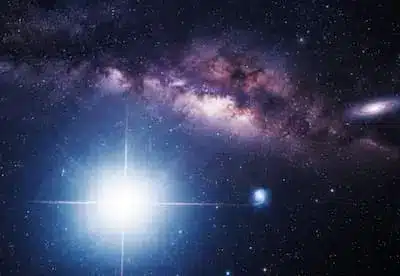
When darkness settles across the Earth, the sky transforms into a vast canvas filled with shimmering points of light. These night sky stars are not small or insignificant—they are enormous spheres of hot plasma, powered by nuclear fusion at their cores. This process releases tremendous energy, allowing stars to shine for millions or even billions of years. Our own Sun is a typical star, yet many others are far larger, hotter, and brighter.
The colors of night sky stars can tell us a great deal about them. Blue stars are extremely hot, while red stars are cooler in comparison. Their brightness, known as luminosity, depends not only on size but also on temperature and distance from Earth. Some stars we see may have already burned out, but their light continues traveling through space, reaching us long after they are gone.
Stars also form patterns called constellations, which have been used for navigation and storytelling for centuries. By studying night sky stars, scientists gain insight into the origins of galaxies and the universe itself, making them one of the most fascinating features of the cosmos.
Constellations of The secrets of the Night Sky
**Constellations of The Secrets of the Night Sky**
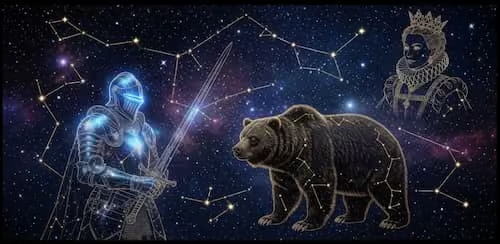
Constellations have fascinated humanity for thousands of years, serving as both a scientific tool and a source of imagination. The focus keyword, constellations, refers to groups of stars that appear to form recognizable patterns in the night sky. While these stars may be vast distances apart in space, from Earth they seem connected, creating shapes that ancient civilizations interpreted in meaningful ways. Different cultures developed their own constellations, with the Greeks, Egyptians, and Chinese all mapping the sky according to their beliefs and traditions.
Beyond storytelling, constellations played a crucial role in early navigation and timekeeping. Sailors relied on star patterns to guide their journeys across oceans long before modern instruments existed. Farmers also observed constellations to determine the changing seasons, helping them know when to plant or harvest crops. Today, astronomers use constellations as a way to organize the sky into regions, making it easier to locate stars, planets, and other celestial objects.
Even in modern times, the focus keyword constellations continues to inspire curiosity and exploration. With the help of telescopes and mobile apps, people can identify constellations more easily than ever before. Whether for science or storytelling, these star patterns remain a timeless connection between humanity and the vast universe above.
The Moon: Earth’s Silent Companion
**The Moon: Earth’s Silent Companion**
The Moon: Earth’s Silent Companion has fascinated humanity for thousands of years, serving as both a scientific wonder and a cultural symbol. As Earth’s only natural satellite, it orbits our planet at an average distance of about 384,400 kilometers, influencing tides through its gravitational pull. This connection between Earth and the Moon plays a vital role in stabilizing our planet’s rotation and climate over long periods.
The Moon does not produce its own light; instead, it shines by reflecting sunlight. This reflection creates the familiar phases—from new moon to full moon—that have been used throughout history to measure time and guide agricultural practices. Early civilizations relied heavily on these cycles to plan planting and harvesting seasons.
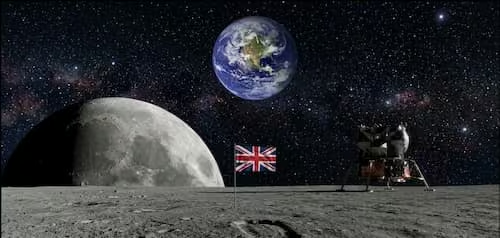
In addition to its practical importance, the Moon has been central to exploration. During the 20th century, human curiosity led to historic space missions, making the Moon the first extraterrestrial body visited by humans. Its surface, covered with craters and vast plains called “maria,” tells the story of billions of years of cosmic impacts.
Even today, The Moon: Earth’s Silent Companion continues to inspire scientists and dreamers alike, as new missions aim to uncover more secrets about its origin and potential for future exploration.
Planets: Wandering Stars of the secrets of the Night Sky
**Planets: Wandering Stars of the Secrets of the Night Sky**
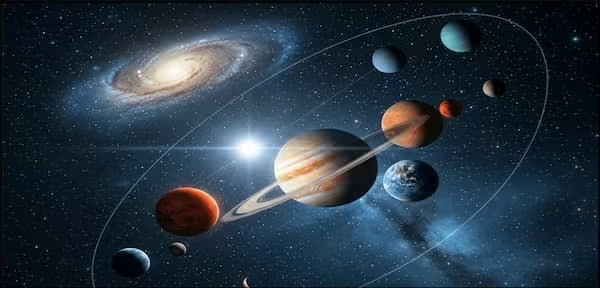
The phrase “wandering stars” beautifully describes how planets appear to move against the fixed background of stars in the night sky. Unlike distant stars, which maintain consistent positions relative to one another, night sky planets shift gradually along a path known as the ecliptic. This movement is caused by their orbits around the Sun, making them fascinating objects to track over days and weeks.
Among the most noticeable night sky planets, Venus shines the brightest due to its thick cloud cover reflecting sunlight. It is often visible shortly after sunset or before sunrise, earning its titles as the Evening Star or Morning Star. Jupiter, the largest planet, stands out with its strong, steady light and can sometimes be seen throughout the night. Saturn, though dimmer, has a golden hue and can also be spotted without telescopes under clear conditions.
One key way to distinguish night sky planets from stars is their steady glow. Stars twinkle because of Earth’s atmosphere, while planets appear more stable. Observing these wandering lights not only connects us to ancient sky watchers but also helps us understand our place in the solar system.
The Milky Way: Our Galactic Home
**The Milky Way: Our Galactic Home**
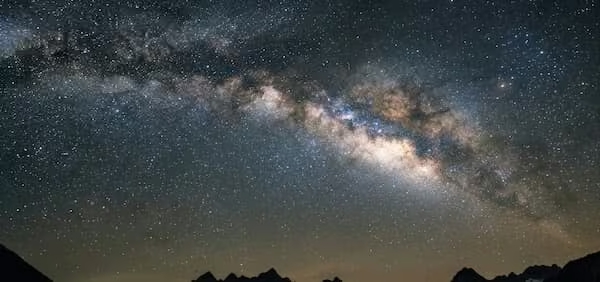
On a clear night, far from city lights, the Milky Way stretches across the sky like a glowing silver ribbon. This breathtaking sight is not just a collection of stars, but our home galaxy—a vast cosmic system containing hundreds of billions of stars, along with planets, gas, dust, and dark matter. The Milky Way is shaped like a विशाल spiral, with long arms that slowly rotate around a dense central core. Our solar system lies in one of these arms, making us just a tiny part of this immense structure.
The Milky Way plays a central role in helping scientists understand the universe. By studying its stars and movements, astronomers can learn about the formation of galaxies and the evolution of cosmic systems over billions of years. At its center lies a supermassive black hole, an object of intense gravity that influences the motion of nearby stars.
Observing the Milky Way also reminds us of our place in the universe. It highlights how small Earth is compared to the vastness of space, yet how connected we are to it. Every star visible in that glowing band tells a story, making the Milky Way not just our galactic home, but a gateway to understanding the mysteries of the night sky.
Modern Exploration of the Night Sky
**Modern Exploration of the Night Sky**
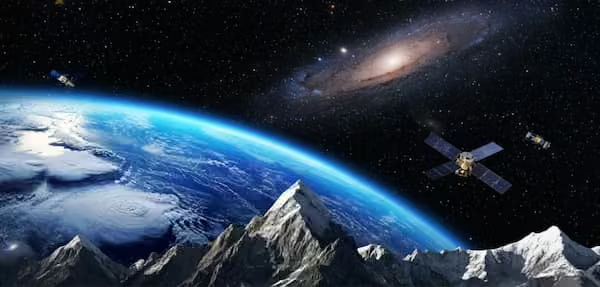
Modern exploration of the night sky has transformed our understanding of the universe in remarkable ways. Advanced telescopes, both on Earth and in space, now allow scientists to observe galaxies billions of light-years away, giving us a glimpse into the early stages of cosmic history. Powerful observatories capture detailed images of stars being born, planets forming, and black holes influencing entire galaxies. This continuous progress in technology has made the modern exploration of the night sky more precise and insightful than ever before.
In addition, space missions and robotic spacecraft have extended human knowledge far beyond our own planet. Probes sent to Mars, Jupiter, and even the outer edges of the solar system provide valuable data about planetary environments and the potential for life elsewhere. Satellites orbiting Earth play a crucial role as well, helping scientists monitor climate patterns, improve global communication, and enhance navigation systems.
Furthermore, modern exploration of the night sky is not limited to professionals. Amateur astronomers, equipped with affordable telescopes and digital tools, can also contribute to discoveries. As technology continues to advance, each new breakthrough brings humanity closer to answering fundamental questions about the origins of the universe and our place within it.
Conclusion: The Secrets of the Night Sky
**Conclusion: The Secrets of the Night Sky**
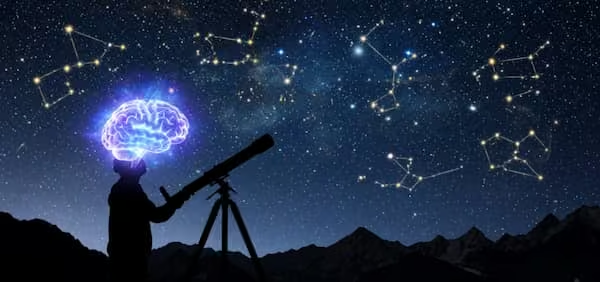
The secrets of the night sky have fascinated humanity for thousands of years, inspiring both scientific discovery and imaginative storytelling. As we gaze upward, we are not just looking at distant stars, but also into the past—some of the light we see has traveled for millions of years before reaching Earth. This makes the night sky a natural time machine, revealing clues about the origins of the universe and the life cycles of stars. Constellations, once used for navigation and seasonal tracking, still hold cultural significance today, connecting modern observers with ancient civilizations.
Beyond its beauty, the night sky plays a crucial role in advancing science. Astronomers study celestial bodies such as planets, galaxies, and nebulae to better understand cosmic phenomena like black holes and dark matter. Technological advancements, including powerful telescopes and space missions, have allowed us to uncover details that were once unimaginable. Yet, despite these achievements, much of the universe remains a mystery.
By observing the night sky, we not only expand our knowledge but also deepen our sense of curiosity and perspective. It reminds us of our place in the vast cosmos and encourages continuous exploration, making every stargazing experience both meaningful and inspiring.