
Mount Judi and the Duration of the Flood
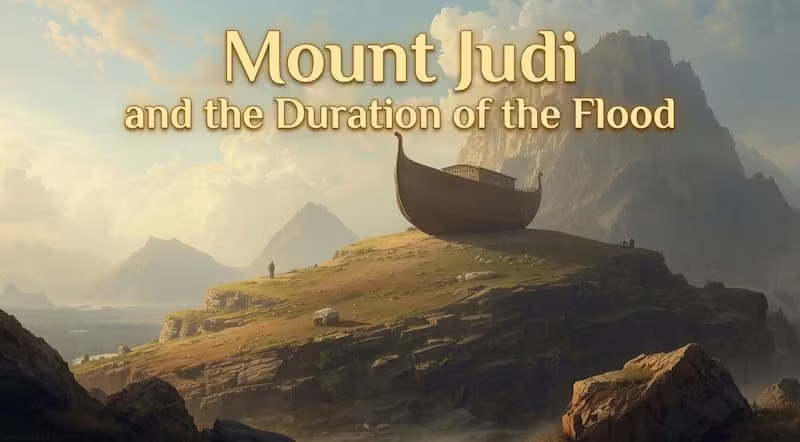
Mount Judi and the Duration of the Flood. The Ark of Prophet Nuh comes to rest on the sacred mountain after the deluge.
Mount Judi and the Duration of the Flood According to Islamic and Abrahamic Sources
Mount Judi and the Duration of the Flood: is a significant topic in Islamic tradition that highlights key aspects of Prophet Nuh’s (peace be upon him) story. The Qur’an offers a profound yet succinct narrative of the Flood, focusing on the Ark’s resting place and the duration of the deluge.
Rooted firmly in the Qur’an and the most authoritative classical interpretations, this discussion presents a balanced perspective that prioritises spiritual guidance, sincere devotion, and profound ethical lessons over historical speculation.
Mount Judi and the Duration of the Flood provide important insights into the story of Prophet Nuh’s Flood (peace be upon him), illustrating Allah’s perfect justice balanced with His boundless mercy. Although the Qur’an primarily emphasises timeless spiritual truths and moral lessons for all humanity, it also provides key factual details.
These include the Ark’s final resting place upon Mount Judi and broad indications of the event’s chronology within the broader context of Prophet Nuh’s long mission of calling his people to monotheism. Understanding Mount Judi and the Duration of the Flood helps readers appreciate both the historical context and the enduring spiritual lessons of this remarkable event.
Mount Judi and the Duration of the Flood is an important topic in understanding the story of Prophet Nuh (peace be upon him). For nine hundred and fifty years, Prophet Nuh (peace be upon him) tirelessly invited his community to worship Allah alone, warning them of the consequences of persistent denial and oppression.
As stated in the Qur’an: “And We certainly sent Noah to his people, and he remained among them a thousand years minus fifty years…” (Surah Al-Ankabut 29:14). This extraordinary period of patient dawah demonstrates Allah’s immense mercy in granting people ample opportunity to repent before His decree of justice, setting the stage for the events surrounding Mount Judi and the Duration of the Flood.
Mount Judi and the Duration of the Flood are significant aspects of Prophet Nuh’s story, beginning with Allah’s command to build the Ark. When the appointed time arrived, Allah inspired Prophet Nuh to construct the Ark under His direct observation and guidance.
The Qur’an recounts: “And construct the ship under Our observation and Our inspiration…” (Surah Hud 11:37). This divine instruction prepared the means of salvation for the believers and pairs of every creature, ensuring the continuation of life after the purification of the land from wrongdoing.
Understanding Mount Judi and the Duration of the Flood also requires remembering what happened before the Ark came to rest. As the command came to pass and the sign appeared, Prophet Nuh was ordered to load the Ark with his believing family—except those already decreed otherwise—and pairs from every species. He declared:
“Embark in it, in the name of Allah is its course and its anchorage. Indeed, my Lord is Forgiving and Merciful.” (Surah Hud 11:41). The few who believed boarded, demonstrating complete trust in Allah’s promise amid the rising waters.
The Enduring Message of Renewal After the Storm. The Ark of Prophet Nuh on the mountain as people witness the end of the flood.
Mount Judi and the Duration of the Flood By in the Qur’an
The Qur’an names the Ark’s landing site with unmistakable clarity:
“And it was said: ‘O earth, swallow your water! O sky, withhold your rain!’ The waters receded, the decree was fulfilled, and the Ark came to rest upon Judi. And it was said: ‘Away with the oppressive people!” (Surah Hud 11:44)3 |
| This explicit reference sets the Islamic tradition apart from others and affirms the Qur’an’s precise revelation. |
Mount Judi and the Duration of the Flood are highlighted in the explanations of classical Islamic scholars. In his renowned Tafsir, Ibn Kathir explains that Allah commanded the earth to swallow the waters which had sprung forth and the sky to cease its rain.
The water then subsided, and the divine decree was completely fulfilled with the removal of the disbelieving wrongdoers from the earth. The Ark came to rest upon Mount Judi, a mountain in the region of Al-Jazirah in northwest Mesopotamia.
Classical scholars also relate that during the deluge, mountains sought to rise above the floodwaters, while Mount Judi humbly submitted to Allah’s command and was honoured as the resting place of the Ark. These accounts help explain Mount Judi and the Duration of the Flood within the context of traditional Islamic scholarship.
Mount Judi and the Duration of the Flood provide important insights into the Qur’anic account of Prophet Nuh (AS). Qatadah, as cited by Ibn Kathir, mentioned that the ship remained upon Mount Judi for a full month before the survivors disembarked. This detail serves as a powerful sign and lesson for subsequent generations.
The declaration, “Away with the oppressive people!” signifies their complete destruction and eternal distance from Allah’s mercy, underscoring that persistent zulm and rejection of truth lead to utter loss.
The account of Mount Judi and the Duration of the Flood is further enriched by the mountain’s location in the region historically known as Kurdistan, near the borders of modern-day Turkey and Iraq.
This precise naming in the Qur’an distinguishes its narrative from other traditions, affirming its divine origin and inviting reflection on how all creation submits to the Creator’s command. The humbling of the mountain exemplifies the ethical principle that true elevation comes through humility and obedience to Allah rather than pride or resistance.
Indications of the Timeframe and Chronology
Mount Judi and the Duration of the Flood are significant aspects of the Qur’anic account of Prophet Nuh (peace be upon him). While the Qur’an does not specify the exact number of days or months in the manner of some other scriptures, it provides a clear sequence of events and broad chronological indications through the narrative in Surah Hud and cross-referenced verses.
Authoritative classical tafsirs, including those compiled from the reports of early scholars like al-Tabari and al-Baghawi, convey that Prophet Nuh (peace be upon him) embarked upon the Ark on the tenth day of the month of Rajab. The vessel then sailed for approximately six months under divine protection.
According to these interpretations, the floodwaters subsided on the tenth of Muharram, known as Ashura, when the Ark finally rested upon Mount Judi. In gratitude for their salvation, Prophet Nuh and those with him observed a fast on that day, a practice that later became part of prophetic tradition.
Mount Judi and the Duration of the Flood together highlight the divine order behind the event and deepen appreciation of Allah’s wisdom. The preceding nine hundred and fifty years of preaching further illustrate the profound balance between extended mercy and eventual justice.
In conclusion, the Qur’anic account of Prophet Nuh’s Flood offers far more than historical narrative; it delivers essential guidance for believers across ages. It teaches unwavering trust in Allah during trials, the supremacy of righteousness over worldly ties, the consequences of oppression, and the promise of new beginnings filled with blessings for the righteous.
As the Qur’an states: “O Nuh, disembark in peace from Us and blessings upon you and upon nations from those with you…” (Surah Hud 11:48). May we draw closer to Allah through reflection on these truths, embracing devotion and ethical living.
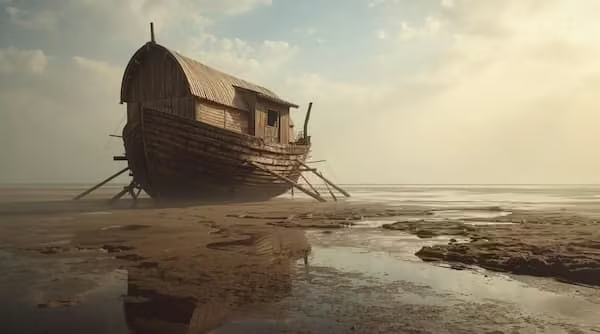
Mount Judi in the Qur’an. The Ark of Prophet Nuh rests on dry land after the great flood.
Mount Judi and the Duration of the Flood: The Location of Mount Judi Today
Classical scholars of the highest authority overwhelmingly identify Mount Judi, mentioned explicitly in the Qur’an, with Cudi Dağı, a prominent and majestic peak located in south-eastern Turkey’s Şırnak Province. This mountain rises near the historic town of Cizre and lies close to the modern borders with Syria and Iraq.
The region forms part of the ancient cradle of Upper Mesopotamia, a land rich in prophetic history and divine signs. Esteemed commentators such as Al-Ṭabari and Ibn Kathir strongly endorse this location, drawing upon early transmitted reports that place the mountain firmly within the area known in classical times as Al-Jazirah.
Mount Judi and the Duration of the Flood: Ibn Kathir, in his detailed tafsir of Surah Hud 11:44, describes Mount Judi as situated in Al-Jazirah in northwest Mesopotamia. He records the narration that on the day of the great deluge, mountains competed to rise higher in an attempt to escape the rising waters, yet Mount Judi alone humbled itself in submission to Allah’s command.
Because of this humility, it remained above the flood and became the honoured resting place of the Ark. Al-Ṭabari similarly affirms this identification through chains of narration from the early generations, confirming that the Qur’anic name “al-Judiyy” corresponds precisely to this well-known mountain in the region.
Mount Judi and the Duration of the Flood: Geographically, Cudi Dağı stands as a striking and isolated peak within a rugged range of mountains that have historically served as natural boundaries and pathways between major civilisations. Its position near the upper reaches of the Tigris River and the fertile plains of Upper Mesopotamia made the surrounding area a natural centre for the renewal of human life after the flood.
The mountain’s distinctive profile and enduring presence have made it a recognisable landmark for centuries, visible from the surrounding towns and valleys that still bear names and traditions linked to the story of Prophet Nuh (peace be upon him).
Local traditions across Muslim, Christian, and other communities in south-eastern Turkey, northern Syria, and northern Iraq have preserved the memory of this mountain for generations.
Mount Judi and the Duration of the Flood: The name “Judi” or “Cudi” has remained attached to the same peak without interruption, reflecting a remarkable continuity of oral and written heritage. While these living traditions add colour and depth to the historical picture, they are secondary to the clear statement of the Qur’an itself.
The scholarly consensus among the greatest mufassirun provides the firmest foundation for identifying the site.
Although Islam places no reliance on material relics or archaeological finds for the validation of faith—because true belief rests solely upon divine revelation and the guidance of the Qur’an—the longstanding agreement of classical scholars on this location strengthens the believer’s appreciation for the Qur’an’s precision and historical accuracy.
The Qur’an does not merely mention a generic mountain; it names a specific, identifiable place. This specificity serves as a subtle yet powerful sign that the revelation is rooted in real events and real geography, inviting reflection rather than doubt.
In the broader context of the story, the resting of the Ark upon Mount Judi marks the beginning of a new chapter for humanity under the mercy and justice of Allah. From this mountain, the survivors descended to repopulate the earth, carrying with them the lessons of patience, obedience, and the consequences of persistent wrongdoing.
The mountain’s own act of humility, as described in tafsir, offers a profound ethical lesson: true elevation and honour come through willing submission to the will of the Creator, not through pride or resistance.
Thus, the identification of Mount Judi with Cudi Dağı in south-eastern Turkey stands as a point of harmony between the Qur’anic text, classical Islamic scholarship, and the living geography of the region.
It reminds the thoughtful reader that the Qur’an speaks of real places and real events while always directing attention to the timeless spiritual truths they contain. The focus remains, as ever, upon guidance, devotion, and the ethical transformation that the story of Prophet Nuh (peace be upon him) continues to inspire in every generation.
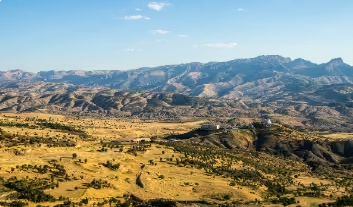
Historical depiction of Cudi Dagı
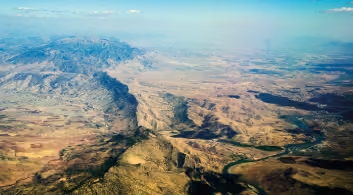
View of the mountainous region associated with Mount Judi
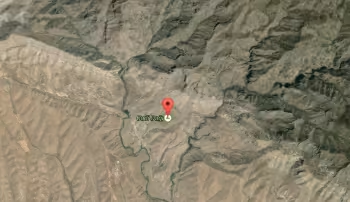
The Location of Mount Judi Today
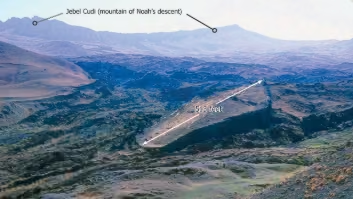
Another view of the historic Mount Judi site
Page 5