
The Moment of Sacrifice and the Divine Intervention (The Appearance of the Ram ) 🐏
Chapter Third
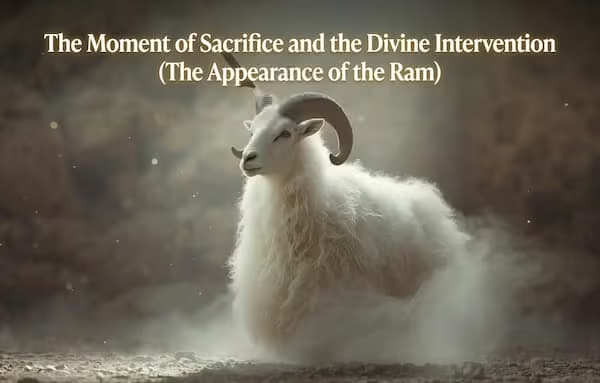
The Moment of Sacrifice and the Divine Intervention – The ram appears as divine mercy in Hazrat Ibrahim’s test of faith
A Timeless Testament of Faith, Obedience, and Divine Mercy
In the sacred valleys of Mina, Hazrat Ibrahim (عليه السلام), the beloved friend of Allah and patriarch of monotheism, stood ready to fulfill a command that pierced his very soul. Beside him lay his devoted son, Hazrat Ismail (عليه السلام), prepared with serene acceptance. This was the ultimate test of submission—a moment that would echo through eternity and shape the rituals of Hajj and Eid al-Adha forever.
This story from Surah As-Saffat in the Holy Quran transcends mere history. It serves as a living beacon for the Ummah of Prophet Muhammad (ﷺ), reminding every believer that true faith demands action, that tests elevate rather than punish, and that Allah’s mercy is boundless when sincerity is proven. Here we witness the triumph of human will aligned with divine will and the birth of an eternal legacy of sacrifice and sharing.
The Life of Unwavering Trials: Preparing the Heart of Khalilullah
Long before this climax, Hazrat Ibrahim (عليه السلام) had walked a path of extraordinary tests. He defied idolatry and was cast into Nimrod’s raging fire, only for Allah to command it to become “coolness and safety” (Quran 21:69). He left his wife Hajar (عليها السلام) and infant son Ismail (عليه السلام) in the barren desert of Makkah, leading to the miracle of Zamzam and the Sa’i ritual now eternal in Hajj. Each trial stripped away worldly attachment, forging a heart ready for the greatest sacrifice. Ibrahim (عليه السلام) had already proven he loved Allah above all else—comfort, family, and even his own safety. The stage was set.
The Divine Vision: A Command That Shook the Heavens
It began with a clear, recurring dream. Hazrat Ibrahim (عليه السلام) saw himself sacrificing his beloved son—the child he had prayed for in old age. The Quran records this pivotal moment:
“My Lord, grant me [a child] from among the righteous.” So We gave him good tidings of a forbearing son. And when he reached with him [the age of] exertion, he said, “O my son, indeed I have seen in a dream that I [must] sacrifice you, so see what you think.”
(Surah As-Saffat 37:100-102)
Ibrahim (عليه السلام) shared the vision with his son. Hazrat Ismail (عليه السلام) responded with pure submission:
“O my father, do as you are commanded. You will find me, if Allah wills, of the steadfast.”
(Surah As-Saffat 37: 102)
No rebellion. No plea. Only willing surrender. Both understood this was divine command. The test belonged to father and son together.
The Journey to Mina: Resolve Amid Turmoil
With heavy yet resolute hearts, they traveled to Mina. Tradition recounts Shaytan’s attempts to dissuade them at three places—now the Jamarat—yet they rejected every whisper, pelting stones in defiance. At Mina, preparations were solemn. The knife was sharpened for mercy. Hazrat Ismail (عليه السلام) lay facing the Qibla, forehead to the earth in full prostration—embodying Islam itself.
Hazrat Ibrahim (عليه السلام), heart torn between love and command, blindfolded himself. He could not bear to see his son’s face. With unwavering resolve, he raised the blade. The air grew still.
The Split Second That Changed Everything
In that frozen instant, as the knife descended toward Ismail (عليه السلام)’s neck, time seemed to suspend. The father’s hand moved with obedient precision, yet every fiber recoiled at what he was about to do. This was the pinnacle of human struggle—the clash between natural love and divine command.
But then the miraculous occurred. The blade did not cut. Allah rendered it harmless, protecting Ismail (عليه السلام) completely. At that exact moment, the angel Jibril (عليه السلام) descended, bringing a majestic ram from Paradise itself. It appeared suddenly beside them—a magnificent creature traditions describe as having grazed in Jannah’s gardens for forty years. Through Jibril, Allah declared:
“O Ibrahim! You have fulfilled the vision!”
(Surah As-Saffat 37:100-105)
The test was complete. Their faith stood proven. The physical act upon the son was no longer needed.
The Divine Ransom and Eternal Legacy
Hazrat Ibrahim (عليه السلام) released his unharmed son. They embraced in relief and gratitude. Turning to the ram, he slaughtered it as the ransom sacrifice, distributing the meat to the needy. This established the Qurbani tradition that continues today.
The Quran proclaims with power:
Allah made this sacrifice essential for pilgrims in Hajj, enduring until Judgment Day. Every Eid al-Adha, Muslims worldwide perform Qurbani—reenacting that moment in Mina, giving of what they hold dear to feed the needy. The stoning of Jamarat, Sa’i between Safa and Marwa, and the sacrifice together form the living tapestry of Hajj, linking billions across time to these sacred trials.
Profound Lessons for Every Believer: Tests as Elevations of Faith
This sacred narrative offers layers of wisdom that penetrate the heart and transform the soul. At its core, it teaches that tests from Allah are never punishments but profound elevations of faith—opportunities for the believer to rise higher in spiritual rank and draw closer to the Divine.
Just as wealth, children, and blessings can be tests of gratitude, so too can commands requiring sacrifice serve to purify the heart and strengthen iman. Hazrat Ibrahim (عليه السلام) was given a son after long years of supplication; that very gift became the means of his greatest trial, demonstrating that what Allah grants can also be asked back—not out of cruelty, but to confirm whether our love for the Giver surpasses our attachment to the gift.
This event mirrors the earlier fire incident in powerful symmetry. In both cases, there was an apparent path to destruction—his body consumed by flames, his son’s life ended by the knife—yet divine salvation transformed each into a lasting legacy. The fire became “coolness and safety”; the sacrifice was replaced with a ram from Paradise and became an eternal commemoration in the rituals of Hajj and the global observance of Eid al-Adha. These parallels reveal a consistent divine pattern: when the servant demonstrates complete trust and readiness to surrender, Allah intervenes with mercy that not only preserves but elevates and immortalizes the moment.
Theologically, the story underscores that true faith requires decisive action, not passive belief alone. Allah does not need our sacrifices—He is the Owner of all that exists—yet He commands them to demonstrate sincerity, to train the soul in detachment, and to foster empathy through sharing with the less fortunate. The willingness of both father and son to proceed without hesitation exemplifies the essence of Islam itself: total submission (islam) to the will of Allah, even when that will challenges every human instinct and emotion.
Their story teaches that obedience is not blind; it is illuminated by certainty (yaqeen) that Allah’s wisdom far exceeds our limited understanding, and that He never burdens a soul beyond what it can bear. Furthermore, this narrative highlights the intergenerational transmission of faith. Ismail (عليه السلام)’s willing participation was not mere compliance but active partnership in devotion, modeling how parents and children can together navigate life’s tests with shared reliance on Allah.
It also reveals Allah’s mercy in the most trying circumstances—He does not desire the harm of His servants but uses such moments to manifest His compassion, replacing what is given up with something greater, whether in this life or the next. For the Ummah today, facing personal trials of health, loss, financial strain, or spiritual doubt, the story of Mina offers profound reassurance: submit fully, and watch how Allah provides the ram—the unexpected relief, the hidden blessing, the strengthened faith that emerges from the test.
Finally, it calls us to action. The complete submission of both Hazrat Ibrahim and Hazrat Ismail (عليهما السلام) to the will of Allah should be a profound lesson for the Ummah of Muhammad (ﷺ)—to remain steadfastly connected to Allah with deep faith and firm certainty. In a world of distractions and competing loyalties, this story invites us to examine our own hearts: What are we willing to sacrifice for Allah? Our time? Our comforts? Our desires? Our very selves? The answer determines the depth of our connection to the Divine.
🤲 The Enduring Call: Emulating the Faith of the Forefathers 🤲
As Muslims gather each year for Eid al-Adha, slaughtering animals and sharing their bounty, they are not simply following a ritual—they are stepping into the sandals of Hazrat Ibrahim (عليه السلام) and Hazrat Ismail (عليه السلام). They are declaring, through action, that their love for Allah supersedes all else. This is the spirit that built civilizations, fueled the spread of Islam, and continues to inspire resilience in the face of adversity.
May Allah grant us all—the young and the old, the rich and the poor, the strong and the weak—the strength, the tawfiq, and the unshakeable faith to succeed in our exams, trials, and every test of life with the same obedience and certainty demonstrated in that sacred valley of Mina. Let us strive to be among those whom Allah describes as the doers of good, whom He rewards abundantly and mentions with honor among later generations.
2 — All praise be to Allah, Lord of all the worlds/universe. 3 — The Most Compassionate, the Most Merciful. 4 — Master/Owner of the Day of Judgment/Recompense. 5 — You alone we worship, and You alone we ask for help. 6 — Guide us to the Straight Path. 7 — The path of those You have blessed, not of those who have earned Your anger, nor of those who go astray.
The complete submission of both Hazrat Ibrahim and Hazrat Ismail (عليهما السلام) to the will of Allah should be a profound lesson for the Ummah of Muhammad (ﷺ) — to remain steadfastly connected to Allah with deep faith and firm certainty.
May Allah grant us all — young and old — the strength and tawfiq to succeed in our exams, trials, and every test of life with the same unshakeable faith and obedience.
آمين يا رب العالمين 🤲✨
Ameen 🤲🌟