
The Ark of Nuh (ʿalayhi al-salam) in the Light of Classical Tafsir
Historical Details, Theological Depth, and Enduring Lessons from al-Ṭabari, Ibn Kathir, and al-Qurtubi
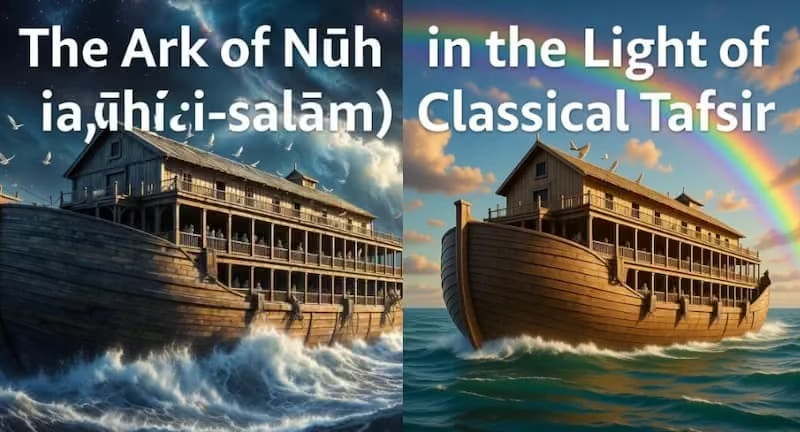
Ark of Nuh (ʿalayhi al-salam): from flood to covenant rainbow in classical Tafsir
The Ark of Nuh: From Narrative to Exegetical Depth
The Qur’anic account of Prophet Nuh (peace be upon him) is the longest continuous prophetic story in the Muslim scripture. It spans four major surahs. It offers a profound meditation on faith, rejection, and divine justice.
While the broad outlines are universally known, the classical tafsir tradition transforms this narrative into a rich repository of historical, linguistic, and theological insight. This article examines the episode of The Ark of Nuh through three seminal works.
These works are:
Al-Tabari’s Jamiʿ al-Bayan Ibn Kathir’s Tafsir al-Qur’an al-Azim Al-Qurtubi’s al-Jamiʿ li-Ahkam al-Qur’an
These tafsirs reveal dimensions that remain strikingly relevant to contemporary Islamic thought.
Ibn Kathir, in Tafsir al-Qur’an al-ʿAzim, streamlines the account with a focus on moral exhortation and authentic hadith, rejecting weaker Israelite traditions.
He vividly portrays the onset of the flood when water gushed from the household oven, the boarding of believers and family (save the disbelieving son and wife), and the final command to disembark “with peace and blessings upon you and upon nations from those with you.”
For Ibn Kathir, The Ark of Nuh symbolizes patient resilience and divine mercy extended only to the faithful, highlighting Nuh’s unyielding call to tawhid despite mockery and social ostracism.
Al-Qurtubi’s al-Jamiʿ li-Aḥkam al-Qur’an, while jurisprudential in orientation, extracts deeper linguistic and theological layers.
He elucidates phrases like “wahy” as both revelation and assisted construction, interpreting The Ark of Nuh itself as a living ayah (sign) of Allah’s power to rescue the righteous from overwhelming adversity.
Qurtubi draws fiqhi implications on obedience, the futility of familial ties without iman, and the balance of justice and mercy, cautioning against modern parallels of moral decay and secular denial of divine signs.
Collectively, these tafsirs elevate The Ark of Nuh episode beyond folklore into a timeless blueprint for daʿwah, warning believers today against complacency in the face of cultural rejection while affirming that ultimate salvation rests in unwavering submission to Allah.
In an age of ideological floods—materialism, relativism, and eroded faith—the narrative calls Muslims to emulate Nuh’s steadfastness, constructing arks of knowledge and piety amid rising waters of disbelief.
The Ark of Nuh (ʿalayhi al-salam): The Unprecedented Duration of Prophetic Mission
The Qur’anic account of Prophet Nuh (ʿalayhi al-salam) is the longest continuous prophetic story in the Muslim scripture. It spans four major surahs—primarily Surah Hud (11:25-49), Surah Nuh (71), Surah al-Mu’minun (23:23-30), and elements in Surah al-Ankabut (29:14-15). This narrative offers a profound meditation on faith, rejection, and divine justice.
While the broad outlines are universally known, the classical tafsir tradition transforms the narrative into a rich repository of historical, linguistic, and theological insight. This article examines the episode of The Ark of Nuh through the authoritative lenses of three seminal works: al-Ṭabari’s Jamiʿ al-Bayan, Ibn Kathir’s Tafsir al-Qur’an al-ʿAzim, and al-Qurtubi’s al-Jamiʿ li-Aḥkam al-Qur’an. These sources reveal dimensions that remain strikingly relevant to contemporary Islamic thought.
Al-Ṭabari (d. 310/923), in his encyclopedic Jamiʿ al-Bayan, provides extensive linguistic and historical exegesis, compiling reports from the Salaf. He details Nuh’s 950-year mission (Q 29:14) as a patient call to tawhid amid escalating idolatry. His people deified righteous forebears whose images Shaytan later corrupted.
On the construction of The Ark of Nuh (Q 11:37; 23:27), Ṭabari explains that divine inspiration (“under Our eyes and with Our inspiration”) guided Nuh to build a sturdy vessel of planks and nails. It is often said to have commenced on a mountain. The floodwaters gushed from the earth’s ovens (tannur) and skies, submerging all but the believers—numbering variously 7 to 80 per narrations from Ibn Abbas.
The Ark of Nuh rested on Mount Judi (Q 11:44), a site in al-Jazirah near Mosul, serving as an enduring sign. Ṭabari emphasizes the narrative’s historicity as a warning: defiance of messengers invites collective ruin, yet individual faith secures salvation.
Ibn Kathir (d. 774/1373), drawing on Ṭabari while prioritizing authentic chains, offers a narrative-driven tafsir in Tafsir al-Qur’an al-ʿAzim and his Qisas al-Anbiya. He portrays Nuh as the first messenger after Adam, sent to a people steeped in shirk.
The episode of The Ark of Nuh underscores obedience: Nuh loaded pairs of every living creature (male and female of soul-possessing species), his believing family (except his disbelieving wife and son), and a small band of followers. As waves towered like mountains (Q 11:42), the son’s futile climb to a peak illustrated the futility of worldly refuge against Allah’s decree.
Ibn Kathir stresses divine justice—kinship avails nothing without iman—and mercy: The Ark of Nuh became a floating sanctuary, sailing “in the name of Allah” at departure and anchoring. Post-flood, humanity descends from Nuh’s progeny, rendering the event a reset for monotheism. This resonates today in calls for steadfast dawah amid secular mockery.
Al-Qurtubi (d. 671/1273), in his jurisprudential al-Jamiʿ li-Aḥkam al-Qur’an, extracts legal and moral rulings. He highlights that salvation hinges solely on faith, not blood ties: Nuh’s son drowned despite paternal pleas (Q 11:42-43), teaching that iman supersedes lineage.
The command against interceding for the wrongdoers (Q 11:37) warns against misplaced mercy. Qurtubi discusses practical aspects, such as the capacity of The Ark of Nuh for animals and provisions, and the flood’s scope as punitive for Nuh’s specific community, purifying the earth.
He links verses to fiqh principles, like gratitude (fasting on Ashura, per some reports, marking the rest of The Ark of Nuh) and the peril of persistent kufr.
Collectively, these tafsirs portray The Ark of Nuh not merely as a vessel of wood but as a symbol of tawakkul, divine sovereignty, and the triumph of truth over arrogance. In an age of moral relativism and ideological floods, Nuh’s story urges Muslims to build “arks” of faith—through patient invitation to Islam, rejection of false gods (materialism, nationalism), and trust in Allah’s promise.
Rejection may endure centuries, yet justice prevails; believers, however few, are preserved. This timeless meditation reinforces that true security lies in boarding the ship of submission, even as the world mocks from dry land.

Ark of Nuh battling the flood – symbol of long prophetic mission
Divine Supervision in the Construction of the Ark
The command “And construct the ship under Our eyes and Our revelation” (Qur’an 11:37) carries deep meaning. All three scholars see it as direct divine guidance. This guidance elevated The Ark of Nuh from a human project to a miraculous act of obedience.
Al-Qurtubi explains “Our eyes” as Allah’s protection. It shielded the site from sabotage by Nuh’s people. “Our revelation” gave precise technical instructions for building the vessel.
Ibn Kathir reports that Jibril personally taught Nuh the measurements. Wooden pegs were used instead of iron nails. This made The Ark of Nuh strong enough to survive the flood and last for centuries.
Al-Tabari’s Jamiʿ al-Bayan records the precise dimensions of The Ark of Nuh from the Salaf:
Length: 300 cubits Width: 50 cubits Height: 30 cubits
The structure of The Ark of Nuh had three distinct decks. The lowest deck housed animals. The middle deck accommodated human believers and provisions. The uppermost deck was for birds.
Construction of The Ark of Nuh spanned many years. Nuh faced relentless ridicule throughout this period. Yet constant divine supervision turned potential despair into steadfast resolve.
Key Lessons from The Ark of Nuh: The Ark of Nuh shows tawhid in action. Every plank became an act of worship. Today, Muslims face ideological storms. The story encourages us to build our own arks of faith. Patient dawah and trust in Allah bring safety. Even if the world mocks, believers are preserved.
The Three-Tiered Symbolism of the Ark
Beyond its physical specifications, The Ark of Nuh functions as a multi-layered symbol in classical exegesis.
Al-Tabari views the vertical stratification of The Ark of Nuh as a microcosm of divine order: animals (instinct), humans (intellect), and birds (aspiration toward the heavens).
Ibn Kathīr highlights the role of The Ark of Nuh as the sole locus of legitimate authority once divine decree was sealed.
Al-Qurtubī adds a juridical dimension: boarding The Ark of Nuh constituted an act of obedience equivalent to entering the fold of salvation, prefiguring the covenant of the final Prophet.
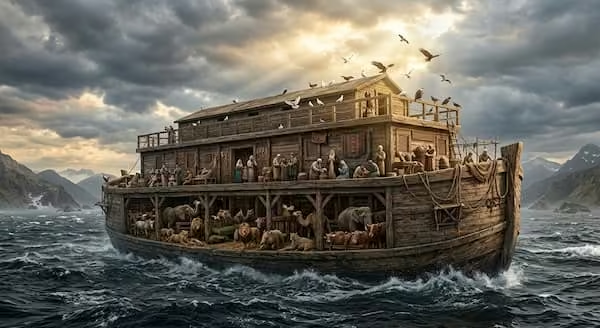
Three-tiered Ark of Nuh – symbolism of divine refuge and salvation
The Cosmic Nature of the Deluge
The Qur’anic description “We opened the gates of the heaven with pouring water, and caused the earth to gush forth springs” (54:11–12) portrays a truly cosmic cataclysm.
Early scholars like al-Ṭabarī relate that the rain descended with such violent force that it pierced through stone roofs as if they were mere fabric.
Simultaneously, the earth burst open with gushing springs from every direction.
This dual assault—celestial torrents from above and subterranean waters from below—signified the complete reversal of the natural order established at creation.
Ibn Kathīr adds that the floodwaters rose fifteen cubits above the tallest mountains, ensuring no peak or high ground could offer safety.
Every living being, save those in The Ark of Nuh, was engulfed in this universal judgment.
The event was not a mere regional flood but a total planetary submersion.
The heavens and earth collaborated in erasing corruption, symbolizing divine wrath that overturned the very fabric of the created world in a single, awe-inspiring act of purification.
The Tragedy of a Prophet’s (A.S.) Son: Faith, Lineage, and Individual Responsibility
The drowning of Nuh’s (A.S.) son (11:42–43) constitutes one of the most poignant theological moments in the Qur’an.
As the deluge surged, Prophet Nuh (A.S.) urgently called his son to board the Ark of salvation.
The son arrogantly refused, seeking refuge on a mountain instead.
A mighty wave separated them, and he perished among the disbelievers.
Al-Qurṭubī stresses that the son was biologically legitimate yet spiritually disaffiliated due to disbelief, establishing the principle that prophethood confers no automatic immunity upon offspring.
Ibn Kathīr cites the divine response “He is not of your family; verily his work was unrighteous” (11:46) as definitive proof that spiritual kinship supersedes biological ties.
This narrative forms a cornerstone of Islamic soteriology, underscoring individual accountability: salvation rests on personal faith and deeds, not lineage.
Even a prophet’s child must choose belief independently, reminding believers that divine justice prioritizes righteousness over hereditary bonds.
Mount Judi and the First Post-Diluvian Covenant
The Ark’s final resting place on Mount Judi (Quran 11:44) is identified by Ibn Kathir as a mountain in the region of modern-day south-eastern Turkey near Cizre, in Şırnak Province, close to the Syrian and Iraqi borders.
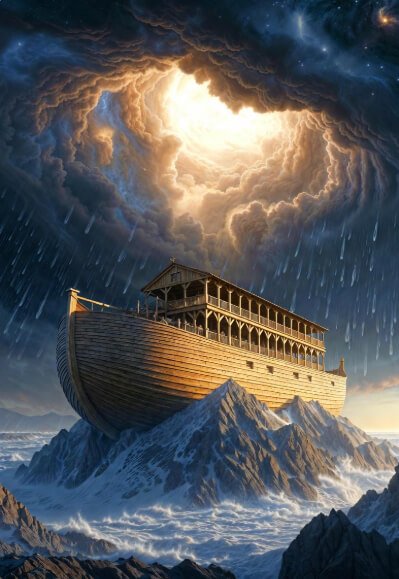
Ark of Nuh after the flood – contemporary resonance of divine mercy
Al-Tabari records variant narrations placing it within the ancient Mesopotamian cultural sphere, often linked to Upper Al-Jazirah or areas near Mosul.
This event symbolizes divine mercy and the end of the flood, with the waters subsiding as commanded.
The divine benediction pronounced upon Nuh (A.S.) and his companions, “Peace be upon Nuh (A.S.) among the worlds” (37:79), marks the establishment of a renewed covenant: humanity henceforth descends from believers rather than from a single primordial couple.
It affirms Nuh’s honored legacy, ensuring his praise endures across nations while highlighting salvation through faith and obedience to Allah.
This post-diluvian era underscores renewal, moral responsibility, and the continuity of prophethood.
Contemporary Resonance
The classical tafsir tradition presents the episode of Nuh (A.S.) not merely as ancient history but as a perennial paradigm for all ages.
His 950-year mission exemplifies the unrelenting obligation of daʿwah in the face of systemic rejection, mockery, and hostility.
Prophets are commanded to persist regardless of apparent failure, trusting only in Allah’s wisdom and timing.
The Ark stands as a profound metaphor for the Muslim community itself: an embattled minority, often ridiculed and isolated, yet preserved and protected by divine command amidst a global sea of disbelief and moral corruption.
Just as the Ark navigated the deluge safely, the ummah finds security through obedience, unity, and adherence to revealed guidance.
Finally, the principle that salvation is contingent solely upon personal faith and righteous action—rather than inherited privilege, tribal lineage, or ethnic identity—remains a powerful corrective to every form of ethno-religious exclusivism and false sense of entitlement.
Nuh’s story reminds believers that divine judgment is individual, universal, and just.
Conclusion
Through the meticulous scholarship of al-Tabari, Ibn Kathir, and al-Qurtubi, the narrative of Nuh (A.S.) transcends its historical particularity to become a timeless exposition of divine justice, prophetic resilience, and the primacy of faith over lineage.
The Ark, far from being an archaic relic, emerges as an enduring archetype: a divinely ordained refuge for those who anchor themselves to revelation when the floods of falsehood rise.
Ibn Kathir vividly recounts how Nuh (A.S.) preached for centuries amid mockery, yet only a handful believed, underscoring that salvation hinges solely on tawhid and obedience, not blood ties—as tragically illustrated by the drowning of his own disbelieving son despite the familial bond.
Al-Tabari and al-Qurtubi elaborate that the Flood was no mere natural catastrophe but Allah’s decisive judgment against idolatry and arrogance, sparing the faithful while the waves towered like mountains.
This episode warns every generation: worldly status, kinship, or denial of signs offer no protection from divine decree.
Ultimately, the story inspires steadfast dawah, patient endurance, and unwavering trust in Allah’s promise, reminding believers that truth prevails and the righteous find eternal security in His mercy.
© 2025 – All praise is due to Allah, Lord of the worlds.
Other Useful Resources
Page 2