
The First Renewal of Humanity — A Tazkira of Faith and Patience
Prophet Nuh (A.S.): Perseverance in the Face of Ignorance Prophet Nuh (A.S.): Perseverance in the Face of Ignorance

The First Renewal of Humanity — A Tazkira of Faith and Patience. Noah’s Ark endures the great storm as a timeless symbol of faith, patience, and the renewal of humanity.
Introduction: The First Renewal of Humanity and Hazrat Nuh's (A.S.) Story
After the creation of Prophet Adam (peace be upon him), generations of humanity lived upon the guidance of Allah. They knew the truth of their Creator, worshipped Him sincerely, and walked upon the earth in harmony with His commands. But as centuries passed, the purity of that faith began to fade.
People started to glorify their ancestors, and the remembrance of Allah slowly gave way to the worship of images and idols. It was during this era of spiritual decay — when truth was forgotten and falsehood was dressed in beauty — that Allah chose Prophet Nuh (peace be upon him) as His messenger.
He was sent to awaken hearts that had fallen asleep and to remind a heedless nation of its purpose. The First Renewal of Humanity began with his mission. It marked a new phase in human history after the descent of Adam, and the first great warning before the final Day of Resurrection.
Nuh’s (A.S.) people lived in abundance and strength, yet their hearts were empty. They had made gods of stone and star, and they worshipped their desires as though they were divine. Into this darkness came a single man with a message of light: “Worship none but Allah. You have no deity but Him.”
The First Renewal of Humanity was carried through his gentle, reasoned, and compassionate call. He appealed to their conscience and intellect — reminding them of the heavens above, the earth beneath, and the mercy of their Lord reflected in every breath. For years, he spoke to them openly in gatherings and privately in quiet counsel.
But the more he called, the more they turned away. They ridiculed him. They said, “You are nothing but a man like us. How can a human be chosen by God?” Others mocked his simplicity, measuring truth by wealth and power.
Yet Nuh’s (A.S.) faith remained unshaken. He neither sought their approval nor feared their rejection. His mission was not to please the people but to fulfill the trust of prophethood. The First Renewal of Humanity shone through his steadfastness in the face of rejection.
In every moment of opposition, he held firmly to the truth. The First Renewal of Humanity was not achieved through force or numbers, but through one prophet’s unwavering commitment to the pure message of monotheism.
Enduring Centuries of Rejection: 950 Years of Rejection
For nine hundred and fifty years, Nuh (A.S.) carried the banner of truth among his people—the longest recorded mission of any prophet in the Qur’an (Surah Al-Ankabut 29:14). Sent as the first messenger after the time of Adam (A.S.), he confronted a society that had drifted into open shirk. The First Renewal of Humanity began through this extraordinary perseverance.
They worshipped five idols carved from stone and wood: Wadd, Suwa‘, Yaghuth, Ya‘uq, and Nasr (Surah Nuh 71:23). These deities, originally righteous men whose images were later idolized, became the centre of their culture, festivals, and social status.
The elite mocked Nuh (A.S.) as a mere mortal “like yourselves” (Surah Al-A‘raf 7:63), while the masses inherited disbelief generation after generation. Every time a rejecting cohort perished, another rose in its place, more hardened than the last. The First Renewal of Humanity faced continuous resistance across centuries.
He called them tirelessly—by day in the marketplaces and by night in private gatherings, openly and secretly (Surah Nuh 71:5-9). His message was simple yet profound: “O my people, worship Allah; you have no deity other than Him. Will you not fear Him?” (Surah Al-A‘raf 7:59).
Yet they responded with arrogance, insults, and accusations of madness. They threatened to stone him and demanded he stop “babbling” about unseen punishment. Their hearts grew so rigid that even the sight of the Ark being built under divine command only fueled their ridicule: “If you mock us, then we will mock you likewise” (Surah Hud 11:38).
Behind every insult, Nuh (A.S.)’s patience only deepened. His perseverance was never born of weakness, but of unshakeable faith. He understood that guidance belongs to Allah alone; his duty was only to convey the message with utmost sincerity and clarity.
In one of the most moving supplications recorded in the Qur’an, he poured out his heart: “My Lord, I have called my people night and day, but my call has only increased them in flight…” (Surah Nuh 71:5-20). He reminded them of Allah’s favours—how He created them in stages, made the earth a resting place, and sent rain in due measure—yet they turned away. The First Renewal of Humanity was sustained by this deep, unwavering sincerity.
This phase of Nuh’s (A.S.) life transcends his own story; it mirrors the timeless struggle between truth and human ego. Prophets embody divine endurance in the face of ignorance, showing that rejection does not diminish the value of the message—it tests the sincerity of the messenger.
Even after nearly a millennium of apparent failure, Nuh (A.S.) never despaired. His steadfastness teaches every believer that dawah is measured not by immediate results, but by unwavering loyalty to Allah. In an age still filled with modern idols and hardened hearts, The First Renewal of Humanity remains a beacon of hope, patience, and trust in divine wisdom.
The Divine Decree — The First Cataclysm
After 950 years of patient invitation, the Divine Decree was sealed. Allah commanded Nuh (A.S.) to build the Ark under His direct supervision — “Construct the ship under Our observation and Our inspiration” (Surah Hud 11:37). The massive vessel, unlike any ship the world had seen, stood as a living sign and a final warning. The First Renewal of Humanity was about to begin through this decisive command.
When the decree arrived, the skies and the earth unleashed their fury together. The fountains of the great deep burst forth, and the windows of heaven were opened. Rain poured in unrelenting sheets, while the oceans rose in monstrous waves.
What began as mockery turned into terror as the people witnessed the very waters they ridiculed now swallowing their homes, their idols, and their lives. Even then, Nuh (A.S.) continued calling them to board the Ark. The First Renewal of Humanity unfolded amid this overwhelming judgment.
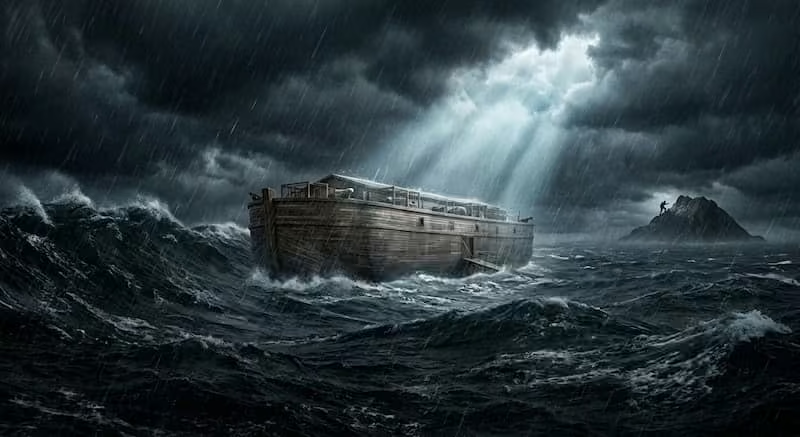
When the Divine Decree descends, no power on earth can turn it back.
His own son refused, choosing to climb a mountain instead, saying, “I will take refuge on a mountain to protect me from the water.” Nuh (A.S.) replied with sorrow, “There is no protector today from the decree of Allah, except for whom He has mercy” (Surah Hud 11:43). In that moment, the final separation between truth and falsehood was complete.
The first cataclysm — the Great Flood — was not merely a natural disaster. It was the execution of Divine Justice after centuries of warning. The same waters that destroyed the disbelievers became the means of salvation for the believers.
The Ark, carrying Nuh (A.S.), his faithful family, and pairs of every creature, floated safely upon the raging ocean while the entire civilization of the rejectors was wiped from the face of the earth. The First Renewal of Humanity was accomplished through this complete cleansing.
This cataclysm serves as a stern reminder that when a people collectively reject the truth after exhaustive opportunity, Allah’s decree comes without delay. The Flood marked the end of an era of open rebellion and the beginning of a new chapter for humanity under the guidance of Nuh (A.S.).
In every age, the story echoes: warnings are sent, patience is extended, but when the Divine Decree descends, no power on earth can turn it back. The First Renewal of Humanity remains a powerful lesson of justice, mercy, and the ultimate triumph of truth.
The Trial of the Heart: Nuh's (A.S.) son
The Trial of the Heart
Among those left behind was Nūḥ’s (A.S.) own son. His disbelief became the deepest trial Nuh (A.S.) ever faced — deeper than nine hundred and fifty years of mockery, rejection, and loneliness. The First Renewal of Humanity was tested most severely in this personal loss.
From the deck of the Ark, as the floodwaters surged, Nuh (A.S.) called out with desperate love: “O my son, come aboard with us and do not be with the disbelievers!”
His son replied with arrogant confidence: “I will take refuge upon a mountain; it will save me from the water.” Nuh (A.S.) answered with sorrowful finality: “There is no protector today from the decree of Allah except the one to whom He shows mercy.”
In that instant, a massive wave rose between them, and his son vanished into the depths. This moment reveals the absolute truth of submission: bloodline, kinship, love, and status hold no power before the will of Allah. The First Renewal of Humanity made clear that faith alone defines salvation.
Even the son of a prophet cannot be saved by heritage — only by sincere belief and obedience to the truth. In the silence that followed, Nuh (A.S.) turned to his Lord in grief and complete humility, saying: “My Lord, I seek refuge in You from asking that of which I have no knowledge. And unless You forgive me and have mercy upon me, I will be among the losers” (Surah Hud 11:47).
His total surrender — even in the face of personal heartbreak — became the final seal of his greatness. The Trial of the Heart teaches every believer that the strongest bond is not of blood, but of īmān.
No relationship on earth can ever stand above the command of Allah. The First Renewal of Humanity was completed through this pure and absolute submission.
The Renewal — Peace After the Storm
After the Divine Decree had passed, this moment marked The First Renewal of Humanity. Nuh (A.S.), his faithful family, and the believers disembarked with divine peace and blessings. Allah commanded the earth to swallow its water and the sky to withhold its rain.
The raging torrents receded, the oceans calmed, and the decree was fulfilled. The Ark came to rest peacefully upon Mount Judi, surrounded by a profound silence and a horizon cleansed of all corruption. The air felt fresh and pure, as if the entire earth had been reborn under a new divine order.
Then came the beautiful divine proclamation from Allah:
“O Nuh! Come down from the ship with peace from Us and blessings upon you and upon the nations (who will spring) from those with you. But (there will be other) nations to whom We shall grant enjoyment for a time, then a painful torment will reach them from Us.”
(Surah Hud 11:48)

The First Renewal of Humanity — A Tazkira of Faith and Patience. Divine light connects Noah’s Ark and a man of faith as a giant wave rises in the storm.
This moment marked the beginning of a new chapter for humanity. Nuh (A.S.), his faithful family, and the believers disembarked with divine peace and blessings. The survivors carried within them the hard-earned lessons of unwavering obedience, patience, and divine justice. From this small group, the human race would multiply once again, spreading across the earth. The First Renewal of Humanity began with this pure and blessed start.
The Tufan (Great Flood) of Nuh (A.S.) was not merely a historical punishment; it became an eternal mirror and a miniature preview of the Final Hour. Just as the heavens broke open and the earth released its burdens during the flood, the Day of Judgment will witness similar cosmic upheaval. Every destruction ordained by Allah carries within it the seed of renewal. Every end conceals a new beginning.
The story of Nuh (A.S.) reminds believers that no matter how widespread corruption becomes, Allah’s promise of justice is certain. Yet His mercy is equally vast for those who submit. The landing on Mount Judi stands as a symbol of hope: after the darkest storm comes the dawn of a purified world, built upon faith and guided by prophetic legacy.
This renewal teaches us that true survival lies not in mountains or worldly power, but in complete reliance upon Allah. Humanity’s second chance began with peace and blessings — a reminder that every trial can lead to spiritual rebirth for those who remain steadfast. The First Renewal of Humanity continues to inspire hope in every age.
Eternal Lessons: The Legacy of Prophet Nuh (A.S.)
The legacy of Prophet Nuh (A.S.) stands as a timeless call to every believer across the ages.
The story of the first renewal of humanity through Prophet Nuh (A.S.) reminds every believer that no matter how widespread corruption becomes, Allah’s promise of justice is certain.
Truth is often lonely, yet it is never lost. Patience is not weakness, but the highest form of strength. Faith must remain firm even when the entire world mocks and opposes it. Obedience to Allah brings salvation, even when His command seems beyond human reason. Allah’s mercy envelops those who persevere, while arrogance and rejection lead only to ruin.
Nuh’s (A.S.) Ark continues to sail through time — not upon the waters of the earth, but through the hearts of those who believe. It calls upon every generation to build their own ark of faith, plank by plank, through unwavering trust, deep patience, and sincere prayer.
For every age faces its own flood. Only those firmly anchored in divine truth will find safety when the storms rise.

Eternal Lessons: The Legacy of Prophet Nuh (A.S.)
Page 1