
Search of the Heavens: A Journey to Certainty 🕋
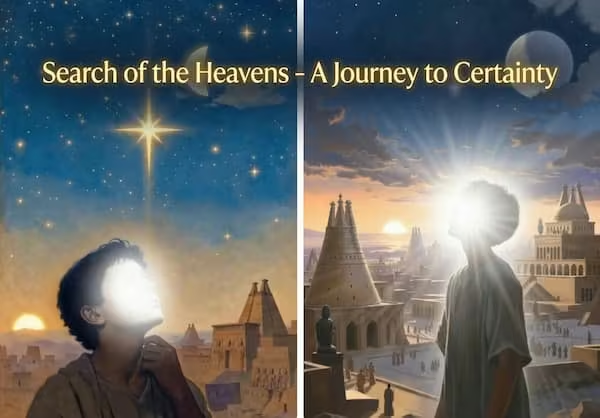
From the stars to the light — the spiritual journey to certainty.
Search of the Heavens: A Journey to Certainty – Information and Quranic Insights
The Search of the Heavens: A Journey to Certainty reveals a fundamental principle of Islamic theology. Anything subject to change, limitation, or dependency cannot be God.
Stars, moons, and suns all rise and set. They follow fixed paths and are created entities that serve specific functions in the universe.
They depend on the laws Allah established and do not control their own existence. Through the Search of the Heavens, Prophet Ibrahim عليه السلام understood that the Divine must be self-sufficient.
He must not disappear, weaken, or require anything outside Himself. This insight dismantled the polytheistic worldview of his time.
Celestial bodies were often worshipped as gods or intermediaries. His rejection was not emotional rebellion.
It was the result of careful observation combined with sincere desire for truth. This forms the essence of the Search of the Heavens.
The Night of Contemplation: Ibrahim عليه السلام Begins His Search of the Heavens
The Qur’an describes how night fell upon Ibrahim عليه السلام during his Search of the Heavens. In that quiet darkness, he turned his gaze toward the sky. He saw a bright celestial body — described as a kawkab, often understood as a planet or brilliant star.
“When the night fell over him, he saw a star. He said, ‘This is my lord.’ But when it set, he said, ‘I do not love those that set.’”
(Surah Al-An’am 6:76)
This simple observation carried profound weight during the Search of the Heavens. Anything that appears and then vanishes cannot be the ultimate Lord. The criterion was clear: true divinity must be permanent and unchanging.
Ibrahim عليه السلام did not stop there. His Search of the Heavens continued with greater scrutiny as he sought something truly worthy of worship.

The heavens that guided Prophet Ibrahim عليه السلام toward certainty
The Moon and the Sun: Further Stages in the Journey to Certainty
The Qur’an describes how night fell upon Ibrahim عليه السلام. In that quiet darkness, he turned his gaze toward the sky. He saw a bright celestial body — described as a kawkab, often understood as a planet or brilliant star.
When the moon rose later, its soft light filled the sky. It appeared greater and more majestic than the star. Ibrahim عليه السلام again considered the possibility: “This is my lord.”
Yet the moon also completed its cycle and set. He responded with humility and awareness of his need for guidance: “If my Lord does not guide me, I will be one of the erring people.”
The following morning brought the sun — the brightest and most powerful object visible. Its rising was overwhelming. Ibrahim عليه السلام said, “This is my lord, this is bigger.”
But even the sun set at the end of the day. At that moment, he turned to his people with a clear and courageous declaration: “O my people, I am innocent of your idolatry.”
6:77 → The moon – 6:78 → The sun
Through this sequence, Ibrahim عليه السلام systematically examined the most impressive created things. Each one failed the test of permanence. His reasoning was both rational and spiritual. He sought something eternal, independent, and worthy of worship.
Why Celestial Bodies Cannot Be Divine
The Search of the Heavens: A Journey to Certainty reveals a fundamental principle of Islamic theology. Anything subject to change, limitation, or dependency cannot be God. Stars, moons, and suns all rise and set. They follow fixed paths and are created entities that serve specific functions in the universe.
They depend on the laws Allah established and do not control their own existence. Through the Search of the Heavens, Prophet Ibrahim عليه السلام understood that the Divine must be self-sufficient. He must not disappear, weaken, or require anything outside Himself.
This insight dismantled the polytheistic worldview of his time, where celestial bodies were often worshipped as gods or intermediaries. His rejection was not emotional rebellion but the result of careful observation combined with sincere desire for truth, which forms the essence of the Search of the Heavens.
The Role of Reason and Revelation in Ibrahim’s عليه السلام Journey
One of the most striking features of this Search of the Heavens: A Journey to Certainty is the beautiful balance between human reason and divine guidance. Ibrahim عليه السلام did not rely on blind faith. He used his intellect to observe, question, and analyse.
At the same time, he remained humble. When the moon set, he acknowledged his need for guidance from his Lord. This shows that reason alone is not enough. True certainty (yaqin) comes when the mind is guided by revelation and spiritual insight.
This harmony between ‘aql (intellect) and wahy (revelation) is a key lesson from the story. It protects believers from both blind imitation and arrogant rationalism.
From Personal Discovery to Public Call: The Hanif’s Mission
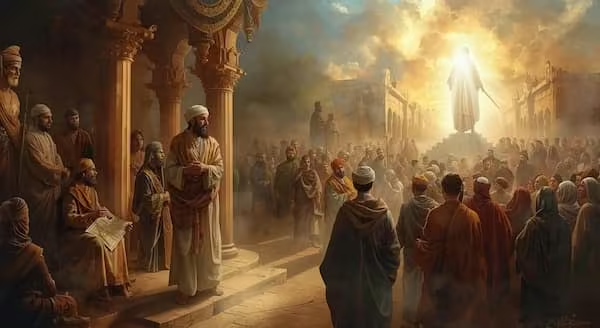
The sacred moment a seeker becomes a messenger — the Hanif’s public call begins.
Once Ibrahim عليه السلام reached certainty in his heart, he did not keep it private. He began with his own father, addressing him with gentleness and respect. He asked why his father worshipped idols that could neither hear nor see nor bring any benefit.
When his message was rejected, Ibrahim عليه السلام expanded his invitation to the wider community. He challenged the priests and the symbolic power of the idols. He questioned rituals that had no logical or spiritual foundation.
His arguments were systematic. He exposed the powerlessness of man-made objects. Later, he would physically demonstrate this by breaking the idols, leaving the largest one intact and asking the people to question it — an act that flowed directly from the certainty he gained during his search of the heavens.
This phase marks the transition from personal conviction to prophetic responsibility. The journey to certainty naturally produces a desire to share truth with others.
Confronting False Authority: Ibrahim عليه السلام and King Nimrod
Ibrahim’s عليه السلام message eventually reached the political and religious elite. King Nimrod claimed divine status for himself. The confrontation between the prophet of tawhid and the tyrant of shirk became legendary.
Ibrahim عليه السلام calmly dismantled Nimrod’s claims using simple logic rooted in observable reality. When Nimrod boasted of giving life and death, Ibrahim عليه السلام pointed to the sun’s rising in the east — something no human could control. He challenged Nimrod to make it rise from the west instead.
The king was silenced. Yet tyranny does not yield easily. Ibrahim عليه السلام was thrown into a great fire. Through Allah’s direct intervention, the fire became cool and safe for him. This miraculous protection further strengthened his certainty and confirmed his prophethood.
The Search of the Heavens: A Journey to Certainty had prepared him for every trial that followed.
Truth, Certainty, and the Illumination of Consciousness
The narrative of Prophet Ibrahim’s عليه السلام early mission illustrates a perennial truth: when conviction is grounded in certainty (yaqin), it possesses inherent transformative power.
Certainty in the Islamic tradition is not mere intellectual agreement. It is a deep state reached through observation, rational reflection, spiritual experience, and divine guidance. Ibrahim’s عليه السلام journey beautifully merges reason with revelation. The result is an inner illumination often described as the “light of wisdom.”
This illumination allowed him to see beyond cultural traditions and family pressure. He discerned the oneness of Allah with clarity that no external authority could shake. His monotheistic awakening became the foundation for a prophetic mission that would influence billions across history.
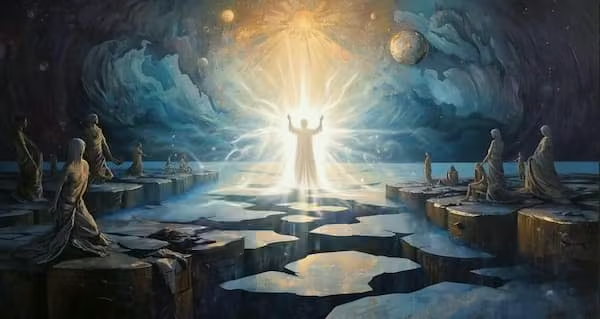
The Hanif receives the light of truth as consciousness awakens across the broken world.
The Enduring Power of Ibrahim’s عليه السلام Journey to Certainty
Search of the Heavens: A Journey to Certainty is not just ancient history. It offers a living model for every generation. It shows that sincere questioning, when combined with humility and openness to guidance, leads to truth.
In our time, many people inherit beliefs without deep reflection. Others look only to science or philosophy. Ibrahim’s عليه السلام example encourages a balanced path: use the mind to observe the signs in creation, then turn to Allah for guidance and certainty.
The heavens still declare the glory of their Creator. Stars, moons, and suns continue their cycles under perfect laws. Those who reflect sincerely, as Ibrahim عليه السلام did, will reach the same conclusion: there is only One worthy of worship — Allah, the Eternal, the Self-Sufficient.
Practical Lessons from the Search of the Heavens
➤ Observe the natural world with fresh eyes and sincere intention. |
➤ Test beliefs against clear criteria: Does this thing depend on something else? Does it change or disappear? |
➤ Combine rational thinking with spiritual humility and prayer for guidance. |
➤ Once certainty is reached, share it with wisdom and courage, beginning with those closest to you. |
➤ Expect trials, but know that true yaqin brings inner strength and divine support. |
Remember that the journey to certainty often begins with honest questioning rather than immediate answers. |
These lessons flow directly from Ibrahim’s عليه السلام experience during his search of the heavens and remain relevant for Muslims in every era.
Conclusion: A Timeless Invitation
The Search of the Heavens: A Journey to Certainty remains one of the most beautiful and instructive stories in the Qur’an. It begins with a young man looking at the night sky and ends with a prophet who changes the spiritual direction of humanity.
Ibrahim عليه السلام did not find God in the stars, the moon, or the sun. He found the signs that pointed beyond them to the One who created them all. His journey to certainty teaches us that the path to truth is open to anyone willing to look, to question honestly, and to seek guidance from the Lord of the heavens and the earth.
May we all be granted a portion of that same clarity and conviction. May our own reflections on creation lead us to the same pure declaration: “I am innocent of all that is worshipped besides Allah.”
Page 2