
The Four Rivers Flowing from Sidrat al-Muntaha: Their Reality, Meaning, and Connection to Creation
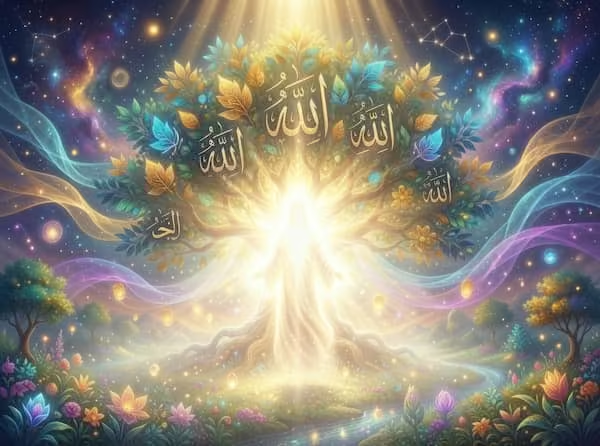
Divine rivers of light and mercy flowing from Sidrat al-Muntaha — where the heavenly and earthly realms meet.
Introduction: The Four Rivers Flowing from Sidrat al-Muntaha
The Four Rivers Flowing from Sidrat al-Muntaha: During the Mi’raj, the Prophet Muhammad ﷺ stood at the base of Sidrat al-Muntaha, the ultimate cosmic boundary of the created universe. There he witnessed four majestic rivers flowing from beneath this lote-tree: two hidden rivers flowing exclusively toward Paradise and two visible rivers whose divine blessings extend to the earthly realm. These waters are far more than physical streams. They represent divine mercy in constant flow, the circulation of spiritual commands, and the sustaining power that upholds life across creation.
The Four Rivers Flowing from Sidrat al-Muntaha: Islamic tradition, classical tafsīr, and reflections on the natural world all affirm the profound reality of these rivers originating from Sidrat al-Muntaha. The scene reveals a living connection between the unseen heavenly realm and our visible world. Through these rivers, believers glimpse how Allah’s mercy descends and how human deeds ascend in perfect spiritual balance. The four rivers flowing from Sidrat al-Muntaha thus serve as a powerful reminder of the interconnectedness of all existence under divine wisdom.
The Prophetic Witness: Four Rivers Flowing from Sidrat al-Muntaha in the Mi'raj
Eternal rivers of divine mercy flowing from beneath Sidrat al-Muntahā — the sacred Lote Tree at the boundary of Paradise.
The Four Rivers Flowing from Sidrat al-Muntaha: The authentic hadith in Sahih Muslim records the Prophet’s ﷺ words clearly. He said he saw four rivers flowing from the root of the lote-tree of the farthest limits: two manifest rivers and two hidden rivers. When he asked Jibril what these rivers were, the answer came that the two hidden rivers are rivers of Paradise, while the two manifest ones are the Nile and the Euphrates. This vision occurred in the seventh heaven after the Prophet ﷺ met Prophet Ibrahim عليه السلام during his miraculous ascent.
Classical scholars explain that the two hidden rivers belong exclusively to Paradise and remain unseen by earthly beings. The two visible rivers reach Earth spiritually rather than through literal physical channels from the heavens. They serve as conduits of blessing and divine grace that touch human civilization in both symbolic and practical ways. Many mufassirūn note that these rivers flowing from Sidrat al-Muntaha symbolize the meeting point where divine mercy descends and human deeds ascend.
The Four Rivers Flowing from Sidrat al-Muntaha: The Sidrat al-Muntaha thus marks the cosmic axis of this sacred exchange. The Prophet ﷺ also described the tree itself: its leaves resemble the ears of elephants and its fruits resemble the clay pitchers of Hajar. The entire lote-tree was covered with indescribable colors and lights by divine command. This majestic setting underscores that the four rivers flowing from Sidrat al-Muntaha are signs of Allah’s greatest gifts to creation during the Mi’raj.
Sidrat al-Muntaha as the Cosmic Boundary of Creation
The Four Rivers Flowing from Sidrat al-Muntaha: Sidrat al-Muntaha functions as the final spiritual checkpoint of the universe. All deeds performed on Earth ascend and reach their limit here. All divine commands descend and pass through this station before reaching the lower realms. Angels pause at this boundary to receive fresh instructions from Allah. Knowledge belonging to created beings reaches its utmost extent at this point and goes no further.
The four rivers flowing from Sidrat al-Muntaha beautifully illustrate this unique role. They embody continuous circulation: divine mercy flowing downward to sustain life and human deeds rising upward toward their Lord. This spiritual mechanism maintains perfect balance between the heavenly and earthly domains. The Sidrat al-Muntaha therefore stands as both a barrier and a bridge — the place where the unseen and the seen meet under Allah’s perfect decree.
Quranic verses in Surah An-Najm describe this lote-tree of the utmost boundary near the Garden of Refuge. The Prophet’s ﷺ sight neither swerved nor transgressed its limit, and he witnessed some of the greatest signs of his Lord. These details deepen our understanding of why the rivers flowing from Sidrat al-Muntaha carry such immense meaning for all of creation and its spiritual connection to the divine.
The Identity and Spiritual Reality of the Four Rivers from Sidrat al-Muntaha
The Four Rivers Flowing from Sidrat al-Muntaha: Related authentic narrations identify the four rivers of Paradise as the Nile, the Euphrates, Sayhan, and Jayhan. The two hidden rivers — Sayhan and Jayhan — flow exclusively within Paradise and remain beyond human perception. The two visible rivers — the Nile and the Euphrates — carry their blessings into our world. Their physical waters originate on Earth, yet their fertility, life-giving power, and role in sustaining civilizations are spiritually linked to the divine command that emanates from Sidrat al-Muntaha.
The Four Rivers Flowing from Sidrat al-Muntaha: Scholars emphasize that this connection is not a claim of literal water flowing from the seventh heaven to Earth. Instead, it highlights the immense honor and barakah these rivers possess as rivers flowing from Sidrat al-Muntaha. Their reality reflects how Allah has chosen to channel mercy through specific means that benefit humanity. The hidden rivers remind us of the unseen Paradise prepared for the righteous, while the visible rivers demonstrate how that same mercy touches our daily lives through water and sustenance.
This distinction between hidden and visible rivers from Sidrat al-Muntaha teaches a profound lesson. Much of Allah’s mercy operates beyond our sight, yet its effects appear clearly in the world around us. The four rivers flowing from Sidrat al-Muntaha thus bridge the gap between the eternal and the temporal, revealing the spiritual reality behind every blessing we receive.
The Connection of Sidrat al-Muntaha Rivers to Earthly Creation and Divine Mercy
The Four Rivers Flowing from Sidrat al-Muntaha: The Nile and Euphrates have historically sustained some of humanity’s earliest and most influential civilizations. The Nile brought fertility to Egypt, while the Euphrates nourished the lands of Mesopotamia. These rivers enabled agriculture, trade, and the rise of great societies — clear manifestations of divine mercy reaching Earth through the spiritual reality originating at Sidrat al-Muntaha. Their life-sustaining waters reflect the same mercy that flows from the cosmic tree described in the Mi’raj.
Modern observations of ecology and hydrology further illustrate this connection. These rivers support vast ecosystems, biodiversity, and millions of human lives in often arid regions. Their intricate balance of flow, sediment, and seasonal cycles points to the wise design behind creation. While science describes the physical mechanisms, Islamic tradition reveals the deeper spiritual source: the rivers flowing from Sidrat al-Muntaha carry blessings ordained by Allah.
In this way, the four rivers symbolize the ongoing link between heavenly command and earthly life. They remind every believer that the mercy descending from Sidrat al-Muntaha continues to nourish both body and soul. The visible rivers offer practical sustenance, while the hidden rivers point toward the ultimate reward in Paradise and the spiritual connection to creation.
Qur’anic Precedent: Hidden Pathways in the Story of Musa and Khidr
The Four Rivers Flowing from Sidrat al-Muntaha: The story of Musa and Khidr in Surah Al-Kahf offers a beautiful parallel to the rivers flowing from Sidrat al-Muntaha. Musa observes water behaving in ways that defy ordinary understanding when a hidden path opens beneath the sea and the fish disappears through it. Khidr navigates the unseen currents, revealing divine secrets invisible to ordinary perception. This Quranic account shows how Allah can open pathways that connect the seen and unseen worlds.
Similarly, the rivers from Sidrat al-Muntaha reach Earth through invisible spiritual pathways. They connect heavenly abundance to earthly life without violating the physical laws of nature. These rivers act as portals of divine blessing rather than literal physical channels from the seventh heaven. The parallel teaches that divine wisdom often operates through hidden mechanisms that only the insightful can recognize.
Just as Khidr explained events that appeared strange on the surface, the four rivers flowing from Sidrat al-Muntaha carry meanings that go beyond what the eye can see. They demonstrate that Allah’s mercy can flow through both visible rivers like the Nile and Euphrates and through unseen spiritual channels that sustain creation. This Quranic precedent deepens our appreciation of the hidden orchestration behind the rivers of Sidrat al-Muntaha.
Modern Scientific Reflections on Water and Rivers Flowing from Sidrat al-Muntaha
The Four Rivers Flowing from Sidrat al-Muntaha: Science increasingly echoes the wonder of water as a cosmic gift that aligns with the spiritual reality of the rivers flowing from Sidrat al-Muntaha. Water predates Earth itself, with astronomers discovering gigantic clouds of water vapor in distant space that sometimes contain more water than trillions of Earth’s oceans combined. Earth’s water cycles — precipitation, rivers, oceans, and groundwater — reflect a continuous, divinely sustained system that maintains life across the planet.
The Qur’an states: “We made from water every living thing” (Surah Al-Anbiya 21:30). The rivers of Sidrat al-Muntaha symbolize this divine origin of life. They link celestial oversight to earthly ecosystems and show that every drop of water on Earth remains connected to higher, unseen realities. Modern discoveries about water in the cosmos thus complement the Islamic understanding that the four rivers flowing from Sidrat al-Muntaha represent a profound connection between the heavens and our world.
These scientific reflections do not replace the spiritual meaning but rather highlight the intricate design that Allah has placed in creation. The continuous movement of water through rivers and cycles mirrors the spiritual circulation of mercy that descends from Sidrat al-Muntaha. Every river on Earth, including the Nile and Euphrates, participates in this divine system that sustains both physical life and spiritual awareness.
The Nile and Euphrates as Manifestations of Blessings from Sidrat al-Muntaha
The Four Rivers Flowing from Sidrat al-Muntaha: The Nile stands as the lifeline of Egypt and shaped one of history’s greatest ancient civilizations. It provided fertile soil for crops, enabled trade and urban development, and supported religion and culture across millennia. Its importance also appears in the miraculous events of the prophets. When Prophet Musa عليه السلام struck the sea with his staff by the command of Allah during the exodus, a path opened through the waters. When Pharaoh approached, the waters returned by Allah’s command and drowned him. This shows that terrestrial waters flow under the direct command of Allah and reflect the blessings flowing from the unseen realm of Sidrat al-Muntaha.
The Euphrates served as the cradle of Mesopotamian civilization. It supported early cities, legal systems, irrigation networks, and agriculture that fed growing populations. Together, the Nile and Euphrates demonstrate how the visible rivers flowing from Sidrat al-Muntaha have nurtured human progress and cultural achievement throughout history. Their fertility and life-giving properties carry the spiritual honor described in the hadith of the Mi’raj.
The historical, cultural, and miraculous significance of these rivers illustrates how heavenly blessings reach the earth. They fulfill the symbolic role of the rivers of Sidrat al-Muntaha in human life. They stand as living reminders that all earthly water, sustenance, and civilizational development occur under divine supervision, reflecting the spiritual reality of Sidrat al-Muntaha and its connection to creation.
Conclusion: The Cosmic and Earthly Significance of Sidrat al-Muntaha
The Four Rivers Flowing from Sidrat al-Muntaha: Sidrat al-Muntaha is not merely a celestial landmark. It is the ultimate threshold of divine presence, the point where creation’s limits meet Allah’s infinite knowledge and mercy. Beneath its roots flow four sacred rivers: two reaching unseen realms of Paradise and two whose blessings manifest on Earth, nurturing life and sustaining civilizations. These rivers flowing from Sidrat al-Muntaha are more than symbolic. They remind us that divine mercy and provision are woven into the very fabric of creation.
Just as the Nile and Euphrates shaped the rise of humanity’s earliest civilizations, the unseen rivers from Sidrat al-Muntaha sustain the spiritual and material order of the cosmos. Every drop of water, every breath of life, and every bounty on Earth originates from Allah’s command. They flow through invisible pathways from the heavens to the world below, linking the cosmic boundary to our daily existence.
The Four Rivers Flowing from Sidrat al-Muntaha, As Allah declares in the Qur’an, signs exist in the heavens and the earth for those who reflect, yet many fail to ponder and understand. No amount of human reasoning can reach the fullness of His knowledge or the treasures of His mercy. The Sidrah teaches that while creation is bound, divine grace is limitless. Even the highest reaches of the heavens serve as a conduit of sustenance and guidance to our earthly realm through the four rivers flowing from Sidrat al-Muntaha.
The Four Rivers Flowing from Sidrat al-Muntaha, For the thoughtful observer, Sidrat al-Muntaha inspires humility, reflection, and awe. It calls us to recognize the sacredness of life and the interconnectedness of all beings. It helps us appreciate the hidden orchestration of creation that links the heavens to the Earth. It invites us to see the material world as a reflection of divine order and mercy. Ultimately, Sidrat al-Muntaha reminds us that all creation is finite, yet the generosity, knowledge, and blessing of Allah extend beyond all boundaries, inviting humanity to witness, contemplate, and live in harmony with the cosmic design.