
Portals in the Sky
Sky Portals and Celestial Gates: From Atmospheric Phenomena to Mythical Gateways and Modern Speculation
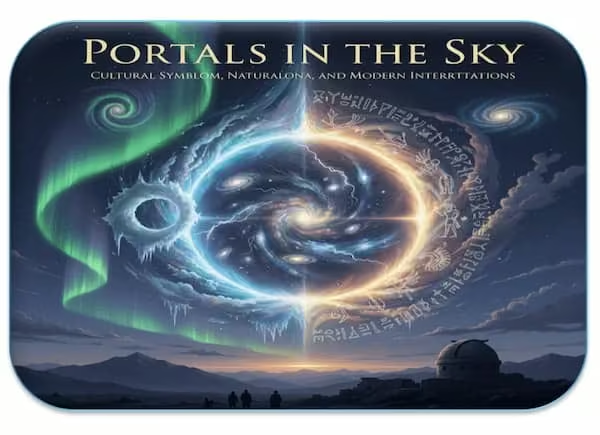
Introduction: Protals in the Sky - Human Consciousness and Contemporary Relevance
The sky has always occupied a central place in human consciousness, embodying both overwhelming power and an irreducible sense of mystery. Across every culture and era, it has functioned simultaneously as a practical guide for navigation, agriculture, and timekeeping while also serving as a profound metaphor for transcendence and connection to realms beyond ordinary perception.
This dual role explains why the concept of “Portals in the Sky” or “celestial gates” recurs so persistently in global mythologies, religious scriptures, indigenous spiritualities, and even contemporary scientific speculation. These imagined or observed openings in the heavens, known as Portals in the Sky, are seen as thresholds linking our terrestrial existence with higher dimensions, divine presence, or alternate realities.
In an age of advanced satellite imagery, renewed governmental interest in unidentified aerial phenomena after the 2017 Pentagon disclosures and subsequent official reports, and groundbreaking observations from telescopes such as the James Webb Space Telescope, the archetype of Portals in the Sky feels more relevant than ever.
People worldwide continue to photograph and share dramatic atmospheric events that look exactly like rips or gateways in the clouds. At the same time, theorists and researchers explore whether some of these sightings might represent genuine interdimensional phenomena rather than simple optical effects or misidentifications.
This article explores Portals in the Sky through three interconnected lenses: the verifiable natural atmospheric phenomena that create portal-like visuals; the rich religious and cultural symbolism that has interpreted such openings as sacred thresholds across civilizations; and the scientific and speculative frameworks that keep the idea of Portals in the Sky alive in modern discourse.
By examining these dimensions together, we gain deeper insight into humanity’s timeless quest to understand what lies beyond the visible sky and our place within a potentially much larger and more mysterious reality: Portals in the Sky.
Portals in the Sky - Natural Atmospheric Phenomena - Authentic Formed by Optical Effects and Electrical Activity
Many authentic Portals in the Sky appear as stunning optical illusions or brief luminous events. Sunlight, moonlight, or electrical discharges interact with ice crystals, water droplets, atmospheric particles, and Earth’s magnetic field to create them.
Observers often see circular holes, vertical beams, glowing rings, shifting curtains, or sudden flashes that look like tears or gateways. The beauty of Portals in the Sky still evokes deep wonder even though physics and meteorology fully explain them today.
Fallstreak holes, also called hole-punch clouds, form nearly perfect circular gaps in mid-level altocumulus clouds. Supercooled water droplets freeze into ice crystals that grow heavy and fall, leaving expanding clearings often edged by bright sunlight.
Viral photos frequently label these clean geometric openings as Portals in the Sky because they seem deliberately punched through the cloud layer. Scientists understand the glaciation process, yet the visual impact of Portals in the Sky remains powerful and otherworldly.
Light pillars produce tall vertical beams of light through reflection off flat, plate-like ice crystals in high cirrus clouds or diamond dust. These striking columns resemble luminous beams shining from another realm.
Ancient cultures across the world interpreted them as divine ladders or bridges long before science explained the optics. Modern viewers still experience light pillars as genuine Portals in the Sky. The pure vertical form continues to make people feel they are looking at true Portals in the Sky.
Halos, glories, subsuns, and circumhorizontal arcs arise from refraction and reflection inside hexagonal ice crystals. They create vivid rings around the sun or moon, bright sun dogs, and rare horizontal bands of spectral color known as fire rainbows.
The common 22-degree halo frames the sun like a glowing window or sacred mandala. Such displays have inspired both scientific study and spiritual awe for millennia. Many people sense sacred Portals in the Sky in these perfect celestial rings. The radiant geometry of these events keeps them firmly linked to the idea of Portals in the Sky.
Auroras display shifting curtains of colorful light caused by charged solar particles colliding with Earth’s upper atmosphere and magnetic field. Ancient peoples viewed these moving ethereal glows as heavenly veils being drawn aside or gateways for spirits and ancestors.
Modern science fully explains the process through solar wind and magnetospheric physics. Yet the living, breathing quality of the aurora still makes observers feel they are witnessing active Portals in the Sky. Countless viewers describe the experience as watching real Portals in the Sky open between worlds.
Sprites, blue jets, and elves add another layer of fleeting otherworldly luminosity. These rare electrical discharges occur high above intense thunderstorms in the mesosphere and ionosphere, appearing as brief red sprites, blue conical jets, or expanding ring-shaped elves that last only milliseconds.
Their sudden colorful and geometric flashes create the visual impression of celestial apertures activating above the storm clouds. Although high-speed cameras capture them routinely today, science only recognized them in recent decades. These events expand the catalog of Portals in the Sky. Their momentary nature reinforces the sense of brief, high-altitude Portals in the Sky.
Collectively, these atmospheric optical and electrical phenomena show how the sky itself generates genuine physics-based portal visuals. Specific meteorological conditions produce the same striking forms again and again, which is why similar descriptions appear in both ancient texts and modern viral videos.
The emotional and symbolic power of these holes, beams, rings, and curtains continues to bridge empirical observation with the human longing for transcendence. Portals in the Sky remain a living connection between science and wonder. True Portals in the Sky remind us that the atmosphere still holds profound beauty capable of stirring the soul.
| Here are some illustrative examples to help visualize these “portals”: |
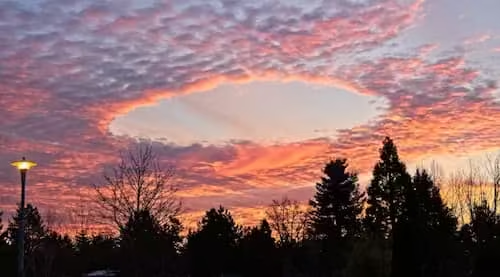
Nature’s own portal: a dramatic fallstreak hole in the sunset clouds.
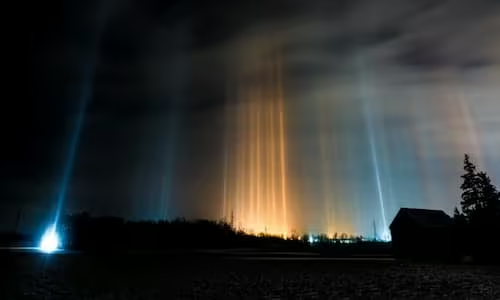
Light pillars forming glowing natural portals in the dark sky.
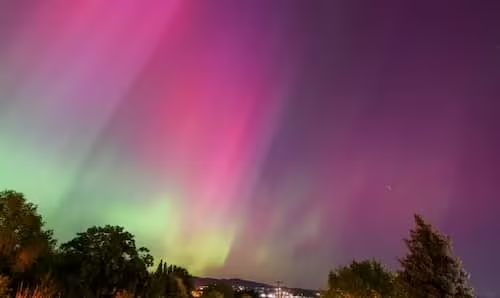
Aurora Borealis – Natural Light Portals in the Sky
Religious and Cultural Symbolism: Celestial Gates in Ancient Myths, Scriptures, and Indigenous Traditions
The motif of sky portals and celestial gates permeates religious traditions worldwide, transforming natural wonders into symbols of divine access, judgment, and spiritual journey. From Mesopotamian layered heavens to Christian pearly gates and indigenous sacred alignments, these openings represent the boundary between mundane and sacred realms, reflecting humanity’s desire for cosmic connection.
In Mesopotamian beliefs, the Babylonians and Sumerians envisioned the heavens as layered realms guarded by powerful deities. Celestial gates served as controlled entry points through which gods, kings, and worthy souls could pass between the earthly plane and divine domains.
Similar ideas appear in Egyptian mythology, where the Book of the Dead describes the soul’s perilous journey through multiple gates in the sky to reach the afterlife. The precise alignment of pyramids and temples with stars such as Orion’s Belt further reflects the conviction that stellar configurations marked functional gateways for the pharaoh’s spirit to ascend.
Greek and Roman traditions viewed Mount Olympus as a cloud-shrouded mountain whose summit opened into the realm of the gods. Norse mythology featured the Bifröst, a burning rainbow bridge from Midgard to Asgard guarded by Heimdall, possibly inspired by observations of the Milky Way or aurora borealis, whose destruction was foretold during Ragnarök.
Abrahamic traditions emphasize celestial gates consistently. The Hebrew Bible mentions the “windows of heaven” in Genesis through which floodwaters poured. Christianity celebrates the “pearly gates” of Heaven as the entrance to eternal life. Islamic texts including the Qur’an (7:40) describe gates of heaven that remain closed to disbelievers, while Hadith detail their opening for divine purposes.
Indigenous traditions treat sky portals as living spiritual realities. Native American cultures regard mountains and celestial events as doorways for ancestors or vision seekers. Navajo sandpaintings serve as temporary portals for Holy People during ceremonies. Andean huacas connect Pachamama with the sky as energetic gateways for rituals and guidance. These traditions show sky portals as active spiritual technology affirming that transcendence is possible through meaningful cosmic connections.
Scientific and Speculative Perspectives: Sky Portals, UAP, Wormholes, and Interdimensional Inquiry
Modern science blends rigorous explanation with inquiry into sky portals. Most dramatic visuals are identified as optical effects, yet persistent unexplained aerial phenomena fuel theories of genuine interdimensional rifts or spacetime openings.
The interdimensional hypothesis advanced by Jacques Vallée proposes some UAP represent glimpses through transient sky portals rather than conventional spacecraft, reframing them as leaks between realities when spacetime becomes locally permeable.
The 2022 documentary A Tear in the Sky follows a team of former military personnel, scientists, and special guest William Shatner as they deploy advanced multi-sensor equipment to observe and triangulate UAP activity, particularly the famous “Tic Tac” incidents.
By seeking high-resolution data and exploring possible spacetime anomalies, the project explicitly investigates whether some UAP might constitute literal “tears” or openings that bridge our reality with other dimensions or altered states of consciousness.
In theoretical physics, traversable wormholes (Einstein-Rosen bridges) and related concepts from general relativity offer mathematically permissible mechanisms for portal-like connections.
Physicists including Kip Thorne have demonstrated that under extreme conditions spacetime might link distant regions or parallel universes, ideas popularized in Contact and Interstellar. Although creating stable macroscopic wormholes remains far beyond current technology, the theoretical possibility sustains serious speculation.
Consciousness researchers link focused intention or collective states to transient anomalies manifesting as portal effects, incorporating quantum entanglement insights.
Most viral “portal” videos are debunked as flares, drones, or atmospheric optics, but a residue of high-quality multi-sensor cases remains unexplained, preserving space for investigation. This synthesis connects ancient imagery with questions about reality, consciousness, and spacetime limits, reminding us the boundary between known and unknown is permeable.
| Here are some illustrative examples to help visualize these “portals”: |
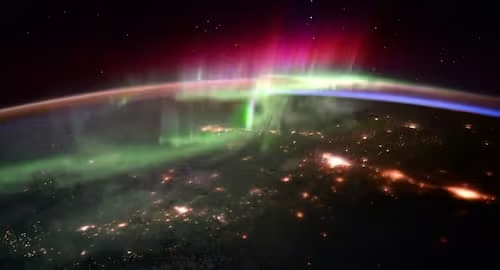
Aurora Borealis seen from space, evoking ideas of sky portals and interdimensional phenomena.
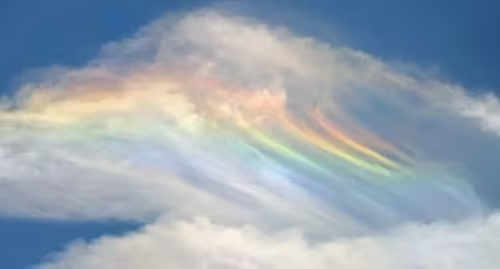
Shimmering rainbow clouds resembling mysterious sky portals and interdimensional light.
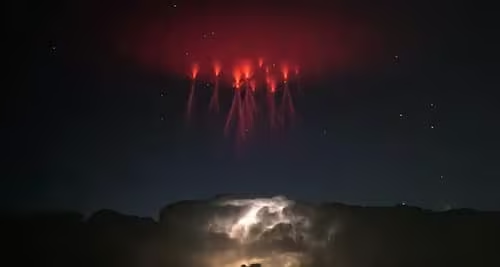
Red sprites forming mysterious glowing portals above a thunderstorm.
The Interpretive Significance: Why Sky Portals Captivate the Human Imagination
The sky portal image has retained magnetic power across millennia because it symbolizes humanity’s deepest aspiration: transcendence. It represents the urge to move beyond material constraints into whatever lies beyond ordinary perception. Whether a natural halo, religious ladder, UAP tear, or theoretical wormhole, the motif points to one intuition—something more exists just beyond our perceptual boundary.
Psychologists note the archetype taps cognitive structures: the sky as source of mystery, the arch as symbol of passage, the vertical as aspiration. Jungian views see sky portals as mandala-like symbols of Self integration with the cosmos.
Evolutionary perspectives suggest attention to unusual sky events conferred advantages, embedding predisposition to find meaning in them. The portal endures as an expression of our longing to know what lies on the other side, reappearing in art, dreams, and speculation during transformation, reassuring us the universe holds hidden connections and breakthrough possibilities.
Conclusion: Sky Portals as Enduring Symbols of Awe, Curiosity, and Cosmic Connection
Sky portals weave natural wonder, spiritual symbolism, and scientific speculation into one enduring motif. They begin with real atmospheric phenomena—light pillars, fallstreak holes, auroras, and high-altitude lightning—that visually evoke gateways. These extend into profound metaphors from the Norse Bifröst rainbow bridge and Lion’s Gate Portal in modern esotericism to sacred alignments in indigenous and ancient traditions.
In contemporary discourse they resonate in speculative physics and UAP research, where wormholes and interdimensional gateways suggest cosmic connections beyond conventional spacetime. Far from fleeting fancy, sky portals embody humanity’s deepest curiosity—the drive to look upward and seek meaning in the vastness. They stand at the intersection of grounded science, timeless spirituality, and imagination.
Sky portals remind us that the sky is no empty or static expanse. It remains a perpetual source of awe, aspiration, and the profound sense that something extraordinary may lie just beyond the visible horizon—waiting, perhaps, for us to develop the eyes, the instruments, or the consciousness to perceive and cross through.
Whether through the lens of a camera capturing a fallstreak hole, the pages of an ancient text describing celestial gates, or the equations of a theoretical physicist modeling traversable wormholes, the archetype continues to call us toward greater understanding of the universe and our place within its magnificent, mysterious architecture.