
Satellites Deep Dive
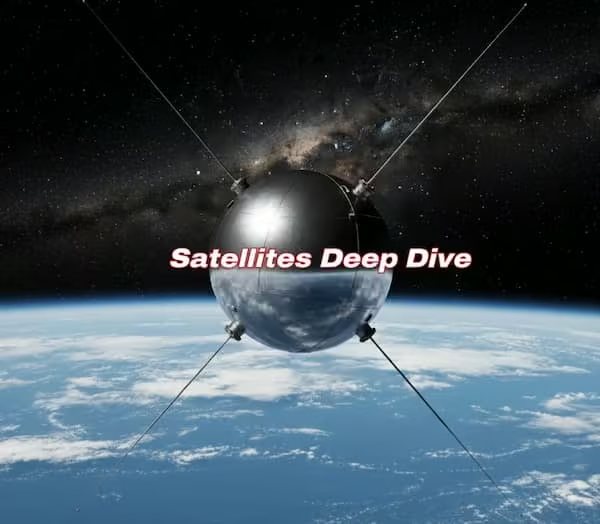
Exploring the technology and future of satellites in space.
Satellites Deep Dive: What Satellites Are and Their Meaning
A satellite is any object that revolves around a larger body due to gravitational forces. This fundamental definition covers both natural satellites that have existed for billions of years and artificial satellites created by humans. In this Satellites Deep Dive, we explore the true meaning of satellites and the essential roles they play around Earth and other celestial bodies.
Natural satellites, often called moons, formed alongside planets during the birth of the solar system. Earth’s Moon is the most familiar example — it stabilizes our planet’s tilt, controls ocean tides, and has guided human culture for millennia. Other planets have their own impressive satellite systems.
Mars is accompanied by the small moons Phobos and Deimos. Jupiter possesses more than 95 known natural satellites, including Ganymede, the largest moon in the solar system. Saturn’s moons, such as the mysterious Titan with its thick atmosphere and liquid lakes, continue to fascinate scientists. Even planets themselves function as natural satellites while orbiting stars like our Sun. These ancient orbiting bodies offer valuable clues about how solar systems form and evolve.
Artificial satellites are very different. They are human-engineered machines deliberately launched into orbit to perform specific functions that benefit life on Earth. The space age began on October 4, 1957, when the Soviet Union successfully launched Sputnik 1, the first artificial satellite. This simple metal sphere, designed under the leadership of scientist Sergei Korolev, transmitted radio signals back to Earth and proved that humans could place objects in orbit.
Since that historic launch, satellites have transformed modern civilization. Communication satellites deliver television, radio, and internet signals across continents. Weather satellites provide early storm warnings that save lives. Navigation satellites power GPS systems used in phones, cars, ships, and aircraft. Earth-observation satellites monitor climate change, deforestation, agriculture, and natural disasters from space. Even the International Space Station operates as a large artificial satellite, supporting continuous scientific research.
Today, thousands of active satellites orbit Earth, with new mega-constellations expanding global internet access. However, this rapid growth also creates challenges such as space debris and orbital congestion.
By understanding what satellites are — both the natural wonders that have orbited for eons and the artificial ones that now connect and protect our world — we build the foundation for the rest of this Satellites Deep Dive series. Their story is one of cosmic origins, human innovation, and ever-growing importance to life on Earth and beyond.
Satellites Deep Dive: Satellite Orbits
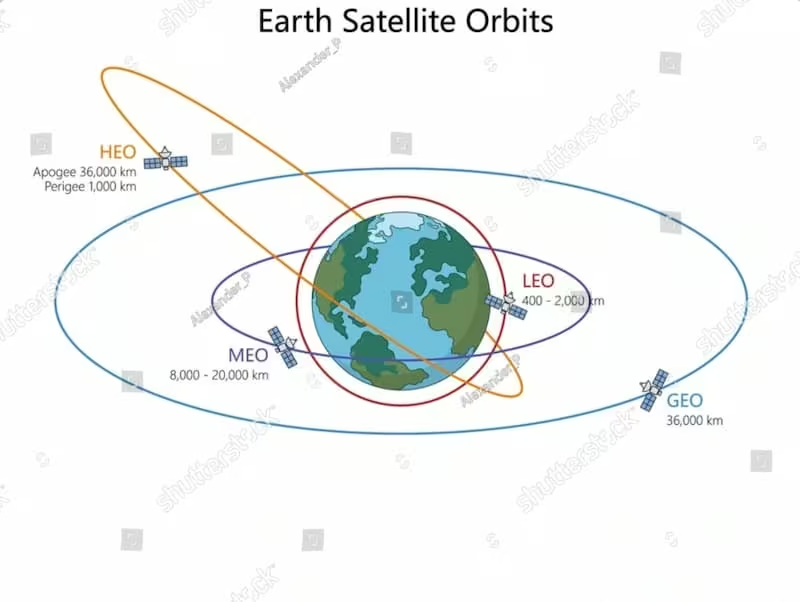
The paths satellites follow around Earth or other celestial bodies are called orbits. A satellite’s orbital characteristics — especially its altitude, inclination, and period — directly determine how it operates and what functions it can perform. Satellites are therefore categorized primarily by altitude and orbit type. The main categories are Low Earth Orbit (LEO), Medium Earth Orbit (MEO), Geostationary Orbit (GEO), and higher regimes used for specialized scientific missions.
Each orbital regime offers unique advantages and trade-offs in coverage, revisit time, signal latency, launch cost, and the number of satellites required. Choosing the correct orbit is one of the most important decisions in any space mission. In this part of the Satellites Deep Dive, we examine these major orbit types and their distinct roles in communication, navigation, observation, and exploration.
Satellites Deep Dive: Low Earth Orbit (LEO)
Low Earth Orbit (LEO) lies between 200 km and 2,000 km above Earth’s surface. This relatively low altitude is ideal for applications that need close proximity to Earth, such as high-resolution imaging, weather monitoring, scientific research, and large communication constellations. A leading example is the Starlink mega-constellation developed by SpaceX under Elon Musk, which is delivering global broadband internet.
One of LEO’s greatest advantages is its short orbital period of roughly 90 minutes, allowing satellites to circle the planet many times per day and providing rapid revisit times over specific locations. Although each individual LEO satellite covers only a small area at any moment, large constellations can achieve near-continuous global coverage.
Lower altitude also reduces launch costs and communication latency, although satellites experience more atmospheric drag and need regular station-keeping. Many crewed missions, including the International Space Station, operate successfully in LEO.
Satellites Deep Dive: Medium Earth Orbit (MEO)
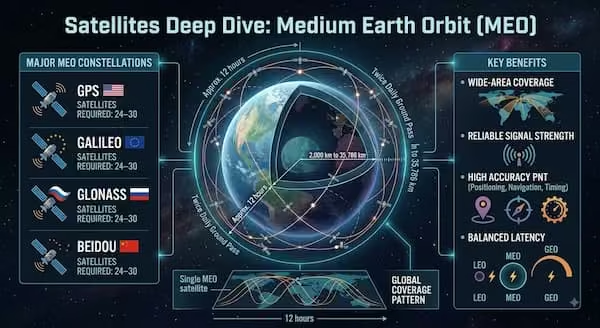
Satellites Deep Dive: Medium Earth Orbit (MEO) – GPS, Galileo, GLONASS & BeiDou
Medium Earth Orbit (MEO) occupies the altitude band from 2,000 km to 35,786 km. This region offers an excellent balance between wide-area coverage and reliable signal strength, making it the preferred choice for global navigation systems. Major constellations in MEO include the United States’ GPS, the European Union’s Galileo, Russia’s GLONASS, and China’s BeiDou.
These systems typically need only 24–30 satellites to provide worldwide coverage — far fewer than the thousands required in LEO mega-constellations. Satellites in MEO have orbital periods of approximately 12 hours, so each satellite passes over the same ground location twice per day. This configuration delivers highly accurate positioning, navigation, and timing services to billions of users and devices. MEO satellites also experience less atmospheric interference than those in LEO while still offering lower latency than geostationary systems.
Satellites Deep Dive: Geostationary Orbit (GEO)
Geostationary Orbit (GEO) sits exactly 35,786 km above the Earth’s equator. At this precise altitude, a satellite’s orbital period perfectly matches Earth’s rotation, so the satellite appears stationary from any fixed point on the ground. This stationary position greatly simplifies ground infrastructure because antennas can remain pointed in one fixed direction without expensive tracking systems. GEO is widely used for television broadcasting, international telecommunications, and continuous weather monitoring.
The visionary idea of geostationary satellites was first popularized by science fiction writer Arthur C. Clarke in his 1945 paper. Although GEO provides excellent wide-area coverage with relatively few satellites, the long distance creates noticeable signal delay (about 240 ms round-trip) and requires more powerful rockets for launch. Despite these challenges, GEO remains essential for broadcast and fixed communication services around the world.
Satellites Deep Dive: High Earth Orbit and Interplanetary Probes
Beyond Geostationary Orbit lie High Earth Orbits and interplanetary trajectories used for advanced scientific research and deep-space exploration. High Earth Orbits include stable regions near gravitational Lagrange points, such as the halo orbit at the Sun-Earth L2 point where the James Webb Space Telescope operates. Interplanetary probes travel even farther, escaping Earth’s gravity to study other planets or venture into interstellar space.
Landmark examples include NASA’s Voyager 1 and Voyager 2, now exploring beyond the heliopause, and India’s Mars Orbiter Mission (Mangalyaan), successfully placed into Martian orbit by ISRO under the leadership of Dr. K. Radhakrishnan. These distant missions require exceptional reliability, autonomous systems, and powerful communication links to send data back across vast distances. They represent the cutting edge of satellite technology and continue to expand our knowledge of the solar system and universe in this Satellites Deep Dive.
Satellites Deep Dive: Applications of Satellites
Breathtaking image from the James Webb Space Telescope — demonstrating the power of scientific satellites.
Satellites play vital roles that underpin modern society and scientific progress. In communication, they enable global telephone networks, high-speed internet, television broadcasting, and secure military links. Pioneering companies such as Intelsat (USA) and Inmarsat (UK) laid the foundation for today’s connected world. Navigation and positioning satellites, including GPS (USA), Galileo (EU), GLONASS (Russia), and BeiDou (China), deliver precise location data essential for transportation, logistics, aviation, and emergency response.
Earth observation satellites operated by NASA (USA), ESA (Europe), and ISRO (India) monitor climate change, deforestation, natural disasters, and urban growth, supporting environmental protection and disaster management. Scientific research satellites such as the Hubble Space Telescope and James Webb Space Telescope study distant galaxies, exoplanets, and cosmic phenomena.
Military and defence satellites provide critical surveillance, reconnaissance, missile tracking, and secure communications. Across all these domains, satellites have become indispensable tools that enhance safety, connectivity, and knowledge in this Satellites Deep Dive.
Satellites Deep Dive: Satellite Components
A typical satellite is a complex system built from several key components working together in the harsh environment of space. The payload consists of the instruments or equipment that perform the satellite’s primary mission, such as cameras, sensors, transponders, or scientific instruments.
The bus serves as the structural framework and houses all supporting systems, providing stability and protection. Power systems, pioneered by engineers like Hans K. Ziegler, rely on solar panels and batteries to generate and store energy for continuous operation.
Communication systems, including antennas and transponders, enable the satellite to send and receive data with ground stations or other satellites. Finally, propulsion systems allow precise orbital adjustments, station-keeping, and collision avoidance maneuvers. Together, these components must operate reliably for years without maintenance, making satellite design one of the most demanding engineering challenges. Understanding these building blocks is essential in any Satellites Deep Dive into space technology.
Satellites Deep Dive: Challenges and Considerations
Despite their importance, satellites face significant challenges throughout their lifecycle. Space debris and collision risks have grown dramatically, a problem first highlighted by scientist Donald J. Kessler through his theory of the “Kessler Syndrome,” where cascading collisions could render orbits unusable.
Radiation exposure in space can damage sensitive electronics, requiring robust shielding and error-correcting systems. Orbital decay caused by atmospheric drag, especially in Low Earth Orbit, combined with limited fuel for station-keeping, shortens satellite lifetimes. High costs of design, construction, and launch have historically limited access to space.
However, newer companies such as SpaceX (USA) and Arianespace (Europe) are dramatically reducing these barriers through reusable rocket technology and mass production techniques. Addressing these challenges through international cooperation, active debris removal, and sustainable design practices is critical for the long-term viability of satellite operations in this ongoing Satellites Deep Dive.
Satellites Deep Dive: Future of Satellites
The future of satellites promises rapid expansion and technological transformation. Mega-constellations are already delivering global broadband internet, with ambitious projects such as Starlink by SpaceX and OneWeb leading the way. Advanced Earth observation satellites will provide even higher-resolution monitoring of climate change, deforestation, and environmental health.
Deep-space exploration will benefit from autonomous satellites and probes, including ESA’s JUICE mission launched in 2023 to study Jupiter’s icy moons. Artificial intelligence is increasingly being integrated into satellite operations for real-time data analysis, autonomous decision-making, and optimized constellation management, with leading research from institutions such as MIT (USA) and Cambridge University (UK). Sustainability is also becoming a priority, with new designs focusing on deorbiting capabilities and reduced space debris.
These developments will make satellites even more central to daily life and scientific discovery in the coming decades of this Satellites Deep Dive.
Satellites Deep Dive: Timeline of Satellite Milestones
The evolution of satellite technology has been marked by remarkable achievements. It began in 1957 with the launch of Sputnik 1 by the USSR, the first artificial satellite, which opened the space age. In 1961, Yuri Gagarin became the first human in space, supported by satellite tracking networks.
1962 saw Telstar 1 (USA) relay the first live transatlantic television broadcast. 1972 marked the launch of Landsat 1 (USA), the first dedicated Earth observation satellite. In 1989, the Galileo spacecraft began its journey to Jupiter. The 1990 deployment of the Hubble Space Telescope revolutionized astronomy. China’s BeiDou Navigation System started operations in 2003. A major milestone came in 2013 when India’s Mars Orbiter Mission became the first Asian probe to orbit Mars.
The 2021 launch of the James Webb Space Telescope delivered the most powerful space observatory ever built. Today, the rapid expansion of mega-constellations such as Starlink and OneWeb continues to transform global connectivity, showing how far satellite technology has come in this Satellites Deep Dive.
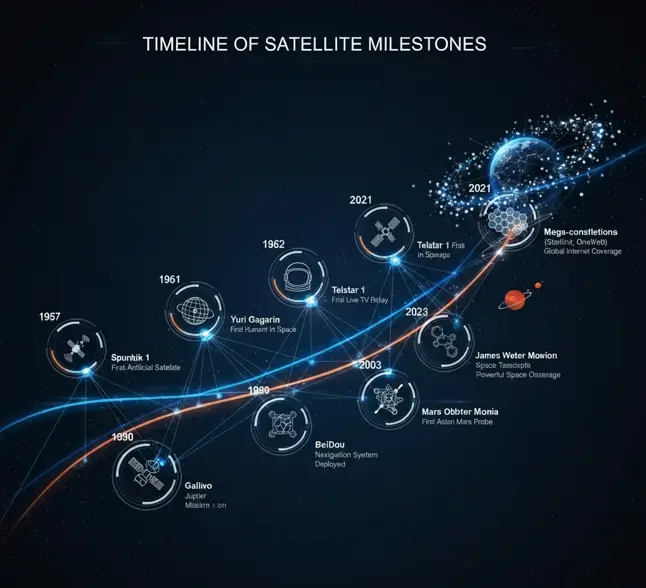
A visual timeline of the most important milestones in satellite history.
Satellites Deep Dive: Conclusion
Satellites have become indispensable to modern civilization, supporting communication, navigation, scientific discovery, environmental monitoring, and national security. From Sergei Korolev’s groundbreaking work on Sputnik 1 to the visionary mega-constellations led by Elon Musk and others, satellites demonstrate humanity’s extraordinary capacity for innovation and exploration.
They connect remote communities, protect lives through early warning systems, expand our understanding of the universe, and enable technologies we now take for granted. As we look ahead, satellites will play an even greater role in addressing global challenges such as climate change and in opening new frontiers in deep space. The story of satellites is far from over — it is only accelerating.
Thank you for joining this Satellites Deep Dive. We hope it has given you a deeper appreciation of these remarkable machines that quietly orbit above us, shaping the present and future of humankind.