
Hazrat Ismail (A.S.): A Legacy of Faith - Sacrifice
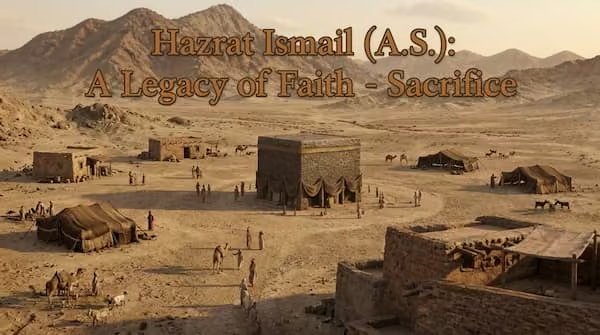
Hazrat Ismail (A.S.): A Legacy of Faith & Sacrifice
The Noble Son of Prophet Ibrahim (A.S.) - Hazrat Ismail (A.S.) A Legacy of Faith - Sacrifice
Hazrat Ismail (A.S.): A Legacy of Faith – Sacrifice:
The life of Hazrat Ismail (A.S.) is one of the strongest examples of faith, patience, and complete submission to Allah in Islamic history. Born as the first son of Prophet Ibrahim (A.S.) to his wife Hajra (Hagar, may Allah be pleased with her), Ismail (A.S.) embodies the essence of patience, obedience, and resilience. His life continues to inspire believers today.
Hazrat Ismail (A.S.): A Legacy of Faith – Sacrifice: The Quran and authentic Hadith narrate his story with clarity, emphasizing trials that test the human spirit and reveal Allah’s infinite wisdom. From his miraculous birth and desert survival to his role in constructing the Kaaba and his willing submission to sacrifice, Ismail’s (A.S.) journey continues to inspire millions.
Birth of Hazrat Ismail (A.S.): A Divine Gift After Long Await
Hazrat Ismail (A.S.): A Legacy of Faith – Sacrifice: Prophet Ibrahim (A.S.) fervently prayed for righteous offspring: “My Lord, grant me [a child] from among the righteous” (Quran, Surah As-Saffat 37:100). His first wife, Sarah (may Allah be pleased with her), recognizing her husband’s longing and her own advanced age, suggested he marry her servant Hajra. Ibrahim (A.S.) accepted, and through Allah’s mercy, Hajra gave birth to Ismail (A.S.) when Ibrahim was approximately 86 years old.
Scholars note this birth occurred in the region of Palestine (Canaan). It was no ordinary event but a fulfillment of divine promise. Some narrations mention angelic glad tidings to Hajar during pregnancy, prophesying a son whose descendants would play a significant role in guiding humanity. This birth brought immense joy to the family, symbolizing hope amid apparent barrenness and reinforcing trust in Allah’s timing.
The event underscores a key lesson: Allah responds to sincere supplications in ways that often exceed human expectations, establishing Ismail (A.S.) as the forefather of many prophets and, ultimately, the noble lineage leading to Prophet Muhammad (PBUH).
Hazrat Ismail (A.S.), Hazrat Ishaq (A.S.), And Hazrat Ibraheem (A.s.) Relationship
Hazrat Ismail (A.S.) – A Legacy of Faith and Sacrifice: Hazrat Ismail (A.S.) and Hazrat Ishaq (A.S.) share one of the most significant familial and prophetic relationships in Islamic history. They are half-brothers, born to the same father, Prophet Ibrahim (A.S.), but from different mothers. This bond is not merely biological but deeply spiritual, symbolizing unity in monotheism (Tawhid), shared trials, and the continuation of divine guidance across nations.
The Family Connection
Common Father: Prophet Ibrahim (A.S.), the friend of Allah (Khalilullah), known for his unwavering faith and sacrifice.
Mothers:
Hazrat Hajar (Hajra,Hagar, may Allah be pleased with her): Mother of Ismail (A.S.). She was a righteous servant who demonstrated immense trust when left in the desert.
Hazrat Sarah (may Allah be pleased with her): First wife of Ibrahim (A.S.) and mother of Ishaq (A.S.). Her birth of Ishaq was a miracle in old age.
Timeline: Ismail (A.S.) was born first when Ibrahim (A.S.) was around 86 years old. Ishaq (A.S.) was born later, when Ibrahim (A.S.) and Sarah were advanced in age — a divine gift announced by angels (Quran, Surah Hud 11:71-72). The age gap is traditionally understood to be about 13–14 years or more, making Ismail the elder brother.
Quranic and Historical Evidence: The Quran mentions both sons in contexts of blessing and prophethood.
Early Life and the Heart-Wrenching Journey to the Desert
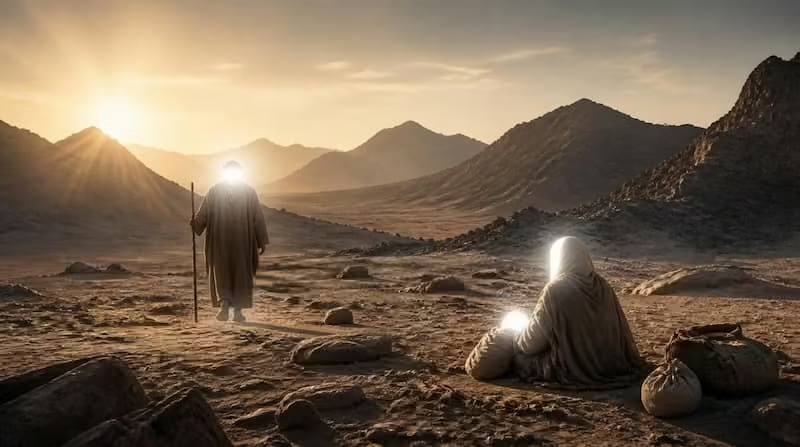
An illustration depicting Hazrat Ibrahim (A.S.), Hazrat Hajra (A.S.), and Hazrat Ismail (A.S.) during their emotional journey to the desert.
Hazrat Ismail (A.S.): A Legacy of Faith – Sacrifice: Ismail’s (A.S.) early life was marked by profound trials that tested familial bonds and reliance on the Divine. When he was still an infant, Allah commanded Ibrahim (A.S.) to take Hajra and the child to an uncultivated valley in the Arabian Peninsula—the future site of Makkah. There, in a barren land with no vegetation, food, or water, Ibrahim (A.S.) was to leave them with minimal provisions.
Hajra, embodying remarkable faith, asked her husband: “Did Allah command you to do so?” Upon confirmation, she replied with complete trust: “Then He will not neglect us.” Ibrahim (A.S.) turned toward the Kaaba’s future location and prayed: “Our Lord, I have settled some of my descendants in an uncultivated valley near Your sacred House… provide for them from the fruits that they might be grateful” (Quran, Surah Ibrahim 14:37).
This separation was not abandonment but a divine decree to establish a center of worship. Alone in the desert, Hajar and infant Ismail soon exhausted their water. Thirst overwhelmed the child, who began crying. Hajra, unable to bear the sight, ran desperately between the hills of “Safa and Marwah” seven times in search of help or water—mirroring the Sa’y ritual performed by pilgrims today.
The Divine Miracle of Zamzam: Survival and Settlement
Hazrat Ismail (A.S.): A Legacy of Faith – Sacrifice: In her moment of utmost desperation, Allah sent relief. An angel (often identified as Jibril, A.S.) appeared and struck the ground near Ismail (A.S.) with his heel or wing. Fresh, pure water gushed forth—the blessed Well of Zamzam. Hajar contained the flow, forming a basin, and drank while nursing her son. The Prophet Muhammad (PBUH) later praised her: “May Allah have mercy on the mother of Ismail! If she had left the water (without containing it), Zamzam would have become a flowing stream.” (Sahih Bukhari).
Birds circling the water attracted the Jurhum tribe, who sought permission to settle. Hajra granted it on the condition they not claim ownership of the well. This marked the beginning of human settlement in Makkah. Ismail (A.S.) grew up among them, learning Arabic and tribal skills while retaining his prophetic character. The miracle of Zamzam remains a testament to Allah’s provision for those who trust Him, sustaining pilgrims for millennia.
Hazrat Hajra (may Allah be pleased with her) lived to witness her son’s growth and the community’s establishment. While exact lifespan details vary in historical accounts, she passed away after settling in Makkah, having fulfilled her role with unparalleled steadfastness. Her legacy endures in the Hajj rites.
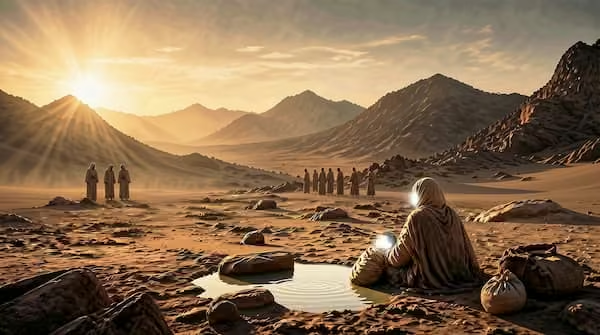
An illustration of the miraculous Zamzam spring that brought survival, hope, and settlement to Hazrat Hajra (A.S.) and Hazrat Ismail (A.S.).
Continuing His Father’s Teachings: Obedience and Prophethood
Hazrat Ismail (A.S.): A Legacy of Faith – Sacrifice: As Ismail (A.S.) matured into a young man, he exemplified the teachings of his father—monotheism (Tawhid), prayer, charity, and patience. The Quran praises him: “And mention in the Book, Ismail. Indeed, he was true to his promise, and he was a messenger and a prophet. And he used to enjoin upon his people prayer and zakah and was to his Lord pleasing” (Quran, Surah Maryam 19:54-55).
He continued Ibrahim’s (A.S.) legacy of calling to Allah. When the command came for the ultimate test—the sacrifice—Ismail (A.S.) responded with full submission, demonstrating he had internalized his father’s lessons deeply.
❯❯ The Trial of Sacrifice: Ultimate Submission
Hazrat Ismail (A.S.) and his Legacy of Faith mean Sacrifice moment. One of the most poignant episodes is the command to sacrifice Ismail (A.S.). Ibrahim (A.S.) saw in a dream (a form of revelation for prophets) the order to offer his beloved son. He informed Ismail (A.S.), who replied calmly: “O my father, do as you are commanded. You will find me, if Allah wills, of the steadfast” (Quran, Surah As-Saffat 37:102).
Father and son prepared at Mina. As Ibrahim (A.S.) laid him down, Allah intervened, replacing the son with a ram:
“We called to him, ‘O Abraham, You have fulfilled the vision.’ Indeed, We thus reward the doers of good” (Quran 37:104-105).
According to Ibn Kathir in his tafsir of Surah As-Saffat, Ismail’s willingness showed complete submission, and Allah’s replacement of him with a ram established the Sunnah of sacrifice for all later generations.
This event is commemorated in Eid al-Adha, teaching that true sacrifice is one of the heart and will. Ismail’s (A.S.) willingness proved his noble character.
❯❯ Married Life: Wisdom in Choosing a Righteous Companion
Hazrat Ismail (A.S.): A Legacy of Faith – Sacrifice: After Hajra’s (may Allah be pleased with her) passing, Ismail (A.S.) married. Ibrahim (A.S.) visited and tested the household subtly. The first wife complained of hardship; Ibrahim (A.S.) advised changing the “threshold.” Ismail (A.S.) understood and divorced her. He then married a second woman from the Jurhum tribe, who expressed gratitude and contentment. Ibrahim (A.S.) approved, advising to keep her.
This narrative, from Sahih Bukhari, highlights the importance of a supportive spouse in faith and life. Ismail (A.S.) fathered twelve sons, whose descendants formed tribes, including the Adnanites leading to Quraysh and Prophet Muhammad (PBUH).
Divine Miracles in the Life of Hazrat Ismail (A.S.)
Beyond Zamzam, miracles punctuated his life: |
|
|
|
These miracles affirm Allah’s support for His prophets and their mission to establish worship.
Hazrat Ismail (A.S.) A Legacy of Faith - Sacrifice: End of Life and Eternal Legacy
Hazrat Ismail (A.S.): A Legacy of Faith – Sacrifice: Ismail (A.S.) lived a life of prophethood in Makkah, teaching monotheism and guiding his people until his death. He was buried in the vicinity of the Kaaba (Hajr Ismail area). His exact age at death is not definitively recorded in primary sources, but he lived a full life of service, outliving his mother and sharing profound moments with his father. Ibrahim (A.S.) lived to see the Kaaba’s completion and continued his mission.
Ismail’s (A.S.) descendants preserved the pure faith for generations, culminating in the final Prophet (PBUH). His story reminds us that trials forge greatness.
Hazrat Ismail (A.S.) A Legacy of Faith - Sacrifice: Powerful Lessons for Contemporary Believers
|
|
|
|
|
In a world of distractions, his example calls us to prioritize faith, family, and worship. Perform Sa’y and drink Zamzam with renewed appreciation for this history.

Hazrat Ismail (A.S.): A Legacy of Faith, Sacrifice & Obedience