
Prophet Yaqub AS (Jacob): Family, Wives, 12 Sons & the Quran Story
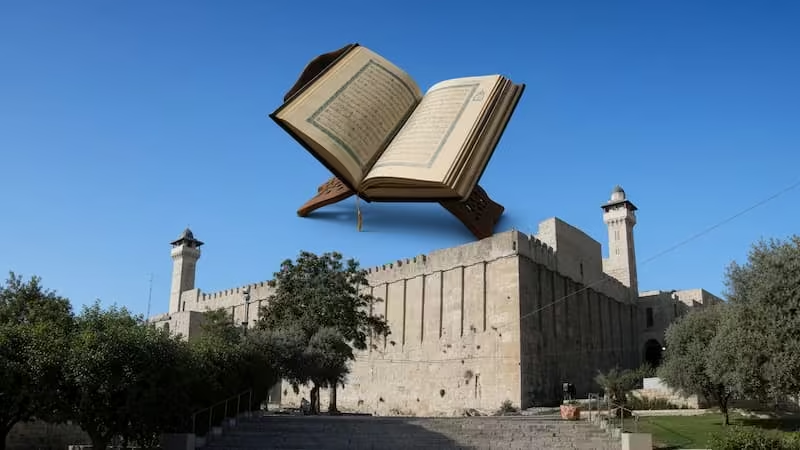
The Quran and Masjid Ibrahimi in Hebron, linked with the family of Prophet Yaqub AS.
Prophet Yaqub AS is one of the noble prophets of Islam. He is the son of Prophet Ishaq (A.S.), the grandson of Prophet Ibrahim (A.S.), and the father of Prophet Yusuf (A.S.). Muslims also know him as the father of the twelve tribes later called Bani Israel.
Many articles mix the Qur’an with later stories. This article does the opposite. First comes what the Qur’an states. Then comes what tafsir scholars say. Then come the family details found in history books. That way the reader can see the strength of each claim.
Who Is Prophet Yaqub AS?
Prophet Yaqub AS was a messenger of tawhid. He called his household to worship Allah alone, to pray, and to live as people who submit to Allah.
The Qur’an places him in the blessed line of Ibrahim:
“And We bestowed upon Ibrahim Ishaq and Yaqub, and each of them We guided.”
(Surah al-An‘am 6:84)
Allah also says He gave Ibrahim Ishaq, and after Ishaq, Yaqub:
“And his wife was standing, and she smiled. Then We gave her good tidings of Ishaq, and after Ishaq, of Yaqub.”
(Hud 11:71)
So the birth of Prophet Yaqub AS was already part of the good news given to the household of Ibrahim.
The Qur’an praises him with Ishaq and Ibrahim as men of strength and insight:
“And remember Our servants Ibrahim, Ishaq and Yaqub — those of strength and insight. Indeed, We chose them for an exclusive quality: remembrance of the Home of the Hereafter. And indeed, they are with Us among the chosen and the best.”
(Sad 38:45–47)
It also says Allah made Ibrahim, Ishaq, and Yaqub leaders who guided by His command:
“And We gave him Ishaq and Yaqub in addition, and all of them We made righteous. And We made them leaders guiding by Our command. And We inspired them to do good deeds, to establish prayer, and to give zakah. And they were worshippers of Us.”
(Al-Anbiya 21:72–73)
In short: Prophet Yaqub AS is not a side character. He is a prophet, a father of prophets, and the head of a family from which many later prophets of Bani Israel came.
Parents, Twin Brother, and Early Home
According to the historians, the father of Prophet Yaqub AS was Ishaq (A.S.) and his mother was Rifqah. He had a twin brother named Al-Eis (Esau).
The Qur’an does not tell the twin-birth story. It does not name the mother of Prophet Yaqub AS. Those names come from tafsir and history. What the Qur’an does confirm is the line:
Ibrahim → Ishaq → Yaqub → Yusuf
The Prophet Muhammad ﷺ described that line when he said Yusuf was the prophet of Allah, son of Yaqub the prophet of Allah, son of Ishaq the prophet of Allah, son of Ibrahim the Close Friend of Allah.
Reports say Prophet Yaqub AS grew up in Canaan, the land linked with Ibrahim and Ishaq. Later, according to the same reports, he spent years with his maternal uncle and then returned. The Qur’an itself does not narrate that journey. The Qur’an focuses on his faith, his patience, and the trial of Yusuf.
Did Allah Name Him Israel?
This point must be written with care.
The Qur’an does not say: “Yaqub, and We named him Israel.”
What the Qur’an does is use two names in two ways:
|
|
The link “Israel = Yaqub” is the reading of classical tafsir, not a one-line definition inside a verse.
1. The key verse: Israel as a person
Allah says:
“All food was lawful to the Children of Israel except what Israel had made unlawful to himself before the Torah was revealed. Say, ‘Bring the Torah and recite it, if you are truthful.’”
(Aal Imran 3:93)
What this verse shows:
|
|
|
What this verse does not say:
- It does not add the words “and Israel is Yaqub.”
The major mufassirun, including al-Tabari and Ibn Kathir, identify the man in this verse as Prophet Yaqub (A.S.). They explain the word Israel as “servant of Allah”: Isra meaning servant, Il meaning God.
Reports in tafsir say he forbade to himself a food he loved — often camel meat and its milk, or veins after an illness — as a vow. Those details are from tafsir reports, not from the wording of the verse itself.
2. Israel as an ancestor-line
Allah also says:
“Those were the ones upon whom Allah bestowed favour from among the prophets, of the descendants of Adam, and of those We carried with Nuh, and of the descendants of Ibrahim and Israel, and of those We guided and chose. When the verses of the Most Merciful were recited to them, they fell down prostrating and weeping.”
(Maryam 19:58)
This verse places Israel next to Ibrahim as a father of a blessed line of prophets. Again, the verse names Israel. It does not write “Yaqub, who is Israel.” Tafsir reads Israel here as Yaqub, because Bani Israel are his descendants.
3. The nation is called Bani Israel, not Bani Yaqub
The Qur’an addresses that nation many times as Bani Israel:
“O Children of Israel, remember My favour which I have bestowed upon you, and fulfil My covenant [so] I will fulfil your covenant, and fear Me alone.”
(al-Baqarah 2:40)
The same address is repeated:
“O Children of Israel, remember My favour which I have bestowed upon you, and that I preferred you over the worlds.”
(al-Baqarah 2:47)
The Qur’an does not say “O children of Yaqub” in these addresses. It says Bani Israel. That is why Muslims say the nation takes its name from Israel, whom tafsir identifies as Yaqub.
4. The same man is named Yaqub in other verses
When the Qur’an speaks of the prophet as a person in the family of Ibrahim, it uses Yaqub:
“And We gave him Ishaq and Yaqub. Each [of them] We guided.”
(al-An‘am 6:84)
“And We gave her good tidings of Ishaq, and after Ishaq, of Yaqub.”
(Hud 11:71)
When death comes, the Qur’an again uses Yaqub, not Israel:
“Or were you witnesses when death approached Yaqub, when he said to his sons, ‘What will you worship after me?’ They said, ‘We will worship your God and the God of your fathers, Ibrahim, Ismail, and Ishaq — one God. And to Him we submit.’”
(al-Baqarah 2:133)
So the Qur’an uses Yaqub for the prophet’s own story, and Israel / Bani Israel for the name of the nation that comes from him.
Accurate summary
What we can say | Source |
The Qur’an names a man Israel who forbade a food to himself before the Torah. | 3:93 |
The Qur’an names a nation Bani Israel. | 2:40, 2:47, and many other verses |
The Qur’an names the prophet Yaqub in the line of Ibrahim and Ishaq. | 6:84, 11:71, 2:133 |
Classical tafsir identifies Israel with Yaqub and explains the word as “servant of Allah.” | Tafsir of 3:93 and 19:58 |
The Qur’an does not contain the sentence “We named Yaqub Israel.” | Direct reading of the text |
The Torah story of wrestling an angel is not Qur’anic proof. | Not in the Qur’an |
The Qur’an uses the name Israel and the name Yaqub. It does not join them in one defining sentence. The scholars of tafsir join them, and that is why Muslims say Prophet Yaqub (A.S.) is Israel and his children are Bani Israel.
How Many Wives Did Prophet Yaqub AS Have?
The Qur’an does not name the wives of Prophet Yaqub AS.
Historians and many books of qasas al-anbiya record four wives:
| 1. Lia / Laya / Leah — elder daughter of Laban, the maternal uncle of Prophet Yaqub AS |
| 2. Rahil / Raheel / Rachel — younger daughter of Laban, sister of Lia, mother of Yusuf |
| 3. Zulfa / Zilpah — servant given to Lia, then given to Yaqub |
| 4. Balha / Bilhah — servant given to Rahil, then given to Yaqub |
Lia and Rahil were sisters. Combining two sisters in marriage was reported as allowed in that earlier law. It is not allowed in the Shariah of Muhammad ﷺ. The article mentions this only so the old report is not judged by later Islamic marriage rules.
The usual historical story is that Prophet Yaqub AS went to his uncle Laban in Haran, served for years as a shepherd, married Lia first because the uncle’s custom was not to marry the younger daughter before the elder, then married Rahil after more years of service. The two servant women also became wives. He later returned to Canaan with his household.
Treat that wedding story as history-book material, not as a Qur’anic chapter.
Children of Prophet Yaqub AS: Sons and Daughter
The standard count in the histories is twelve sons and one daughter.
The Qur’an supports the number of sons in an indirect way. Surah Yusuf speaks of Yusuf and his brothers. Ten brothers travel to Egypt first. Binyamin stays with the father. That makes eleven brothers besides Yusuf — twelve sons in total. The Qur’an does not list the other names.
The names below are the names transmitted by historians.
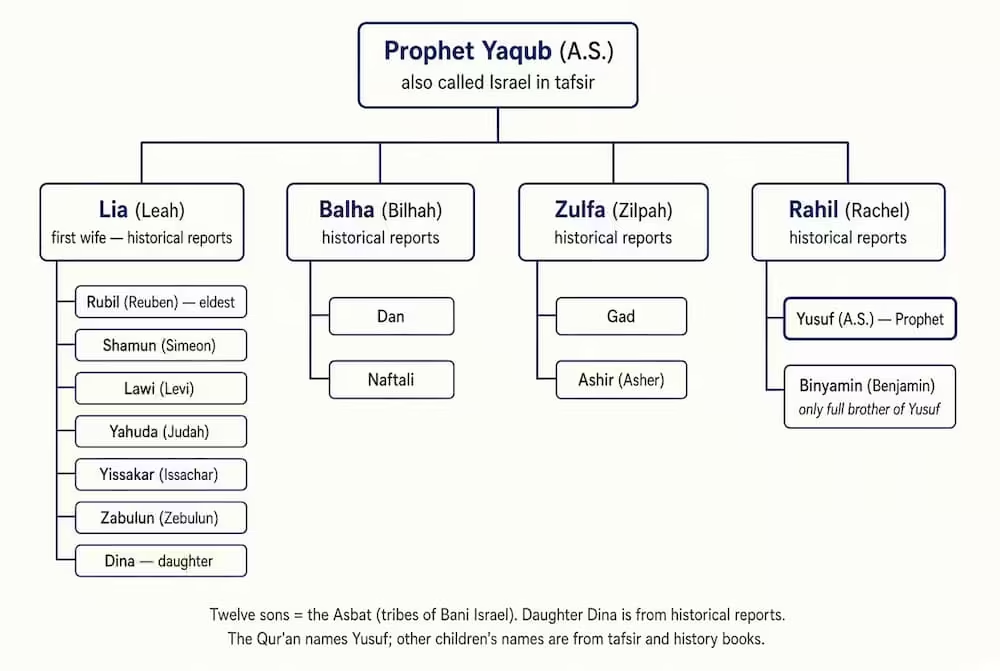
Family tree of Prophet Yaqub AS: children listed under Lia, Balha, Zulfa, and Rahil. Yusuf (A.S.) is the prophet among the sons.
These twelve sons are called the Asbat, the tribal fathers of Bani Israel. Later prophets such as Musa, Dawud, Sulaiman, and Isa came from that nation. Reports often place Musa in the line of Lawi.
The Qur’an groups “Yaqub and the Asbat” with those who received revelation (al-Baqarah 2:136; Aal Imran 3:84; al-Nisa 4:163). Scholars discuss the exact meaning of that phrase. What is certain is that Prophet Yaqub AS is a prophet, and that Yusuf from his sons is a prophet whose story Allah told in detail.
Who Was the Prophet Among the Children?
Among the children of Prophet Yaqub AS, the son whose prophethood is clear in the Qur’an and Hadith is Yusuf (A.S.).
Binyamin is honoured in Surah Yusuf as the full brother whom the father feared to send away. The Qur’an does not call Binyamin a prophet.
The other sons are the rest of the Asbat. The Qur’an shows their jealousy, their plot, their later regret, and their reunion. It does not give each of them a prophetic biography.
So a clean summary is:
|
|
|
|
What the Quran Tells About Prophet Yaqub AS
The longest Qur’anic scene for Prophet Yaqub AS is Surah Yusuf. The surah is mainly the story of Yusuf, but the father’s patience is a second centre of the chapter.
The dream
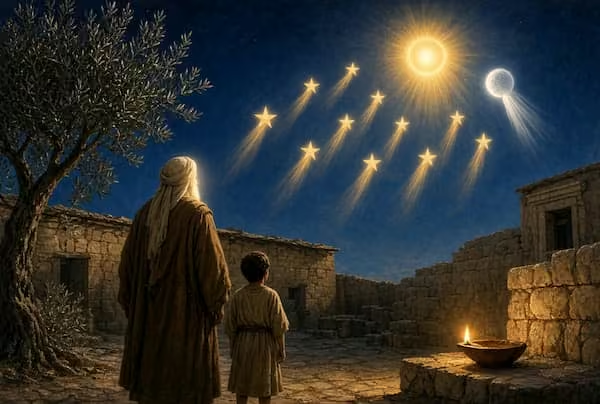
Yusuf tells Prophet Yaqub AS his dream of eleven stars, the sun, and the moon (Surah Yusuf 12:4–5).
Yusuf tells his father that he saw eleven stars, the sun, and the moon prostrating to him. Prophet Yaqub AS understands that the dream is a sign. He warns Yusuf not to tell his brothers, because Shaytan can use envy to harm a family.
He tells him that Satan is a clear enemy to man, and that the brothers may plot against him if they hear the dream (Yusuf 12:4–5).
The loss of Yusuf
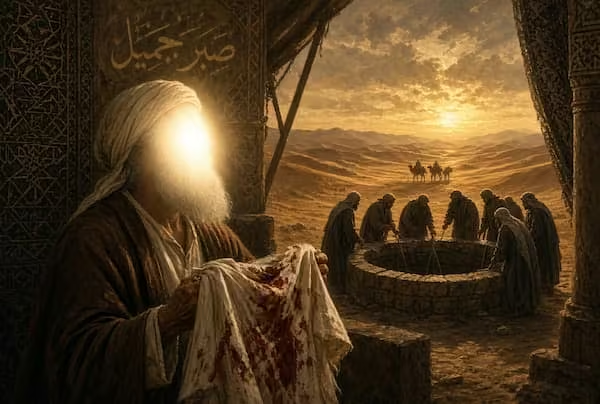
Sabr Jamil: Prophet Yaqub’s beautiful patience after the loss of Yusuf.
The brothers take Yusuf, throw him into a well, and bring a false story and a shirt with fake blood. The father does not accept the lie as the full truth. He says patience is beautiful and that Allah is the One whose help is sought against what they describe.
This is one of the most famous lines linked with Prophet Yaqub AS: beautiful patience, not loud despair.
Years of grief
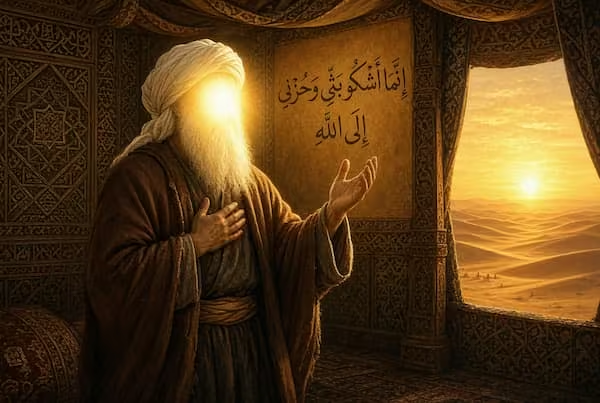
Prophet Yaqub turns his anguish only to Allah after years of grief and the trial of Binyamin.
The Qur’an says his eyes turned white from grief, yet he did not leave the remembrance of Allah. He knew from Allah what the brothers did not know. When the second trial came — the detention of Binyamin in Egypt — he still turned his sorrow to Allah and said he complained of his anguish only to his Lord.
This is the heart of the character of Prophet Yaqub AS: love for his sons, pain that is real, and tawakkul that does not break.
The shirt and the reunion
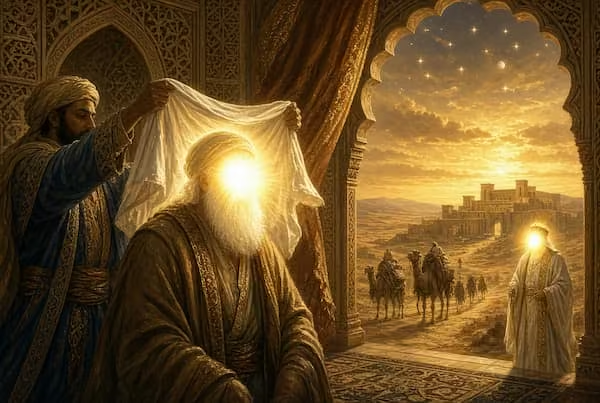
Yusuf’s shirt restores Yaqub’s sight; the family travels to him and the dream is fulfilled.
The Qur’an says the shirt of Yusuf was thrown over the father’s face, and his sight returned by Allah’s leave. He then took his family to Yusuf in Egypt, and the household was gathered again. When they were raised on the throne, they fell in prostration, and the dream of the stars, the sun, and the moon was fulfilled.
This is the end of the trial of Prophet Yaqub AS: a prophet who waited for Allah’s relief and did not invent a false ending himself.
The last will
The most important family verse about Prophet Yaqub AS is not about wives or place names. It is about tawhid.
“Or were you witnesses when death approached Yaqub, when he said to his sons, ‘What will you worship after me?’ They said, ‘We will worship your God and the God of your fathers, Ibrahim, Ismail, and Ishaq — one God. And to Him we submit.’”
(al-Baqarah 2:133)
The Qur’an confirms the move to Yusuf in Egypt in meaning, because the family is reunited there. It does not give the age or the exact grave.
Rahil, Binyamin, and Bethlehem
This is another place where a careful article must slow down.
|
|
|
History books, following older People-of-the-Book reports, say Rahil died after the birth of Binyamin and that Yaqub buried her on the road in Canaan. Later Jewish, Christian, and some Muslim writers pointed to a site on the road between Jerusalem and Bayt Lahm (Bethlehem), known as Qabr Rahil.
That is a transmitted location, not a verse. Bethlehem as a famous town is also a later name for that area. A professional article should not tell readers that “the Qur’an says she is buried in Bethlehem.” It does not.
Character of Prophet Yaqub AS: What to Teach
If the article is for readers and for search engines, the living lessons matter as much as the family list.
1. Tawhid first. The last question of Prophet Yaqub AS was not about land or tribes. It was: whom will you worship after me? |
2. Love does not cancel justice. He loved Yusuf. The Qur’an still shows a father who warns, waits, and refuses a lie. |
3. Grief can be honest. He wept until his eyes were worn. Islam does not ask a believer to pretend that loss is light. It asks him not to despair of Allah. |
4. Patience has a method. He said “Allah is the best guardian” and “patience is beautiful.” That is work of the heart, not only a slogan. |
5. A prophet’s children are still tested. The sons of Prophet Yaqub AS made a grave mistake. The Qur’an records it so that later families do not hide envy and then dress it in religion. |
History books, following older People-of-the-Book reports, say Rahil died after the birth of Binyamin and that Yaqub buried her on the road in Canaan. Later Jewish, Christian, and some Muslim writers pointed to a site on the road between Jerusalem and Bayt Lahm (Bethlehem), known as Qabr Rahil.
That is a transmitted location, not a verse. Bethlehem as a famous town is also a later name for that area. A professional article should not tell readers that “the Qur’an says she is buried in Bethlehem.” It does not.
Short Family Box
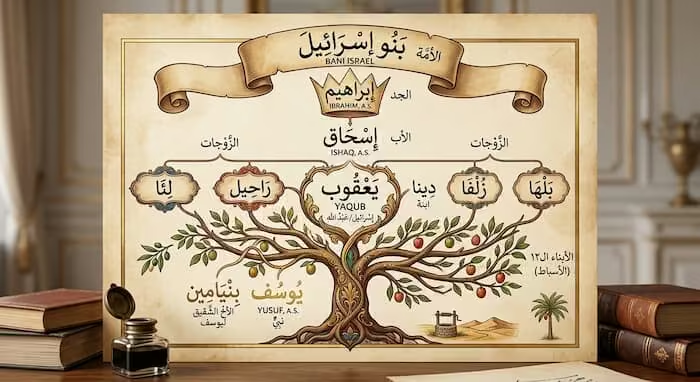
The family of Yaqub (Israel): from Ibrahim and Ishaq to the twelve tribes, Yusuf and Binyamin.
Among his twelve sons, the Asbat, were the prophet Yusuf and his full brother Binyamin, a lineage whose patience and reunion still speak through the Qur’an.
|
|
|
|
|
|
|
|
|
|
FAQ About Prophet Yaqub AS
1. Is Prophet Yaqub AS the same as Prophet Jacob?
Yes. Jacob is the English form. In Arabic and in the Qur’an the name is Yaqub.
2. How many sons did Prophet Yaqub AS have?
Twelve sons, according to the Qur’anic family scene in Surah Yusuf and according to the histories. The histories also mention one daughter, Dina.
3. Which son of Prophet Yaqub AS was a prophet?
Yusuf (A.S.).
4. Why are Jews and many earlier prophets linked to Prophet Yaqub AS?
Because his sons became the tribes of Bani Israel. The word often linked to “Jew” is also connected in history to the son Yahuda. The religious point in Islam is the prophetic line, not modern politics.
5. Did Prophet Yaqub AS write a scripture?
The Qur’an lists him among those to whom revelation was given. It does not describe a separate book named after him in the way it names the Tawrah of Musa.
Conclusion
Prophet Yaqub AS stands between two great stories: the house of Ibrahim and the story of Yusuf. The Qur’an wants him remembered as a guided prophet, a patient father, and a man who left tawhid as his will.
The family details — four wives, the list of sons, Dina, Haran, Bethlehem — help readers understand later history. They should stay labelled as reports. The verses about guidance, patience, the dream, the shirt, and the deathbed question are the firm core.
That is the balanced picture of Prophet Yaqub AS: strong where the Qur’an is strong, careful where the books of history speak.