
Hazrat Daniyal AS – Complete Islamic Life Story and History
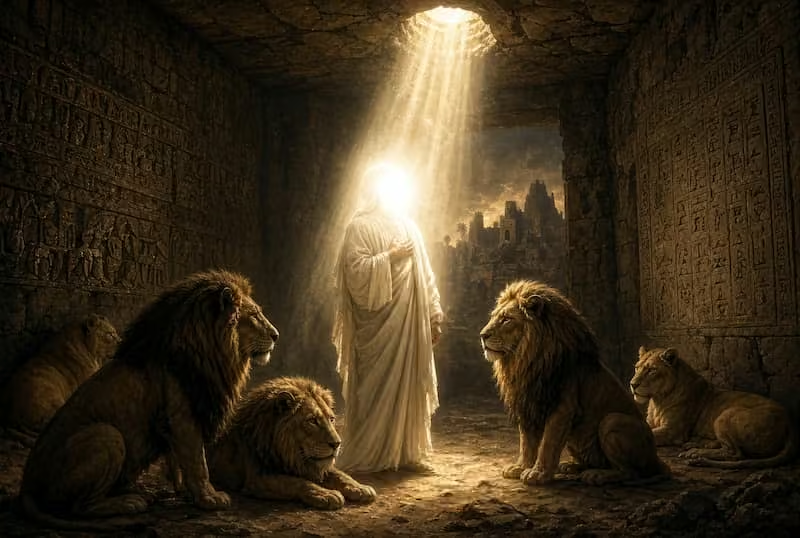
Hazrat Daniyal AS, whose name means “Allah is my Judge,” remains unharmed by the lions through Allah’s protection during the Babylonian exile.
Hazrat Daniyal AS is remembered in Islam as a prophet and sage of Bani Israel. His Hebrew name means “Allah is my Judge.” He lived in a dark time for his people, when Bayt al-Maqdis was destroyed and many Israelites were taken to Babylon.
This article presents the well-known Muslim account of Hazrat Daniyal AS. His name is not in the Holy Quran. The story comes from Islamic history, reports of the Salaf, and Isra’iliyyat that do not contradict the Quran and Sunnah.
Many Muslims regard Hazrat Daniyal AS as a Nabi of Bani Israel. A report attributed to Hazrat Ali (R.A.) says he was a Nabi, not a Rasul. Some scholars stay cautious, because these reports are not at the rank of Quran and authentic Hadith.
Hazrat Daniyal AS, known in English as Daniel, served Allah inside a foreign palace. He did not confront a king in the open like Musa (A.S.). He rose to high office among idol-worshipping rulers, yet he never gave up his salah, his food laws, or his sajdah.
Later scholars often place Hazrat Daniyal AS beside Yusuf (A.S.). Both were young captives. Both kept Tawhid in a hostile court. Both were given wisdom that even pagan rulers had to respect.
He spoke Hebrew and followed the law of Musa (A.S.). Allah granted him two special gifts: the interpretation of dreams, and knowledge of events that had not yet come.

Hazrat Daniyal AS kept his salah, his law, and his Tawhid while serving in a foreign palace, just as Yusuf (A.S.) had done before him.
In Shia reports, Imam Ja‘far al-Sadiq (A.S.) described Hazrat Daniyal AS as a prophet to whom Allah taught dream interpretation. Sunni historians treat him as an Israelite prophet who lived after Dawud and Sulayman (A.S.) and before Zakariyya and Yahya (A.S.).
Father, Family, and Birthplace of Hazrat Daniyal AS

Hazrat Daniyal AS was born in Jerusalem from the noble line of Judah and the house of Dawud. As a youth he was carried into Babylon when Bukht Nasr destroyed Bayt al-Maqdis.
The exact name of his father is not firmly established. Some books call him Daniyal bin Hizqil al-Asghar, meaning Daniel, son of Ezekiel the Younger. They say he came from the descendants of the prophets and from the lineage of Sulayman bin Dawud (A.S.).
Other genealogies give names such as Yuhanna or Yukhanna bin Hizqiya. They trace him through the royal house of Judah back to Dawud and Sulayman (A.S.). What is agreed is that Hazrat Daniyal AS belonged to the tribe of Judah and came from a noble Israelite family.
He was born in Jerusalem, in the Kingdom of Judah. As a youth of noble stock he was taken captive when Bukht Nasr destroyed Bayt al-Maqdis.
The king killed many of Bani Israel and carried thousands into Babylon, in present-day Iraq.
There, Hazrat Daniyal AS was trained for the royal court with three companions: Hananya, Azarya, and Mishael. Later he lived in the east. Most Muslim tradition says he died in Susa, also called Shush, in Khuzestan, Iran. Some say he died in Babylon. The famous shrine linked with him stands in Shush.
How Long Did Hazrat Daniyal AS Live?
No exact age is recorded in reliable Islamic sources. Historically, Hazrat Daniyal AS belongs to the late seventh and sixth centuries before the Common Era.
He was taken to Babylon as a youth around 605 BC. He was still alive in the time of the Persian king Cyrus, around 538 BC. That span means he reached old age. Writers commonly estimate eighty to a hundred years or more.
When Muslim soldiers later found a body they believed to be his, local people said three hundred years had passed since the death. Ibn Kathir accepted the chain of that report. He still warned that “three hundred years” cannot be used as a precise date.
Hazrat Daniyal AS was taken to Babylon as a youth around 605 BC and was still living in the time of Cyrus around 538 BC. He reached old age. Exact years are known only to Allah.
If that number were taken literally, the man could not be a prophet. Authentic Hadith states there is no prophet between Isa (A.S.) and Muhammad (peace be upon him). Either the number is mistaken, or the death was much earlier. Allah knows best.
What Hazrat Daniyal AS Did in His Life?
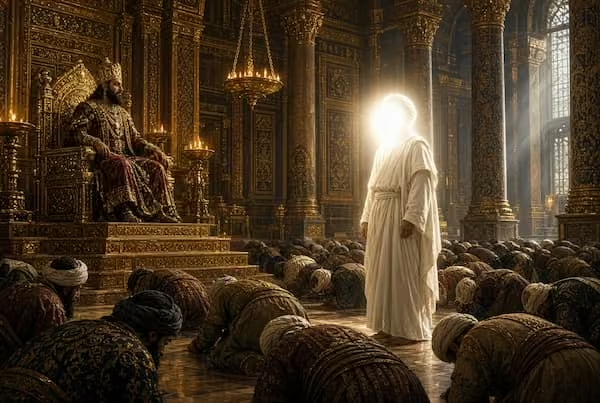
Hazrat Daniyal AS advised kings and interpreted their visions, yet he never gave sajdah to a man, never ate unclean food, and never left his salah.
Allah granted Hazrat Daniyal AS wisdom, the reading of dreams, and knowledge of future kingdoms. His work was not to lead an army or found a city. It was to remain a servant of Allah while sitting in the council of kings.
He advised rulers. He interpreted visions that terrified them. He preached in Babylon that people should return to God. According to Muslim tradition, he also taught the Persian king Cyrus the oneness of Allah.
He saw more than one dynasty. First came the Babylonians under Bukht Nasr and his successors. Then came the Medes and Persians. Through all of that, Hazrat Daniyal AS kept the law of Musa (A.S.).
When later kings forbade prayer except to the ruler, he continued to pray. When food from the royal table was unclean, he refused it. When the court demanded sajdah to a man, he stood and named his Lord.
Some scholars, including Shaykh al-Islam Ibn Taymiyyah in al-Jawab al-Sahih, said Hazrat Daniyal AS announced the coming of Prophet Muhammad (peace be upon him) by name and described his Ummah. Muslims are said to have read such a text when they conquered Iraq. That claim belongs to earlier scripture reports, not to the Quran itself.
How Hazrat Daniyal AS Conveyed the Message of Allah
Hazrat Daniyal AS did not stand in a marketplace with a staff like Musa (A.S.). He conveyed Tawhid in six ways that appear again and again in the Muslim telling of his life.
First was personal example. He refused the king’s unclean food, prayed toward Jerusalem three times a day, and never prostrated to a created being.
Second was knowledge. He interpreted dreams and mysterious writing as signs from Allah. Even pagan rulers had to admit that their magicians were empty.
Third was speech. He preached in Babylon and called people back to God.

Hazrat Daniyal AS did not preach only with words. He prayed toward Jerusalem three times a day, refused unclean food, and never bowed to a created being.
Fourth was counsel to kings. He taught Cyrus Tawhid. In some accounts he also guided the return of Israelites toward Sham.
Fifth was miracles of protection. Lions did not bite him. Fire did not burn his companions. Food was carried from Sham to Babylon.
Sixth was written prophecy, which later generations read.
The method is close to the method of Yusuf (A.S.). Serve people honestly. Speak the truth when asked. Let Allah’s knowledge expose the helplessness of idols.
Important Events in the Life of Hazrat Daniyal AS
The infant and the lions
The Finding of the Body of Hazrat Daniyal AS
Before his birth, astrologers told a king that a child born that night would bring his kingdom to an end. The king ordered every newborn boy killed.
The infant Hazrat Daniyal AS was thrown to a lion and a lioness. They licked him and did not harm him. His mother later took him back.
When he grew, he had two lions licking a child carved on the stone of his ring. He did this so he would not forget Allah’s favour. That ring was later found with the body discovered by the Companions.

Before he grew, the infant Hazrat Daniyal AS was thrown to a lion and a lioness. They licked him and did not harm him. His mother later took him back.
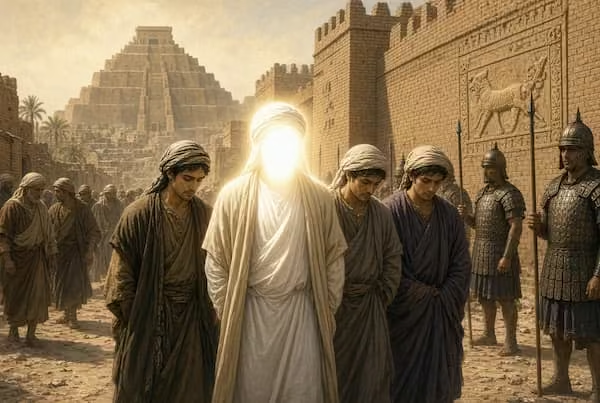
Hazrat Daniyal AS was taken to Babylon with some seventy thousand Israelites. He met the test with patience and three friends who bowed only to Allah.
Captivity in Babylon
When nations exceeded their limits in disobedience, Allah gave them into the hand of Bukht Nasr. He destroyed Jerusalem and took some seventy thousand Israelites to Babylon. He distributed them among his chiefs.
Hazrat Daniyal AS was among the captives. The imprisonment was a test. He met it with patience and with three friends who also refused to bow to anyone but Allah.
The forgotten dream of the statue
Bukht Nasr saw a great statue in a dream and forgot it. He demanded that his magicians tell him both the dream and its meaning. They could not. He ordered the wise men killed.
Hazrat Daniyal AS and his companions prayed. Allah taught them the dream. They saw a statue of gold, silver, bronze, iron, and iron mixed with clay. A stone cut without hands struck it. The statue became dust. The stone became a mountain that filled the earth.
He explained the metals as successive kingdoms, beginning with Babylon. In the common reading, the stone is the kingdom Allah would set up, which would last. Some Muslim writers said the stone is the Messenger whom Allah would send with the Book at the end of time.
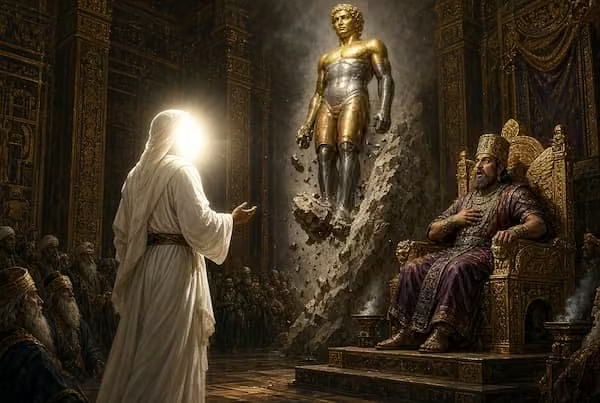
Bukht Nasr forgot his dream of a statue of gold, silver, bronze, and iron. Allah taught it to Hazrat Daniyal AS. The stone that smashed the statue became a mountain that filled the earth.
The king honoured Hazrat Daniyal AS and set him over the wise men.

At Belshazzar’s feast a hand wrote on the wall. Hazrat Daniyal AS read it: the kingdom was numbered, weighed, and found wanting. That night it fell.
Fire, lions, and the writing on the wall
When a golden image was set up and music called the court to bow, Hananya, Azarya, and Mishael refused. They were thrown into a furnace. The fire did not consume them.
Later, enemies of Hazrat Daniyal AS had him cast into a pit of lions because he continued to pray to Allah. The lions licked his feet. When he hungered, Allah sent food through the prophet Armiya (Jeremiah), carried from Sham to the edge of the pit in Babylon.
At a feast of Belshazzar, the king used the vessels of Bayt al-Maqdis to praise idols. A hand wrote on the wall. Hazrat Daniyal AS read the words and said the kingdom was numbered, weighed, and found wanting. It would be divided and given to the Medes and Persians. That night the kingdom fell.
Under the Persians, and his death
After Babylon fell, Hazrat Daniyal AS lived into the reign of Cyrus and taught him the unity of God. A Persian authority later treated Bani Israel with kindness.
In one account they were freed and he was made their leader on the road to Sham. In another, the governor of Babylon refused to let him leave and made him head judge. Temple treasures were sent back for the rebuilding of Bayt al-Maqdis.
He died in Susa, or, according to another opinion, in Babylon. He is said to have asked Allah that the Ummah of Muhammad (peace be upon him) should bury him.
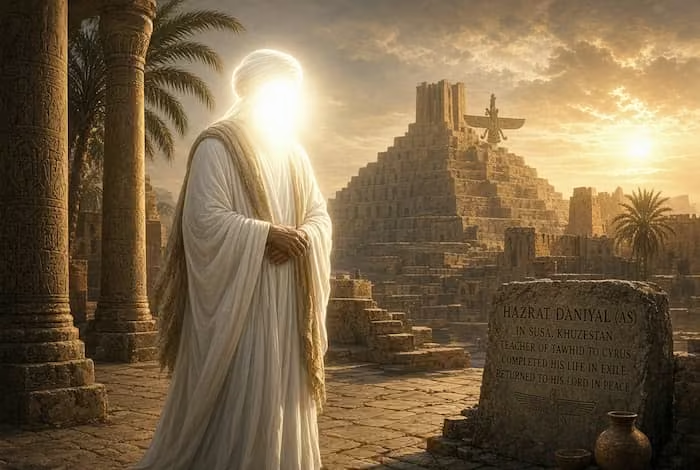
After Babylon fell, Hazrat Daniyal AS lived into the time of Cyrus and taught him Tawhid. Most Muslim tradition says he died in Susa.
Important Events in the Life of Hazrat Daniyal AS
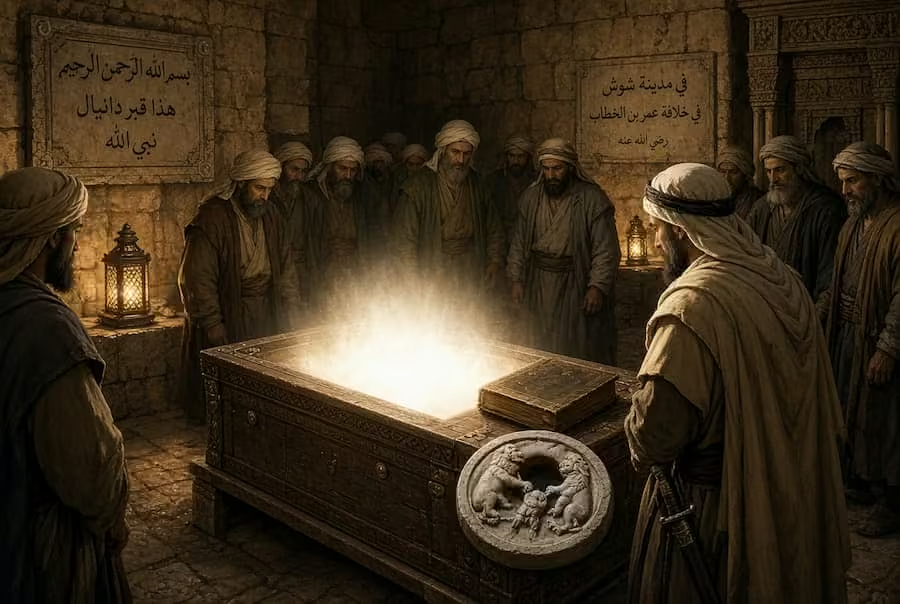
In the caliphate of Umar (R.A.), Abu Musa al-Ash‘ari found in Susa an uncorrupted body, a scripture, and a ring of two lions. Umar ordered a secret burial so the grave would not become a place of fitnah.
In the caliphate of Umar (R.A.), Abu Musa al-Ash‘ari conquered Tustar and Susa. In the treasury they found an uncorrupted body in a coffin, a scripture at his head, and a ring of two lions. Locals used the coffin to seek rain.
Umar wrote that this was one of the prophets, whose bodies the earth does not consume. He ordered a secret burial so the grave would not become a place of fitnah.
The Companions buried him at night among many dummy graves, or under a river. A shrine later rose at Shush. That later building is not the same as the hidden burial Umar commanded.
Lessons from the Life of Hazrat Daniyal AS
The story of Hazrat Daniyal AS is the story of iman that does not need a throne. A young exile kept the worship of one God in a palace of idols. He used knowledge as da‘wah. He accepted high office without selling his salah.
He was protected in the den of lions because he had already chosen Allah in the smaller tests of food and bowing.
It is also a warning about graves. The same Companions who honoured his body refused to leave it as a public relic. Umar hid the place so that love of a prophet would not turn into a rite around bones. That balance — respect for the righteous, refusal to worship them — is part of the Sunnah of the first generation.
We ask Allah to grant us a share of the steadfastness of Hazrat Daniyal AS. May we keep Tawhid when the court is against us. May we speak when knowledge is asked of us. And may we remember that protection comes from the Lord who did not forget His servant in a pit in Babylon. And Allah knows best.