
Sun Rising from the West: The Path of the Sun in Science and Islamic Texts
Every day the same light appears on the eastern horizon. We call it sunrise. We plan work, prayer, and travel around it. Yet two different kinds of question follow that light.
The first question is physical: what is the Sun, and why does it move the way we see? That is the subject of the companion article, The Sun Power: What the Sun Is and How It Moves.
The second question is older and more charged: what do sacred texts say about that path, and do they speak of a day when the pattern breaks? In Islamic sources the most famous of those claims is sun rising from the west.

The path of the sun at dawn — an astrolabe and an Islamic text in the same light. Astronomy measures that light; the texts speak of the command behind it.
This article does not ask science to prove a Hadith, and it does not ask a Hadith to replace astronomy. It shows the same sun in two frames: a star whose light we measure, and a created thing described as being under command. That is the honest way to write about sun rising from the west without turning the page into a warning poster or a classroom lecture.
Why the sun rises in the east
Before any text about sun rising from the west, the daily fact must be clear.
The Sun does not fly around Earth like a lamp on a string. It is a star. Earth spins on its axis from west to east. Because of that spin, the Sun appears to climb the eastern sky and leave by the west. That appearance is why every culture learned to say that the sun rises in the east.
A magnetic pole reversal does not flip that spin. A viral post that “NASA confirmed sun rising from the west” is not a scientific forecast. For the full physical picture — size, energy, orbit, and rotation — read The Sun Power: What the Sun Is and How It Moves. This page only needs one point from that article: why the sun rises in the east is a question about Earth’s rotation, not about the Sun changing its mind.
Keep that point in view. Every report below is talking about the path we watch from the ground.
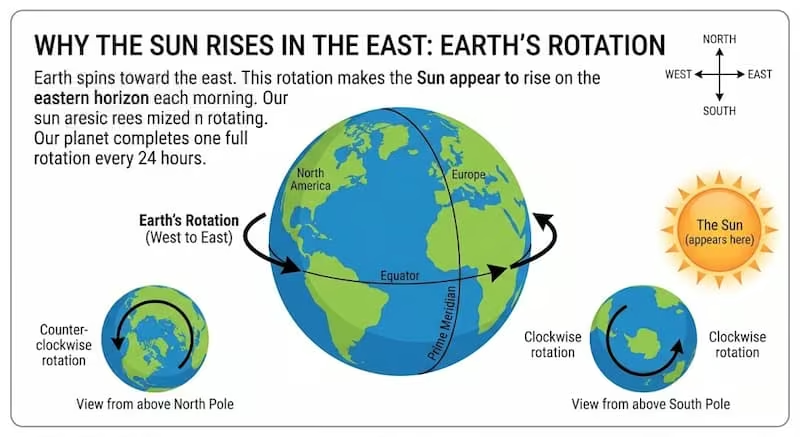
Why the sun rises in the east: Earth rotates west to east, so the Sun appears on the eastern horizon each morning.
The path of the sun under the Throne
Islamic tradition does not stop at the horizon. A well-known Hadith, narrated from Abu Dharr and recorded in Sahih al-Bukhari, begins at sunset with a question: do you know where the sun goes?
The reply in the Hadith is that the sun travels until it prostrates beneath the Throne of Allah, asks permission to rise again, and is permitted. The same report says a time will come when the prostration is not accepted and permission is refused. Then the sun will be told to go back the way it came — and that is tied to sun rising from the west.
A shorter wording says the sun’s appointed stopping place is under the Throne. The Quran verse often attached to this is 36:38: the sun runs on a fixed course for a term that is decreed.
Classical scholars treated this as a matter of the unseen, not as a travel itinerary for telescopes. They did not need the Sun to leave its place in space, fly to a platform, and bow like a person. The Throne, in this theology, is above and encompasses creation, so created things are under it. The “prostration” of the sun is read as the submission that suits a created body: it follows the command set for it.
Quran 22:18 already says the sun, the moon, the stars, the mountains, and many people prostrate to Allah. The Hadith of the Throne is in that family of meaning. It is a statement about command and permission. It is not a substitute for the diagram in The Sun Power: What the Sun Is and How It Moves.
The daily lesson of that Hadith is simple. The path continues because permission is given. The shock of sun rising from the west is what happens when that permission changes.
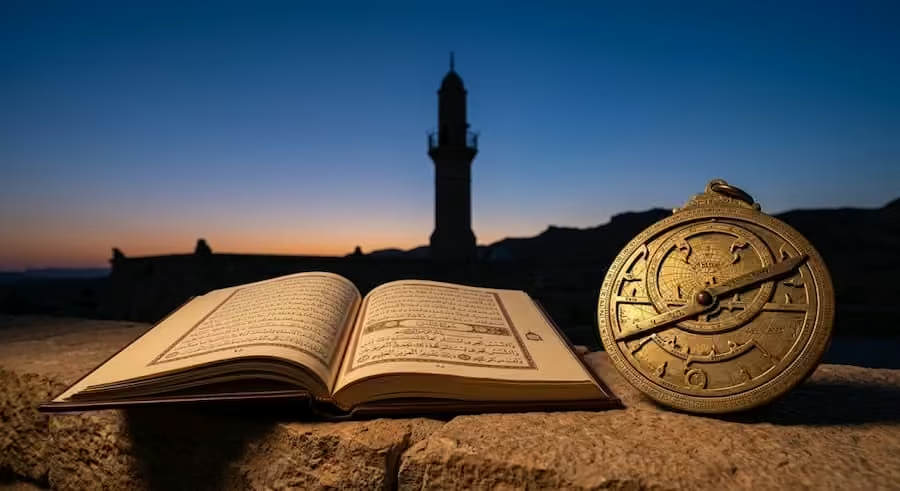
The Hadith of the Throne is read as command and permission, not as a route through space.
Sun rising from the west as a sign of the Hour
The phrase sun rising from the west is not a modern slogan. It is part of reports about the major signs of the Last Hour.
In Sahih al-Bukhari and Sahih Muslim, Abu Hurairah reported that the Hour will not be established until the sun rises from the west. When people see it, they will all believe. That will be the time when belief does not benefit a soul that had not believed before. The Prophet ﷺ recited Quran 6:158 with that meaning: when certain signs of the Lord come, faith will not help the one who did not believe earlier or earn good through faith.
Other reports say repentance is accepted until the sun rising from the west. After that door is described as closed.
This is why sun rising from the west is not written in these sources as a pretty miracle for cameras. It is written as the end of the test. The usual order — why the sun rises in the east — is the order of ordinary life. The reversal is the sign that ordinary life, as a place of choosing, is over.
Some later writers offered a metaphorical reading: light coming to the West as Islam spreading in Western lands. That is one interpretation in a minority stream. The wording of the famous Hadiths is physical and public: people see the sun, and then everyone believes. A professional article should state both facts: the main reports speak of a visible sun rising from the west; some readers take the image as symbol. They are not the same claim.
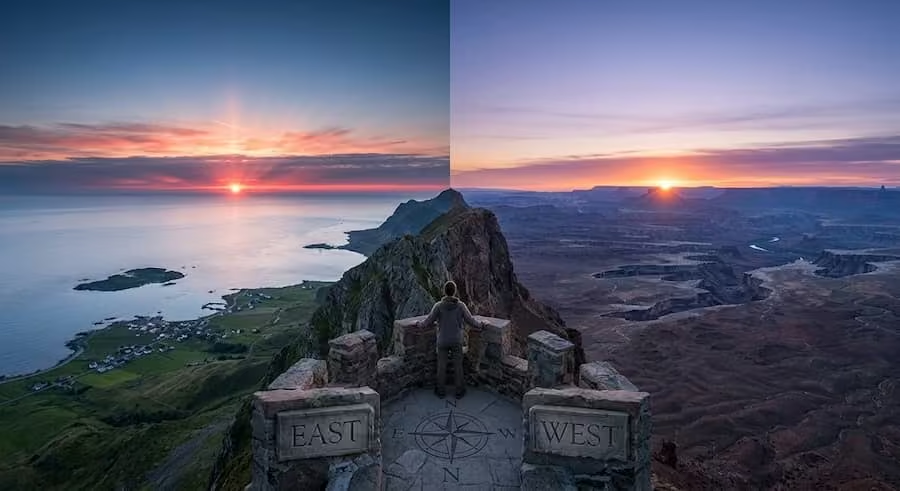
The famous Hadiths speak of a rising people can see — from the place of setting, not from a change of colour in the clouds.
Was the sun ever stopped? Yusha, not Dawud
Visitors often bring a third story to this subject: a prophet for whom the sun was held so a battle could finish.
That story is not about Dawud (David). In the two most famous collections, Bukhari and Muslim, the Prophet ﷺ spoke of “one of the prophets” who went to war, reached a town around Asr, and said to the sun: you are commanded and I am commanded; O Allah, hold it for me. The sun was held until victory.
A separate report in Musnad Ahmad, from Abu Hurairah, names that prophet as Yusha ibn Nun (Joshua) and says the sun was never held for any human except him when he marched toward Bayt al-Maqdis (Jerusalem). Many Hadith scholars used that report to identify the unnamed prophet. The chain that names Yusha has been discussed; the event of a held sun is in Bukhari and Muslim.
The Bible also describes Joshua and a standing sun. Islamic and biblical details are not identical. What matters for this article is the name that belongs to the story. Mixing Dawud into the held-sun report is a common error. Dawud has other well-known scenes with angels — two visitors in a dispute about sheep, the angel of death, birds shading his funeral from heat. None of those is the Hadith of the sun held in the sky.
Place the stories on separate shelves:
|
|
|
When those three are mixed, the page becomes folklore. When they are kept apart, the page becomes clear.
Angels, extra stories, and what not to pile on
Some later narrations speak of angels at sunrise and sunset, or of many angels accompanying the sun. A few popular talks invent a “friend of Dawud” who pushes the sun. Those extras are not on the same level as Bukhari 3199 or the reports of sun rising from the west.
A professional article can mention that people have always imagined servants of the sun. It should not build the main argument on them. The strong core is short:
| 1. We know why the sun rises in the east. |
| 2. Hadith describes that same cycle as permission under the Throne. |
| 3. The same body of texts says the cycle ends in sun rising from the west. |
| 4. A different report speaks of the sun held for Yusha. |
That is enough. More angels do not make the piece deeper. They make it noisier.
Hoaxes that weaken the subject
Whenever sun rising from the west trends online, the same false partners arrive.
One is the claim that a pole flip will reverse Earth’s spin. Pole reversals are a real geologic subject. They do not turn the planet around and produce sun rising from the west.
Another is the claim that a space agency has dated the event. No such confirmation exists. Astronomy has no timetable for sun rising from the west.
A third is the habit of forcing every eclipse, red sky, or unusual dawn into the prophecy. The Hadiths describe a public, unmistakable rising from the place of setting — not a rare colour in the clouds.
Clearing these errors does not attack faith. It protects the texts from being tied to rumours that collapse in a week. Readers who want the physics of light and motion still belong on The Sun Power: What the Sun Is and How It Moves. Readers who want the reports of signs belong here. Both groups are served when the rumours are named and dropped.
How to read the same sun in two ways
The tension people feel is usually this: if Earth is spinning, how can the sun go under a Throne? If the sun is a star 150 million kilometres away, how can there be sun rising from the west without the planet tearing itself apart?
Those questions assume both sentences are doing the same job. They are not.
Astronomy answers what moves and what we measure. The Hadiths answer who commands the motion and when the test ends. You can accept Earth’s rotation and still read the Throne report as unseen submission. You can study fusion in the Sun’s core and still treat sun rising from the west as a future act that, in the theology, is not bound to today’s orbital mechanics.
You can also reject the religious claims. That is a different decision. What a serious article should not do is pretend the Hadith is a lab paper, or pretend the lab paper is a tafsir. The path of the sun in the sky is one fact on the ground. Why the sun rises in the east is settled as appearance caused by rotation. Sun rising from the west is a reported sign, not a current observation.
That split is not a weakness. It is the reason two articles exist.
What this means for a reader today
As long as the sun rises in the east, the texts say the door is still open.
If you take the Islamic reports as they stand, the useful conclusion is not panic. The useful conclusion is timing.
As long as the sun rises in the east, the texts say the door of repentance is open. The shock of sun rising from the west is that the door is described as shut. The daily sunrise, in that reading, is not boring. It is still permission.
If you take only the scientific frame, the useful conclusion is also not panic. The Sun will not reverse Earth’s spin next season. The light you saw this morning followed the same geometry described in The Sun Power: What the Sun Is and How It Moves.
Either way, the subject is larger than a headline. Sun rising from the west is powerful language because the east has been reliable for every human life we know. The Hadith of the Throne is powerful because it turns that reliability into a granted path rather than an accident. Together they explain why people keep asking about this star even after they know it is a ball of hydrogen and helium.
A short map of the sources
For readers who want to check rather than trust a summary:
|
|
|
|
|
|
|
Closing: one sun, two honest pages
The professional way to publish this subject is the way this pair of articles is built.
The first page tells what the Sun is and how it moves. It answers why the sun rises in the east with rotation, orbit, and light.
This page tells how Islamic texts speak of that same path: a course under the Throne, a permission renewed each day, a past report of the sun held for Yusha, and a future report of sun rising from the west.
Nothing is gained by making one page defeat the other. Everything is gained by letting a visitor stand in front of the same sun and hear both descriptions without being shouted at.
If you have not read the physical account, start with The Sun Power: What the Sun Is and How It Moves. Then return here. The star will still be the star. The reports will still be the reports. And the phrase sun rising from the west will mean what the sources said it means — a sign attached to the end of choosing — not a rumour attached to the next unusual dawn.