
Animals That Navigate by Stars: Evidence from Marine and Terrestrial Species
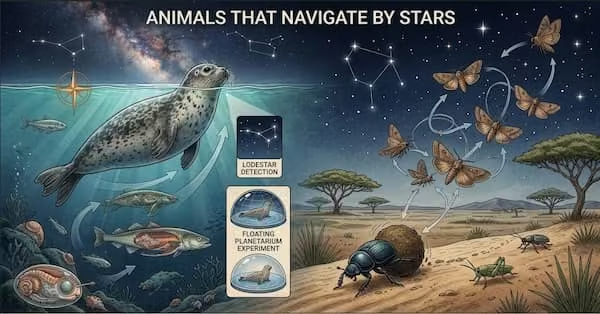
Animals that navigate by stars with lodestar detection
Animals that navigate by stars rely on the night sky as a reliable directional reference in environments where other cues may be limited. Controlled experiments have confirmed that specific animals that navigate by stars extract useful orientation information from stellar patterns.
These animals that navigate by stars typically combine stellar cues with additional sensory systems such as the sun, moon, polarized light, or magnetic fields.
This article reviews the verified experimental evidence for animals that navigate by stars in marine and terrestrial settings. The focus remains strictly on published findings that demonstrate actual stellar orientation abilities.
Animals that navigate by stars face different challenges depending on whether they live in open water or on land. Research has isolated stellar information through planetarium projections, arena tests, and selective cue blocking.
The resulting data show that animals that navigate by stars can maintain directed movement under starlight alone. Understanding animals that navigate by stars requires careful examination of both laboratory results and ecological context. The following sections present the strongest documented cases among animals that navigate by stars.
Marine Animals That Navigate by Stars
Offshore waters often lack fixed visual landmarks, especially at night. Among marine species, harbor seals stand out as the best-studied animals that navigate by stars.Early experiments established that harbor seals can detect individual stars under low-light conditions.
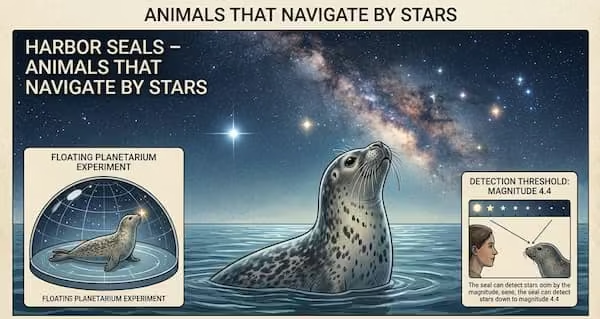
Marine animals that navigate by stars – harbor seals
Researchers trained a dark-adapted seal to respond only when a star appeared in a viewing tube. The animal reliably detected natural stars such as Venus and Sirius.
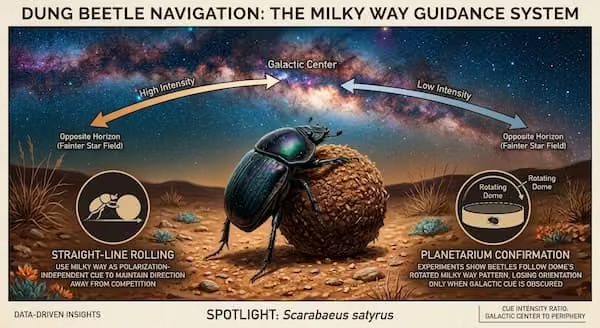
Dung beetle spotlight – Scarabaeus satyrus navigates by Milky Way
Artificial stars of controlled brightness revealed a detection threshold near magnitude 4.4. This sensitivity allows seals to perceive many stars that could serve as orientation references.
Later work tested active orientation in animals that navigate by stars. Scientists constructed a floating planetarium consisting of a circular pool covered by a dome that projected a realistic northern-hemisphere night sky.
Two harbor seals learned to swim toward specific lodestars for food rewards. After training with a laser pointer, the pointer was removed. The seals continued to swim accurately toward the learned star even when the entire sky projection was rotated.
Directional precision remained high across trials. These results, published in 2008, provide the first clear evidence that a marine mammal can identify and follow individual stars within a complete starry sky.
Harbor seals forage extensively at night in open or coastal waters where landmarks may be absent. Spyhopping behavior raises the head above the surface and could permit sky inspection. Laboratory evidence confirms that harbor seals possess the sensory capacity required of animals that navigate by stars.
Other sensory systems, including hydrodynamic detection with vibrissae and olfactory cues, operate alongside any stellar information. Field confirmation of routine stellar use in free-ranging seals remains limited, yet the controlled data establish the necessary prerequisites.
Evidence for other marine animals that navigate by stars is weaker. Sea turtles primarily use geomagnetic maps and wave direction. Hatchlings orient toward the brightest horizon, often the reflection of moonlight or starlight on water, but this represents simple phototaxis rather than pattern-based stellar navigation.
Experimental studies have not demonstrated a functional star compass in turtles. European eels rely mainly on magnetic and lunar cues during long migrations. Starfish use arm-tip eyes for local visual orientation toward reefs, not for celestial guidance. Among sea creatures, harbor seals remain the most rigorously documented animals that navigate by stars.
Land Animals That Navigate by Stars
Terrestrial environments also contain animals that navigate by stars, particularly insects that must maintain straight courses or complete long migrations under starlight. African dung beetles of the species Scarabaeus satyrus provide one of the clearest examples of animals that navigate by stars.
These beetles form dung balls and roll them away from the source pile in straight lines to reduce competition. Straight-line rolling continues on clear, moonless nights. Arena tests under natural skies showed that beetles reached the edge faster and with straighter paths under starlight than under overcast conditions.
Cardboard caps that blocked the upward view caused paths to become circuitous and transit times to increase markedly.
Planetarium experiments isolated the precise cue used by these animals that navigate by stars. Beetles oriented equally well under a full projected starry sky and under a projection containing only the Milky Way band.
Individual bright stars alone proved insufficient. Further analysis showed that the beetles detect the intensity gradient along the Milky Way, comparing the brighter region toward the galactic center with the opposite direction. They maintain a constant angle relative to that band. Contrast-sensitivity tests indicated that a difference of roughly 13 percent is adequate under natural conditions.
The 2013 study established the first clear demonstration of Milky Way orientation in any animal and the first robust stellar orientation in an insect. These animals that navigate by stars also use the sun, moon, and polarized light when available.
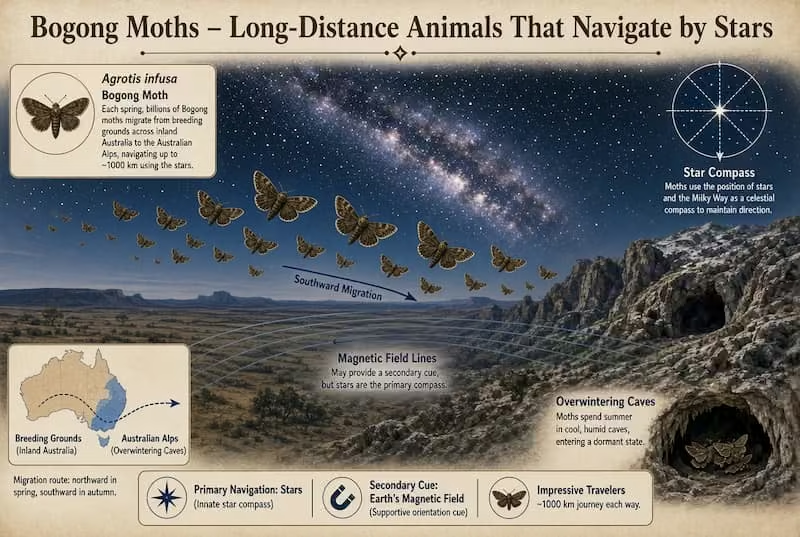
Bogong moths use the stars and Milky Way as a celestial compass during their 1000 km migration – a clear example of animals that navigate by stars.
Australian Bogong moths constitute another well-supported group of animals that navigate by stars. Each spring, billions of moths migrate up to 1,000 kilometers from breeding grounds across southeastern Australia to specific cool caves in the Australian Alps.
The same individuals return in autumn. A 2025 study demonstrated that these animals that navigate by stars use the starry sky as a compass. Tethered moths were tested in flight simulators under projected night skies while the magnetic field was neutralized.
When the projected sky matched the natural seasonal orientation, moths flew in the correct migratory direction. Rotation of the sky by 180 degrees produced a corresponding reversal of heading. Scrambled star patterns eliminated oriented flight.
Electrophysiological recordings identified visual interneurons that responded selectively to rotations of the starry sky. These neurons were tuned to a common orientation consistent with the required migratory heading.
The results show that Bogong moths possess a true stellar compass capable of guiding long-distance travel to a destination never previously visited. Magnetic cues and visual landmarks function alongside stellar information in these animals that navigate by stars.
The combination produces robust nocturnal navigation across hundreds of kilometers.
Southern cricket frogs also rank among animals that navigate by stars. Outdoor arena tests presented frogs with conditions in which only stars were visible. The animals exhibited bipolar orientation along the axis appropriate to their home shoreline.
Orientation remained consistent across repeated trials. Frogs could reorient after experimental displacement. These findings form part of broader research on celestial orientation in amphibians that includes the sun and moon as well as stars. Cricket frogs therefore demonstrate that stellar cues contribute to shoreline and Y-axis orientation in certain amphibians.
Synthesis of Evidence on Animals That Navigate by Stars
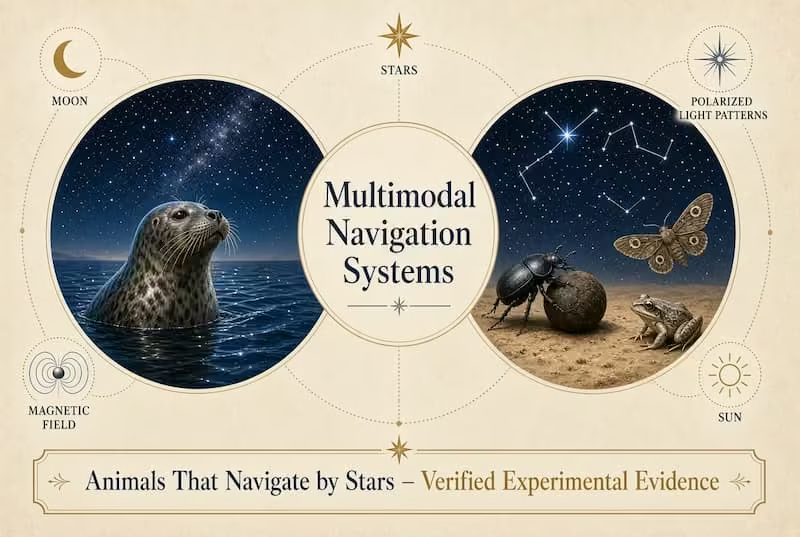
Animals that navigate by stars use multimodal systems including stars, moon, magnetic fields and polarized light.
The experimental record confirms that animals that navigate by stars exist in both marine and terrestrial environments. Harbor seals can identify and follow individual lodestars within a complete sky projection. Dung beetles exploit the large-scale intensity pattern of the Milky Way for short-range straight travel.
Bogong moths use stellar patterns as a directional compass for long-distance seasonal migration. Cricket frogs incorporate stellar information into shoreline orientation. In every case the stellar system operates as one component of a broader sensory toolkit.
Common experimental methods have proven essential for studying animals that navigate by stars. Planetarium projections, arena and flight-simulator tests, selective occlusion of cues, and neural recordings allow isolation of stellar information from competing variables.
When stars are unavailable, animals that navigate by stars typically switch to magnetic, solar, lunar, or landmark-based systems. The documented abilities highlight both the reliability of the night sky as a directional reference and the sophistication of the sensory mechanisms that extract usable information from it.
Continued research will further clarify the precise visual features used by animals that navigate by stars and the frequency of these mechanisms in free-ranging populations.
These findings also reveal important patterns across different habitats. Marine animals that navigate by stars, such as harbor seals, must operate in a three-dimensional and often featureless environment where visual landmarks disappear at night.
Their ability to detect and follow specific stars therefore represents a valuable backup system during long foraging trips. In contrast, terrestrial animals that navigate by stars usually travel shorter distances or follow more predictable seasonal routes.
Dung beetles require only a stable directional reference for a few meters, while Bogong moths need consistent orientation across hundreds of kilometers. Despite these differences in scale, both groups demonstrate that stellar cues can be processed by relatively small nervous systems with high efficiency.
The research further shows that animals that navigate by stars rarely depend on a single celestial source. Instead, they maintain flexible hierarchies of information. When the Milky Way is visible, dung beetles prefer it; when the moon appears, they shift to polarized moonlight.
Bogong moths combine stellar patterns with magnetic information, allowing them to remain oriented even if one cue becomes unreliable. This redundancy increases survival chances under changing weather and light conditions. Such flexibility is a defining characteristic of successful animals that navigate by stars.
Future studies will need to examine how often these mechanisms are used in natural settings and how light pollution may interfere with them. Controlled laboratory results have established clear capabilities, yet the relative weight of stellar cues versus other sensory inputs in the wild remains only partially understood.
Expanding field observations and long-term tracking of animals that navigate by stars will help close this gap and deepen our understanding of one of nature’s most elegant orientation strategies.