
Sector-Specific Benefits
Sector-Specific Benefits: Satellite Technology Benefits in Key Sectors
Sector-Specific Benefits of satellite technology are transforming how organizations operate across industries where terrestrial networks fall short.
Terrestrial networks often cannot reach every location or respond instantly to crises. Satellite technology benefits organizations by providing global reach, rapid activation, and resilient performance. Low Earth orbit constellations have transformed possibilities by slashing delays that once blocked real-time applications from space.
This article examines the Sector-Specific Benefits satellites bring to communications, Earth observation, navigation, research, defence, and the Internet of Things. It includes metrics, practical examples, and implementation guidance to show how these systems drive faster decisions and stronger resilience.
Sector-Specific Benefits: High-Performance Connectivity from Orbit
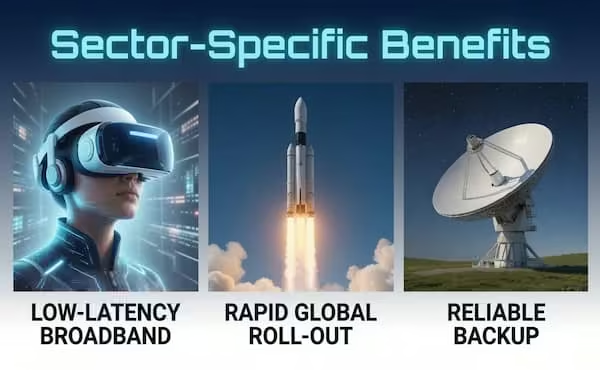
Satellite broadband’s sector-specific benefits support interactive uses in remote and mobile settings. Low-latency links enable smooth video calls, gaming, and cloud access without frustrating delays. Users in rural areas or at sea enjoy responsiveness previously limited to cities.
Lower orbital altitude drives the improvement. Leading low Earth orbit services achieve median latencies of 25 to 50 milliseconds in real conditions. This makes telemedicine and remote collaboration practical far from fiber lines. Geostationary systems typically exceed 600 milliseconds.
Rapid deployment adds major value. Terminals ship anywhere, set up in minutes, and connect within hours or days. No lengthy construction or permits are required. The broadcast nature of satellite signals allows one transmission to serve many users efficiently, saving bandwidth during large events or crisis broadcasts.
Reliable backup protects operations during outages. When earthquakes or storms disable cables and towers, satellite links restore voice and data quickly. Emergency teams coordinate, hospitals maintain records, and businesses continue essential functions. This strengthens business continuity and national resilience strategies.
Remote communities and temporary operations now depend on these connections. Effects include better education access, faster medical support, and new economic activity in isolated regions.
Sector-Specific Benefits: Space-Based Monitoring for Earth Insights
Imaging satellites deliver frequent views that support rapid response and long-term monitoring. Disaster monitoring has shifted from multi-day waits to revisit intervals of minutes through coordinated low Earth orbit constellations. Responders receive fresh maps in time to guide rescues and resource allocation.
Automated analytics powered by artificial intelligence convert imagery into insights almost immediately. Change detection highlights damaged buildings or flooded areas without manual review. This speed turns data into actionable intelligence while events unfold Sector-Specific Benefits.
Geostationary satellites provide complementary continuous coverage. They watch entire hemispheres without gaps, tracking storm development and atmospheric conditions around the clock. Forecasters issue earlier warnings because observation never pauses.
Beyond emergencies, these systems support agriculture through crop health assessment, environmental tracking of deforestation, and urban planning with current land-use data. Frequent revisits combined with smart processing improve both emergency response and sustainable development.
Sector-Specific Benefits: Precise Navigation and Timing Services

Sector-Specific Benefits of precise navigation and timing services visualized through digital mapping and location tracking technology.
Global navigation satellite systems underpin positioning and synchronized timing across modern economies. Sector-Specific Benefits in financial markets depend on precise timestamps to record trades fairly and support high-frequency strategies. Microsecond accuracy prevents disputes and meets regulatory standards worldwide.
Telecom networks and power grids use the same signals for synchronization. Fifth-generation mobile systems demand tighter timing than earlier generations. Satellite timing provides a universal reference that works everywhere, independent of local infrastructure.
Accurate positioning improves logistics, emergency response, and autonomous operations. Sector-Specific Benefits help fleet managers optimize routes in real time. Rescue teams locate callers quickly even in areas with poor cellular coverage. Autonomous systems in agriculture and mining depend on reliable location data.
Resilience against jamming and spoofing has grown in importance. Multi-constellation receivers and backup timing sources maintain performance during interference. These protections keep critical services running when individual signals face disruption.
Sector-Specific Benefits: Supporting Science and Research Initiatives
Satellites open windows into atmospheric processes, space weather, and planetary changes that ground instruments alone cannot capture. Time-series data reveal long-term trends in temperature, greenhouse gases, and ice cover. Researchers build better models because consistent observations arrive from every region.
Small satellite platforms have lowered barriers dramatically. Universities and startups launch targeted missions for specific phenomena instead of waiting for rare slots on large spacecraft. Rapid-response capabilities allow quick deployment when events demand immediate study. Data returns within days rather than years.
These missions often carry specialized sensors for atmospheric chemistry or ocean monitoring. Constellations provide frequent sampling needed to track fast-moving features. International data sharing multiplies the scientific return from every launch.
Educational programs benefit as well. Students analyze real satellite data in classrooms, gaining practical skills in remote sensing and data science.
Sector-Specific Benefits: Strengthening Defence and Security Operations
Defence and security organizations depend on satellites for intelligence, surveillance, and communications that function independently of local networks. Near-real-time imagery and signals intelligence reveal movements and threats without risking personnel. Decision cycles compress from days to hours.
Tactical communications maintain connectivity for forward units beyond terrestrial coverage. Secure links support command and control, logistics, and medical support in remote or contested environments. Orbital paths prove difficult to interdict completely.
Space domain awareness adds protection. Sensors track objects in orbit and monitor potential threats to satellite constellations. Diversified architectures ensure that loss of one system does not cripple overall capability.
Commercial satellite services increasingly support government missions through hosted payloads and data purchases. This hybrid model delivers capability faster and at lower cost than dedicated military satellites alone.
Sector-Specific Benefits: Powering the Internet of Things Ecosystem
Satellite IoT connects devices in remote locations where terrestrial networks cannot serve. Moving assets such as ships, aircraft, and trucks transmit real-time telemetry via low Earth orbit links. Operators monitor engine health, cargo conditions, and routes without waiting for the next port or depot.
Static sensors in agriculture, energy, and environment use medium or geostationary orbits for efficient periodic updates. These platforms trade higher latency for lower power use and wider coverage. Soil probes, pipeline sensors, and wildlife trackers deliver data that supports predictive maintenance and resource management.
Maritime operations illustrate the value. Satellite tracking of automatic identification system signals reveals vessel positions far offshore. Authorities detect illegal fishing, monitor traffic, and coordinate search and rescue with greater precision. Anomaly detection flags unusual behavior for investigation.
Integration with terrestrial networks creates seamless coverage. Devices switch automatically between cellular and satellite links. This hybrid model delivers the best balance of speed, cost, and reach for diverse IoT applications.
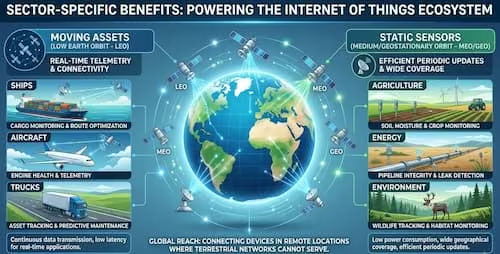
Powering the Internet of Things Ecosystem: LEO real-time tracking & GEO wide-coverage monitoring
Sector-Specific Benefits: Real-World Applications Demonstrating Value
Disaster response showcases the impact of faster data flows. Optimized ground stations and processing now deliver satellite imagery within 15 to 60 minutes of collection. Teams receive damage assessments quickly enough to prioritize search zones and allocate equipment before conditions worsen.
Maritime monitoring combines identification signals with satellite communications for near-real-time awareness. Operators detect route deviations, potential collisions, and illegal activities. Search and rescue missions launch with accurate positions, increasing survival chances.
Content delivery reaches global audiences with consistent quality. Live events and broadcasts maintain uniform latency worldwide. Production teams coordinate across continents without timing issues. The same systems support rapid software updates for distributed organizations.
Financial systems depend on satellite-derived timing for synchronized trading worldwide. Exchanges timestamp orders to microsecond precision. This common reference prevents disputes, supports audits, and enables fair competition among participants separated by vast distances.
These cases share a common thread. Satellite technology benefits stand out when speed and reach determine outcomes. Minutes saved in disaster assessment protect lives. Consistent timing underpins trillions in daily transactions. Reliable links keep remote operations productive.
Sector-Specific Benefits: Key Factors for Successful Deployment
Ground segment optimization often decides overall performance. Edge computing at gateways or onboard satellites processes data locally. Only relevant insights travel long distances. Artificial intelligence prioritizes urgent information and compresses the rest, cutting latency and bandwidth use.
Scaling constellations improves capacity, latency, and revisit times. Adding satellites shortens paths, raises elevation angles, and increases imaging frequency. Operators balance launch plans, orbital spacing, and spares while managing space traffic and regulations.
Trade-offs require careful planning. Higher revisit rates usually need more satellites or narrower coverage, which can affect resolution or cost. Mission designers match orbital regime and constellation size to the exact balance of timeliness, detail, and budget required.
Network integration produces the strongest outcomes. Hybrid satellite-terrestrial systems combine reach with speed. Modern standards enable smooth handovers between cellular and satellite connections. Users experience continuous service while operators optimize routing and economics.
Successful programs treat these elements as one integrated design. Ground systems, space segment, software, and terminals must align from the start. Pilot projects test full workflows early and build confidence before larger rollouts.
Sector-Specific Benefits: Essential Performance Benchmarks
Latency varies sharply by orbit. Low Earth orbit services deliver 25 to 60 milliseconds round trip in practice. Medium Earth orbit ranges from 80 to 200 milliseconds. Geostationary systems span 240 to 600 milliseconds or higher.
Imagery revisit depends on constellation size. Single low Earth orbit satellites may return every few days. Coordinated groups achieve hours or minutes for priority areas. Geostationary platforms offer continuous hemisphere coverage with no gaps.
Broadband throughput reaches hundreds of megabits per second on leading low Earth orbit networks, with peaks above 400 megabits. Optical inter-satellite links push backbone capacity into the terabit range. These speeds support multiple high-definition streams and enterprise use.
Deployment speed differs dramatically from terrestrial options. Satellite terminals operate within minutes to hours of arrival. Fiber or microwave links in remote terrain often take weeks to years. This advantage proves decisive for disaster recovery, temporary sites, and rapid market entry.
Sector-Specific Benefits: Choosing the Right Orbital Approach
Several questions guide orbital selection. Need ultra-low latency for interactive uses? Low Earth orbit constellations provide the required responsiveness for gaming, collaboration, and control systems.
Require continuous regional observation? Geostationary satellites deliver persistent coverage ideal for weather monitoring, border surveillance, and fixed infrastructure. The same platforms support efficient broadcast across continents.
Seek broad coverage with fewer satellites? Medium Earth orbit and geostationary each offer wide footprints. Medium Earth orbit balances latency and coverage for navigation and some communications. Geostationary excels at continuous hemispheric services.
Demand frequent updates? Low Earth orbit constellations create short revisit cycles through multiple coordinated satellites. This supports near-real-time tracking of moving objects or fast-changing ground conditions.
Plan large-scale broadcast? Geostationary and high-throughput satellites deliver efficient one-to-many transmission across vast areas with consistent performance.
Require fast emergency backup anywhere? Portable terminals activate quickly and work independently of local infrastructure. Pre-positioned kits restore communications for responders and field teams within hours of an event.
Many programs combine multiple regimes and hybrid links. The checklist provides a starting framework. Detailed requirements analysis refines the final design.
Sector-Specific Benefits: Compelling Arguments for Stakeholders
Executive summaries work best when focused on outcomes. Satellites deliver global reach and near-real-time insight, from minute-level imagery revisits to sub-100 millisecond connectivity. These capabilities enable faster decisions and quicker responses where terrestrial networks cannot reach.
Accelerate decision-making from days to minutes through frequent passes and automated processing. Emergency managers shift from waiting for aircraft imagery to receiving processed maps while events unfold. Business leaders gain current visibility into remote assets instead of delayed reports.
Enable low-latency global connectivity that supports modern applications everywhere. Remote workers join video meetings without lag. Cloud services and operational technology function reliably in mines, farms, and offshore sites.
Deploy resiliently within hours anywhere. Crisis response no longer waits for infrastructure repair. New operations or temporary facilities begin without months of civil works. Business continuity plans gain practical offsite capability that activates on demand.
Technical specifics reinforce the case. Low Earth orbit constellations achieve 25 to 60 millisecond latency with minute-level revisits when properly scaled. Geostationary systems provide continuous hemisphere coverage for monitoring and broadcast. Multi-orbit approaches combine strengths for optimal results.
Stakeholders respond when arguments match their priorities. Finance leaders value synchronized timing and transaction integrity. Operations executives focus on uptime and rapid recovery. Policy makers appreciate disaster resilience and digital inclusion.
Sector-Specific Benefits: Steps to Implement High-Performance Satellite Solutions
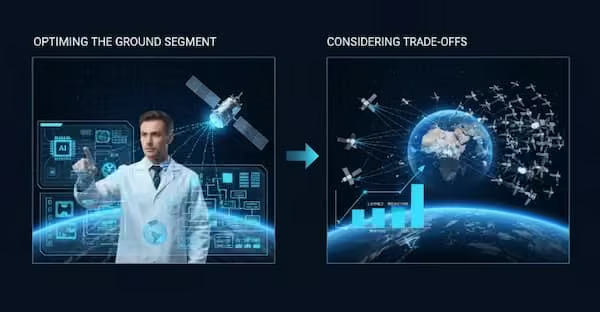
Sector-Specific Benefits: Key steps to implement high-performance satellite solutions by optimizing the ground segment and evaluating trade-offs.
Clear service level agreements set the foundation. Define targets such as imagery delivery within 60 minutes or latency below 80 milliseconds. These goals guide orbital choice and ground system design from day one.
Match the orbital regime to requirements. Ultra-low latency and frequent updates point to low Earth orbit. Continuous monitoring favors geostationary. Global timing and navigation align with medium Earth orbit. Many solutions blend regimes for balanced performance.
Automate processing to remove bottlenecks. Edge computing and artificial intelligence handle filtering and prioritization near the source. Only refined products travel to central systems. This cuts latency, cost, and inconsistency.
Test resilience before it is needed. Regular exercises simulate outages, handovers, and ground station failures. Documented playbooks ensure backup systems activate smoothly when primary links degrade.
Measure and iterate continuously. Timestamped workflows capture every stage from tasking to delivery. Dashboards reveal bottlenecks. Regular reviews with stakeholders confirm service levels and identify refinements as needs evolve.
Programs that follow this sequence avoid mismatched expectations and under-optimized ground segments. Early pilots demonstrate value and build expertise before full-scale commitment.
Sector-Specific Benefits: Looking Ahead with Orbital Capabilities
Satellite technology benefits continue to grow as constellations expand, processing improves, and integration with terrestrial networks advances. What started as niche backup now supports mainstream operations across industries. Reach, speed, and resilience have made orbital systems essential infrastructure delivering Sector-Specific Benefits.
Organizations that adopt thoughtfully gain advantages in responsiveness and flexibility. Those that wait risk falling behind peers already using satellite insights for faster decisions. The metrics and examples here show the technology has matured well beyond early limitations with Sector-Specific Benefits.
Future systems promise even better performance. Next-generation low Earth orbit targets aim for sub-20 millisecond latencies. Higher resolution with more frequent revisits will further compress event-to-insight time. Onboard artificial intelligence will deliver answers rather than raw data.
Hybrid architectures will blend satellite and terrestrial strengths. Non-terrestrial network standards will enable seamless experiences. Lower barriers through commercial services and open data will bring new adopters. The outcome is a more connected and responsive world where distance no longer limits possibility.
Satellite technology benefits are measurable, deployable, and increasingly indispensable. Leaders should consider not whether to engage, but how quickly they can integrate these capabilities into strategy and daily operations for Sector-Specific Benefits.