
The Journey to Mina: Taking Ismail from Home and Overcoming Iblis's Temptations 🕋
Chapter Second
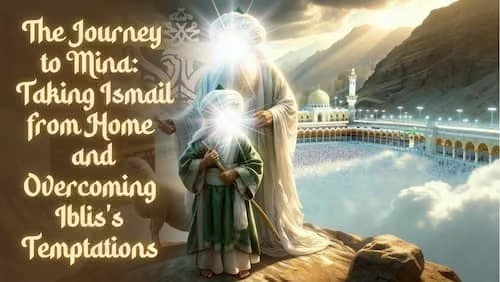
The Journey to Mina: A powerful test of faith, obedience, and family unity.
In the barren yet blessed valley of Mecca, one of the most powerful stories of faith, sacrifice, and divine obedience in Islamic tradition took place. The Journey to Mina involving Prophet Ibrahim (عليه السلام), his son Ismail (عليه السلام), and wife Hajra (رضي الله عنها) remains a timeless beacon of submission to Allah’s will. This sacred journey not only tested the limits of human love and devotion but also laid the foundation for some of the most significant rituals performed by millions of Muslims during Hajj every year. It teaches us that true faith requires complete trust, even when the path seems impossible.
The Divine Command Through a Dream
After years of longing for a righteous heir, Prophet Ibrahim (عليه السلام) was blessed with a son, Ismail (عليه السلام), in his advanced age through his wife Hajra (رضي الله عنها). Yet, when the boy reached the age where he could accompany and assist his father, Ibrahim (عليه السلام) began receiving a recurring dream. In this dream, he was commanded by Allah to sacrifice his beloved son.
As mentioned in the Quran:
“And when he reached with him [the age of] exertion, he said, ‘O my son, indeed I have seen in a dream that I [must] sacrifice you, so see what you think.’ He said, ‘O my father, do as you are commanded. You will find me, if Allah wills, of the steadfast.’
[Quran 37:102]”
This verse beautifully captures the profound conversation between father and son. Ismail’s response demonstrated remarkable maturity, patience, and complete trust in Allah.
A Father’s Gentle Disclosure to Hajra (رضي الله عنها): 🕋
Before setting out, Prophet Ibrahim (عليه السلام) had to inform his wife Hajra (رضي الله عنها), the devoted mother of Ismail. According to traditional narrations, he did not reveal the full severity of the divine command immediately, to spare her immediate distress. He simply told her that he was taking their son for a special purpose.
Hajra (رضي الله عنها), a woman of exceptional faith and strength, trusted her husband’s prophethood and devotion to Allah completely. Though her maternal heart must have been filled with unspoken anxiety, she gave her consent with grace and patience. Her quiet acceptance added another layer of sacrifice to this momentous event.
Embarking on the Sacred Journey to Mina: 🕋
With heavy hearts but resolute faith, Prophet Ibrahim (عليه السلام) and his son Ismail (عليه السلام) set out from their home in Mecca toward the plains of Mina. This short yet deeply significant trek symbolized the ultimate detachment from worldly attachments and complete surrender to the Creator. The father and son walked together, bound not only by blood but by a shared commitment to fulfill Allah’s command.
Mina, a nearby valley designated for the act of sacrifice, would soon become one of the holiest sites in Islam. Every step of the Journey to Mina was filled with spiritual weight, turning a physical walk into a profound act of worship.
The Fierce Battle Against Iblis: Three Temptations
As they journeyed, Iblis (Satan), the eternal enemy of humanity, appeared multiple times to derail their obedience. According to classical narrations, including those recorded by the historian Al-Azraqi (d. 250 AH), Iblis tried to exploit their emotions at three different points along the path.
First, he approached Prophet Ibrahim (عليه السلام), whispering doubts: “Are you really going to slaughter your own beloved son over a mere dream?” Recognizing the source of these whispers, Ibrahim (عليه السلام) pelted him with seven stones, driving him away.
Undeterred, Iblis then turned to the young Ismail (عليه السلام), attempting to plant seeds of fear and rebellion: “Your father is about to kill you – how can you accept this?” With the same steadfastness as his father, Ismail (عليه السلام) also stoned Iblis with seven pebbles.
In some narrations, Iblis even approached Hajra (رضي الله عنها), appealing to her motherly instincts to intervene and stop her husband and son. She too rejected him firmly by casting stones.
These three encounters are believed to have occurred at the exact locations where the three pillars (Jamarat) now stand in Mina: the Small (al-Jamrah al-Sughra), Middle (al-Jamrah al-Wusta), and Large (al-Jamrah al-Kubra).
The Enduring Symbolism of Rami al-Jamarat: 🕋
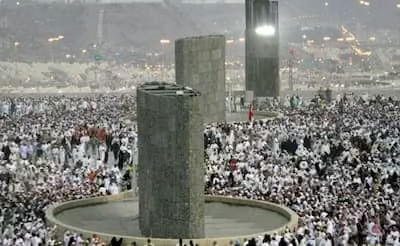
Rami al-Jamarat: Casting away temptation and following the footsteps of Prophet Ibrahim
Today, these events are commemorated through the important Hajj ritual known as Rami al-Jamarat – the stoning of the pillars. Pilgrims throw seven pebbles at each of the three Jamarat over several days. This act is not merely symbolic but serves as a powerful reminder for believers to reject Satan’s whispers – doubts, desires, fears, and distractions – that pull them away from the path of Allah.
Hadith sources, such as those in Musnad Ahmad, and explanations by scholars like Ibn Kathir in his Tafsir, highlight how Iblis targeted the entire family to disrupt their unity in faith. Angel Jibril is also said to have guided Ibrahim (عليه السلام) in stoning the devil at each location.
Arrival at Mina and the Moment of Supreme Sacrifice: 🕋
Upon reaching the place of sacrifice in Mina, Prophet Ibrahim (عليه السلام) prepared to fulfill the divine command. He laid his son down, sharpened the knife, and turned his face away so as not to see the pain in his son’s eyes. Ismail (عليه السلام) remained calm and encouraging, fully submitting to Allah’s will.
Just as the knife was about to descend, Allah called out to Ibrahim (عليه السلام), stopping him and announcing that he had already passed the test. In place of Ismail, a ram was provided as a ransom.
“Then We ransomed him with a great sacrifice.” [Quran 37:107]
This divine intervention not only saved Ismail (عليه السلام) but also established the tradition of animal sacrifice that Muslims observe worldwide during Eid al-Adha.
Profound Lessons from the Journey to Mina: 🕋
This extraordinary story teaches believers several timeless lessons that remain relevant in every era: |
◉ Complete trust and submission to Allah’s will, even when it defies human logic or emotions. |
◉ The power of family unity in faith – father, mother, and son stood together against temptation. |
◉ The importance of actively rejecting evil temptations through decisive action. |
◉ That true sacrifice and patience (sabr) are always rewarded by the Most Merciful. |
The Journey to Mina shows that the real “Iblis” we face is often our own inner doubts and desires. By following the example of Prophet Ibrahim, Ismail, and Hajra (رضي الله عنها), we learn to cast away distractions and draw closer to Allah. |

Then We ransomed him with a great sacrifice.” (Quran 37:107)
A Living Legacy in Hajj 🕋
Every year, millions of pilgrims retrace these steps during Hajj. By performing the stoning of the Jamarat, the sacrifice, and remembering this story, they not only honor the obedience of Ibrahim, Ismail, and Hajra but also cast away their own inner “Iblis.” The rituals bring the Journey to Mina alive, transforming ancient history into a personal spiritual experience for every believer.
The story continues to inspire Muslims worldwide to prioritize their relationship with Allah above all worldly attachments. It reminds us that the greatest victories come through unwavering faith and complete submission.
🕋 May Allah grant us all the faith of Ibrahim and Ismail (عليهما السلام) and the strength of Hajra (رضي الله عنها). Ameen.