
The Hoopoe Bird and the Discovery of Sheba
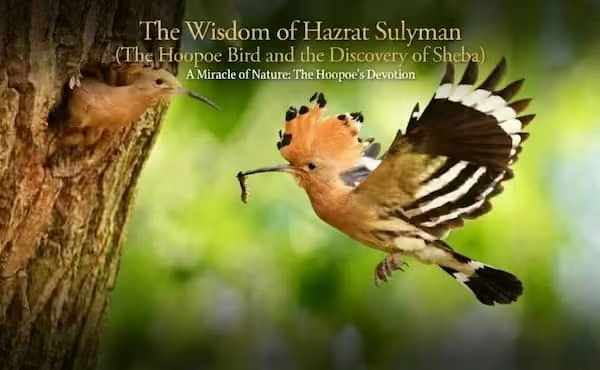
The Hoopoe Bird — Devoted Messenger of Hazrat Sulyman and the Discovery of Sheba
Introduction: The Hoopoe Bird and the Discovery of Sheba
The Hoopoe Bird and the Discovery of Sheba: The tale of the Hoopoe bird and the discovery of Sheba is a captivating narrative drawn primarily from ancient religious texts, blending elements of mythology, history, and natural wonder. At its core, this story revolves around King Solomon (Sulayman in Islamic tradition), renowned for his wisdom and command over nature, and how a small, colorful bird—the Hoopoe—played a pivotal role in revealing the distant kingdom of Sheba and its enigmatic queen. In the Quran, the Hoopoe emerges as a wise messenger, scouting far lands and bringing back intelligence that leads to a profound encounter between two powerful rulers. This “discovery” isn’t just geographical; it symbolizes a clash of faiths, cultures, and ideologies, where sun worship meets monotheism, and diplomacy unfolds through miraculous events.
The Hoopoe Bird and the Discovery of Sheba: While the Bible mentions the Queen of Sheba’s visit to Solomon to test his wisdom with riddles, it omits the Hoopoe’s involvement. The fuller account, enriched by the bird’s agency, appears in Islamic tradition, highlighting themes of obedience, exploration, and divine intervention. The Hoopoe, known scientifically as Upupa epops, is no mere fable; it’s a real bird with striking features and behaviors that have inspired symbolism across cultures. This article explores the bird’s biology, the historical context of Sheba, the detailed story, and its enduring legacy, weaving in examples from art, literature, and archaeology. By delving into these aspects, we uncover how a humble avian creature became a bridge between worlds, inspiring questions about faith, nature, and human connection.
The Hoopoe Bird and the Discovery of Sheba: Key question keywords: What is the role of the Hoopoe in the Quran? How did the Hoopoe discover Sheba? Where was the Kingdom of Sheba located? What are Hoopoe bird facts? Queen of Sheba story in Bible vs. Quran.
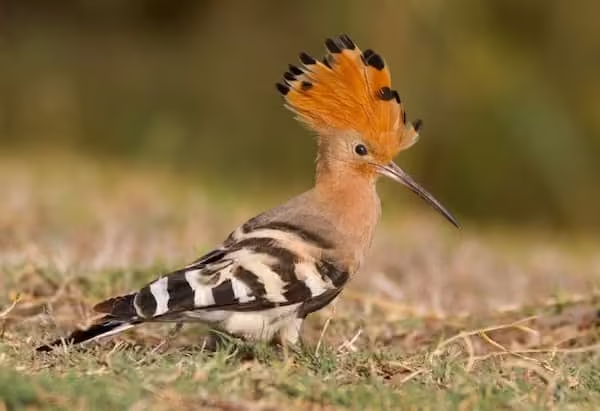
Hudhud, the wise messenger of Prophet Sulayman, stands vigilant with crest raised, symbolizing discovery and devotion.

A devoted Hudhud carries food to its nest, echoing its ancient journey to Prophet Sulayman with news of Sheba.
The Hoopoe Bird: Biology and Characteristics
Physical Appearance
The Hoopoe Bird and the Discovery of Sheba: One of the Hoopoe’s most iconic features is its erectile crest, a fan of feathers tipped in black that resembles a crown or mohawk. This crest can be raised when the bird is excited or alarmed, adding to its regal aura—a trait that likely contributed to its symbolic status in stories like that of Solomon. The bird’s long, slender bill is slightly curved (downcurved), ideal for probing soil and crevices. Its wings and tail display bold zebra-like stripes in black and white, which become prominent during flight. The coloration serves practical purposes: camouflage when the crest is flattened and a display for mating or territory defense. Females are slightly duller than males, but both sexes share the striking pattern.

The faithful Hudhud soars with grace, embodying the wise messenger who brought tidings of Sheba to Prophet Sulayman (peace be upon him).
Habitat and Behavior
The Hoopoe Bird and the Discovery of Sheba: Hoopoes thrive in diverse environments across Africa, Asia, and Europe, preferring open woodlands, savannas, orchards, farmlands, heathlands, and lightly vegetated ground where they can forage. They are migratory in northern regions, wintering in Africa or India, but resident in milder climates. Behaviorally, Hoopoes are territorial and monogamous, often returning to the same nesting sites year after year. They nest in natural cavities like tree holes, cliffs, walls, or abandoned burrows, lining them minimally.
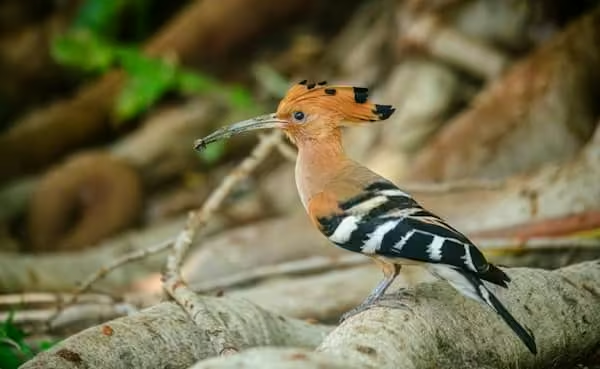
The loyal Hudhud perches proudly, insect in beak, ready to deliver tidings like the wise messenger to Prophet Sulayman (peace be upon him).
- Diet: Primarily insectivorous, feeding on crickets, beetles, locusts, earwigs, cicadas, antlions, bugs, ants, and occasionally small reptiles, frogs, seeds, or berries. They use their bill to probe soil or dung, helping control pest populations—a boon for agriculture.
- Breeding: Clutch sizes vary (up to 12 eggs in the north), with eggs being pale blue or similar. Both parents incubate and feed chicks, using a unique defense: secreting a foul-smelling liquid from the uropygial gland to deter predators.
- Vocalizations: Their call, a soft “hoop-hoop-hoop,” gives them their name. It’s used for communication during courtship or territory claims.
Examples in Nature: In Israel, where the Hoopoe is the national bird since 2008 (chosen by public vote for its beauty and biblical ties), it’s commonly seen probing lawns for grubs. In Europe, populations have declined due to habitat loss and hunting, leading to conservation efforts.
The Hoopoe Bird and the Discovery of Sheba: These traits not only make the Hoopoe a resilient survivor but also align with its portrayal as a clever, far-traveling scout in religious narratives.
The Hoopoe in Religious and Cultural Contexts
The Hoopoe Bird and the Discovery of Sheba: Beyond its biological intrigue, the Hoopoe holds profound symbolic weight in various cultures, often embodying wisdom, protection, and leadership. Its role in religious texts amplifies this, turning a common bird into a divine intermediary.
Role in the Quran
The Hoopoe Bird and the Discovery of Sheba: In Islamic tradition, the Hoopoe (known as “hudhud”) features prominently in Surah An-Naml (Chapter 27) of the Quran. Here, Prophet Solomon, gifted with the ability to understand animals, reviews his army of birds, jinn, and men. Noticing the Hoopoe’s absence, he threatens punishment unless it provides a valid excuse. The bird returns, reporting: “I have encompassed [in knowledge] that which you have not encompassed, and I have come to you from Sheba with certain news.” It describes a queen ruling a prosperous land where people worship the sun instead of God.
This discovery prompts Solomon to send the Hoopoe back with a letter demanding submission to the one true God. The bird’s intelligence and loyalty are highlighted, portraying it as more than a messenger—it’s a spy and advisor. Examples include its detailed description of Sheba’s throne, adorned with gems, and the people’s idolatry, which disturbs Solomon.
Comparisons with Biblical Accounts
The Hoopoe Bird and the Discovery of Sheba: The Bible (1 Kings 10:1-13; 2 Chronicles 9:1-12) recounts the Queen of Sheba hearing of Solomon’s fame and visiting him with spices, gold, and riddles to test his wisdom. She leaves impressed, but there’s no mention of the Hoopoe or any bird facilitating the encounter. This contrast suggests the Quranic version draws from or expands on Jewish folklore, such as the Targum Sheni, which includes similar bird stories.
- Similarities: Both emphasize Solomon’s wisdom and the Queen’s wealth.
- Differences: Quran adds miraculous elements like throne teleportation and focuses on conversion from polytheism.
Examples: In Jewish midrash, birds aid Solomon, but the Hoopoe’s specific role is Quranic.
Symbolism Across Cultures
The Hoopoe’s symbolism varies widely. In ancient Egypt, it represented heirship; in Persia, virtue and guidance, as in Attar’s “Conference of the Birds” where it leads to enlightenment. In Europe, it was seen as a thief or war omen; in Arab folklore, a healer. Modernly, it’s Israel’s national bird, symbolizing resilience.
- Protection and Wisdom: Often linked to royalty due to its crest.
- Examples: In Greek mythology, King Tereus transforms into a Hoopoe; in Estonian lore, it’s tied to the underworld.
This multifaceted symbolism underscores why the Hoopoe was chosen for such a pivotal narrative role.
The Kingdom of Sheba: Historical Overview
The Hoopoe Bird and the Discovery of Sheba: Sheba, or Saba, was an ancient kingdom whose discovery by Solomon via the Hoopoe adds historical intrigue to the tale. Archaeological evidence places it in southern Arabia, modern Yemen.
Location and Archaeology
Centered around Marib and Sirwah in Yemen, Sheba flourished from around 1000 BCE to 275 CE. It controlled trade routes, with ruins like the Marib Dam showcasing engineering prowess. While Ethiopian traditions claim Sheba in Africa (Horn of Africa), historical sources and inscriptions confirm Yemen as the primary location.

Towering pillars of the ancient Sabaean kingdom rise against the sky, where the Hudhud revealed the splendor and misguidance of Queen Bilqis’s realm to Prophet Sulayman (peace be upon him).

The Hoopoe Bird and the Discovery of Sheba” – The majestic remnants of the kingdom of Sheba, where the Hudhud brought astonishing news to Prophet Sulayman (peace be upon him) of a splendid yet sun-worshipping realm.
The Hoopoe Bird and the Discovery of Sheba: Key Sites: Almaqah Temple in Marib, inscribed with Sabaean script. Inscriptions mention kings and trade, aligning with biblical wealth.
Economy and Trade
Sheba’s prosperity stemmed from the incense trade—frankincense and myrrh—exported to the Mediterranean. Camels facilitated caravans, making it a hub.
- Goods: Spices, gold, gems.
- Examples: The Queen’s gifts to Solomon mirror this.
Debates persist on exact location, but Yemen is the consensus among historians and archaeologists.
The Story of Solomon and the Queen of Sheba
The narrative unfolds in the Quran as a lesson in faith and humility. Solomon, commanding winds, animals, and jinn, inspects his forces. The Hoopoe’s tardiness leads to its report on Sheba.
Key Events in the Tale
- The Hoopoe’s Discovery: Flying far, it finds Sheba, ruled by Bilqis (in later traditions), with a magnificent throne. People prostrate to the sun, misled by Satan.
- The Letter: Solomon sends: “Do not exalt yourselves above me, but come to me in submission.”
- The Queen’s Response: She consults advisors, sends gifts, then visits.
- Miracles: Solomon relocates her throne via a knowledgeable servant. She mistakes a glass floor for water, lifts her skirts, and converts.

Queen Bilqis, richly attired, presents herself before Prophet Sulayman (peace be upon him), the culmination of the Hudhud’s discovery and divine invitation to the truth.

Queen Bilqis kneels in awe before Prophet Sulayman (peace be upon him), fulfilling the journey sparked by the Hudhud’s report of her magnificent yet misguided kingdom.
Examples: In art, Mughal paintings and European works like those by Lavinia Fontana depict this meeting.
Themes and Interpretations
The Hoopoe Bird and the Discovery of Sheba: The story emphasizes monotheism over idolatry, with the Hoopoe as a catalyst.
Modern Interpretations and Legacy
Today, the tale inspires literature, like in “The Conference of the Birds,” and art. Conservation efforts protect Hoopoes amid habitat threats. In popular culture, it appears in films and books, questioning historical vs. mythical elements.
The Hoopoe Bird and the Discovery of Sheba: The Hoopoe’s “discovery” of Sheba reminds us of nature’s role in human stories, bridging ancient wisdom with modern inquiry.