
Earth’s Core — The Inner Heart of Fire & Magnetic Shield
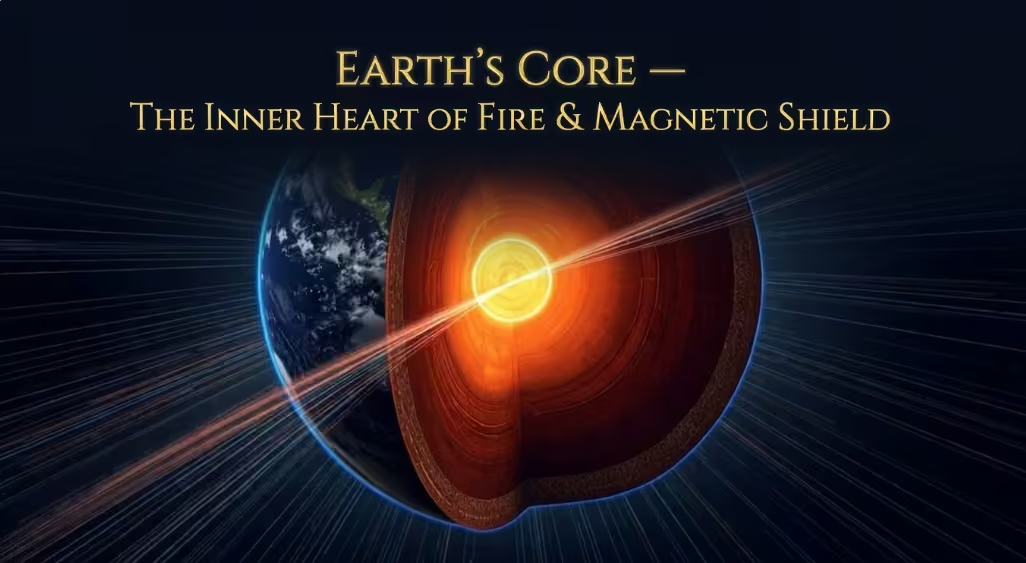
Cross-section of Earth revealing the blazing inner core — the fiery heart that powers our planet’s protective magnetic shield.
Introduction : Earth’s Core — The Inner Heart of Fire & Magnetic Shield
🔥Earth’s core, positioned roughly 1,800 to 2,900 miles beneath the surface, forms a blazing sphere primarily of molten iron and nickel, with temperatures reaching approximately 5,700–6,000 °C—comparable to or slightly exceeding the Sun’s surface temperature of about 5,500–5,800 °C. This profound heat source, sustained by residual energy from planetary formation, gravitational compression, and radioactive decay, functions as the dynamic engine powering essential planetary processes. It maintains Earth’s geological activity, protects the atmosphere, and supports conditions conducive to life. Far from a dormant relic, this deep interior remains a vibrant, ever-active domain that continues to shape the planet’s evolution.
Table of Contents
| ➤ Introduction |
| ➤ Structure and Extreme Conditions |
| ➤ Powering the Geomagnetic Field |
| ➤ Driving Tectonic Activity |
| ➤ Fueling Geothermal Dynamics |
| ➤ Surface Manifestations as Release Mechanisms |
| ➤ Future Cooling and Planetary Fate |
| ➤ Conclusion |
Introduction
Deep within Earth lies a realm of extraordinary heat and pressure, where iron remains in fluid motion despite conditions that would vaporize surface materials. This central region, divided into a liquid outer layer and a solid inner sphere, generates immense energy that radiates outward. The resulting effects include the creation of a protective magnetic envelope, the movement of continental plates, and the flow of heat that sustains mantle convection. These interconnected systems ensure ongoing geological renewal and atmospheric stability. Scientists study this hidden furnace through seismic wave analysis, laboratory simulations of extreme pressures, and satellite observations of the magnetic field, revealing a planet that remains geologically alive billions of years after formation.
Structure and Extreme Conditions
Earth’s Core — The Inner Heart of Fire & Magnetic Shield, The core spans from about 1,800 miles below the surface to the center, encompassing the outer core—a fluid layer roughly 1,400 miles thick—and the inner core, a solid ball approximately 1,500 miles in diameter. Temperatures in the inner core hover around 5,700 °C, maintained by immense pressures exceeding 3 million atmospheres that prevent melting despite the heat.
This metallic composition, dominated by iron with nickel and lighter elements, allows for electrical conductivity essential to geophysical phenomena. Heat sources include primordial accretion energy trapped during Earth’s formation 4.5 billion years ago, latent heat from inner core solidification, and ongoing radioactive decay in surrounding layers. These factors combine to keep the interior dynamic, contrasting with cooler, inactive worlds like the Moon.
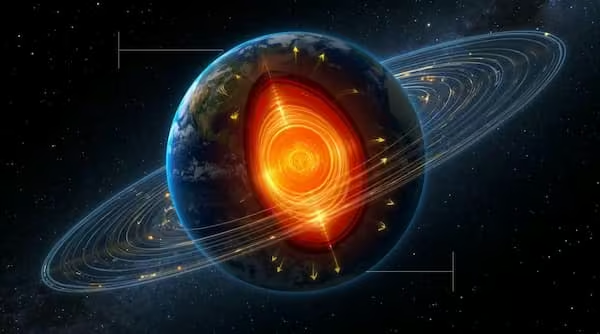
Earth’s hidden layers under extreme heat and pressure — the engine behind our magnetic field.
Powering the Geomagnetic Field
Earth’s Core — The Inner Heart of Fire & Magnetic Shield: Convective motions in the liquid outer core, driven by heat differences, generate electric currents via the geodynamo process. These currents produce Earth’s magnetic field, an invisible barrier extending far into space that deflects solar wind particles.
This shield prevents atmospheric stripping by charged solar particles, preserving the ozone layer and reducing surface radiation exposure. Paleomagnetic records in ancient rocks document periodic reversals and excursions, demonstrating the field’s variability over geological time. Current observations indicate gradual weakening in regions like the South Atlantic Anomaly, prompting research into long-term stability. Without this dynamo, Earth would face rapid atmospheric loss similar to Mars.
Driving Tectonic Activity
Earth’s Core — The Inner Heart of Fire & Magnetic Shield: Heat escaping from the core fuels mantle convection, where hotter material rises and cooler material sinks, propelling the lithospheric plates across the surface. This process recycles crustal materials, regulates carbon through subduction and volcanism, and distributes nutrients vital for ecosystems.
Plate tectonics manifests in several ways:
| 🔥 Subduction zones: Dense plates sink, generating earthquakes and arc volcanism while returning carbon to the mantle. |
| 🔥 Divergent boundaries: New oceanic crust forms at mid-ocean ridges, releasing heat and gases. |
| 🔥 Transform boundaries: Plates slide past each other, producing seismic activity along faults. |
| 🔥 Hotspot volcanism: Deep plumes create chains like the Hawaiian Islands, independent of plate edges. |
These movements continuously reshape continents, influence climate through volcanic outgassing, and promote biological evolution by altering habitats.
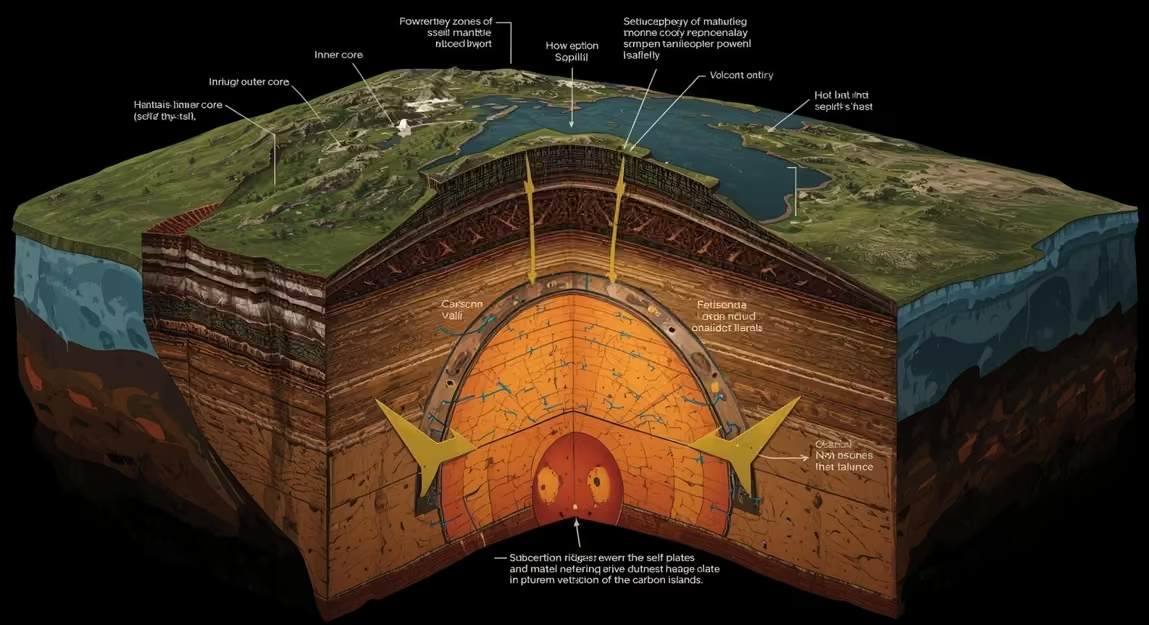
“Earth’s interior drives surface change: mantle convection moves tectonic plates, fuels volcanism, and recycles carbon.”
Fueling Geothermal Dynamics
Geothermal heat flow from the interior keeps the mantle partially molten, enabling viscous flow and long-term planetary circulation. This energy, though modest compared to solar input at the surface, sustains deep processes that would otherwise cease.
It contributes to phenomena like mantle plumes and supports renewable geothermal resources in tectonically active areas. Models indicate that without this persistent heat, the mantle would rigidify, ending convection and surface dynamism.
Surface Manifestations as Release Mechanisms
Volcanoes, hot springs, and hydrothermal vents act as natural outlets for excess heat and pressure from below. These features release magma, gases, and heated fluids, preventing dangerous accumulations while enriching the surface environment.
Examples include:
| Explosive stratovolcanoes that build steep cones through viscous lava. |
| Effusive shield volcanoes producing broad lava flows. |
| Geothermal fields with geysers and fumaroles driven by subsurface boiling. |
| Deep-sea vents supporting chemosynthetic life communities. |
Such systems play roles in global cycles, including water and carbon regulation, and provide insights into subsurface conditions through monitoring.

Volcanoes function as dramatic release mechanisms, venting extreme pressure and heat from deep within Earth.
Future Cooling and Planetary Fate
Over immense timescales, radioactive decay and heat loss will gradually diminish the core’s temperature. Estimates suggest the dynamo may weaken significantly in billions of years, potentially leading to magnetic field decline, increased solar wind erosion of the atmosphere, and cessation of plate tectonics.
Earth could eventually resemble Mars—geologically inactive, with a thin or absent atmosphere. However, this fate lies far in the future, possibly tens of billions of years away, long after the Sun’s expansion renders the surface uninhabitable. Until then, ongoing activity signals a resilient, living world.
Conclusion
🧲 The core’s relentless energy orchestrates the planet’s protective, dynamic, and life-sustaining features. From generating the magnetic shield to driving surface renewal, its influence permeates every layer. Advances in geophysics continue to illuminate this enigmatic domain, fostering greater appreciation for Earth’s intricate balance. This inner furnace embodies the enduring vitality of our world, pulsing as the steadfast heartbeat of a planet that remains profoundly alive.
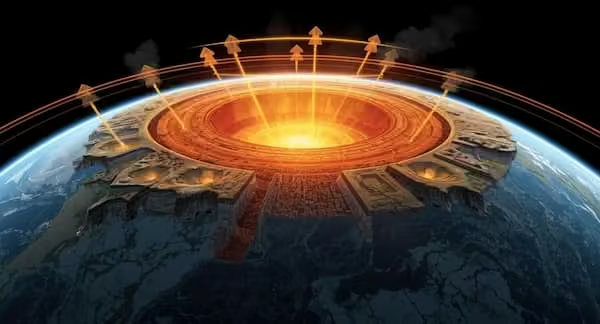
The core’s relentless energy acts as Earth’s heartbeat — generating the magnetic shield and fueling continuous planetary renewal.
One day — billions of years from now — this inner fire will cool. The magnetic shield will fade, plate tectonics will stop, and Earth will become a frozen, airless tomb like Mars. Until then, every tremor, every eruption, every invisible pulse of the magnetic field is the heartbeat of a living world that refuses to die.💓
Humanity — The Nervous System & Emerging Consciousness
☀️ Here is the most confronting truth: we are not outside observers.
Table of Contents
Introduction | The Autoimmune Crisis: Humanity’s Destructive Impact
|
The Metaphor of Humanity as Earth’s Nervous System
| Pathways to Healing: Learning, Adaptation, and Choice
|
Earth’s Self-Awareness Through Humanity
| Conclusion |
Introduction ➤ The Metaphor of Humanity as Earth's Nervous System
In an era where humanity grapples with its place in the cosmos, a profound metaphor emerges: we are not mere inhabitants of Earth but its evolved nervous system. This perspective challenges the notion of humans as external observers, positioning us instead as integral components enabling the planet’s self-awareness. Drawing parallels to biological systems, where neurons facilitate bodily consciousness, humanity empowers Earth to perceive, reflect, and respond to its own existence. Yet, this role carries dual potential—for enlightenment or self-destruction. As we explore this concept, we uncover how our technologies, knowledge, and creativity serve as extensions of planetary cognition, while environmental crises signal an autoimmune disorder. This article delves into these ideas, highlighting the urgency of healing and the promise of conscious choice, ultimately advocating for a harmonious integration with our global body.
The idea that humanity functions as Earth’s nervous system reframes our relationship with the planet. Just as a nervous system in a living organism processes information, coordinates responses, and enables self-awareness, humans collectively perform similar roles on a global scale. This metaphor, inspired by systems thinking and ecological philosophy, underscores our interconnectedness with the biosphere.

Neurons and Planetary Awareness
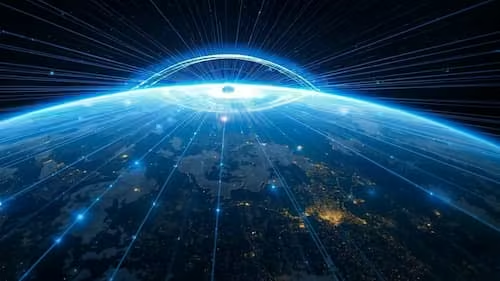
In biology, neurons form networks that allow an organism to sense its environment, process stimuli, and achieve consciousness. Similarly, humanity’s global population acts as a distributed neural network for Earth. Our collective intelligence mirrors synaptic connections, transmitting data across continents and oceans. This emerging planetary consciousness arises not from isolation but from the intricate web of human interactions, fostering a unified awareness of Earth’s state.
This neuronal analogy highlights how humanity’s evolution marks a pivotal shift, transforming Earth from a passive entity into one capable of introspection.
Human Innovations as Sensory Extensions
Technological advancements extend Earth’s perceptual capabilities far beyond natural limits. Satellites orbiting the planet serve as artificial eyes, capturing high-resolution images of forests, oceans, and urban sprawls. These tools enable real-time monitoring, turning abstract data into actionable insights.
Consider how remote sensing technologies detect deforestation in the Amazon or track melting polar ice caps. Such innovations amplify Earth’s “vision,” allowing for a comprehensive self-view that was previously impossible. In this framework, engineers and scientists become the architects of planetary perception, weaving human ingenuity into the fabric of global consciousness.
Distributed Sensing: Billions of individuals contribute observations, from local weather patterns to global seismic activity. |
Information Processing: Social networks and data centers process vast amounts of environmental data, akin to neural computations. |
Feedback Loops: Human responses to natural events, such as disaster relief, create adaptive cycles that enhance planetary resilience. |
Earth's Self-Awareness Through Humanity
Humanity’s contributions transcend mere observation, infusing Earth with cognitive and creative dimensions. This self-awareness manifests through scientific inquiry and artistic expression, elevating the planet to a state of reflective existence.
Science as Planetary Thought
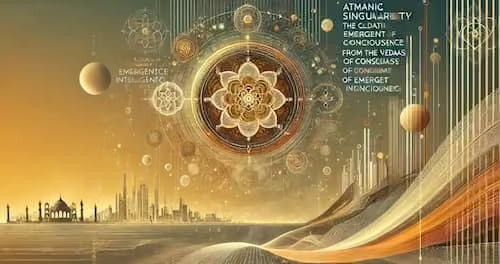
Science represents Earth’s analytical mind, systematically unraveling the mysteries of its own composition and history. From geology to climatology, human research deciphers planetary processes, revealing patterns like tectonic shifts and atmospheric dynamics.
Through these endeavors, humanity facilitates Earth’s intellectual growth, turning raw data into coherent narratives about its past, present, and future.

Art and Culture as Planetary Dreams
Beyond empirical thought, art and music embody Earth’s imaginative realm. These expressions capture the planet’s emotional and aesthetic essence, from symphonies inspired by natural rhythms to paintings depicting landscapes.
Cultural artifacts serve as dreams, allowing Earth to envision alternative realities. For instance, environmental literature like Rachel Carson’s Silent Spring awakens collective consciousness to ecological perils, while global music festivals celebrate biodiversity’s harmony. In this way, humanity’s creativity infuses the planet with soulful depth, enriching its emerging consciousness.
Geological Insights: Studies of rock formations and fossils provide a timeline of Earth’s evolution. |
Climatic Modeling: Advanced simulations predict future scenarios, enabling proactive adaptations. |
Biodiversity Mapping: Genetic sequencing catalogs life’s diversity, fostering a deeper understanding of ecological interdependencies. |
The Autoimmune Crisis: Humanity's Destructive Impact
However, a nervous system can malfunction, leading to self-harm. When humanity’s actions undermine the planet’s health, it triggers an autoimmune-like response, where the system attacks its own body.
➤ Climate Change and Environmental Degradation
Climate change exemplifies this pathology, driven by human-induced greenhouse gas emissions. Rising temperatures disrupt ecosystems, manifesting as extreme weather events that ravage the very “body” we inhabit.
➤ Mass Extinction and Pollution as Self-Attack
Mass extinction events, accelerated by habitat destruction, and widespread pollution further illustrate self-sabotage. Oceans choked with plastics and species vanishing at unprecedented rates signal Earth’s distress signals gone unheeded.
- Biodiversity Loss: Over 1 million species face extinction due to human activities.
- Pollution Hotspots: Industrial waste contaminates air, water, and soil, creating toxic feedback loops.
- Resource Depletion: Overexploitation of forests and minerals erodes the planet’s foundational structures.
These crises reveal humanity’s dual role: as both healer and harbinger of disease.
Pathways to Healing: Learning, Adaptation, and Choice
Amid the gloom, hope emerges. A nervous system possesses plasticity—the ability to learn, adapt, and heal. Humanity can redirect its energies toward restoration, choosing love over destruction.
➤ The Potential for Conscious Evolution
Conscious evolution involves intentional shifts in behavior and policy. Renewable energy transitions, reforestation projects, and sustainable agriculture demonstrate this capacity.
- Renewable Innovations: Solar and wind technologies reduce carbon footprints.
- Conservation Efforts: Protected areas preserve biodiversity hotspots.
- Educational Initiatives: Global awareness campaigns foster eco-literacy.
By embracing these, humanity steers Earth toward equilibrium.
➤ Choosing Love Over Destruction
At its core, healing requires a paradigm of love—empathy for the planet and its inhabitants. Community-driven movements, like indigenous stewardship practices, embody this ethos, prioritizing harmony over exploitation.
➤ Further Reading & Scientific Resources
Conclusion ➤ Humanity — The Nervous System & Emerging Consciousness
Humanity’s role as Earth’s nervous system offers profound opportunities for planetary self-awareness and growth. Yet, the autoimmune threats of climate change and extinction demand urgent recalibration. By learning from our missteps and choosing paths of healing and love, we can nurture a conscious, thriving Earth. This metaphor not only confronts our truths but inspires a collective awakening, ensuring that our planetary body flourishes in unity.

Humanity awakening as the nervous system of the universe — a cosmic vision of emerging collective consciousness.