
The Significance of Mount Judi: A Symbol of Deliverance and Divine Compassion
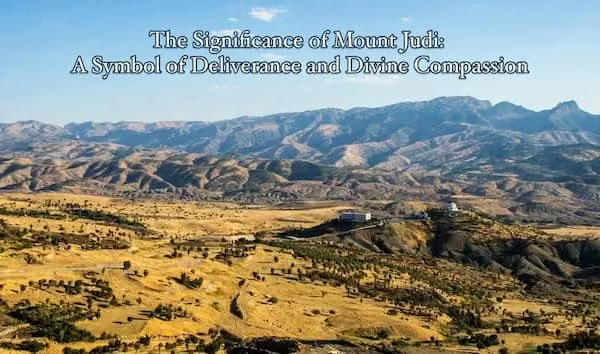
The sacred mountain where Prophet Nuh’s Ark rested, marking hope after the Flood.
Introduction: The Significance of Mount Judi – Symbol of Deliverance, Renewal, and Divine Compassion
The significance of Mount Judi lies in its powerful role as a symbol of deliverance amid devastation and divine compassion following righteous judgement. After the Great Flood, the Ark of Prophet Nuh (عليه السلام) came to rest upon this sacred mountain, marking the end of destruction and the beginning of renewal for humanity. Nestled among lush fertile plains and nourished by essential water sources, Mount Judi provided an ideal foundation for a fresh start. Far beyond its physical geography, this blessed site stands as a profound reminder of hope emerging from catastrophe and obedience being rewarded by Allah’s mercy.
The significance of Mount Judi carries deep spiritual meaning that continues to inspire believers across generations. The Qur’an invites us to reflect upon its deeper lessons, encouraging contemplation of divine wisdom, resilience in faith, and the cycle of judgement followed by grace. Through its sacred mention in the Holy Qur’an, Mount Judi elevates from a historical landmark into a timeless beacon of spiritual awakening and compassionate redemption. It reminds every generation that steadfast faith leads to deliverance — just as it did for Nuh (AS) and the believers on the blessed slopes of Mount Judi.
The Duration of the Flood in the Qur’an: Patience, Perseverance, and Divine Wisdom
The Qur’an does not specify an exact number of days or a precise timeline for the active phase of the Flood during Prophet Nuh’s time. Instead, it focuses on the deeper spiritual and moral lessons, highlighting the extraordinary patience, perseverance, and divine wisdom required in calling people to truth. A central element is the remarkably long 950-year prophetic mission of Nuh (AS), during which he tirelessly preached monotheism despite widespread rejection, mockery, and hostility. This extended period of dedication set the foundation for the divine decree that followed. In this context, the significance of Mount Judi becomes especially meaningful as the sacred place where the Ark would finally come to rest, marking the transition from prolonged trial to renewal and hope for the believers.
➤ The 950-Year Mission of Prophet Nuh (عليه السلام)
A central Qur’anic reference highlights the remarkable length of Prophet Nuh’s prophetic mission rather than the Flood’s duration itself. In Surah Al-Ankabut (29:14), Allah states:
“And We certainly sent Noah to his people, and he remained among them a thousand years minus fifty years. Then the Flood overtook them while they were wrongdoers.”
(Surah Al-ʿAnkabut 29:14)
Nuh’s tireless dedication is further shown through his continuous invitations to his people both openly and in secret, day and night, urging them to seek forgiveness so they could receive Allah’s blessings of rain, increased wealth, children, gardens, and rivers. Despite these sincere and persistent efforts, most responded with arrogance and remained steadfast in disbelief. Eventually, divine instruction confirmed that the time for judgment had arrived, leading to the construction of the Ark and the onset of the Flood. The significance of Mount Judi thus stands out clearly as the destined site of deliverance, where the long journey of faith reached its meaningful conclusion and a new beginning was granted to those who endured with trust in Allah.
➤ Nuh’s Tireless Dedication in Surah Nuh (71:5-20)
The Qur’an further illustrates Nuh’s dedication in Surah Nuh (71:5-20), where he describes calling his people night and day, publicly and privately, yet they persisted in disbelief. In these verses, Prophet Nuh (AS) says:
“My Lord, indeed I invited my people [to truth] night and day. But my invitation only increased them in flight [from truth]. And whenever I invited them that You may forgive them, they put their fingers in their ears, covered themselves with their garments, persisted [in disbelief], and were arrogant with [great] arrogance.”
(71:5-7)
He continues to explain how he called them openly and in secret, urging them to seek forgiveness so that Allah would send rain, increase their wealth and children, and grant them gardens and rivers. Yet, despite these sincere efforts, his people turned away, refused to listen, and remained steadfast in their idolatry and sin.
➤ Divine Instruction in Surah Hud (11:36)
In Surah Hud (11:36), Allah reveals to Nuh:
“None of your people will believe except those who have already believed. So do not be distressed by what they have been doing.”
Surah Hud (11:36)
This divine instruction came after long years of effort, signaling the appointed time for judgement. It marked the transition from the phase of prolonged invitation to the moment of divine decree, after which the construction of the Ark began and the Flood was unleashed.

Where the Ark rested after the Flood, symbolising divine mercy and new beginnings.
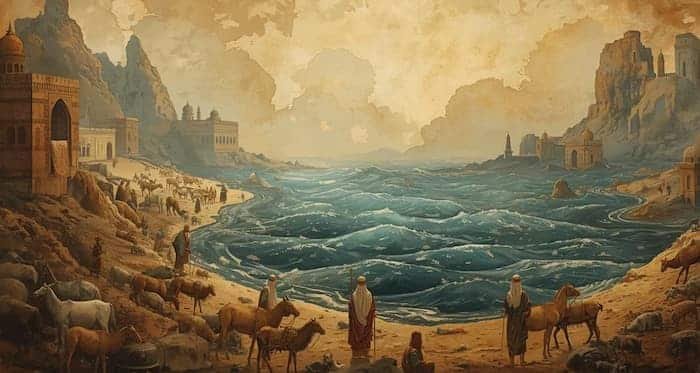
The moment before the great deluge, as Prophet Nuh (AS) calls his people amid gathering waters.
➤ Absence of Specific Flood Duration Details
Unlike some other scriptures that mention detailed timelines, the Qur’an remains silent on the exact length of the Flood’s active phase. It describes the event dramatically but concisely in Surah Hud (11:40-44).
In Surah Hud (11:40), Allah says:
“And when Our command came and the oven burst ˹with water˺, We said ˹to Noah˺, ‘Take into the Ark a pair from every species along with your family—except those against whom the decree ˹to drown˺ has already been passed—and those who believe.’ But none believed with him except for a few.”
Then, in 11:41-44, the Qur’an continues:
“And he said, ‘Board it! In the Name of Allah it will sail and cast anchor. Surely my Lord is All-Forgiving, Most Merciful.’ And ˹so˺ the Ark sailed with them through waves like mountains, and Noah called out to his son, who had been apart ˹from the believers˺, ‘O my son! Embark with us and do not be with the disbelievers.’ But he replied, ‘I will take refuge on a mountain to save me from the water.’ Noah cried, ‘Today there is no refuge from Allah’s decree except for those to whom He shows mercy!’ And the waves came between them, and his son was among those overwhelmed ˹by the flood˺. Then it was said, ‘O earth, swallow your water, and O sky, withhold ˹your rain˺.’ The water subsided, the command was fulfilled, and the Ark rested on Mount Judi. And it was said, ‘Away with the wrongdoing people!”
The focus remains entirely on divine command, the salvation of the believers, and the destruction of the oppressors.
➤ Symbolic and Moral Significance
By emphasizing the 950-year mission and Nuh’s unwavering dedication instead of Flood mechanics, the Qur’an teaches that Allah grants ample opportunity for repentance. Prophet Nuh’s endurance serves as an inspiring model for all believers facing rejection. The narrative culminates in renewal after judgement, linking beautifully to themes of deliverance on Mount Judi.
In essence, the Qur’an prioritizes reflection on faith, patience, and divine compassion over historical specifics. The Flood stands as a timeless reminder that while judgement is inevitable for the unrepentant, Allah’s guidance and mercy precede it for an extraordinarily long period.
The Duration According to Islamic Tradition: Insights from Exegetical Narratives
While the Qur’an intentionally omits any exact timeline for the Flood’s active phase, Islamic tradition—drawn from classical tafsir works, historical reports, and narrations compiled by scholars such as Imam al-Tabari, Ibn Kathir, and al-Qurtubi—offers detailed supplementary accounts. These traditions, often incorporating early Muslim reports and elements from Isra’iliyyat, enrich the narrative without forming part of core Islamic creed. They serve primarily as aids for reflection, underscoring Allah’s mercy, the scale of divine judgement, and the calm assurance granted to the righteous.
According to these sources, the deluge began with torrential rain that continued uninterrupted for forty days and forty nights. Water surged forth from the earth and descended from the heavens with overwhelming force, yet the Ark of Nuh (عليه السلام) remained perfectly calm and stable amid the chaos. One can only pause and reflect: in the midst of universal devastation, the vessel carrying the believers floated serenely under divine protection, a powerful symbol of peace granted to those who submit to Allah’s command.

Prophet Nuh’s Ark sailing through the torrential Flood under divine protection.
The elevated waters are said to have persisted for several months, with most reports converging around six months of continuous flooding. During this period, the Ark remained afloat for roughly six months to a year, depending on the particular narration. These accounts vividly describe how the entire earth was submerged, mountains were covered, and only the believers aboard the Ark survived.
Additional traditional reports provide a chronological framework using the Islamic lunar calendar. The deluge is said to have commenced in the month of Rajab, the Ark settled upon Mount Judi in Muharram, and the believers finally disembarked on the 10th of Muharram—the day of ʿAshuraʾ. This date later became one observed with gratitude and voluntary fasting in certain Islamic traditions, commemorating deliverance after trial.
These traditional details, while not binding upon belief, appear frequently in exegetical literature because they humanise the grandeur of the event and highlight profound spiritual lessons: the immense patience of Nuh (AS), the certainty of divine justice, and the renewal that follows righteous judgement. They complement the Qur’anic emphasis on faith and perseverance, reminding believers that even in the longest storms, Allah’s mercy and protection remain constant.
The Gradual Receding of the Waters: Divine Mercy, Orderly Restoration, and Hope for Renewal
Islamic narratives portray the Flood’s conclusion as deliberate and measured, far from an abrupt end. The waters withdrew steadily, enabling the earth to regain stability and once again sustain life anew. This phased restoration beautifully embodies Allah’s infinite mercy, wisdom, and foresight, ensuring that the land was prepared gradually for the survivors to rebuild humanity upon a purified foundation.
The Divine Command in Surah Hud (11:44)
The Qur’an describes this pivotal moment with majestic brevity and power. In Surah Hud (11:44), Allah states:
“And it was said, ‘O earth, swallow your water, and O sky, withhold [your rain].’ And the water subsided, and the matter was accomplished, and the ship came to rest on Mount Judi. And it was said, ‘Away with the wrongdoing people!’”
This verse marks the turning point. The same divine command that unleashed the waters now ordered their controlled recession. Classical scholars such as Ibn Kathir explain that the waters began to decrease gradually — absorbed back into the earth and restrained from the heavens — rather than vanishing instantly. The process allowed the flooded world to stabilise step by step, preventing sudden chaos or destruction of the fertile ground needed for renewed life.
➤ Symbolism of Measured Withdrawal
The gradual receding carries profound symbolic value. It reflects Allah’s compassion even in the aftermath of severe judgement. After months of overwhelming waters, the earth was not left in turmoil; instead, it was methodically restored. The Ark, carrying the seeds of new humanity, settled peacefully on Mount Judi at the precise moment ordained by Allah. This orderly transition from devastation to hope underscores that divine judgement is always paired with mercy, and destruction is never the final word for the righteous.
Traditional accounts complement the Qur’anic text by noting that the Ark remained upon Mount Judi for a period — sometimes reported as a month — before the believers disembarked. During this time, the waters continued to subside, the land dried, and the environment became habitable once more. The narrative invites deep reflection: just as the Flood served as a complete purification, its ending was a careful re-creation, preparing fertile plains and vital water sources for the next chapter of human civilisation.
The Significance of Mount Judi as a Beacon of Hope and Renewal
The Qur’an and Islamic tradition deliberately prioritise profound moral and spiritual lessons over precise chronological details regarding the duration and mechanics of the Flood. Rather than focusing on exact timelines or scientific measurements, the narrative consistently directs the believer’s attention toward faith, patience, repentance, divine justice, and mercy. This approach transforms the story of Prophet Nuh (عليه السلام) from a mere historical event into a timeless source of guidance and reflection for all humanity.
➤ Why the Qur’an Emphasises Lessons Instead of Timelines
By remaining silent on the exact length of the Flood’s active phase while highlighting Prophet Nuh’s remarkable 950-year mission, the Qur’an teaches that Allah grants abundant opportunities for repentance. The prolonged dawah of Nuh (AS), his tireless calls night and day (Surah Nuh 71:5-20), and the eventual divine instruction in Surah Hud (11:36) all underscore a central message: mercy precedes punishment for an extraordinarily long period, yet persistent rejection of truth ultimately leads to judgement.
The gradual receding of the waters, powerfully described in Surah Hud (11:44), further illustrates that divine commands are executed with perfect wisdom and compassion. The same authority that brought the Flood also ordered its controlled withdrawal, allowing the earth to stabilise gradually for renewed life.
➤ Key Moral and Spiritual Lessons
Patience and Perseverance: Nuh’s 950 years of unwavering dedication despite mockery and rejection remains the ultimate model of prophetic endurance and trust in Allah. |
Divine Mercy Before Judgement: The extended warning period reveals Allah’s kindness — He does not hasten punishment but gives every possible chance for people to turn back to Him. |
Justice and Deliverance: The Flood shows that wrongdoing eventually faces consequences, while the obedient are saved, culminating in the safe arrival on Mount Judi. |
Renewal and Hope: The orderly withdrawal of waters and the settlement on fertile plains prove that destruction is never the final word; Allah replaces trial with compassion and enables fresh beginnings. |
➤ Spiritual Lessons for Believers
This phased restoration offers powerful lessons for all believers. It teaches that relief after hardship often comes gradually, allowing time for reflection, gratitude, and preparation. Just as the waters receded step by step, Allah’s mercy unfolds in perfect measure, giving strength to rebuild with renewed faith and purpose. The event beautifully connects to the broader themes of Mount Judi as a symbol of deliverance amid devastation and divine compassion following righteous judgement.
In essence, by prioritising moral lessons over precise chronology, the Qur’an turns the Flood narrative into a universal call for reflection. It reassures believers across all generations that steadfast faith, sincere repentance, and trust in divine wisdom lead to deliverance — just as they did for Nuh (AS) and the believers on the blessed slopes of Mount Judi.

Prophet Nuh’s Ark resting on Mount Judi after the Flood — a powerful symbol of deliverance, hope, and new beginnings.
Page 6