
Key Elements of the Sacred Structure: Symbols of Heavenly Grace 🕋
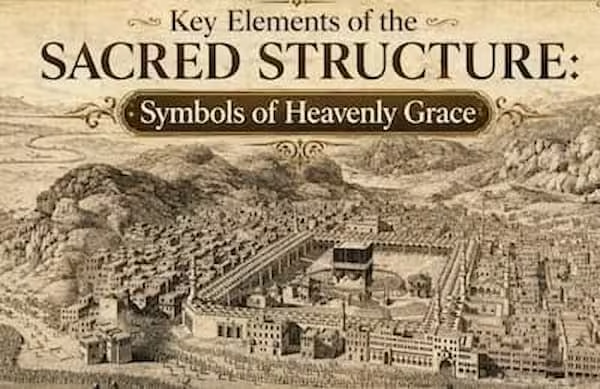
Key elements of the sacred structure — symbols of heavenly grace in the Masjid al-Haram.
The Black Stone (Hajar al-Aswad) in Hajj and Umrah: History and Origins
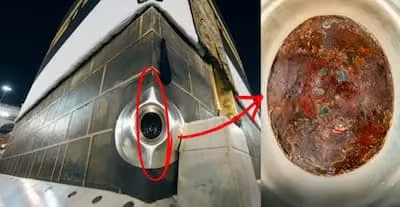
The sacred Black Stone (Hajar al-Aswad) set in the Kaaba, highlighted in its original position.
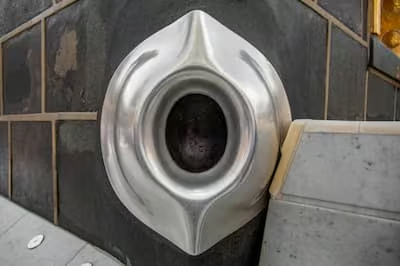
The modern silver frame that now protects and holds the Black Stone (Hajar al-Aswad).
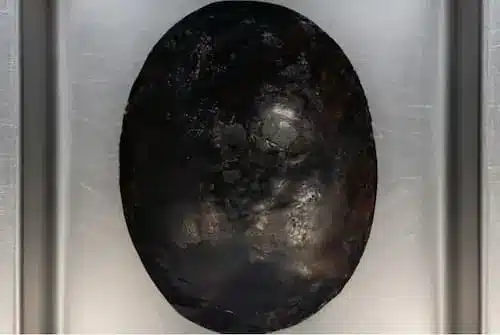
The Black Stone (Hajar al-Aswad) – an ancient relic revered by Muslims worldwide.
The Black Stone, a “Key Elements of the Sacred Structure” in the rituals of Hajj and Umrah—symbols of heavenly grace—holds a central and deeply spiritual place, connecting millions of Muslims to a heritage that stretches back to the earliest foundations of monotheistic worship. Situated in the eastern corner of the Kaaba, the Black Stone (Ḥajar al-Aswad) is much more than a physical object—it is a symbol of divine connection, obedience, and continuity of faith.
Traditions describe the Black Stone (Hajar al-Aswad)—one of the key elements of the sacred structure and a symbol of heavenly grace—as originally white, representing purity and divine light. Over time, it is believed to have turned black due to the sins of humanity. This transformation carries deep spiritual meaning, reflecting the impact of human actions while reminding believers of the enduring possibility of repentance, forgiveness, and spiritual renewal.
Key Elements of the Sacred Structure – Traditions describe the stone as originally white, symbolizing purity and divine light, but over time it turned black due to the sins of humanity. This transformation carries deep spiritual meaning, representing the impact of human actions while also reminding believers of the possibility of repentance and renewal.
Historically Key Elements of the Sacred Structure, the Black Stone (Hajar al-Aswad) was revered even before Islam. However, with the advent of Islam, its significance was purified from any elements of idolatry and firmly established within the framework of worshipping one God alone. The Prophet Muhammad ﷺ further reinforced this meaning during the rebuilding of the Kaaba, when he resolved a tribal dispute by involving all leaders in placing the Black Stone (Hajar al-Aswad) collectively—an act symbolizing unity and justice.
Physically Key Elements of the Sacred Structure, The Black Stone (Hajar al-Aswad) today consists of several fragments held together within a silver frame, the result of damage sustained over centuries. Despite its altered form, its spiritual significance remains unchanged.
Thus Key Elements of the Sacred Structure, The Black Stone (Hajar al-Aswad) in Hajj and Umrah stands as a timeless link between the heavens and the earth, reminding believers of their shared spiritual heritage and their deep connection to the legacy of the prophets.
The Black Stone (Hajar al-Aswad) in Hajj and Umrah: A Divine Test of Faith and Obedience
The Black Stone (Hajar al-Aswad), a key element of the sacred structure and a symbol of heavenly grace in Hajj and Umrah, also represents a profound test of faith, reflecting the essence of submission to Allah’s will. This concept can be understood through the story of Adam and the refusal of Iblis to obey Allah’s command.
When Allah created Adam عليه السلام, He commanded the angels to prostrate before him. As stated in the Qur’an:
“And [mention] when We said to the angels, ‘Prostrate before Adam,’ and they prostrated, except for Iblis. He refused and was arrogant and became of the disbelievers.”
(Surah Al-Baqarah 2:34)
Iblis’s refusal was rooted in arrogance. He believed himself superior due to being created from fire, while Adam was created from clay. This moment established a timeless lesson: disobedience stems from pride, while true faith is rooted in humility and submission.
In a similar way, the Black Stone (Hajar al-Aswad) in Hajj and Umrah, one of the Key Elements of the Sacred Structure: Symbols of Heavenly Grace, serves as a profound test for believers. Allah commanded—through the practice of Prophet Muhammad ﷺ—that pilgrims kiss or gesture toward the stone during tawaf.
While the act may appear simple on the surface, its deeper meaning lies in complete obedience without questioning divine wisdom.
A true believer does not dismiss the act by reasoning that it is merely a stone. Instead, they submit wholeheartedly, understanding that its value comes from following Allah’s command. This reflects the essence of faith—trusting and obeying beyond human logic.
This principle is reinforced in the Qur’an:
“It is not for a believing man or woman, when Allah and His Messenger have decided a matter, that they should [thereafter] have any choice about their affair.”
(Surah Al-Ahzab 33:36)
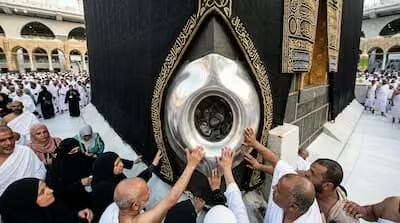
Devoted pilgrims raising their hands to touch the sacred Black Stone (Hajar al-Aswad) embedded in the Kaaba during Tawaf – a profound act of faith and obedience in Hajj and Umrah.
This act distinguishes between humility and arrogance. Where Iblis failed due to pride, the believer succeeds through submission. The Black Stone (Key Elements of the Sacred Structure) thus becomes a symbolic measure of faith, revealing the sincerity of one’s devotion.
Importantly, Muslims do not worship the stone itself. It holds no independent power; rather, it is honored because it is connected to a divine command.
In this way, the Black Stone (Key Elements of the Sacred Structure) in Hajj and Umrah, as one of the key elements of the sacred structure and symbols of heavenly grace, serves as a powerful reminder that true faith lies not in understanding everything, but in trusting Allah completely.
“True faith lies not in understanding everything, but in trusting Allah completely.”
The Black Stone (Hajar al-Aswad) in Hajj and Umrah: Role in Hajj and Umrah Rituals
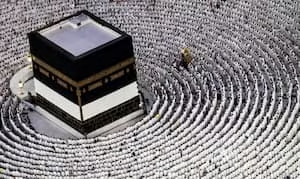
Pilgrims performing Tawaf around the Kaaba during Hajj and Umrah, where the Black Stone (Hajar al-Aswad) marks the starting point of each circuit.
The Black Stone (Key Elements of the Sacred Structure) in Hajj and Umrah plays a central and defining role in the rituals performed by millions of pilgrims each year. Its position in the Kaaba marks the starting and ending point of tawaf, the act of circumambulating the Kaaba seven times in devotion to Allah.
As pilgrims begin tawaf, they align themselves with the Black Stone (Key Elements of the Sacred Structure), either by kissing it, touching it, or gesturing toward it if they are unable to approach due to crowds. This act is known as Istilam and symbolizes the beginning of a sacred journey centered on remembrance and submission.
Each circuit of tawaf begins and ends at the Black Stone (Key Elements of the Sacred Structure), giving the ritual both structure and unity. Despite the diversity of pilgrims—coming from different cultures, languages, and backgrounds—all are united in this shared act of worship. The stone thus becomes a focal point of global spiritual unity.
➤ Key aspects of its ritual role include:
- Starting point of tawaf: Every circuit begins at the Black Stone
- Physical or symbolic interaction: Pilgrims kiss, touch, or gesture toward it
- Spiritual alignment: It represents the orientation of the heart toward Allah
The Prophet Muhammad ﷺ himself kissed the Black Stone (Key Elements of the Sacred Structure), establishing it as a Sunnah. However, he also emphasized ease and accessibility in worship. Therefore, if reaching the stone becomes difficult, pilgrims are encouraged to simply point toward it, ensuring that the ritual remains inclusive and manageable.
It is crucial to understand that this interaction is not an act of worship directed toward the stone. Rather, it is an act of obedience that follows the example of the Prophet ﷺ. The intention behind the act is what gives it meaning.
Through its role in Hajj and Umrah, the Black Stone (Key Elements of the Sacred Structure) transforms from a physical object into a spiritual guidepost—directing movement, intention, and devotion. It reminds pilgrims that their journey is not just physical but deeply spiritual, centered on unity, humility, and remembrance of Allah.
The Black Stone (Hajar al-Aswad) in Hajj and Umrah: Spiritual Significance
The spiritual significance of the Black Stone (Key Elements of the Sacred Structure) in Hajj and Umrah extends far beyond its historical and ritual roles. It serves as a powerful symbol of faith, repentance, and the eternal relationship between humanity and Allah.
One of the most profound aspects of the Black Stone is its connection to the idea of a covenant between Allah and humanity. Some Islamic traditions suggest that the stone will bear witness on the Day of Judgment for those who approached it with sincerity. This belief elevates the act of touching or gesturing toward the stone into a deeply personal and spiritual experience.
The transformation of the stone—from white to black—is often interpreted as a reflection of human nature. Just as the stone darkened due to sins, the human heart can also become clouded. Yet, through repentance and devotion, spiritual purification remains possible.
➤ The Black Stone also reinforces key spiritual lessons:
- Humility before Allah: Pilgrims demonstrate submission regardless of personal reasoning
- Unity of the Ummah: Millions perform the same act, symbolizing equality and brotherhood
- Focus on intention (niyyah): The value of the act lies in sincerity, not physical contact
Moreover, the presence of the Black Stone within the Kaaba connects believers across time. From Prophet Ibrahim عليه السلام to Prophet Muhammad ﷺ and continuing to modern pilgrims, it represents an unbroken chain of devotion.
In a world often driven by logic and material understanding, the Black Stone (Hajar al-Aswad) reminds believers of a higher truth: that faith sometimes requires trust beyond comprehension. It teaches that submission to Allah is the highest form of dignity, not a loss of it.
Ultimately, the Black Stone stands as a timeless symbol of spiritual reflection. It calls believers to examine their hearts, renew their intentions, and strengthen their connection with Allah. Through it, the journey of Hajj and Umrah becomes not just a physical pilgrimage, but a transformative spiritual experience.
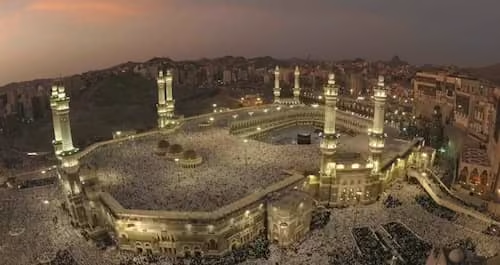
Millions of pilgrims performing Tawaf around the Kaaba, where the sacred Black Stone (Hajar al-Aswad) is located.
These artistic renditions not only preserve history but also motivate viewers to appreciate the Kaaba‘s enduring beauty and spiritual depth. They evoke emotions of wonder, drawing us closer to the divine narrative.
Historically, the Kaaba has undergone reconstructions due to natural disasters like floods and human conflicts, yet its core foundations—laid by Ibrahim عليه السلام—remain intact. Each rebuild honors the original design, a testament to resilience and divine protection.
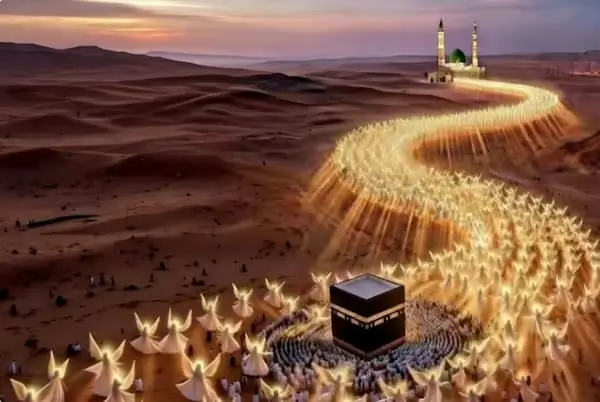
A powerful symbolic representation of the spiritual journey during Hajj and Umrah, showing millions of pilgrims drawn toward the Kaaba where the Black Stone (Hajar al-Aswad) resides.