
One Father, Three Paths
One Father, Three Paths: How Judaism, Christianity, and Islam understand the covenant of Abraham (A.S.)
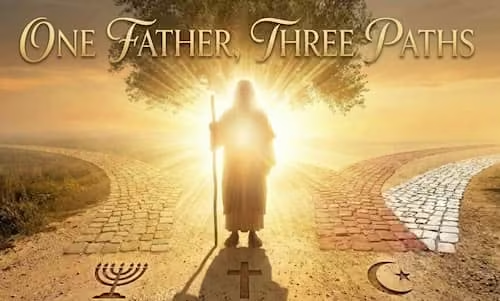
One Father, Three Paths: One divine source, three sacred journeys.
The figure of Abraham (A.S.) stands as the single greatest point of convergence among the three Abrahamic faiths. Jews, Christians, and Muslims all trace their spiritual lineage to him and claim to be heirs of the promises God made to the Friend of God (Khalil Allah). Yet each tradition understands the content, scope, and fulfilment of those covenants in markedly different ways. This article examines the original biblical and Qur’anic texts alongside authoritative classical sources to present, respectfully and accurately, both the shared heritage and the distinct lessons each community draws from the Abrahamic covenant.
One Father, Three Paths - The Covenant in the Torah: Election and Land
The Covenant in the Torah: Election and Land — God’s eternal promise to His chosen people.
One Father, Three Paths: In the Book of Genesis, God establishes two foundational covenants with Abraham (A.S.):
- Genesis 15 – The Covenant of the Pieces: God promises Abraham innumerable descendants and the land “from the river of Egypt to the great river Euphrates.”
- Genesis 17 – The Covenant of Circumcision: Circumcision becomes the eternal sign of the covenant, and God declares, “I will establish My covenant between Me and you and your offspring after you… to be God to you and to your offspring after you” (17:7). The promise is reiterated through Isaac: “through Isaac shall your offspring be named” (21:12).
Jewish tradition, as reflected in the Talmud and later rabbinic literature, understands this as an everlasting covenant of election: Israel is chosen as a “kingdom of priests and a holy nation” (Exodus 19:6), bound by the Torah revealed at Sinai. The land of Israel remains the geographic centre of the covenant, and physical descent combined with fidelity to the commandments secures its continuity.
One Father, Three Paths - The Christian Reinterpretation, A New Covenant in Christ
One Father, Three Paths: The New Testament radically re-reads the Abrahamic promise. Paul, in Galatians 3:16, argues that the “seed” (singular) promised to Abraham refers not to the Jewish people collectively but to Christ: “Now the promises were made to Abraham and to his offspring… who is Christ.” Faith in Jesus, rather than physical descent or Torah observance, becomes the true mark of Abraham’s children (Galatians 3:7, Romans 4:16).
The Epistle to the Hebrews (8:6–13) presents Jesus as mediator of a “new covenant” that supersedes the old, quoting Jeremiah 31:31–34. For most of Christian history, this has been understood to mean that the Church — comprising Jews and Gentiles who believe in Christ — is the spiritual heir of Abraham’s promise, while the old covenant with national Israel has been fulfilled and transcended.
One Father, Three Paths - The Islamic Perspective, Renewal, and Universalisation
The Qur’an reaffirms the Abrahamic covenant but presents its fullest expression through both sons — Ishmael (A.S.) and Isaac (A.S.) — culminating in the final prophethood of Muhammad (ﷺ).
|
|
|
|
Thus Islam views itself as both the restorer of pure Abrahamic monotheism (millat Ibrahim, 2:135; 3:95) and its universal completion, open to every nation without distinction of race or ancestry.
One Father, Three Paths - Shared Elements Across the Three Traditions
Despite theological differences, remarkable common threads remain:
One Father, Three Paths - Shared Element
Monotheism as the core of Abraham’s (A.S.) legacy
Circumcision (or its spiritual equivalent) as a covenantal sign
Willingness to sacrifice the beloved son
Pilgrimage to sacred sites linked to Abraham (A.S.)
Distinctive Lessons — Understanding the unique teachings of the three Abrahamic faiths
➤ Judaism is described as “Particularist (chosen nation)”
➤ Christianity as “Universal through Church”
➤ Islam as “Universal through ummah”
Judaism Covenant = election of Israel+eternal Torah |
Christianity Covenant = Fulfilled & universalised in Christ |
Islam Covenant = Restored & completed through Muhammad ﷺ |
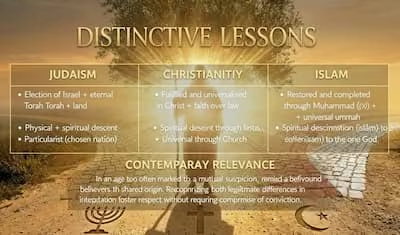
Distinctive Lessons — Understanding the unique teachings of the three Abrahamic faiths.
Conclusion: Shared roots and different understandings
Recognising both the common father and the legitimate differences in interpretation can foster respect without requiring compromise of conviction. Abraham (A.S.) remains the ultimate model of the person who left everything — homeland, comfort, even the expected sacrifice of his son — for the sake of God alone. Each tradition calls its adherents to walk in his footsteps, according to the light it has received.
“Say, ‘We believe in God and what has been revealed to us and what was revealed to Abraham (A.S.), Ishmael (A.S.), Isaac (A.S.), Jacob, and the tribes…’”
(Qur’an 2:136)
Abraham (A.S.) remains the ultimate model of the person who left everything — homeland, comfort, even the expected sacrifice of his son — for the sake of God alone. Each tradition calls its adherents to walk in his footsteps, according to the light it has received.

Conclusion: One sacred city, three Abrahamic faiths, one divine source.
May Allah’s peace and blessings be upon Ibrahim (A.S.), the close friend of Allah.
2025 Read & Riser – All praise is due to Allah, Lord of the worlds.