
The Arrival of the Throne
Part B

The Arrival of the Throne — majestic glowing throne appears before the royal court in a breathtaking palace scene.
The Arrival of the Throne ➤ A Miracle Faster Than the Blink of an Eye
The Arrival of the Throne began the moment Hazrat Sulayman (A.S.) asked his assembly who could bring Queen Bilqis’s throne before her arrival in submission.
The response revealed layers of divine wisdom and power.
A mighty jinn, boasting of his strength and reliability, immediately offered to transport the throne before Sulayman even rose from his seat.
This promise showcased the extraordinary capabilities granted to the jinn under prophetic command, yet it remained within the realm of created effort and time.
Before the jinn could proceed, however, an even greater sign unfolded.
The Arrival of the Throne was then promised by a righteous servant blessed with knowledge from the Scripture—traditionally identified as Asif ibn Barkhiya.
He spoke with unwavering certainty.
He declared that he would bring the throne before Sulayman’s glance returned to him.
In that split second, through sincere supplication and by Allah’s direct permission, the magnificent throne appeared in the royal court.
The Arrival of the Throne required no journey that was visible, no effort exerted by human or jinn hands.
The throne—renowned for its exquisite goldwork, dazzling jewels, intricate carvings, and symbols of Sheba’s prosperity—simply materialized.
It covered immense distance from distant Saba to Jerusalem instantaneously.
This was a clear demonstration that Allah’s command surpasses all limits of space, time, and physical law.
What seemed utterly impossible to the strongest of creation was effortless for the Creator.
In the face of this astonishing miracle, The Arrival of the Throne led Hazrat Sulayman (A.S.) to display the hallmark of true prophethood: profound humility and immediate gratitude.
He did not claim the feat for himself or his court.
Instead, he turned to Allah, acknowledging it as a divine favor and a test of his own thankfulness.
His words reminded all present—and every reader across centuries—that miracles belong solely to Allah, and the role of His servants is to recognize, praise, and remain ever grateful.
The Arrival of the Throne was more than a display of power; it was preparation for Queen Bilqis’s heart to open.
The object she prized as the pinnacle of her worldly authority now stood before her as undeniable proof of a higher dominion, gently guiding her toward submission to the One True God.
A Test for the Queen: A Gentle Invitation to Reflection and Truth
The Arrival of the Throne continued when Queen Bilqis finally entered the grand palace of Hazrat Sulayman (A.S.).
The moment was carefully prepared with prophetic wisdom.
Sulayman (A.S.) did not rush to display the throne as a boastful trophy.
Instead, he had it presented to her in a subtly altered form—perhaps with slight rearrangements of its ornaments, a change in positioning, or a minor disguise that preserved its essential beauty while introducing an element of unfamiliarity.
This was never intended to humiliate or trick her; it was a thoughtful test crafted to engage her celebrated intelligence, sharp perception, and openness to truth.
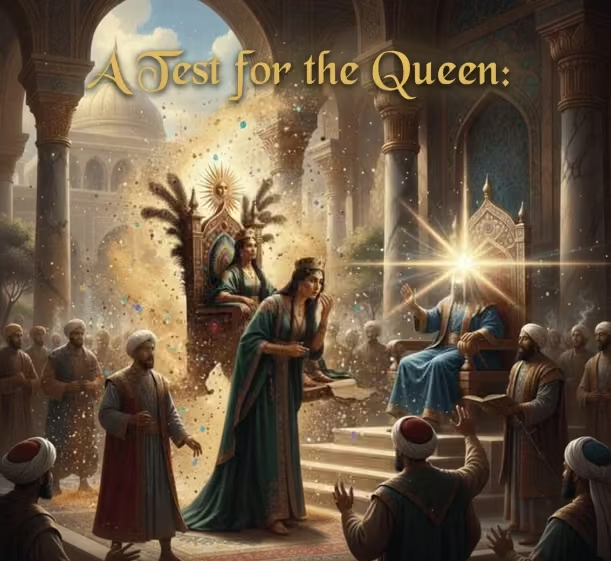
Divine radiance illuminates the queen’s test of wisdom and faith.
The Arrival of the Throne led him to ask her calmly: “Is this your throne?”
The question invited her to observe closely, to compare what she knew so intimately with what now stood before her in this distant court.
Bilqis, true to her reputation as a discerning and prudent ruler, did not respond impulsively.
She examined the throne with care and answered with measured honesty: “It appears to be the same.”
Her reply was neither a flat denial born of pride nor an overconfident claim of ownership.
It reflected wisdom—she acknowledged the striking resemblance while leaving room for the extraordinary nature of its presence, showing humility in the face of something beyond ordinary explanation.
This poised and thoughtful response marked a pivotal softening of her heart.
The Arrival of the Throne meant that the throne, once the unchallenged emblem of her sovereignty and her people’s worldly achievements, now stood as living proof that material grandeur could be transcended effortlessly.
How could an object so central to her identity appear here, intact and unaltered in essence, unless guided by a power infinitely superior to human kingship or craftsmanship?
The Arrival of the Throne through the subtle test achieved its divine purpose: it stirred her insight, helping her see that the powers and possessions of this world are fleeting and insignificant compared to the boundless knowledge and authority of Allah.
In that moment of quiet reflection, the seeds of tawhid were planted deeper.
Bilqis’s cautious yet open reply prepared her soul for the greater signs ahead—the shimmering crystal floor that would humble her further—and ultimately guided her to the profound confession of faith that ended her journey from sun-worship to complete submission to the Lord of the worlds.
The Arrival of the Throne through this gentle encounter reveals a beautiful lesson in da’wah: true guidance often comes not through force or overwhelming display, but through questions that awaken the mind and heart, inviting the seeker to recognize divine truth on their own terms.
A Throne That Led to Faith: From Earthly Splendor to Submission to the One True God
The Arrival of the Throne was far more than a breathtaking display of supernatural power.
It served as a profound catalyst in her spiritual awakening.
What she had long regarded as the ultimate emblem of her sovereignty—crafted with unmatched artistry, gold, jewels, and the pride of her entire nation—now stood before her in a place it could never have reached by ordinary means.
The Arrival of the Throne shattered the illusion of self-sufficiency.
She witnessed firsthand that the authority Sulayman (A.S.) wielded was not rooted in military might, human ingenuity, or even the assistance of jinn.

Divine light envelops the queen in sacred audience—a beacon of wisdom and strength.
It flowed directly from the Lord of all creation, the One who commands the heavens, the earth, and everything between.
The Arrival of the Throne through the throne’s effortless relocation across vast distances in an instant planted seeds of doubt in her previous beliefs.
If such an object, central to her identity and her people’s sun-worship, could be summoned and placed at the feet of a prophet of Allah, then surely the sun she and her subjects had prostrated to held no true dominion.
The Arrival of the Throne began to erode the veil of idolatry that had clouded her heart and mind for so long.
Lessons from the Story of the Throne
➤ Timeless Wisdom from the Miracle of Bilqis and Sulayman (A.S.)
The miraculous journey of Queen Bilqis’s throne in the court of Hazrat Sulayman (A.S.) is far more than a historical or Quranic narrative—it offers profound, enduring lessons for every believer and seeker of truth. These teachings continue to guide hearts across centuries:
➤ True power belongs to Allah alone:
No matter how vast a kingdom, how splendid a throne, or how mighty an army, all worldly authority is fleeting and subordinate. The effortless transportation of the throne across immense distances demonstrated that ultimate dominion rests solely with Allah. Material strength, wealth, and position crumble before divine will, reminding us that every blessing we possess is a trust from the Creator.

Divine throne, open Quran, and scales of justice descend in radiant light—a vision of heavenly guidance and equity.
➤ Knowledge is greater than force:
Sulayman (A.S.) did not resort to conquest or intimidation. Instead, he employed wisdom, clear signs, and gentle invitation to awaken Bilqis’s heart. The miracle unfolded through knowledge granted to a humble servant, proving that intellectual and spiritual insight triumphs over brute power. True guidance reaches the soul through understanding, not coercion.
➤ Humility opens the door to truth:
Queen Bilqis, despite her intelligence, wealth, and authority, did not cling to pride when confronted with undeniable signs. Her cautious yet open response to the disguised throne, and her eventual confession of wrongdoing, show that humility before Allah’s signs is the key to receiving guidance. Arrogance blinds; surrender illuminates.
➤ Miracles serve as reminders, not entertainment:
The relocation of the throne was never meant to astonish for its own sake. It was a purposeful sign to stir reflection, dispel falsehood, and draw hearts toward tawhid. Miracles in the Quran are always tied to faith—they awaken belief, correct misconceptions, and call people to the straight path, rather than merely dazzling the eyes.
➤ A ruler’s greatness lies in justice and sincerity:
Both Sulayman (A.S.) and Bilqis exemplified noble leadership. Sulayman ruled with gratitude, mercy, and prophetic wisdom; Bilqis governed through consultation, diplomacy, and fairness. Her ultimate submission elevated her from a queen of worldly splendor to one who embraced divine justice. True greatness is measured not by crowns or thrones, but by sincerity toward Allah and equity toward creation.
💡 Note
These lessons converge in one eternal truth: the path to real success lies in recognizing Allah’s sovereignty, embracing humility, seeking knowledge, and responding to divine signs with an open heart. The throne that once symbolized earthly pride became, through Allah’s mercy, a bridge to everlasting faith.
Conclusion: A Throne Transformed – From Worldly Majesty to Eternal Submission
The Arrival of the Throne, as narrated in Surah An-Naml, transcends the boundaries of a mere historical miracle.
It stands as a timeless masterpiece of divine wisdom, meticulously orchestrated by Allah to unveil profound truths about power, knowledge, humility, and faith.
What began as an opulent object of earthly splendor—crafted from gold, encrusted with jewels, and revered as the pinnacle of Sheba’s prosperity—became, through Allah’s command, an instrument of spiritual revolution.
The Arrival of the Throne in the court of Hazrat Sulayman (A.S.) shattered illusions of self-sufficiency.
A queen who ruled with unmatched intelligence, consulted her nobles with prudence, and governed a kingdom of gardens and trade suddenly confronted the limits of her dominion.
The effortless relocation of her most cherished symbol across vast distances in the blink of an eye declared unequivocally: true authority belongs to Allah alone.
No army, no ingenuity, no alliance of jinn or men could replicate what divine permission achieves without strain.
This was not a spectacle for entertainment; it was a merciful sign, layered with purpose, designed to penetrate the heart and awaken the soul.
The Arrival of the Throne showed that Sulayman (A.S.), the prophet of profound wisdom, exemplified the highest form of leadership.
He did not conquer with force or humiliate with pride.
Instead, he invited through gentle signs, subtle tests, and unwavering gratitude.
The disguised throne tested Bilqīs’s perception; the crystal floor humbled her physically while elevating her spiritually.
Each element served da’wah at its purest—guiding without coercion, revealing truth without compulsion.
His constant return to praise—“This is from the favor of my Lord”—reminded all that miracles are trusts from Allah, tests of thankfulness, and proofs of His nearness to the sincere.
The Arrival of the Throne also highlights that Queen Bilqīs herself emerges as a figure of enduring inspiration.
Far from a passive observer, she embodied the nobility of a seeker: wise yet open, powerful yet humble.
When confronted with the inexplicable, she did not retreat into denial or arrogance.
Her measured response—“It appears to be the same”—reflected intellectual honesty; her final declaration—“My Lord, indeed I have wronged myself, and I submit with Solomon to Allah, Lord of the worlds”—marked the triumph of tawhid over idolatry.
In submitting, she exchanged a throne of gold for the eternal throne of faith, proving that true greatness lies not in ruling kingdoms but in surrendering to the King of kings.
This Quranic narrative delivers eternal lessons with resounding clarity: |
➤ Divine power eclipses all worldly might—thrones, empires, and achievements are but shadows before Allah’s command. |
➤ Guidance flows through wisdom and mercy, not domination; Sulayman’s approach teaches effective da’wah for every era. |
➤ Humility is the gateway to enlightenment—Bilqīs’s journey shows that pride blinds, while openness illuminates. |
➤ Signs are calls to reflection, urging humanity to look beyond the visible to the Creator behind every phenomenon. |
The Arrival of the Throne reminds us that in an age where material success often masquerades as ultimate fulfillment, the throne of Bilqīs stands as a beacon.
It reminds every soul—ruler or commoner, wealthy or striving—that no attainment is complete without recognition of Allah’s sovereignty.
The Arrival of the Throne shows that what once symbolized fleeting glory became the very means of eternal salvation.
The Arrival of the Throne calls us to, like Bilqīs, allow divine signs to soften our hearts; like Sulayman (A.S.), respond with gratitude and wisdom; and like both, find our highest honor in complete submission to Allah, Lord of the worlds.
Indeed, in His remembrance and obedience lies true power, lasting peace, and everlasting success.
The Arrival of the Throne teaches that true fulfillment is found only in submission to Allah.

Heavenly lotus of justice unfolds with Throne, Quran, and scales—symbol of Allah’s perfect Adl (The Just) guiding the faithful.
Page 13