
Birth of Prophet Musa (AS) in Quran: Mother’s Faith, Divine Rescue & Bani Israel Story
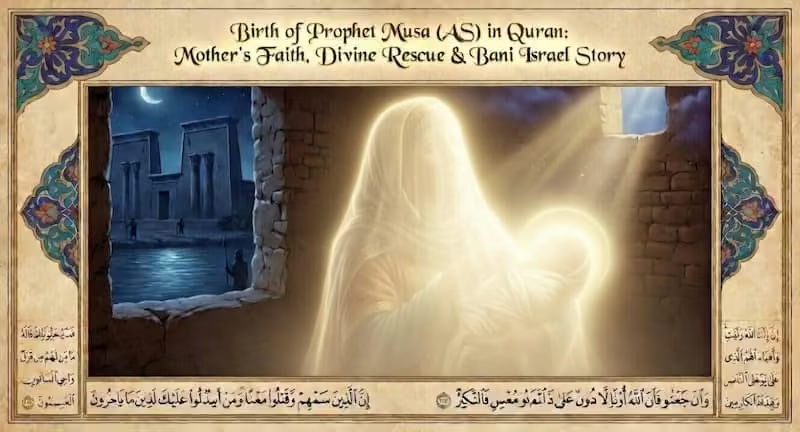
The Faith of Prophet Musa’s Mother – Divine Protection Over Baby Musa (AS)
1 ➤ Introduction: The Birth of Prophet Musa (AS) in the Quran
Among the most powerful and frequently mentioned prophets in divine history is Prophet Musa (Moses) (A.S.), a towering figure revered in the traditions of Islam, Christianity, and Judaism alongside Prophet Ibrahim (A.S.). His life is not merely a story of survival and leadership but a profound narrative of faith, divine intervention, justice, and liberation. From his miraculous rescue as an infant to his role as the leader of Bani Israel (the Children of Israel), every phase of his life carries deep spiritual and historical significance, teaching humanity about reliance on Allah (SWT), the triumph of truth over tyranny, and the resilience required in guiding a community through trials.
The Qur’an dedicates extensive passages to the story of Musa (A.S.), particularly in Surahs Al-Qasas, Ta-Ha, Al-A’raf, and Al-Baqarah, highlighting his birth under oppression, his prophethood, and his mission to free Bani Israel. This article explores in detail the birth of Musa (A.S.), the history of his parents, his relationship with Bani Israel, how his mother was divinely guided to save him, and a brief mention of the historical river associated with his story. Through accurate Qur’anic verses and explanations, we uncover timeless lessons of tawakkul (trust in Allah), patience, and divine wisdom. The story reminds believers that Allah’s plans unfold perfectly even in moments of apparent despair, transforming danger into deliverance and oppression into liberation.
Prophet Musa (A.S.)’s narrative exemplifies how Allah elevates the oppressed and humbles the arrogant. As the Qur’an states in multiple places, Musa (A.S.) was chosen not only to confront Pharaoh but also to receive the Torah and guide his people spiritually. His life continues to inspire millions across centuries, offering guidance on faith when circumstances seem impossible.
2 ➤ Birth of Musa (A.S.) and Historical Context
Prophet Musa (A.S.) was born during a time of severe oppression in ancient Egypt under the rule of a tyrannical king referred to as Pharaoh. The Qur’an vividly describes this era of tyranny without naming the specific Pharaoh, focusing instead on the systemic injustice inflicted upon Bani Israel.
According to the Qur’an, Pharaoh exalted himself in the land, divided its people into factions, and oppressed a sector among them—specifically the descendants of Prophet Yaqub (Jacob) (A.S.), known as Bani Israel. The divine revelation states:
“Indeed, Pharaoh exalted himself in the land and divided its people into factions, oppressing a sector among them, slaughtering their [newborn] sons and keeping their females alive. Indeed, he was of the corrupters.”
(Qur’an 28:4) 📖
This oppression included forced labor, humiliation, and the brutal decree to kill newborn male children of Bani Israel while sparing females. The Qur’an further explains Allah’s overarching plan in response to this cruelty:
“And We wanted to confer favor upon those who were oppressed in the land and make them leaders and make them inheritors [of the land]. And to show Pharaoh and Haman and their soldiers precisely that which they feared.”
(Qur’an 28:5-6) 📖
The Bani Israel had been in Egypt since the time of Prophet Yusuf (A.S.), initially welcomed and favored, but later generations faced escalating enslavement and torment under a new Pharaoh who did not acknowledge the previous benefits bestowed upon Egypt through Yusuf (A.S.). The Qur’an reminds Bani Israel of this salvation in several verses, such as:
“And [recall] when We saved you from the people of Pharaoh, who were afflicting you with the worst torment—killing your sons and sparing your women. And in that was a great trial from your Lord.”
(Qur’an 2:49) 📖
Islamic traditions elaborate that Pharaoh acted out of fear—stemming from dreams or reports of a boy from Bani Israel who might challenge his rule—but the Qur’an emphasizes the general corruption and oppression rather than detailing a specific prophecy. It was in this atmosphere of fear and brutality that Musa (A.S.) was born, destined by Allah to become a messenger who would liberate his people and confront the very tyrant who sought to destroy him. This context sets the stage for divine intervention, showing how Allah turns the plots of the oppressors against them. The birth of Musa (A.S.) thus marks the beginning of a divine plan for justice and the elevation of the oppressed.
3 ➤ Parents of Musa (A.S.)
The parents of Musa (A.S.) played pivotal roles in his survival and upbringing, embodying righteousness and unwavering faith amid extreme danger. While the Qur’an does not explicitly name his father, Islamic historical and traditional narrations refer to him as Imran, a righteous man from the lineage of Bani Israel. He is believed to have passed away either before or shortly after Musa’s birth, leaving his wife to raise the child alone under the shadow of Pharaoh’s decree.
Imran (A.S.) is remembered in narrations as a devout believer who trusted in Allah’s mercy despite the oppression facing his community. His lineage traces back through the prophets of Bani Israel, connecting Musa (A.S.) directly to the prophetic chain from Ibrahim (A.S.) through Yaqub (A.S.). Though little is detailed about his personal life in primary sources, his role as a father in such perilous times underscores the quiet strength of believers who plant seeds of faith for future generations.
3.1 ➤ Mother: A Woman of Extraordinary Faith
The mother of Musa (A.S.) stands as one of the most remarkable women in Islamic history, honored for her profound faith, courage, and complete reliance on Allah despite not being named in the Qur’an. Facing the imminent threat that her newborn son would be killed per Pharaoh’s order, she received direct divine inspiration—a form of guidance (wahy in the general sense, not prophetic revelation reserved for messengers).
Her story exemplifies maternal love fused with spiritual surrender. Instead of succumbing to fear, she acted on Allah’s command with absolute trust. This extraordinary faith transformed a moment of potential tragedy into the foundation of prophetic deliverance. Her actions remind believers that true strength lies in obeying Allah even when logic and emotion suggest otherwise. The Qur’an portrays her as a model of patience and tawakkul, her heart filled with hope in divine promises rather than despair.
4 ➤ Divine Guidance to Save Musa (A.S.)
At the heart of Musa’s survival is a moment of profound divine intervention. Allah inspired his mother with a clear, reassuring plan:
“And We inspired to the mother of Moses, ‘Suckle him; but when you fear for him, cast him into the river and do not fear and do not grieve. Indeed, We will return him to you and will make him [one] of the messengers.’”
(Qur’an 28:7)
This was no ordinary dream or intuition; it was a direct command from the Creator, accompanied by a solemn promise of return and elevation to prophethood. Imagine the emotional turmoil—a mother breastfeeding her infant one moment, then preparing a secure chest or basket the next, placing her child inside, and releasing it into the flowing waters. Yet, her faith prevailed. She did not fear nor grieve because Allah had assured her of the outcome.
This verse beautifully illustrates Allah’s mercy and precise planning. The mother’s obedience set in motion a chain of events that would not only save Musa (A.S.) but position him within Pharaoh’s own household—ironically, under the protection of the enemy’s palace. It teaches that divine inspiration can come to righteous believers in times of crisis, guiding them toward safety and purpose. Her courage remains a timeless example of how complete trust in Allah turns apparent peril into protected destiny.
4.1 ➤ The River: The Nile and Its Importance
The River Nile was already central to Egypt’s agriculture, economy, and transportation. It symbolized life, sustenance, and continuity for the ancient Egyptians. Its significance grew even greater in the story of Prophet Musa (AS) when his mother, trusting in Allah’s command, placed him in a basket that floated along the Nile and ultimately reached the palace of Pharaoh himself — the very tyrant who sought to kill him.
5 ➤ The Return to His Mother: Prophet Moses’ Journey from the Nile River to Pharaoh’s Palace and Back to His Real Mother
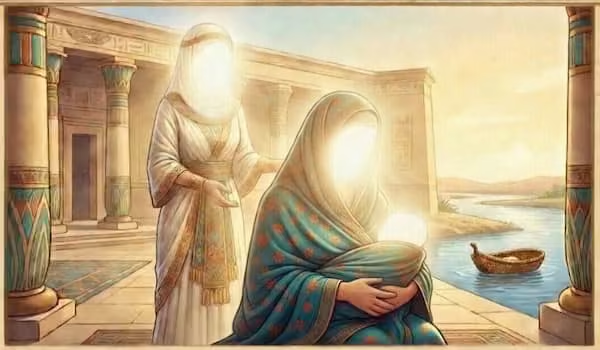
Prophet Musa (AS) as a Baby – Mother’s Faith and Divine Protection
One of the most touching fulfillments of Allah’s promise follows immediately. The basket carrying infant Musa (A.S.) was discovered by the family of Pharaoh. As detailed in the Qur’an:
“Then the family of Pharaoh picked him up so that he would become for them an enemy and a cause of grief. Indeed, Pharaoh and Haman and their soldiers were sinners.” (Qur’an 28:8)
Pharaoh’s wife pleaded for his life, seeing him as a source of joy: “This is a joy for me and for you. Do not kill him; perhaps he will benefit us or we will take him as a son.” (Qur’an 28:9, paraphrased in context)
Musa (A.S.) refused to nurse from any woman in the palace, causing distress. His sister, who had been discreetly following the basket along the riverbank, stepped forward and suggested a nurse from a suitable family—none other than his own mother.
Thus, through intricate divine orchestration:
- Musa (A.S.) was returned safely to his biological mother.
- She was compensated for nursing him while he remained under royal protection.
- Her fear turned to peace, and her grief to certainty in Allah’s word.
The Qur’an completes this beautiful sequence in verses 28:10-13, emphasizing how Allah’s promise was fulfilled exactly. This reunion not only saved the child but allowed his mother to raise him with love and faith in the very heart of the oppressor’s domain. It highlights Allah’s subtle yet perfect wisdom—using the enemy’s resources to nurture His messenger.
6 ➤ Relationship with Bani Israel: Lineage and Identity

Musa (A.S.) belonged to Bani Israel, the descendants of Prophet Yaqub (Israel) (A.S.). Despite being raised in luxury within Pharaoh’s palace, his heart and identity remained rooted in this oppressed community.
6.1 ➤ Lineage and Identity
Musa (A.S.) belonged to Bani Israel, the descendants of Prophet Yaqub (Israel) (A.S.). Despite being raised in luxury within Pharaoh’s palace, his heart and identity remained rooted in this oppressed community.
6.2 ➤ Role as Liberator
Upon receiving prophethood, Musa (A.S.)’s mission was clear: to call Pharaoh to the worship of the One God (Allah), to free Bani Israel from bondage, and to guide them spiritually and socially. He repeatedly demanded, on Allah’s command, “Send the Children of Israel with me” (as echoed in verses such as Qur’an 7:105 and 20:47).
“[Who is] obligated not to say about Allah except the truth. I have come to you with clear evidence from your Lord, so send with me the Children of Israel.”
(Quran 7:105) 📖
“So go to him and say, ‘Indeed, we are messengers of your Lord, so send with us the Children of Israel and do not torment them. We have come to you with a sign from your Lord. And peace will be upon he who follows the guidance.'”
(Quran 20:47) 📖
As a lawgiver, he received the Torah—divine commandments establishing justice, moral order, and worship. As a leader, he endured the challenges of guiding Bani Israel through the exodus from Egypt.
6.3 ➤ Trials and Struggles with Bani Israel
The relationship was multifaceted and often tested. Bani Israel frequently displayed stubbornness, doubt, and ingratitude despite witnessing miracles like the parting of the sea and divine provision of manna and quails. The Qur’an recounts their complaints about food: “Would you exchange what is better for what is worse?” (Qur’an 2:61). In Musa’s absence, some worshipped the golden calf (detailed in Surah Ta-Ha 20:83-98 and Al-A’raf 7:148-150). They questioned his leadership and longed for the comforts of Egypt.
Yet, Musa (A.S.) remained patient, compassionate, and committed. He prayed for them, interceded during divine anger, and demonstrated resilience. His perseverance highlights the complexity of leadership: guiding a community through hardship while upholding truth. These trials underscore themes of gratitude, obedience, and the consequences of ingratitude, serving as lessons for all believers.
More Information from Quran
7 ➤ Broader Historical Impact and Lessons
The story of Musa (A.S.) has shaped moral thought, law, and faith across civilizations for millennia. Its themes include:
- Divine Justice vs. Tyranny: Pharaoh’s downfall proves oppression cannot prevail over Allah’s will.
- Faith and Trust: The mother’s obedience exemplifies ultimate tawakkul.
- Identity and Purpose: Musa (A.S.) chose truth over palace luxury.
- Leadership Under Pressure: Guiding a challenging community with patience and compassion.
The Nile symbolizes divine protection—danger turned to safety, death to life—illustrating that Allah’s plan surpasses human comprehension. Ultimately, the life of Prophet Musa (A.S.) teaches: trust in Allah even when impossible; oppression yields to truth; divine plans unfold unexpectedly. His legacy inspires resilience, justice, and unwavering faith, reminding humanity that guidance, mercy, and liberation are always within reach through submission to the Creator.