
Part 1 — Earth as a Living Body
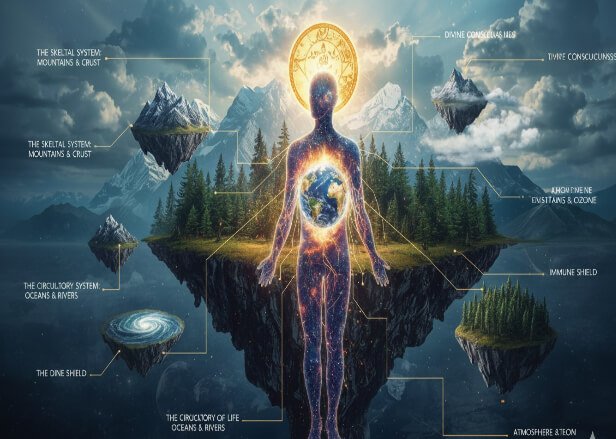
Gaia 🌿Biosphere🌿 Planetary Consciousness 🌍
A Deep Symbolic, 💚 Scientific, 💚 and 💚 Spiritual Exploration
Introduction: 🫁 A Planet That Breathes, Bleeds, and Feels
For thousands of years, poets, philosophers, indigenous elders, and mystics have referred to Earth as Mother, as Gaia, as a living being. Today, modern science quietly confirms what ancient wisdom always knew: our planet is not a dead rock with life stuck on it like moss. It is a single, self-regulating, interconnected super-organism.
When we dare to imagine Earth as one vast living body, something magical happens. Mountains suddenly become bones. Oceans pulse like blood. Forests breathe in and out exactly like lungs. Rivers carry nourishment through veins and arteries. The atmosphere becomes both skin and immune system. The Sun beats as the external heart, the Moon keeps the inner clock, and the fiery core burns as the hidden furnace of life itself.
This is not mere poetry. It is a powerful lens that helps us understand ecology, climate, and our own place in the web of life more deeply than ever before.
Let us walk slowly through every “organ” of this planetary body,
exploring the science, the symbolism, and the urgent message
each part whispers to humanity today.
🌍💚🩸😔
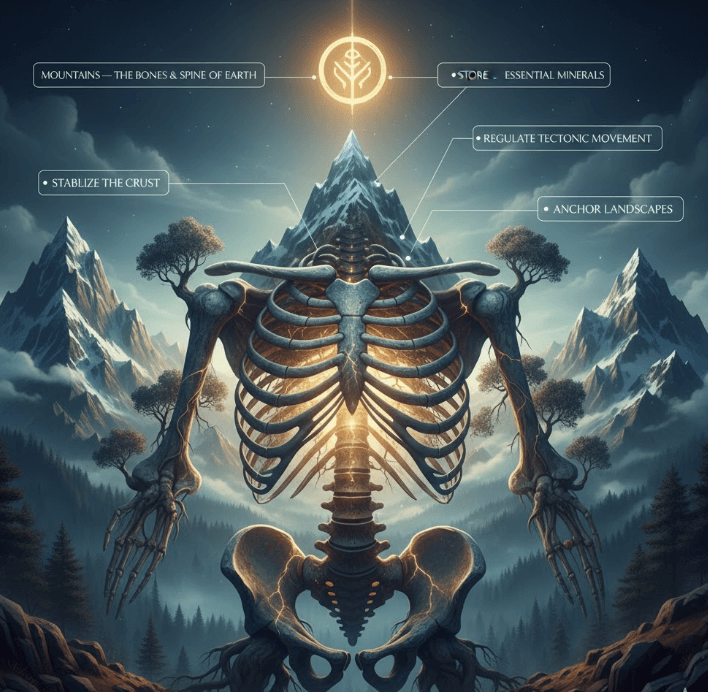
1. Mountains — The Bones and Spine of Earth
🌄 The Himalayas, Andes, Rockies, and Alps are the ridges of Earth’s spine.
🌄 Ancient shield regions like the Canadian Shield or the African Craton are the thick skull and pelvis.
🌄 Mid-ocean ridges are the growing bones, where new crust is born.
🏔️ Scientific roles of mountains (Earth’s skeleton):
🏕️ They lock tectonic plates in position and control the speed of their movement.
🏕️ They store enormous quantities of minerals — calcium, phosphorus, iron — slowly released into rivers and eventually into our own bodies.
🏕️ They create orographic rainfall: moist air rises over peaks, condenses, and waters entire continents.
🏕️ They prevent the planet from wobbling too violently on its axis.
When we mine mountains, blast them for roads, or strip them bare,
When we mine mountains, blast them open for highways, tunnel through their cores, or strip their slopes bare for timber and development, we are not simply reshaping landscapes—we are unraveling systems that took millions of years to form. Mountains are far more than dramatic backdrops on the horizon; they are living structures that regulate water cycles, anchor biodiversity, and stabilize climate patterns across entire regions. Their forests capture rainfall like vast natural sponges, releasing it slowly into rivers that sustain cities, farms, and ecosystems far downstream. Their soils, built gradually through the patient work of weathering rock and decomposing organic matter, hold nutrients essential for plant life. When heavy machinery tears into these environments, that balance is shattered. Exposed earth erodes quickly under rain and wind, sending sediments into waterways, choking aquatic life, and degrading water quality for communities below.
The destruction also fractures habitats that countless species depend on, pushing wildlife into shrinking, fragmented spaces where survival becomes harder each year. Blasting and drilling release not only dust and debris but also stored carbon from soils and vegetation, adding to atmospheric pollution. Roads carved into mountains open previously remote areas to further exploitation, accelerating cycles of deforestation and extraction. Beyond the ecological cost lies a cultural and spiritual one: for many communities, mountains hold historical, spiritual, and ancestral meaning that cannot be replaced once lost. In the pursuit of short-term economic gain, we often overlook the long-term consequences—landslides intensified by weakened slopes, floods worsened by the absence of tree cover, and water sources diminished by disrupted watersheds. Mountains operate as pillars of environmental stability, and when we dismantle them piece by piece, the effects ripple outward far beyond the immediate site of extraction. Protecting them is not about resisting progress; it is about recognizing that true progress must account for the integrity of the natural foundations on which all human life depends.
💥we are breaking the planet’s bones.💥
When we dynamite ridgelines, hollow out hillsides for minerals, and grind ancient rock into gravel, it can feel as though we are breaking the planet’s bones. Mountains are the structural framework of continents, formed through immense tectonic forces over unfathomable spans of time. They rise where plates collide, where pressure folds stone into peaks, and where Earth’s internal heat slowly reshapes the crust. To fracture them in a matter of decades for coal, metals, highways, or expanding cities is to undo in moments what geology built over millions of years. The metaphor of bones is fitting: just as bones support and protect vital organs in a body, mountains shield ecosystems, cradle glaciers, and anchor watersheds that supply life far beyond their slopes.
When these “bones” are broken, the consequences radiate outward. Removing rock and vegetation destabilizes slopes, making landslides and erosion more frequent and more destructive. Rivers fed by mountain snow and rainfall become clogged with sediment, disrupting aquatic life and contaminating drinking water. Forests that once clung to high elevations, storing carbon and moderating climate, vanish—releasing greenhouse gases and reducing nature’s capacity to buffer warming temperatures. The scars left behind are not easily healed; unlike a broken human bone that can mend over months, blasted summits and open-pit mines may take centuries to recover, if they recover at all.
Beyond the physical damage lies a symbolic loss. Mountains have always represented endurance, strength, and permanence. When we reduce them to rubble, we signal a willingness to trade long-term stability for short-term gain. If the planet’s bones continue to fracture under the pressure of unchecked extraction, the body of Earth—its climate systems, its water cycles, its web of life—will struggle to stand upright. True resilience depends on recognizing that the ground beneath our feet is not an infinite resource, but a foundation that must remain intact if life is to flourish.
Fractured spines do not heal quickly.
Landslides, earthquakes, and loss of water sources are the planet’s pain signals telling us:
💔
“Stop. This hurts the entire body.” 💔
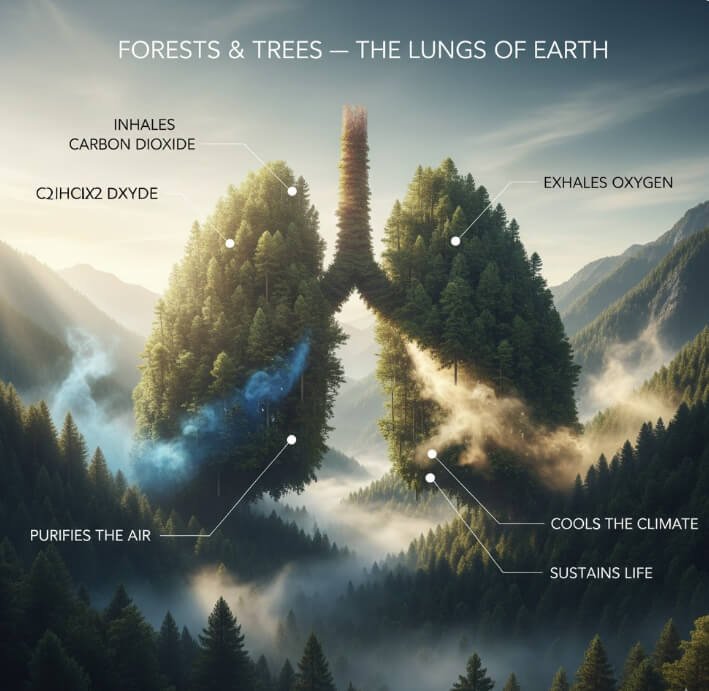
2. Forests and Trees — The Lungs of the Planet
Every schoolchild learns that trees produce oxygen.
Few realise how literal the lung comparison truly is.
The Amazon rainforest alone releases roughly 20% of Earth’s oxygen and stretches across a vast expanse of northern South America, earning its reputation as a single green lung nearly the size of the continental United States. This immense tropical forest, spanning countries such as Brazil, Peru, and Colombia, contains an extraordinary concentration of biodiversity. Towering canopy trees, dense understory vegetation, winding rivers, and flooded forests work together in a complex ecological system that has evolved over millions of years. Through the process of photosynthesis, its billions of trees absorb carbon dioxide and release oxygen, playing a vital role in regulating atmospheric balance. Although scientists note that much of the oxygen produced is also consumed by the forest’s own respiration and decomposition processes, the Amazon’s importance lies even more significantly in its capacity to store carbon, stabilize climate patterns, and recycle moisture through evapotranspiration. The forest generates atmospheric rivers—massive flows of water vapor—that influence rainfall across South America and even affect weather systems far beyond the continent.
Complementing this immense ecosystem is the Congo Basin in Central Africa, the second-largest tropical rainforest on Earth. Spanning six countries, including the Democratic Republic of the Congo and Cameroon, the Congo Basin functions as another essential “lung” of the planet. Its dense forests absorb billions of tons of carbon dioxide, helping to mitigate global warming while providing habitat to iconic wildlife such as forest elephants, gorillas, and countless bird and insect species. The rivers and peatlands of the Congo Basin store vast amounts of carbon underground, preventing it from entering the atmosphere. Moreover, these forests support millions of people who rely on them for food, medicine, and livelihoods, demonstrating the inseparable link between ecological health and human well-being.
Further north, the immense boreal forests of Canada and Russia form what is often called the planet’s third great lung. These forests, also known as taiga, stretch across subarctic regions in a sweeping belt of coniferous trees, including spruce, pine, and fir. Though colder and less biologically diverse than tropical rainforests, boreal forests store enormous quantities of carbon in their soils and permafrost. Their slow decomposition rates allow organic matter to accumulate over centuries, effectively locking away carbon that might otherwise intensify climate change. Together, the Amazon, the Congo Basin, and the boreal forests create an interconnected global system that regulates climate, supports biodiversity, and sustains life. Protecting these critical ecosystems is not simply a regional responsibility but a global imperative, as their health directly influences the stability of Earth’s atmosphere and the future of humanity itself.
How forests breathe:
🌳 Billions of leaf stomata open and close like tiny mouths, inhaling CO₂ and exhaling O₂.
🌳 At night, forests gently exhale CO₂ — exactly like a sleeping body.
🌳 Transpiration from leaves pumps massive amounts of water vapour into the atmosphere, forming “flying rivers” that travel thousands of kilometres and bring rain to distant farmlands.
When we burn or clear forests,
Earth develops emphysema and asthma.
When carbon builds up in the planet’s “bloodstream,” the atmosphere, the entire Earth system begins to feel the strain. Carbon dioxide and other greenhouse gases act like an ever-thickening blanket, trapping heat that would otherwise escape into space. As concentrations rise, global temperatures increase, and this warming disrupts the delicate balance that has allowed ecosystems and human civilizations to thrive. The metaphor of “planetary lungs” wheezing becomes painfully accurate: forests, oceans, and soils struggle to absorb the excess carbon at the pace required to keep the system stable.
Unlike a healthy body, where lungs exchange oxygen and carbon dioxide efficiently, Earth’s natural carbon sinks have limits. When forests are cut down or burned, their ability to draw carbon from the atmosphere weakens. At the same time, the carbon stored in trees and soils is released back into the air, compounding the problem. Warmer temperatures also dry out landscapes, increasing the likelihood of wildfires, which further reduce the planet’s capacity to “breathe.” In the oceans, rising carbon dioxide levels lead to acidification, stressing coral reefs and marine life that play a role in regulating global chemistry.
To me, the most concerning aspect is the feedback loop this creates. The hotter the planet becomes, the harder it is for natural systems to recover and function effectively. Melting permafrost releases methane, a potent greenhouse gas, accelerating warming even more. It feels like a body trying to run while gasping for air—each breath shallower than the last. If we continue adding carbon faster than Earth can process it, the imbalance will intensify, and the symptoms—heatwaves, stronger storms, shifting rainfall patterns—will grow more severe. Restoring balance requires reducing emissions and strengthening the natural systems that help the planet breathe.
Reforestation and protection of old-growth forests
are not environmental luxury —
🌳they are planetary respiratory therapy.🌳