
Discover the "Universe of Stars"
Explore the Mysteries of the Cosmos
Embark on a journey through the celestial wonders that light up our night sky. From their fiery births to their brilliant deaths, stars are the key to understanding the universe.
Stargazing dreams under the Milky Way ✨
Table of Contents
Discover the Universe of Stars |
Understanding the Universe Through Stars (Explain how stars act as cosmic laboratories that reveal the age, composition, and evolution of the universe.) |
Unlock the Mysteries of the Universe (Cover big questions like the origin of elements, dark matter/energy hints, and how stars help us decode the cosmos.) |
Stellar Death and Cosmic Renewal (Detail the death of stars — supernovae, planetary nebulae, neutron stars, black holes — and how their remnants seed new star and planet formation.) |
Space Discoveries and Technology: How Modern Tools Are Transforming Astronomy (Discuss ground-based telescopes, adaptive optics, AI in data analysis, and recent breakthroughs enabled by technology.) |
Space-Based Observatories: Escaping Light Pollution (Focus on Hubble, James Webb Space Telescope (JWST), Chandra, Gaia, and future missions — why space telescopes are revolutionary.) |
Conclusion: Our Place in the Universe of Stars (Tie everything together with an inspiring wrap-up and perhaps a call to stargaze or learn more.) |
The Impact of Stars
Understanding the Universe Through Stars
Stars are the fundamental storytellers of the cosmos. They illuminate the vast darkness of space and serve as the primary key to unlocking the secrets of the universe. From the moment humans first gazed upward in wonder, stars have guided our curiosity, shaped our myths, and driven scientific breakthroughs that continue to redefine our place in the grand cosmic tapestry.
At their core, stars are immense nuclear furnaces where hydrogen fuses into helium, releasing energy that powers entire galaxies. By studying their life cycles — from turbulent birth in swirling nebulae, through stable main-sequence phases that can last billions of years, to dramatic endings as supernovae or the slow cooling of white dwarfs — astronomers gain profound insights into the processes that govern the universe. The death of massive stars, for instance, scatters heavy elements like carbon, oxygen, and iron into space, elements that eventually form new stars, planets, and even the building blocks of life itself. In this way, we are quite literally made of stardust.
Beyond their physical role, stars offer a unique window into the universe’s history and scale. The light we see from distant stars and galaxies has traveled for millions or billions of years, allowing us to peer back in time. Spectral analysis reveals chemical compositions, temperatures, distances, and even the expansion rate of the universe itself. Tools like the Hubble and James Webb Space Telescopes have transformed our understanding, showing us exoplanets orbiting other stars and revealing the faint glow of the earliest galaxies formed after the Big Bang.
Culturally and historically, stars have been far more than scientific objects. Ancient civilizations used them for navigation, calendars, and storytelling. Constellations told tales of gods, heroes, and the natural world. Today, that sense of wonder remains. As we continue to explore, stars remind us of humanity’s enduring drive to understand our origins and our destiny.
The more we learn about stars, the more we understand the universe — and ourselves.
Unlock the Mysteries of the Universe
Dive deeper into the universe and expand your understanding of the stars. Join us at Read & Riser as we explore the wonders of the universe together. Whether you’re curious about the life cycle of stars — from their fiery birth in vast nebulae, through their brilliant main-sequence years, to their dramatic deaths as supernovae or quiet fade into white dwarfs — or fascinated by their profound cultural and historical significance across civilizations, there’s always something new and awe-inspiring to discover.
Countless worlds lie beyond the stars, each one a potential home to mysteries we have yet to unravel. From the ancient astronomers who mapped constellations by firelight to today’s powerful telescopes peering into the depths of distant galaxies, humanity’s relationship with the cosmos has shaped our myths, our science, and our sense of place in the grand scheme of existence.
Humanity must hold its thinking high and continue its relentless quest for knowledge. Every new discovery reminds us how vast, beautiful, and humbling the universe truly is. The stars are not just distant points of light — they are the furnaces that forged the elements within our own bodies, the beacons that guided explorers across oceans, and the silent witnesses to our shared story.
Click below to continue your journey of discovery.
Stellar Death and Cosmic Renewal
If stars must die to create new worlds, is death in the universe actually the ultimate act of creation?
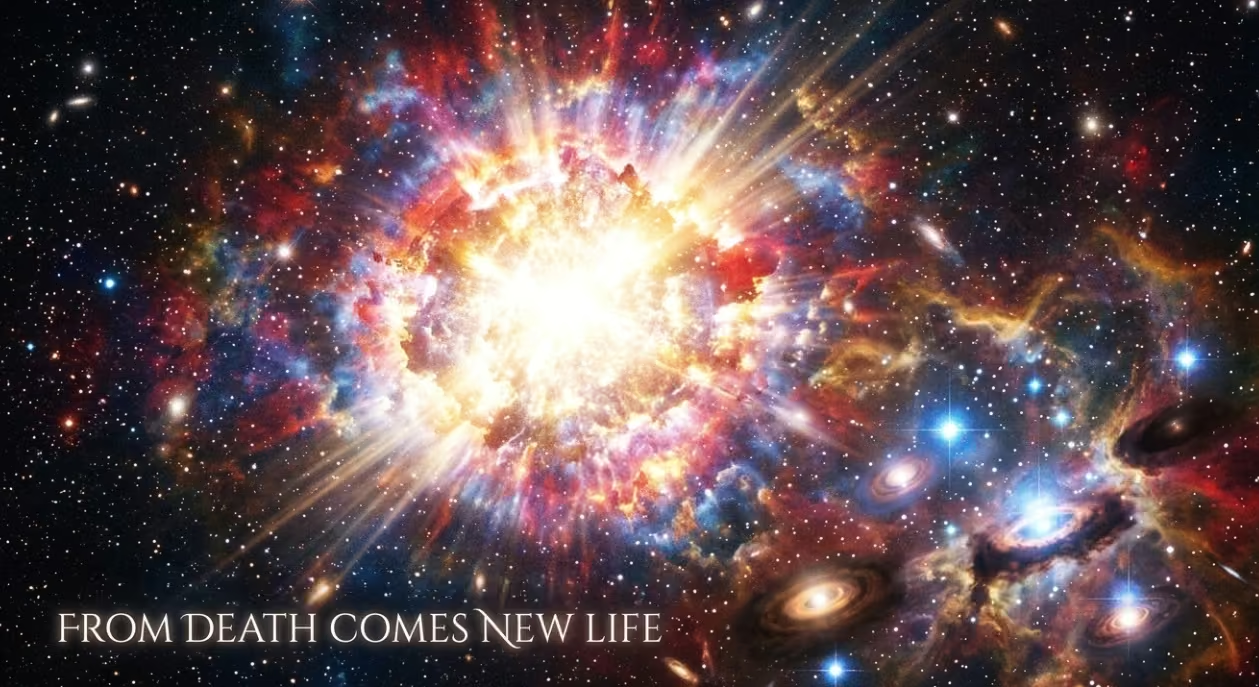
From a star’s explosive end comes the birth of new worlds.
In the grand theater of the cosmos, stars do not simply fade away — they end in spectacular fashion, seeding the universe with new life. Dive into “Stellar Death and Cosmic Renewal,” where we explore the dramatic final chapters of a star’s existence: from the violent explosion of supernovae that outshine entire galaxies to the gentle glow of white dwarfs and the enigmatic birth of black holes. Discover how these cosmic deaths are far from endings — they are acts of profound renewal. The heavy elements forged in a star’s dying moments become the building blocks of new stars, planets, and even the very atoms that make up our bodies. This captivating article reveals how death in the universe drives creation on a universal scale, reminding us that every atom in our world was once part of a star’s fiery farewell. Ready to witness the breathtaking cycle of destruction and rebirth? Read “Stellar Death and Cosmic Renewal” now and see the universe in a completely new light.
Space Discoveries and Technology: How Modern Tools Are Transforming Astronomy
The universe is revealing its deepest secrets like never before. In “Space Discoveries and Technology: How Modern Tools Are Transforming Astronomy,” discover how cutting-edge instruments and innovative techniques are revolutionizing our understanding of the cosmos at an unprecedented pace.
From the revolutionary James Webb Space Telescope (JWST) capturing the faint glow of the earliest galaxies—some shining just 300–330 million years after the Big Bang and already displaying complex structures, intense star formation, and even unexpected Lyman-alpha emissions that hint at how the universe’s reionization began—to powerful radio arrays like the expansive LOFAR Two-metre Sky Survey (LoTSS) mapping millions of invisible cosmic signals across the sky, today’s technology is pushing the boundaries of what we once thought possible.
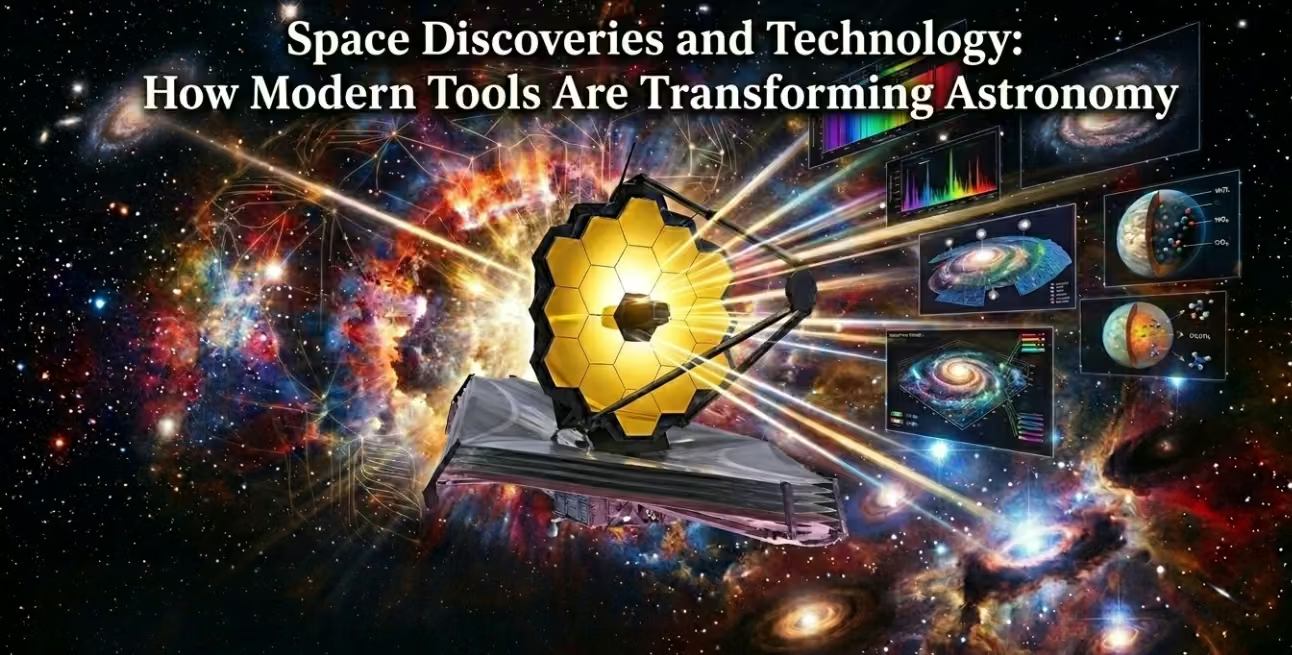
Unlocking the universe’s deepest secrets with tomorrow’s technology.
These groundbreaking tools are not only unveiling thousands of distant exoplanets with remarkable precision and probing the elusive nature of dark matter and dark energy, but also rewriting the story of our cosmic origins. JWST continues to deliver surprises, such as unexpectedly luminous early galaxies and potential signs of primordial light sources that challenge traditional timelines of cosmic dawn. Meanwhile, large-scale radio surveys catalog over 13 million sources, revealing hidden structures and extreme phenomena that optical telescopes simply cannot detect.
AI-driven algorithms now analyze billions of stars, galaxies, and transient events in seconds, sifting through massive datasets from missions like Gaia, Kepler, and JWST to identify new exoplanets with over 96% accuracy, classify supernovae, detect subtle gravitational wave signatures, and even model the formation of the Milky Way from ancestral stars. What once required decades of painstaking manual observation and computation now happens in near real time, dramatically accelerating discoveries and opening breathtaking new windows into the birth of stars, the evolution of galaxies, the dynamics of black holes, and the potential for life beyond Earth.
Advanced adaptive optics, next-generation detectors, photonic technologies, and integrated AI pipelines are transforming ground- and space-based observatories alike. These systems turn faint, invisible signals—ranging from radio waves and infrared light to subtle gravitational ripples—into vivid, actionable insights. The result? A flood of data that is reshaping cosmology, from refining our understanding of the universe’s expansion to hunting for habitable worlds and exploring the possibility of exotic physics in the early cosmos.
Step into the future of astronomy and witness how modern technology is turning the invisible into the visible, the theoretical into the observable, and distant mysteries into tangible knowledge. Whether you’re a passionate stargazer, a science enthusiast, or simply curious about humanity’s place in the vast universe, this article offers an inspiring journey through the innovations driving today’s golden age of discovery.
Read the full article now and explore the exciting frontier where discovery meets innovation—where telescopes peer back to the cosmic dawn, AI unlocks patterns no human could spot alone, and every new observation brings us closer to answering the biggest questions: How did it all begin? Are we alone? What secrets does the cosmos still hold?
Space-Based Observatories: Escaping Light Pollution
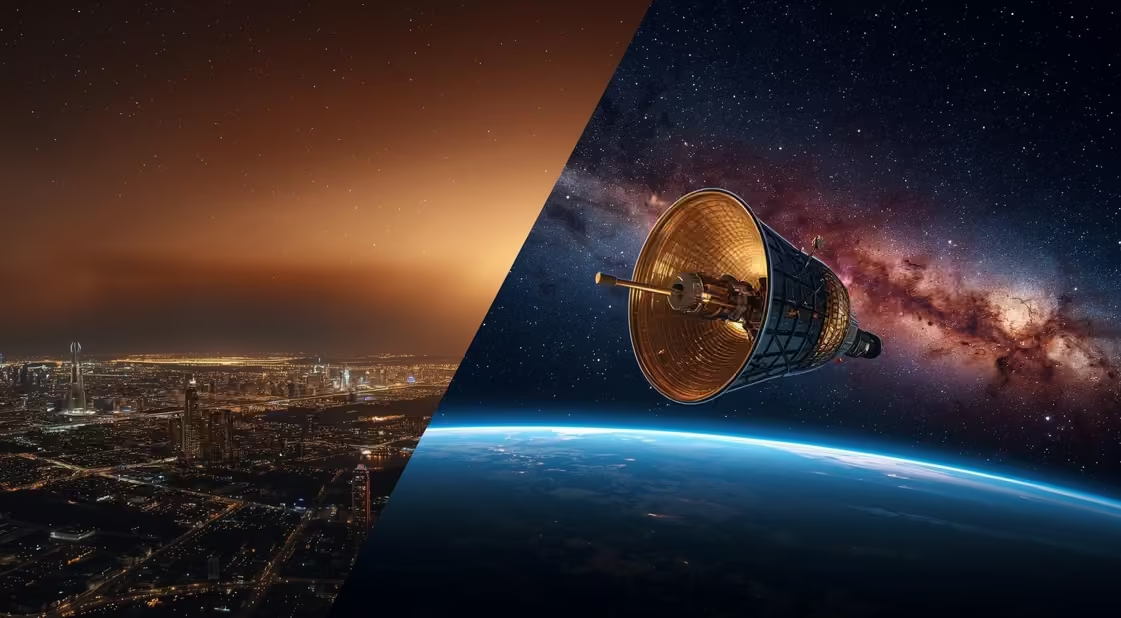
From Earth’s hazy glow to the universe in perfect clarity.
Tired of city lights drowning out the stars? Imagine powerful telescopes floating far above Earth’s glowing atmosphere and endless light pollution, capturing crystal-clear views of the cosmos that ground-based observatories can only dream of.
In “Space-Based Observatories: Escaping Light Pollution,” discover how revolutionary instruments like the Hubble Space Telescope and the James Webb Space Telescope have forever freed us from the limitations of our planet’s hazy skies. Operating in the cold, pristine darkness of space, these extraordinary observatories deliver images of distant galaxies, mysterious exoplanets, and breathtaking cosmic phenomena with unmatched sharpness, depth, and detail.
By escaping Earth’s light pollution and atmospheric distortion, space-based telescopes reveal the universe in ways impossible from the ground. They peer through the veil of our atmosphere to uncover the birth of stars in distant nebulae, the swirling hearts of galaxies billions of light-years away, and the faint signals from the edge of time itself. Every crisp image brings us closer to answering humanity’s greatest questions: How did the universe begin? Are we alone among the stars?
If you’ve ever gazed up at the night sky and wondered what it truly looks like without human interference — without the orange glow of cities, without the blurring effects of air and dust — this article will open your eyes to a clearer, more breathtaking universe than you ever imagined.
Read now and experience space as it was meant to be seen: pure, unfiltered, and awe-inspiring.