
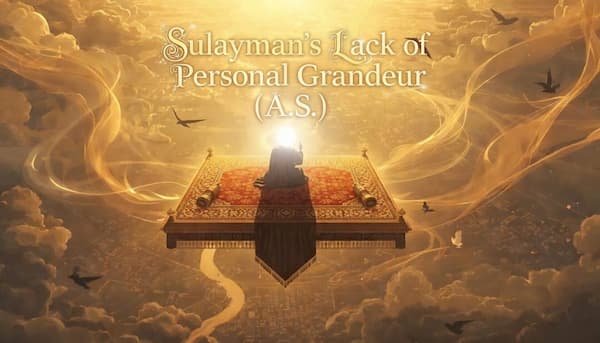
Sulayman’s (A.S.) Lack of Personal Grandeur
The Divine Dominion: Prophet Sulayman (A.S.) and His Command Over the Wind — Continuation
“True power lies in humility.”
Table of Contents
| ➤ 6. The Hallmark of True Greatness: Perpetual Humility & Gratitude 6.1 Never attributing power to himself 6.2 Conscious remembrance during every journey 6.3 Response to praise: “This is by the grace of my Lord…” 6.4 Power as a test of thankfulness vs. arrogance |
| ➤ 7. Timeless Lessons for Humanity Across the Ages 7.1 Authority must be rooted in humility and gratitude 7.2 Technological mastery should serve justice and mercy 7.3 True leadership protects even the weakest of creatures 7.4 Speed and efficiency are meaningless without wisdom 7.5 Harmony of all creation under divine command |
| ➤ 8. Contemporary Reflection: From Sulayman’s Wind to Modern Skies 8.1 Parallels with aviation, global connectivity, and instant communication 8.2 The enduring moral responsibility that accompanies power 8.3 The wind today: still a sign and a reminder |
| ➤ 9. Conclusion: Echoes of a Grateful Servant-King 9.1 Legacy preserved in the Qur’an 9.2 Invitation to emulate his character in our own lives 9.3 Final supplication for guidance and gratitude |
➤6. The Hallmark of True Greatness: Perpetual Humility & Gratitude
True greatness is never measured by the scale of power one possesses, but by the humility and gratitude with which that power is carried. Prophet Sulayman (peace be upon him) exemplified this sublime quality throughout his extraordinary reign, transforming immense authority into a continuous act of worship.

“And to Sulaiman We subjected the wind…”
6.1 Never Attributing Power to Himself
Sulayman (peace be upon him) never allowed the spectacular gifts at his command to inflate his ego. Whether commanding the wind, speaking with birds and jinn, or witnessing the miraculous instantaneous transport of the Queen of Sheba’s throne, he consistently traced every achievement back to its true Source. In moments of awe-inspiring display, his immediate response was not self-congratulation but heartfelt recognition of Allah’s boundless bounty. This deliberate refusal to internalize credit preserved the purity of his leadership and protected his heart from the subtle poison of arrogance. He understood that the moment a servant begins to claim ownership of divine favors, the blessing begins to diminish.
6.2 Conscious Remembrance During Every Journey
Whether gliding effortlessly across vast horizons on the wings of the wind or marching through lush valleys with his vast army, Sulayman remained profoundly mindful of his dependence on Allah. The very medium of his travel—the wind that carried him swiftly from one land to another—served as a living, constant reminder that every movement, every journey, and every breath occurred only by divine permission. No experience became routine or ordinary in his eyes. Each voyage, no matter how frequent, renewed his sense of wonder and reinforced deep gratitude. In this way, even his mode of transportation became an ongoing form of dhikr (remembrance) and an expression of tawhid.
6.3 Response to Praise: “This is by the grace of my Lord…”
When wonders unfolded before astonished observers, Sulayman’s instinctive reflex was never to bask in admiration but to redirect all praise toward Allah. His famous words, “This is by the grace of my Lord…” (Quran 27:40), turned potential moments of self-glorification into powerful opportunities for dawah. This was beautifully demonstrated in his interaction with the Queen of Sheba. Rather than allowing her to be impressed solely by his material and supernatural capabilities, he gently guided her heart toward the recognition of the One True God. His humility transformed awe into guidance and spectacle into spiritual awakening.
6.4 Power as a Test of Thankfulness vs. Arrogance
The Quran explicitly presents Sulayman’s (peace be upon him) unique endowments as a profound test—one that distinguishes between thankfulness and arrogance. He consistently chose the path of gratitude, modeling the only response that leads to lasting success. Gratitude elevates and purifies the soul, drawing one closer to the Divine, while ingratitude ultimately harms only the ungrateful. Allah, being completely Self-Sufficient and in no need of anyone’s thanks, rewards the grateful servant out of His infinite mercy. Sulayman’s (peace be upon him) life stands as a timeless lesson: the greater the blessing, the more essential the attitude of humble thankfulness.
➤7. Timeless Lessons for Humanity Across the Ages
The story of Prophet Sulayman (peace be upon him) offers a blueprint for responsible power that transcends time, culture, and technology. Through his divinely granted gifts—the wind, the jinn, the language of animals, and an empire of unparalleled reach—Sulayman(peace be upon him) demonstrated how authority, innovation, and leadership can serve higher purposes when anchored in faith, wisdom, and compassion. These five lessons remain urgently relevant in an age of artificial intelligence, global governance, and ecological crisis.

“And to Sulaiman We subjected the wind…”
7.1 Authority must be rooted in humility and gratitude
Any position of influence—political, technological, corporate, or social—carries the same sacred trust. Sulayman (peace be upon him) never treated his dominion as a personal achievement; he immediately turned to Allah in gratitude, declaring, “This is from my Lord.” Leaders who forget the Giver inevitably slide toward tyranny, narcissism, and exploitation. Those who remember cultivate justice, mercy, and accountability. In an era of billionaires and superpowers, this orientation is not optional but essential: true greatness begins with the humble recognition that every gift is on loan.
7.2 Technological mastery should serve justice and mercy
Sulayman’s (peace be upon him) command of the wind for swift travel and the jinn for monumental construction parallels today’s breakthroughs in aviation, automation, artificial intelligence, and renewable energy. Yet mastery without a moral compass breeds harm—environmental destruction, inequality, or unchecked surveillance. When directed toward equity and compassion, the same technologies can feed the hungry, heal the sick, and protect the vulnerable. Sulayman’s example teaches that innovation must remain a tool for human flourishing, never an idol that replaces ethical responsibility.
7.3 True leadership protects even the weakest of creatures
The famous incident of the ant colony reveals the true measure of greatness. Hearing an ant warn its fellows, Sulayman smiled, halted his army, and prayed for gratitude rather than crushing the tiny creatures underfoot. This single moment underscores that authentic leadership is judged not by how it treats the powerful, but by its care for the most vulnerable—whether a marginalized community, an endangered species, or a single overlooked individual. Ignoring the “small” in pursuit of the grand exposes a fatal flaw in character.
7.4 Speed and efficiency are meaningless without wisdom
The wind granted Sulayman (peace be upon him) unparalleled velocity, carrying him across vast distances in a morning’s journey. Yet he never wielded this gift recklessly. He used it deliberately: to invite faith, avoid needless conflict, and prioritize guidance over personal glory. In our age of instant communication and supersonic travel, this lesson cuts deep. Raw speed and efficiency can amplify both good and evil. Without wisdom to temper them, they become destructive forces. Sulayman shows that true power lies in knowing when to pause, when to speak, and when to choose mercy over might.
7.5 Harmony of all creation under divine command
Humans, jinn, animals, birds, and the very elements moved in perfect coordination because every creature submitted willingly to Allah. This divinely ordained harmony offers a powerful model for today’s ecological and social crises. When all parts of creation recognize a higher purpose beyond self-interest, balance is restored—forests thrive, societies flourish, and conflict gives way to cooperation. Sulayman’s (peace be upon him) reign reminds us that sustainable peace is possible only when humanity realigns itself with the divine order that already governs the universe.
Note: These lessons are not relics of ancient scripture; they are living principles for ethical leadership in the twenty-first century. When authority is exercised with humility, technology with conscience, and power with compassion, humanity rises to its highest potential.
➤8. Contemporary Reflection: From Sulayman’s Wind to Modern Skies

“When ancient miracles meet the skies…”
8.1 Parallels with Aviation, Global Connectivity, and Instant Communication
The divine gift bestowed upon Prophet Sulayman (peace be upon him)—mastery over the wind—resonates profoundly with humanity’s modern conquest of the skies. In the Qur’an, Allah subjected the wind to Sulayman’s (peace be upon him) command, enabling it to carry him and his hosts vast distances: “its morning course was a month’s journey, and its evening course was a month’s journey” (Qur’an 34:12). What once required months of arduous travel could now be traversed in a single day, a miracle of swift, controlled motion through the air.
Today, this ancient sign finds striking echoes in aviation. Jet aircraft shrink continents into hours, turning what was once an epic journey into routine connectivity. Global trade, diplomacy, and cultural exchange flourish because humanity has harnessed the principles of aerodynamics and propulsion—realizing, in technological form, something akin to Sulayman’s (peace be upon him) wind. Beyond physical flight, instant communication collapses time and space even further. A message sent from one hemisphere reaches the other in milliseconds, mirroring the instantaneous reach once granted solely by divine favor. Social media, video calls, and satellite networks create a borderless world where knowledge, empathy, and influence flow as freely as the wind once did at Sulayman’s (peace be upon him) bidding. These achievements represent not merely human ingenuity but a continuation of the pattern: the subjugation of natural forces for the benefit (and sometimes the burden) of civilization.
8.2 The Enduring Moral Responsibility that Accompanies Power
Yet the story of Sulayman (peace be upon him) offers more than technological inspiration; it delivers a timeless ethical warning. The wind was not a neutral tool but a trust from the Divine, granted to a prophet-king renowned for his wisdom and justice. Sulayman’s (peace be upon him) response was one of profound gratitude and accountability. He recognized that extraordinary power demands extraordinary moral stewardship. In an age of unprecedented technological might—supersonic travel, artificial intelligence, global surveillance, and instantaneous global influence—this lesson remains urgent.
Power without conscience breeds arrogance and harm. Aviation has connected humanity but also enabled warfare and environmental degradation. Instant communication fosters understanding yet amplifies division, misinformation, and manipulation. The moral responsibility that accompanied Sulayman’s (peace be upon him) wind now rests upon scientists, engineers, policymakers, and every user of these technologies. Will we wield our modern “winds” with justice, humility, and concern for the vulnerable, or will we allow them to serve greed, domination, and ecological ruin? True progress lies not only in mastering nature but in mastering the self.
8.3 The Wind Today: Still a Sign and a Reminder
Even now, the wind remains a living sign and a gentle reminder. It powers wind turbines that generate clean energy, whispers through sails on oceans, and sculpts landscapes as it has for millennia. In every breeze, we encounter the same natural force once commanded for a prophet. It invites reflection: the skies above us are not conquered but entrusted. As humanity soars higher and connects faster than ever before, Sulayman’s(peace be upon him)wind calls us back to humility, gratitude, and ethical vigilance. The real miracle is not merely technological flight, but the moral elevation that ensures such power serves the greater good of creation and the Creator.
➤9. Conclusion: Echoes of a Grateful Servant-King
In the grand tapestry of divine guidance, the story of Prophet Sulaiman (peace be upon him) stands as a luminous beacon of balanced leadership, profound wisdom, and unwavering gratitude. He was not merely a king who ruled over humans, jinn, birds, and the winds; he was, above all, an exemplary ‘abd—a servant of Allah. The Qur’an repeatedly honours him with the beautiful title of “excellent servant” (ni‘ma al-‘abd), emphasising that true greatness lies not in dominion or miracles, but in humble submission and constant recognition of the Giver of all blessings.

“My Lord, enable me to be grateful…”
9.1 Legacy Preserved in the Qur’an
Allah has eternally preserved the legacy of this servant-king within the pages of the Glorious Qur’an, ensuring that his example remains a living source of inspiration across generations. In Surah An-Naml (27:15), we read: “And We had certainly given to David and Prophet Sulayman (peace be upon him) knowledge, and they said, ‘Praise be to Allah, who has favoured us over many of His believing servants.’” This verse captures the essence of their character—gratitude expressed through hamd (praise) rather than self-glorification.
The most touching moment comes whenProphet Sulayman (peace be upon him) overhears the ant warning her colony. Instead of pride in his extraordinary abilities, he smiles with humility and turns immediately to his Lord in sincere supplication: “My Lord, enable me to be grateful for Your favour which You have bestowed upon me and upon my parents, and to do righteousness of which You approve. And admit me by Your mercy into [the ranks of] Your righteous servants” (An-Naml 27:19).
Even with a kingdom unmatched in history—where the wind was subjected to his command, the jinn built palaces and structures for him, and he understood the speech of creation— Prophet Sulayman (peace be upon him) never attributed success to himself. He viewed every blessing as a test of gratitude versus ingratitude, constantly seeking Allah’s help to remain among the shakirin (the grateful). His legacy reminds us that power, knowledge, and resources are divine trusts (amanah), not personal achievements. The Qur’an immortalises him not for his miracles alone, but for his heart that remained anchored in servitude and thankfulness, even at the peak of worldly glory.
9.2 Invitation to Emulate His Character in Our Own Lives
The life of Prophet Sulayman (peace be upon him) extends a timeless invitation to every believer: to cultivate the character of a grateful servant-king in our own spheres of influence. In an age of ambition, materialism, and fleeting successes, his example calls us to examine our hearts. Do we recognise our abilities, positions, and provisions as gifts from Allah, or do we allow them to inflate our egos?
Emulating Prophet Sulayman (peace be upon him) means practising shukr (gratitude) actively—not merely saying “Alhamdulillah,” but allowing thankfulness to shape our actions. It means using whatever Allah has granted us—whether influence, wealth, knowledge, or skills—for justice, compassion, and the service of humanity. It means remaining humble when others praise us, turning to prayer when blessings multiply, and seeking forgiveness even in moments of distraction or trial.
Parents can teach their children through his story the beauty of acknowledging parental blessings and striving for righteous deeds. Leaders and professionals can learn to wield authority with wisdom and mercy, never forgetting that they are accountable to the ultimate King. Every individual, regardless of status, can adopt his supplication as a daily dua, asking Allah to make us grateful, righteous, and among His beloved servants.
True emulation transforms ordinary lives into acts of worship. When we handle our responsibilities with integrity, show kindness to the vulnerable (even the smallest creatures in creation), and constantly redirect praise to Allah, we echo the spirit of this noble Prophet (peace be upon him).
9.3 Final Supplication for Guidance and Gratitude
O Allah, the Bestower of all kingdoms and the Turner of hearts, just as You inspired Your servant Prophet Sulayman (peace be upon him) to remain grateful amidst unparalleled blessings, inspire us too. Enable us to recognise every favour You have bestowed upon us and our families. Grant us the strength to perform deeds that please You, and admit us, by Your infinite mercy, into the company of Your righteous servants.
Keep our hearts soft and thankful, even when the world offers distraction or temptation. Make us among those who use every gift—be it knowledge, power, or opportunity—in service to Your cause and for the betterment of humanity. Let the story of Your grateful servant-king Prophet Sulayman (peace be upon him) remain not merely a historical narrative, but a living sign and a constant reminder for us and for all who come after.
Indeed, in the echoes of his humility and gratitude, we find the path to true success in both worlds. All praise is due to Allah, who guides whom He wills to the straight path. Ameen.
Page 7