
Satellites Deep Dive: Time-Centric Benefits: How Precision Timing Enhances Navigation, Communication, and Global Operations
| Satellites and time play a crucial role in today’s digital infrastructure. By providing precise timing for navigation, communication, and global operations, satellites accelerate decision-making, enable real-time monitoring, and support critical services across industries… |

1. Executive summary
Key Insights on Satellite Time-Centric Benefits and Operational Impact
| Precision Timing & Navigation: Satellites provide highly accurate timing and positioning through GPS, GNSS, and other time-dependent systems, forming the backbone of critical services in finance, transportation, and the Internet of Things (IoT). |
| Global Synchronization: By maintaining precise time coordination, satellites ensure that communication networks, financial transactions, and other time-sensitive operations remain synchronized on a global scale. |
| Emerging Technology Support: Satellites enable advanced applications such as 5G/6G network backhaul, autonomous vehicle navigation, and smart city infrastructure, driving innovation across industries. |
Satellites are not just machines in space; they are the backbone of modern digital infrastructure, powering global communication, navigation, and real-time decision-making. Acting as accelerators of operations and global connectivity, they enable services that terrestrial networks alone cannot deliver. From high-speed satellite connectivity in remote areas to Earth observation for climate monitoring, disaster response, and smart agriculture, satellites touch every corner of our digital world.
Crucially, satellites provide precise timing for GPS, financial networks, and time-sensitive operations, ensuring seamless synchronization across industries. They also support emerging technologies such as autonomous vehicles, smart cities, and next-generation networks. By combining connectivity, timing, and data, satellites ensure synchronized, reliable, and efficient operations on a global scale.
2. Why Satellite Accelerate Time?
Exploring How Precision Timing and Global Synchronization Enable Faster, Smarter Operations

Satellites accelerate operations by enabling faster communication, real-time monitoring, and informed decision-making. By delivering near-instantaneous data and connectivity, they empower businesses, governments, and emergency services to respond swiftly and efficiently. With the ability to reach remote or underserved regions and distribute information simultaneously to multiple locations, satellites ensure critical data is transmitted quickly and reliably. High-cadence Earth observation constellations further reduce the interval between data captures from days to minutes, providing rapid insights and supporting timely, actionable decisions.
| Key Ways Satellites Accelerate Time |
| Near-Instant Communication: Satellites transmit and receive data at high speed, enabling organizations to respond rapidly to emergencies and make timely, informed decisions. |
| Rapid Monitoring: Frequent satellite revisits provide near-real-time observation of weather patterns, natural disasters, and critical infrastructure, supporting proactive measures. |
| Accelerated Decision-Making: Immediate access to accurate data allows governments, businesses, and emergency services to act quickly and effectively. |
| Global Reach: Satellites deliver connectivity to regions where terrestrial networks are slow, unreliable, or cost-prohibitive, ensuring consistent access to critical information. |
| Optimized Operations: By facilitating faster communication, monitoring, and coordination, satellites help organizations save time, reduce costs, and enhance operational efficiency. |
3. Performance and Timing Highlights
Key Metrics Demonstrating Satellite Efficiency, Precision, and Real-Time Impact
| Propagation Latency and Revisit Cadence |
| Propagation Latency: The time it takes for a signal to travel between a satellite and Earth depends on orbital altitude. Low Earth Orbit (LEO) satellites, positioned between 160–2,000 km, achieve round-trip signal times of just 20–80 milliseconds, enabling near-real-time communication. Medium Earth Orbit (MEO) satellites (2,000–20,000 km) experience slightly higher latencies of 80–200 milliseconds, while Geostationary Earth Orbit (GEO) satellites at 35,786 km can have delays ranging from 240–600 milliseconds. Minimizing latency is crucial for applications like financial transactions, autonomous systems, and critical communications that demand fast, reliable data exchange. |
| Revisit Cadence: The frequency with which a satellite can observe the same location on Earth is a key factor in timely decision-making. A single LEO imaging satellite may revisit an area only every few days or weeks, limiting the speed of actionable insights. By deploying a full LEO constellation, revisit times can drop dramatically to minutes or hours, enabling rapid monitoring of weather, natural disasters, or infrastructure. In contrast, GEO platforms maintain a continuous view over a fixed hemisphere, providing uninterrupted coverage for real-time monitoring of communications, environmental changes, and strategic operations. |
| Operational Impact: Understanding propagation latency and revisit cadence allows organizations to optimize satellite selection based on mission requirements. LEO constellations are ideal for rapid, time-sensitive observations, while GEO satellites support continuous, high-availability monitoring. By combining these orbital strategies, businesses, governments, and emergency services can achieve a balance of speed, coverage, and precision critical for modern global operations. |

| Throughput and Deployment Speed |
| Throughput: Modern satellite networks deliver impressive data rates to end users, ranging from tens to hundreds of megabits per second (Mbps), depending on orbital altitude, satellite design, and ground infrastructure. Large-scale LEO mega-constellations amplify this capability, providing aggregate throughput in the multi-terabit-per-second range, supporting massive global connectivity, high-definition streaming, enterprise networks, and time-sensitive data applications. High throughput is especially critical for cloud services, IoT networks, and real-time analytics, where consistent bandwidth ensures efficient operations. |
| Deployment Speed: Satellites can be rapidly deployed compared to terrestrial networks, making them ideal for emergency situations, disaster response, and rapid network expansion in underserved regions. New constellations can be brought online within months, bypassing the years often required for fiber or cellular infrastructure rollout. This flexibility and speed enable governments, humanitarian organizations, and enterprises to maintain connectivity and operational continuity when traditional networks are unavailable or damaged. |
| Operational Advantage: Combining high throughput with rapid deployment, satellites provide both scale and agility. Organizations can achieve global coverage, immediate network redundancy, and support time-critical operations—from disaster monitoring and relief coordination to high-speed financial transactions—without the limitations of ground-based infrastructure. |
4. Orbital Regimes and Trade-Offs
Low Earth Orbit (LEO):
| Altitude: 160–2,000 km above Earth |
Low Earth Orbit satellites operate relatively close to the planet, which significantly reduces signal travel time and enables high-speed data transmission.
Performance Characteristics
|
Latency: 20–80 milliseconds round-trip, comparable to some terrestrial fibre networks. This low latency supports real-time applications such as video conferencing, cloud computing, and interactive services. |
|
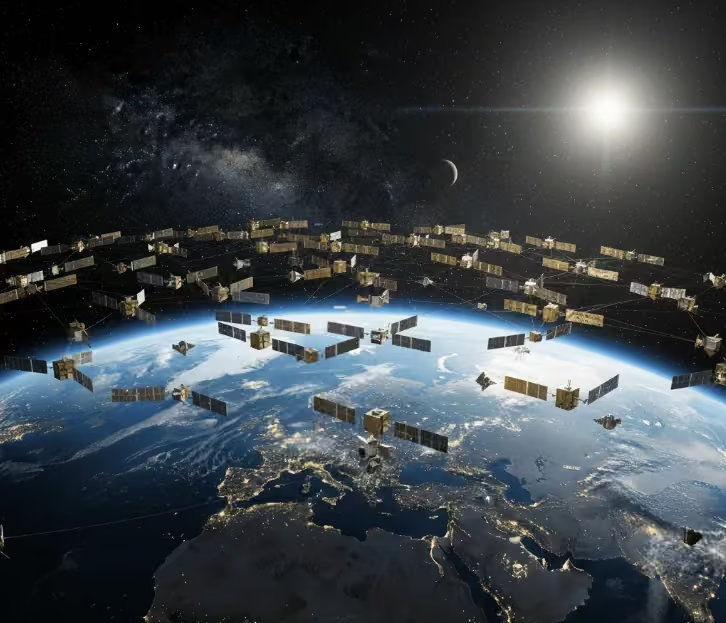
Coverage: Each satellite has a relatively narrow coverage footprint (approximately 1,000 km in diameter). To achieve continuous global coverage, operators deploy large constellations consisting of hundreds or even thousands of satellites. |
|
Revisit Time: With large constellations, revisit times can drop to minutes, making LEO ideal for rapid monitoring, time-sensitive data collection, and dynamic connectivity needs. |
- Key Applications:
Low Earth Orbit (LEO) systems are particularly well suited for broadband internet services, including networks such as Starlink and OneWeb. Their low latency and high throughput make them ideal for Internet of Things (IoT) networks that require reliable, time-sensitive data exchange.
LEO satellites also support high-cadence Earth observation missions, enabling frequent data collection for environmental monitoring, infrastructure management, and disaster response. In addition, they are highly effective in mobility markets, providing seamless connectivity for aviation and maritime operations. Their architecture further enables reliable broadband access in remote and underserved regions where terrestrial infrastructure is limited, unavailable, or cost-prohibitive.
|
| Low Earth Orbit (LEO) systems offer near-real-time communication and efficient data relay, significantly reducing transmission delays compared to higher orbital regimes. |
| Their architecture supports high throughput combined with low latency, enabling seamless performance for bandwidth-intensive and time-sensitive applications. |
| LEO constellations are inherently scalable, allowing operators to deploy large satellite networks that enhance redundancy, network resilience, and service continuity. |
| This combination of speed, capacity, and scalability delivers strong performance for interactive services such as video conferencing, cloud applications, financial transactions, and other latency-critical operations. |
|
| Low Earth Orbit (LEO) systems require frequent handovers between satellites due to their rapid movement relative to Earth. This increases network management complexity and demands advanced ground infrastructure to maintain seamless connectivity. |
| Satellites operating in LEO typically have shorter operational lifespans, often averaging 5–7 years, due to atmospheric drag and higher exposure to space environment factors. As a result, constellations require ongoing replenishment and sustained launch capacity. |
| The deployment and maintenance of large-scale constellations involve significant capital investment, including launch costs, satellite manufacturing, ground stations, and regulatory coordination. |
| Additionally, the growing number of LEO satellites increases space traffic management challenges, requiring careful orbital coordination and debris mitigation strategies to ensure long-term sustainability. |
- Time-Centric Advantage:
Low Earth Orbit (LEO) systems enable interactive digital services and rapid response capabilities by significantly reducing communication latency. Their proximity to Earth allows near-real-time data exchange, supporting applications that depend on immediate feedback and seamless connectivity.
This reduced delay enhances operational agility, enabling faster decision-making across sectors such as emergency response, financial services, transportation, and cloud-based operations. By minimizing signal travel time and increasing data delivery speed, LEO architectures directly contribute to more responsive, time-sensitive, and efficient global operations.
MEO (Medium Earth Orbit)
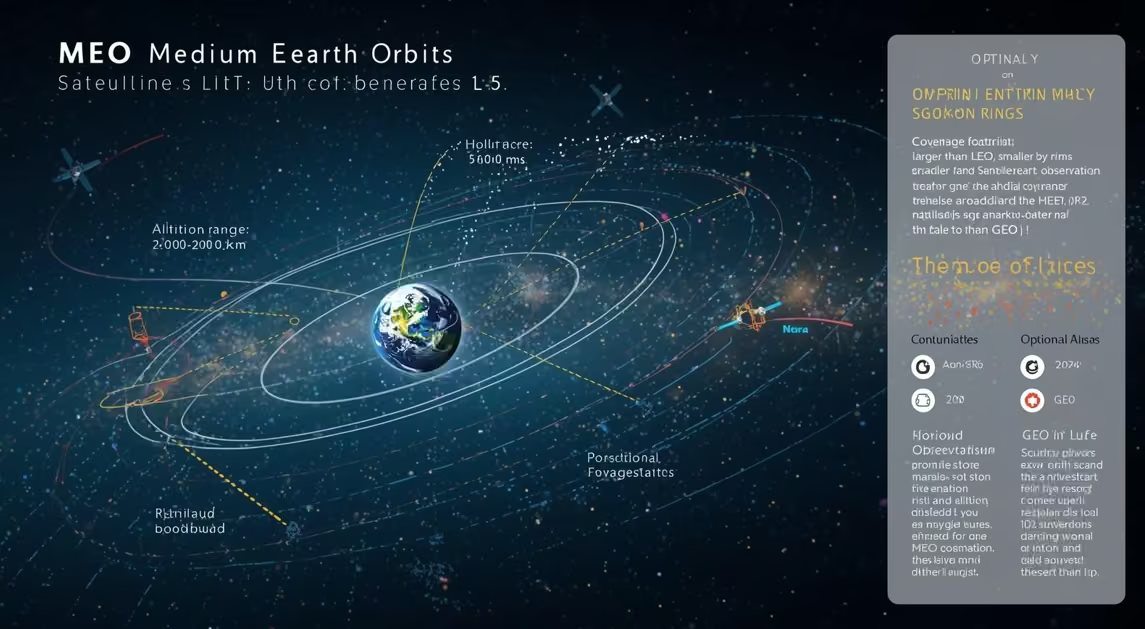
| Altitude: 2,000–20,000 km above Earth |
Medium Earth Orbit satellites operate at intermediate altitudes, offering a balance between coverage area, latency, and revisit frequency.
|
Latency: Typically 80–200 milliseconds round-trip, higher than LEO but lower than GEO, making MEO suitable for navigation, communication, and data services that tolerate moderate delays. |
|
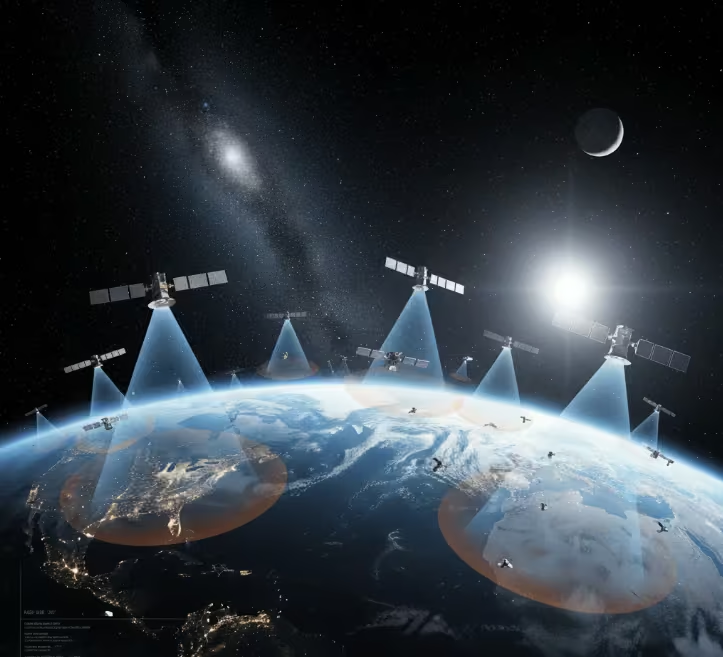
Coverage: Each satellite covers a larger footprint than LEO, reducing the total number of satellites required for global coverage while still enabling focused regional services. |
|
Revisit Time: Revisit intervals range from tens of minutes to several hours, depending on the constellation size and mission design. |
| Key Applications |
| Medium Earth Orbit (MEO) satellites serve a range of critical applications that leverage their balance of coverage and latency: |
| Global Navigation Systems: MEO satellites form the backbone of navigation constellations such as GPS and Galileo, providing accurate positioning, timing, and navigation services for transportation, logistics, and mobile devices worldwide. |
| Regional Broadband and Communication Networks: With larger coverage footprints than LEO, MEO satellites efficiently support broadband connectivity across regions, connecting urban centers, rural areas, and enterprise networks where terrestrial infrastructure may be limited or unavailable. |
| Earth Observation with Moderate Temporal Resolution: MEO platforms enable regular monitoring of environmental conditions, resource management, and infrastructure. While not as frequent as LEO revisit times, MEO observation missions provide consistent updates for applications such as agriculture, disaster preparedness, and climate tracking. |
| Timing and Synchronization Services: MEO satellites provide precise timing signals that are critical for financial systems, telecommunications, and synchronized operations across industries. |
| Hybrid Mission Support: MEO satellites often complement LEO and GEO constellations, combining moderate latency with broader coverage to optimize global network performance. |
|
Advantages Medium Earth Orbit (MEO) satellites offer several operational benefits that make them ideal for navigation, regional communications, and timing applications: |
| Expanded Coverage: Each MEO satellite covers a larger footprint than LEO satellites, reducing the total number of satellites needed to achieve regional or global coverage. |
| Moderate Latency: With round-trip signal times between 80–200 milliseconds, MEO provides latency low enough for navigation, communications, and other time-sensitive applications while balancing coverage. |
| Efficient Regional Deployment: Fewer satellites are required compared to LEO constellations, making it more cost-effective to maintain reliable coverage over large areas without sacrificing performance. |
| Consistent Service: MEO satellites deliver stable and predictable connectivity for regional networks, navigation systems, and timing-dependent operations. |
Limitations
While MEO satellites offer expanded coverage and moderate latency, they have certain constraints:

| Higher Latency than LEO: Round-trip signal times of 80–200 milliseconds are higher than LEO, limiting their suitability for highly interactive, real-time applications. |
| Longer Orbital Periods: Moderate revisit intervals may reduce the frequency of Earth observation updates compared to LEO, affecting time-critical monitoring. |
| Constellation Complexity: Although fewer satellites are required than LEO, managing MEO constellations still involves careful coordination, ground infrastructure, and maintenance planning. |
| Moderate Launch Costs: Deploying MEO satellites requires significant investment, though less than large LEO constellations. |
Time-Centric Advantage
MEO satellites provide precise timing and positioning services essential for global navigation, telecommunications, and industrial applications.
Their combination of moderate latency and wider coverage ensures consistent and reliable synchronization across regions, supporting time-sensitive operations such as:
| Navigation and location services for transportation and logistics |
| Synchronization of financial transactions and communications networks |
| Coordinated monitoring for environmental, agricultural, and infrastructure applications |
By bridging the gap between LEO and GEO performance, MEO satellites deliver a balance of timing precision and regional coverage that enables reliable, time-aware operations at both local and global scales.
GEO (Geostationary Orbit)
| Altitude: 35,786 km above the equator |
Geostationary satellites maintain a fixed position relative to the Earth’s surface, providing continuous coverage over a specific region or hemisphere.
|
Latency: Round-trip signal times are higher, typically 240–600 milliseconds, which limits interactive, real-time applications but remains suitable for broadcast, telemetry, and communications where continuous coverage is critical. |
|
Coverage: Each GEO satellite covers nearly a third of the Earth’s surface, allowing broad regional or continental coverage with fewer satellites than LEO or MEO constellations. |
|
Revisit Time: GEO satellites maintain a constant view of their coverage area, enabling uninterrupted monitoring and communication without the need for frequent handovers. |
|
Key Applications Geostationary (GEO) satellites support a range of critical services that benefit from continuous, fixed-area coverage: |
| Television and Radio Broadcasting: GEO satellites provide uninterrupted broadcast services, delivering television and radio content to wide regions with stable signal quality. |
| Long-Distance Telecommunications and VSAT Networks: They enable voice, data, and internet connectivity over large distances, supporting enterprise networks, remote offices, and global communications. |
| Weather Monitoring and Meteorological Observation: GEO platforms continuously track atmospheric and environmental conditions, allowing accurate forecasting, storm tracking, and climate monitoring in near real-time. |
| Disaster Management and Emergency Coordination: GEO satellites act as reliable communication relays during natural disasters, supporting emergency response, coordination between agencies, and remote connectivity when terrestrial networks are unavailable. |
|
Advantages Geostationary (GEO) satellites provide continuous coverage over fixed regions, making them ideal for applications that require uninterrupted monitoring and communication. |
| Their broad coverage means that fewer satellites are needed to serve large areas, reducing the complexity of satellite deployment. |
| Additionally, GEO satellites benefit from simplified ground infrastructure, as their stationary position relative to the Earth eliminates the need for frequent tracking or handovers. |

| Limitations |
| High Latency: Round-trip signal times of 240–600 milliseconds limit GEO satellites’ suitability for interactive, real-time applications such as video conferencing or online gaming. |
| Limited Coverage Flexibility: GEO satellites are fixed over a specific region, making it difficult to adjust coverage areas without deploying additional satellites. |
| Higher Launch and Operational Costs: Reaching geostationary orbit requires more energy and higher launch costs compared to LEO or MEO satellites, and maintaining operations at high altitude involves long-term financial and technical commitments. |
|
Time-Centric Advantage Despite higher latency, GEO satellites deliver reliable and uninterrupted service for applications that require constant monitoring, including weather forecasting, long-distance communications, and disaster management. Their fixed positioning ensures consistent timing and synchronization for regional operations, providing a stable platform for continuous, time-sensitive services where reliability and coverage are more critical than ultra-low latency. |