
The Divine Dominion: Prophet Sulayman (A.S.) and His Command Over the Wind
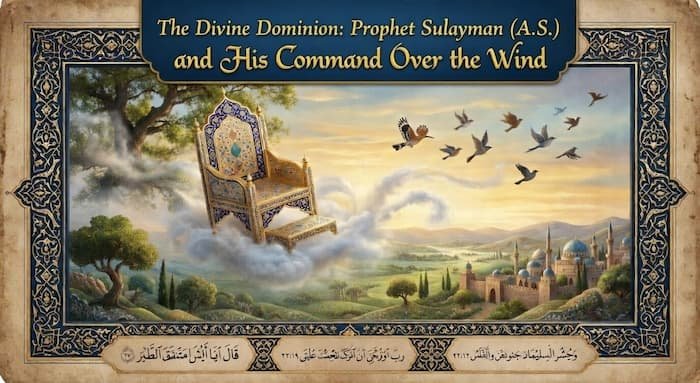
The exalted throne of Prophet Sulayman (A.S.), carried by the winds by Allah’s command, soaring in divine harmony over a blessed landscape.
Table of Contents
➤1. Introduction: The Prophet-King Blessed with Unmatched Dominion 1.1 A kingdom granted through supplication 1.2 The unique miracle of commanding the wind |
➤2. Quranic Foundation: Divine Revelation of Sulayman’s Authority 2.1 Key verses establishing his inheritance and gifts (An-Naml 27:16, Sad 38:35) 2.2 Explicit mention of the wind’s subjection (Al-Anbiya 21:81, Saba 34:12) 2.3 Speed and scope: “morning journey of a month and afternoon journey of a month” |
➤3. The Majestic Gift – Mechanics of the Wind’s Obedience 3.1 Nature of the wind under Sulayman’s command 3.2 The airborne platform: throne, court, soldiers, scholars, and creatures 3.3 Role of jinn, birds, and other subjugated beings in aerial journeys 3.4 Controlled power: forceful yet gentle, precise and protective |
➤4. Voyages of Oversight, Justice & Prosperity 4.1 Inspecting the vast kingdom from the skies 4.2 Swift administration and delivery of justice 4.3 Acceleration of trade, commerce, and economic flourishing 4.4 Strategic military movement and preference for peace 4.5 Exploration, discovery, and expansion of knowledge |
➤5. Core Benefits of the Wind’s Subjection to the Kingdom 5.1 Instant communication and responsive governance 5.2 Unprecedented speed in trade and resource distribution 5.3 Scientific and cultural advancement through exploration 5.4 Deterrence of conflict while preserving peace 5.5 Deepened spiritual connection with Allah’s creation |
➤1. Introduction: The Prophet-King Blessed with Unmatched Dominion
In the sacred chronicles of prophetic history, few figures illuminate the seamless union of supreme authority, profound wisdom, and deep humility as radiantly as Prophet Sulayman (A.S.), the noble son of Prophet Dawud (A.S.). Centuries before humanity mastered flight through engines or steel wings, Allah (Subhanahu wa Ta’ala) conferred upon this chosen servant a kingdom of unparalleled magnificence and reach—one that stood as a unique divine favor in all of creation.
1.1 A kingdom granted through supplication
This extraordinary realm was not inherited by chance nor seized by force. It came in direct answer to Sulayman’s (A.S.) heartfelt supplication, as recorded in the Holy Quran: “My Lord, forgive me and grant me a kingdom such as will not belong to anyone after me. Indeed, You are the Bestower” (Surah Sad 38:35). Allah, in His infinite grace, responded by bestowing upon him dominion unmatched—over jinn, birds, animals, metals, and the very forces of nature. This was no ordinary sovereignty; it was a kingdom designed to manifest justice, mercy, and gratitude across vast expanses, serving as a living testament to Allah’s absolute power and the responsibility that accompanies divine gifts.
1.2 The unique miracle of commanding the wind
At the heart of this divine endowment lay one of the most awe-inspiring miracles granted to any prophet: command over the wind. The Quran explicitly affirms this gift in multiple verses. In Surah Al-Anbiya (21:81), Allah declares: “And to Solomon [We subjected] the wind, blowing forcefully, proceeding by his command toward the land which We had blessed. And We are ever, of all things, Knowing.” Further detail appears in Surah Saba (34:12): “And to Solomon [We subjected] the wind—its morning [journey was that of] a month, and its afternoon [journey was that of] a month…”
This was no gentle breeze under casual direction; it was a mighty, disciplined force—raging yet obedient—that carried Sulayman (A.S.), his throne, his court, his armies, scholars, and even delegations of creatures across immense distances in mere hours. A single day’s travel encompassed what would otherwise require months by land or sea. Far from a tool of personal display or conquest, this control over the wind functioned as a sacred trust: enabling swift justice, widespread governance, exploration of blessed lands, and constant remembrance of the True Bestower.
The story of Sulayman (A.S.) rises far above legend or myth—it is divine revelation preserved in the Quran, offering eternal lessons in power tempered by humility, authority exercised through mercy, and every blessing acknowledged as a test of gratitude.
➤2. The Divine Dominion: Prophet Sulayman (A.S.) and His Command Over the Wind: create image
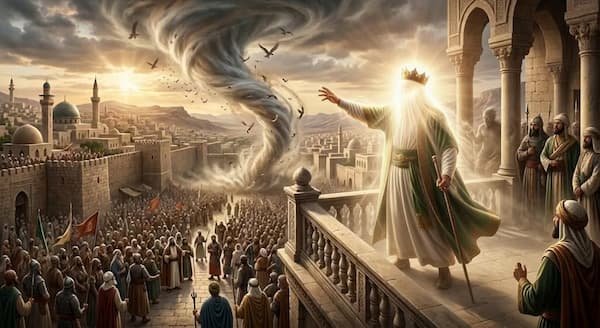
A majestic prophet stands upon the balcony, his face radiant with the divine Noor (Light) of Allah, commanding a mighty whirlwind as the crowd below witnesses in awe.
In the annals of prophetic history, few figures embody the perfect harmony of power, wisdom, and humility as profoundly as Prophet Sulayman (A.S.), the son of Prophet Dawud (A.S.). Long before the advent of modern aviation or mechanical propulsion, Allah (Subhanahu wa Ta’ala) bestowed upon this illustrious servant a kingdom unmatched in splendor and authority. Central to this divine endowment was command over the wind—a force invisible yet irresistible, harnessed not for conquest alone, but for justice, exploration, and the betterment of creation. This is no mere legend or embellished tale; it is a divinely revealed reality, meticulously documented in the Holy Quran, offering timeless lessons for humanity.
The story of Sulayman (A.S.) transcends folklore. It stands as a testament to Allah’s absolute sovereignty over the universe, where even the elements submit to those He chooses. As we delve into this sacred narrative, drawing exclusively from Quranic verses and their authentic interpretations, we uncover not only the mechanics of his extraordinary travels but the profound spiritual ethos that governed them. Far from a display of personal might, his control over the wind was a sacred trust—a tool for governance, mercy, and unwavering gratitude.
➤3. The Majestic Gift – Mechanics of the Wind’s Obedience
Among the unparalleled blessings bestowed upon Prophet Sulayman (A.S.), the subjection of the wind stands as one of the most majestic and awe-inspiring miracles. This divine gift transformed the invisible forces of nature into a disciplined servant, enabling swift, effortless movement across vast territories. Far from random or chaotic power, it exemplified perfect obedience to the will of a grateful prophet, always operating “by the permission of his Lord.”

Prophet Sulayman (A.S.), his face illuminated by the holy Noor of Allah, commands the winds with flowing divine energy as birds and his people witness in awe.
3.1 Nature of the wind under Sulayman’s command
The Holy Quran describes this miracle with remarkable precision. In Surah Al-Anbiya (21:81), Allah states: “And to Solomon [We subjected] the wind, blowing forcefully, proceeding by his command toward the land which We had blessed. And We are ever, of all things, Knowing.” Complementing this, Surah Saba (34:12) details the extraordinary speed and scope: “And to Solomon [We subjected] the wind—its morning [journey was that of] a month, and its afternoon [journey was that of] a month.”
Classical tafsirs, including that of Ibn Kathir, explain that the wind was not a mere breeze but a powerful, raging force that could be harnessed at will. A single morning’s travel covered the distance of an entire month’s ordinary journey, and the same applied to the afternoon return. Scholars such as Al-Hasan al-Basri narrate examples where Sulayman (A.S.) would depart from Damascus in the morning, pause for a meal in distant Istakhar (Persepolis), and reach yet another far-off location by nightfall. This wind—often identified with the eastern wind—moved precisely according to his command, directed toward blessed lands such as Ash-Sham (Greater Syria), rich in divine favor, prophets, and spiritual bounty.
3.2 The airborne platform: throne, court, soldiers, scholars, and creatures
When Sulayman (A.S.) wished to travel, a grand platform—frequently described in tafsirs as a large carpet or throne-like structure—was prepared. Upon this elevated conveyance sat his royal throne, surrounded by his full court: wise advisors, scholars documenting discoveries, soldiers maintaining order, and representatives of various creatures. The entire assembly, including delegations of humans and animals, was lifted gently into the air. This airborne court allowed the prophet-king to inspect his vast dominion, observe the condition of his subjects, and administer justice without the limitations of earthly travel.
The platform moved with majestic dignity, offering a panoramic view of rivers shimmering like silver, endless forests, and sprawling settlements below. What would have required months of arduous caravans or sea voyages was accomplished in a matter of hours, all while preserving comfort and safety for everyone aboard.
3.3 Role of jinn, birds, and other subjugated beings in aerial journeys
The wind did not operate in isolation. Allah also subjected the jinn to Sulayman (A.S.), who worked “by the permission of his Lord” (Saba 34:12). These beings constructed palaces, vessels, and necessary infrastructure, sometimes assisting in stabilizing or enhancing the airborne platform. Birds, whose language Sulayman (A.S.) understood, provided reconnaissance, shade, and aerial formation during journeys. Armies of jinn, men, and birds marched or flew in organized rows, creating a harmonious spectacle of subjugated creation serving a single divine purpose.
This collective obedience highlighted the unity of Allah’s creation under prophetic authority—jinn handling heavy labor, birds offering intelligence from above, and the wind providing the primary means of propulsion.
3.4 Controlled power: forceful yet gentle, precise and protective
What made this miracle truly majestic was its controlled nature. The wind could blow with tremendous force when speed was required, yet it remained gentle and smooth under Sulayman’s (A.S.) direction, ensuring no discomfort or harm to passengers. It was precise, altering course instantly when needed, and protective, shielding the entourage from turbulence or danger. This balance reflected divine wisdom: power that was mighty yet merciful, swift yet safe.
Ultimately, the mechanics of the wind’s obedience served as a profound reminder. Every journey reinforced that such dominion was not Sulayman’s (A.S.) own might but a sacred trust from Allah—the Bestower—who knows all things. In harnessing the wind, the prophet demonstrated that true authority lies in submission to the Creator, using extraordinary gifts for justice, exploration, and gratitude rather than pride or excess.
➤4. Voyages of Oversight, Justice & Prosperity
Prophet Sulayman’s (A.S.) command over the wind transformed governance into an act of visionary oversight. What once required months of perilous travel became routine aerial journeys, allowing the prophet-king to maintain intimate connection with every corner of his vast dominion. These flights were not displays of power but purposeful missions of justice, prosperity, and enlightened rule.

Prophet Sulayman (A.S.), veiled in the divine Noor of Allah, sits upon his magnificent flying carpet throne carried by the wind, surrounded by birds, animals, and his entourage as they soar over the kingdom.
4.2 Swift administration and delivery of justice
The wind’s obedience enabled unprecedented efficiency in governance. Issues that might have festered for weeks or months under conventional rule were addressed within hours. Messengers, carried swiftly by the same winds or accompanying birds, delivered reports from remote provinces. Sulayman (A.S.) could descend upon a troubled area, render judgment, and restore peace before the day ended. This rapid response prevented conflicts from escalating and reinforced the principle of immediate, impartial justice. His subjects knew their ruler was never far—both physically and in concern—fostering deep loyalty and social stability across the kingdom.
4.3 Acceleration of trade, commerce, and economic flourishing
The same winds that carried the royal court also revolutionized trade. Merchants and caravans benefited indirectly as Sulayman’s (A.S.) oversight ensured safe passage and efficient routes. Goods—spices, fine fabrics, precious metals, grains, and copper—moved with remarkable speed between distant regions. Wind-assisted transport reduced journey times dramatically, lowering costs and minimizing spoilage. Markets thrived, wealth circulated freely, and prosperity became widespread. Under this divinely enabled system, the kingdom enjoyed economic abundance that strengthened social bonds and funded grand projects for public welfare.
4.4 Strategic military movement and preference for peace
In matters of defense, the wind granted unmatched strategic advantage. Armies could be deployed rapidly to any threatened frontier, appearing where enemies least expected. Yet Sulayman (A.S.) wielded this power with profound wisdom and restraint. He preferred diplomacy and peaceful resolution over conflict, using the threat of swift military movement primarily as a deterrent. His reign demonstrated that true strength lies not in conquest but in preserving peace and protecting the innocent. Military readiness served justice rather than ambition.
4.5 Exploration, discovery, and expansion of knowledge
Beyond governance and trade, these aerial voyages fueled exploration. Sulayman (A.S.) visited unknown territories, discovering new resources, cultures, and natural wonders. Scholars accompanying him meticulously documented findings—geography, flora, fauna, and indigenous knowledge—greatly enriching the collective wisdom of the kingdom. These journeys expanded intellectual horizons, promoted cross-cultural understanding, and laid foundations for advancements in various fields. Knowledge became a cornerstone of his prosperous and enlightened rule.
Through these purposeful voyages, Prophet Sulayman (A.S.) exemplified leadership as selfless service. The wind did not merely transport him; it enabled a reign defined by vigilance, equity, prosperity, and the pursuit of beneficial knowledge—all rooted in gratitude to Allah, the true Source of every blessing.
➤ 5. Core Benefits of the Wind’s Subjection to the Kingdom
The subjection of the wind was far more than a spectacular miracle; it became the cornerstone of a kingdom defined by efficiency, equity, and enlightenment. Through this divine gift, Prophet Sulayman (A.S.) transformed governance, commerce, knowledge, security, and spirituality into interconnected pillars of prosperity, all while remaining deeply conscious that every blessing originated from Allah alone.
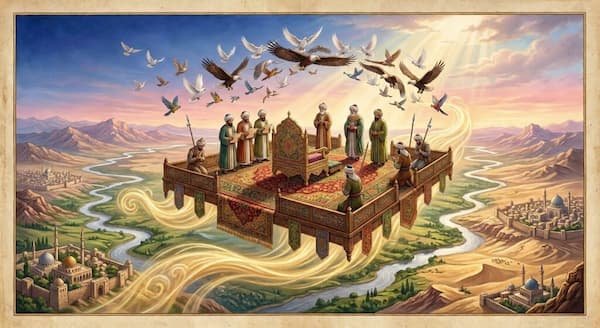
The Prophet Solomon and his court soar above ancient cities on a magical flying platform, surrounded by birds in a divine golden glow.
5.1 Instant communication and responsive governance
Messages that once took weeks to travel across deserts or mountains now arrived within hours. Reports from distant provinces reached the royal court swiftly, enabling Sulayman (A.S.) to respond to grievances, natural disasters, or administrative needs on the same day. This immediacy prevented minor issues from escalating and reinforced a system of justice that felt immediate and personal to every subject.
5.2 Unprecedented speed in trade and resource distribution
Wind-assisted transport revolutionized commerce. Caravans and merchant fleets, guided by the same obedient winds, moved spices, textiles, metals, grains, and copper with astonishing speed and safety. Journey times shrank dramatically, reducing costs, preventing spoilage, and allowing goods to reach even the most remote markets. The result was widespread economic flourishing that enriched every layer of society and funded public welfare projects across the realm.
5.3 Scientific and cultural advancement through exploration
Aerial voyages opened doors to previously inaccessible lands. Scholars traveling with the royal court documented new geographical features, botanical wonders, mineral resources, and cultural traditions. This systematic exploration expanded the kingdom’s intellectual heritage, fostering advancements in geography, natural sciences, and cross-cultural understanding that benefited generations far beyond Sulayman’s (A.S.) era.
5.4 Deterrence of conflict while preserving peace
The ability to deploy forces rapidly created a powerful deterrent against aggression. Armies could appear at threatened borders within a single day, yet Sulayman (A.S.) consistently chose diplomacy and reconciliation. This strategic advantage preserved peace without unnecessary bloodshed, proving that true strength lies in restraint and wisdom rather than conquest.
5.5 Deepened spiritual connection with Allah’s creation
Soaring above vast landscapes offered a humbling perspective of rivers, forests, deserts, and migrating birds. Each journey deepened Sulayman’s (A.S.) awe at the perfection of Allah’s design, strengthening his gratitude and reinforcing the spiritual foundation of his rule. The wind thus became not only a servant of governance but a constant reminder of the Creator’s majesty and mercy.