
Prophet Sulaiman’s Control Over the Jinn
A Divine Authority Beyond the Unseen
Among the many signs of Allah’s absolute power described in the Qur’an, one of the most remarkable is the control of the jinn under Prophet Sulaiman (Solomon), peace be upon him. This authority was not ordinary, nor was it shared with any other ruler before or after him. It was a unique divine grant, given by Allah alone, demonstrating that all creation—seen and unseen—exists under His command.
The jinn, beings created from smokeless fire, are known for their strength, speed, and abilities beyond human reach. Yet even these powerful creatures were placed under the full control of Prophet Sulaiman, not by magic or force, but by Allah’s permission. Their obedience served as a clear sign that true power belongs only to Allah, and He bestows it upon whom He wills.
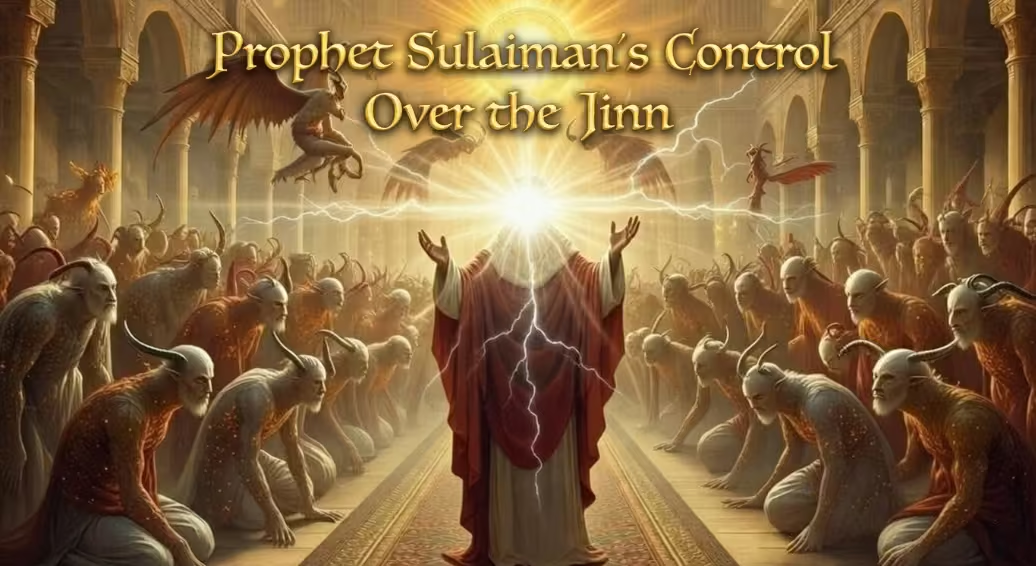
Prophet Sulaiman reigns supreme over the jinn in radiant divine power.
The Jinn Under Divine Command
By Allah's command worked under the supervision of Hazrat Salman (peace be upon him).
The jinn under divine command refers to the state in which the jinn were made completely obedient to Prophet Sulaiman (peace be upon him) by the direct will and permission of Allah, not through magic, coercion, or human power. Their obedience was enforced by divine authority, meaning they acted only within the limits set by Allah and were punished for any disobedience.
The Qur’an explicitly states that the jinn worked under Prophet Sulaiman’s authority by Allah’s command, not their own choice:
“And among the jinn were those who worked for him by the permission of his Lord.”
📖 — Qur’an 34:12
This verse establishes an essential principle: the jinn were not enslaved through fear or deception, but were divinely compelled to obey. Their service was a manifestation of Allah’s control over all creation.
Islamic scholars emphasize that this authority was not transferable. It was a special sign granted to Prophet Sulaiman alone, answering his supplication for a kingdom unlike any other.
By Allah's command allowed Prophet Sulaiman to lawfully direct the jinn to perform constructive tasks—such as building palaces, erecting fortresses, and diving into the sea—while remaining under Allah’s supervision. It stands as a unique example in Islamic belief of Allah’s absolute control over the unseen world.
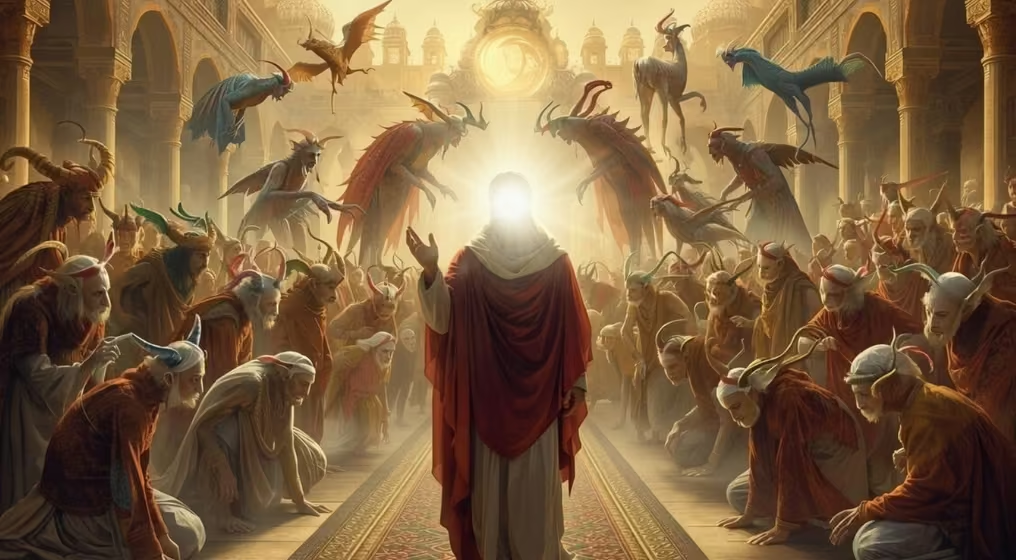
Allah subjected the jinn to Prophet Sulaiman (peace be upon him)
Why were the jinn placed under the control of Hazrat Sulaiman (A.S.)?
The jinn were placed under the control of Hazrat Sulaiman (peace be upon him) as a unique divine gift and miracle from Allah, granted in response to his sincere supplication for a kingdom unmatched by any other (as mentioned in Qur'an 38:35). This authority was not through magic, personal power, or any forbidden means—Allah explicitly cleared him of such accusations (Qur'an 2:102)—but solely by Allah's permission and command, as stated in verses like Qur'an 34:12: "And among the jinn were those who worked for him by the permission of his Lord."
He said, “My Lord, forgive me and grant me a kingdom such as will not belong to anyone after me. Indeed, You are the Bestower.”
📖 — Qur’an 38:35
This verse shows Prophet Sulaiman (A.S.) humbly asking for forgiveness (after a trial mentioned in the preceding verses) and for a unique kingdom (mulkan) that no one after him would have the like of. The word "mulkan" refers to sovereign authority or dominion, which Allah granted—including subjugation of the wind, jinn, and other miracles—as a special sign of divine favor.
And to Solomon [We subjected] the wind—its morning [journey was that of] a month—and its afternoon [journey was that of] a month. And We made flow for him a spring of [liquid] copper. And among the jinn were those who worked for him by the permission of his Lord. And whoever deviated among them from Our command—We will make him taste of the punishment of the Blaze.
📖 — Qur'an 34:12
"And they followed [instead] what the devils had recited during the reign of Solomon. It was not Solomon who disbelieved, but the devils disbelieved, teaching people magic and that which was revealed to the two angels at Babylon, Harut and Marut. But the two angels do not teach anyone unless they say, 'We are a trial, so do not disbelieve [by practicing magic].' And [yet] they learn from them that by which they cause separation between a man and his wife. But they do not harm anyone through it except by permission of Allah. And the people learn what harms them and does not benefit them. But the Children of Israel certainly knew that whoever purchased the magic would not have in the Hereafter any share. And wretched is that for which they sold themselves, if they only knew."
📖 — Qur'an 2:102
The primary reasons, drawn from the Qur'an and scholarly tafsir (such as explanations in sources like Ibn Kathir and others), include demonstrating Allah's absolute sovereignty over all creation, both seen and unseen; establishing divine order by subduing even the rebellious and powerful shayatin (devils among the jinn), who were often independent and strong; redirecting their abilities toward constructive, beneficial tasks like building grand structures, diving for resources, and other labors that showcased Allah's favor upon His prophet; protecting people from the jinn's misleading claims of hidden knowledge or fortune-telling, which led to false worship and superstition (as the subjugation prevented such corruption); and serving as a profound sign (ayah) of tawhid, reminding humanity that true power belongs only to Allah, who bestows it upon whomever He wills as a test of gratitude and justice. This control was exclusive to Sulaiman (AS), unparalleled in history, and ended with him, highlighting that such miracles are divine signs, not tools for personal glory or replication.
The Divine Order establishes the unity of creation under the will of Allah
Jinn Disturbances to Prophet Sulaiman (AS): Trials and Divine Tests
In Islamic tradition, Prophet Sulaiman (peace be upon him), known in the Bible as Solomon, was granted unparalleled dominion by Allah over humans, animals, winds, and especially the jinn. The Quran highlights this blessing in verses like Surah An-Naml (27:17): “And before Sulaiman were gathered his hosts of jinn and men and birds, and they were [marching] in rows.” And in Surah Saba (34:12-13): “And [We subjected] the devil [shayatin from among the jinn], every builder and diver, and others bound together in fetters.” This control was a divine gift, not inherent power, and it came with tests to affirm his gratitude and reliance on Allah.
Despite this authority, the jinn—particularly rebellious or evil ones (shayatin)—caused notable disturbances to Prophet Sulaiman, serving as trials from Allah. The most prominent incident appears in Surah Sad (38:34): “And We certainly tried Sulaiman and placed on his throne a body; then he returned [in repentance].” Classical tafsirs (exegeses) from early scholars like Ibn Abbas and others interpret this as a test where a rebellious jinn (often named Sakhr or Asif in traditions) temporarily seized Sulaiman’s signet ring or authority. Disguised or empowered, this jinn assumed the form of Sulaiman, sat on his throne as an impostor, and ruled briefly in his place. Sulaiman lost his kingdom and power during this period, wandering as a beggar or humbled figure until he repented sincerely to Allah. Allah then restored his dominion, emphasizing that true authority comes solely from Him.
This episode underscores a key theme: even prophets face trials to strengthen their faith. The “body” (jasad) on the throne symbolizes a lifeless or deceptive form placed by divine will to humble Sulaiman after possible momentary pride or oversight. It was not permanent harm but a test of patience, tawbah (repentance), and tawhid (oneness of Allah).
Another subtle disturbance relates to the jinn’s inherent rebellious nature. While many served loyally—building structures like the Temple (Baitul Maqdis), diving for pearls, and performing heavy labor—some shayatin resisted or committed mischief when possible. The Quran notes in Surah Saba that rebellious jinn were bound in chains as punishment for wrongdoing. After Sulaiman’s death, the jinn’s deception continued; they concealed his passing by continuing to work (as in Surah Saba 34:14), where a worm ate his staff, causing his body to fall and reveal the truth: “Nothing informed them of his death except a little creature of the earth eating his staff.” This exposed how the jinn had labored in fear, unaware he had passed, highlighting their subjugation but also their potential for deceit if unchecked.
In broader Islamic lore, while Sulaiman held supreme control, no major ongoing “disturbances” like attacks or possessions are detailed against him personally—unlike general human experiences with jinn whispers or mischief. His era represents peak divine favor, where jinn served humanity under prophetic rule. These stories teach that Allah tests His chosen servants, even with temporary loss, to purify their hearts and demonstrate that all power belongs to Him alone.
The trials involving jinn remind believers of humility: Sulaiman’s repentance after the throne incident exemplifies turning to Allah in adversity. Ultimately, these disturbances were not defeats but divine mechanisms to elevate his status and affirm Allah’s ultimate sovereignty over creation, seen and unseen.
Page 3