
Prophetic Accounts & Classical Reports
The Qur’an gives us the sacred name Sidrat al-Muntaha,
but the hadith literature opens a window into how this moment was experienced by the Messenger of Allah ﷺ during the Ascension (Mi‘raj).
The hadith literature does not describe Sidrat al-Muntaha as an earthly or botanical tree in the ordinary sense. It is not portrayed as something rooted in soil or governed by the biological processes we know. Rather, the Prophet ﷺ described it in terms that suggest both familiarity and transcendence — using the image of a tree, yet indicating realities far beyond the physical world. This balance between resemblance and incomparability reflects a broader Qur’anic method: conveying unseen realities through symbols accessible to human understanding.
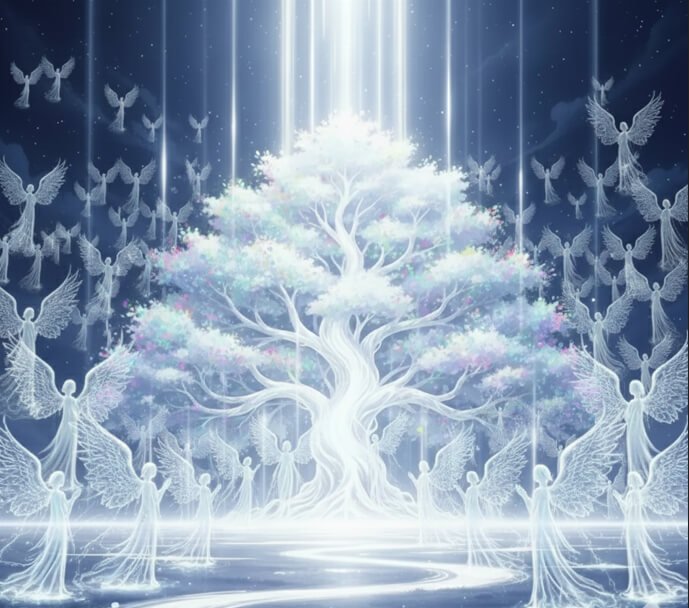
In authentic narrations describing the Night Journey and Ascension, the Prophet ﷺ spoke of the Sidrah’s immense size — its leaves like the ears of elephants, its fruits like large vessels — imagery meant not for measurement, but for awe. These descriptions communicate vastness, abundance, and magnificence, while still affirming that its true nature belongs to the unseen (al-ghayb). It is a created entity, yet situated at the furthest boundary of created existence.
The hadith also indicate its cosmic function. Scholars mention that it is the point where everything that ascends from the lower realms reaches its limit — the deeds of human beings, the souls at appointed times, the supplications rising toward the heavens. At the same time, it is the point through which everything descending from above passes — divine decrees, angelic missions, revelation. In this sense, the Sidrah symbolizes an axis of exchange between realms: a meeting point of ascent and descent within the divine order.
Yet it is crucial to understand that these descriptions do not reduce it to a “cosmic checkpoint” in a mechanical sense. Rather, they offer symbolic glimpses into the structure of reality itself. The Sidrah represents the boundary of angelic knowledge; even Jibril, the greatest of angels, halted there. This establishes a theological principle: creation has limits, and beyond those limits lies only the exclusive domain of Allah.
Thus, the reports about the Sidrah deepen our awareness of hierarchy, order, and humility. They remind us that the universe is not chaotic but structured, layered, and purposeful. The Sidrat al-Muntahā stands as a sign of that structure — a luminous boundary in the highest heaven, pointing beyond itself to the infinite majesty of the Creator.
1. The Mi‘raj: Reaching the Last Point of Creation The Ascent Through the Heavenly Realms
In authentic narrations preserved in classical hadith collections, the Prophet Muhammad ﷺ was taken by Jibrīl عليه السلام through the ascending realms of the heavens — journeying from one station to another, witnessing signs that no human eye had seen before. The ascent was not merely spatial; it was a movement through ranks of nearness, layers of reality, and degrees of divine manifestation, each more profound than the last, until they arrived at Sidrat al-Muntaha — the utmost limit appointed for creation.
There, even Jibril عليه السلام — the angel entrusted with revelation, the most honored among the angels in conveying the word of Allah — halted. The being who had descended countless times with wahy, who had traversed the heavens by divine command, stopped in humility before a boundary he could not cross.
This was not a statement of weakness, but of order. It was not fear, but recognition. Every created being has a limit set by Allah. Rank does not erase boundary. Proximity does not cancel servitude.
In that pause lies profound theology. The greatest of angels acknowledged his مقام — his station — and did not transgress it. The heavens are structured, tiered, and measured. Each realm has its appointed inhabitants, each being its defined scope. Jibrīl’s stopping signifies that beyond that boundary begins a reality that no angelic nature can endure or access.
The Prophet ﷺ, however, was granted a distinction unique to him. The journey continued — not as an elevation of human nature to divinity, but as an honor bestowed by divine will. This moment highlights both transcendence and servanthood: transcendence in the nearness granted, and servanthood in the humility maintained.
Thus, the scene at Sidrat al-Muntaha is not only a description of a celestial location; it is a revelation about hierarchy, obedience, and sacred limits. Even the most exalted of creation stands still when Allah decrees a boundary.
Only the Messenger of Allah ﷺ was granted permission to pass beyond this limit — a nearness, a light unmatched in the history of creation.
2. The Description of the Tree in the Hadith Literature: Describing the Unseen: Prophetic Method and Meaning
The Prophet ﷺ conveyed the reality of Sidrat al-Muntaha through metaphorical language rather than precise measurements. This method is deeply significant. When describing realities of the unseen (al-ghayb), prophetic expression does not aim to quantify but to evoke awe. The Sidrah belongs to a realm that transcends earthly categories; therefore, its description is framed in imagery accessible to human understanding while pointing beyond it.
- Its leaves were compared to the large ears of elephants — an image conveying vastness, grandeur, and expansiveness rather than literal botanical form. The comparison suggests magnitude beyond ordinary proportion.
- Its fruits were described as resembling enormous vessels or pitchers, indicating abundance, weight, and richness. The metaphor evokes fullness and generosity rather than agricultural detail.
- Its appearance was associated with radiant colors — gold, emerald, and hues beyond human imagination — suggesting brilliance, splendor, and a beauty not confined to the earthly spectrum.
- It was enveloped in an overwhelming Light, a covering so intense and majestic that it defies articulation. The narrations emphasize not specification, but transcendence — an illumination belonging to the highest realm.
These descriptions should not be read as literal measurements or material comparisons. Rather, they function as symbolic approximations — linguistic bridges between the known and the unknowable. The Prophet ﷺ employed familiar imagery to gesture toward a reality that cannot be reduced to physical scale or material substance.
In theological terms, the Sidrah represents a created reality situated at the furthest boundary of the cosmos. Its forms, though described in sensory language, belong to a higher ontological order. The comparisons serve to awaken reverence and contemplation, not to define botanical structure.
Thus, the prophetic metaphors are not limitations; they are invitations. They open a window into a realm where ordinary physical categories yield to light, majesty, and nearness — a realm that affirms both the grandeur of creation and the transcendence of its Creator.
3. The Rivers that Flow from Its Roots: Symbolism of Divine Provision and Sustenance
Among the profound elements mentioned in authentic narrations concerning Sidrat al-Muntaha is the report that four mighty rivers emerge from beneath it. This detail adds another dimension to its symbolism — portraying the Sidrah not only as a boundary, but also as a source.
🔸 Two hidden rivers, belonging to Paradise.
🔸 Two visible rivers, flowing within the earthly realm.
In the narrations, the visible rivers were identified as the Nile and the Euphrates — earthly waterways known for sustaining civilizations. The hidden rivers, however, were described as rivers of Paradise, unseen and belonging to the higher realm.
Classical exegetes reflected deeply on this imagery. Among them, Ibn Kathir and earlier mufassirūn understood these rivers not merely as geographical references, but as signs of a greater metaphysical truth. The emerging rivers symbolize provision (rizq) flowing from the highest divine command into all levels of existence.
The “hidden” rivers represent spiritual nourishment — mercy, faith, guidance, and eternal reward. They belong to the unseen realm and sustain the soul. The “visible” rivers represent physical sustenance — water, fertility, civilization, and life on earth. Together, they illustrate that both material and spiritual nourishment originate from a single source.
🔸 Divine Origin of Sustenance – All forms of provision, whether earthly or heavenly, ultimately stem from Allah’s decree.
🔸Unity of Realms – The unseen and the seen are not disconnected worlds; they are linked through divine governance.
🔸 Downward Flow of Mercy – Just as rivers descend from higher ground to nourish what lies below, divine mercy descends from the highest realms to sustain creation.
This symbolism harmonizes with a central Qur’anic theme: that Allah is Rabb al-‘Ālamīn — the Sustainer of all worlds. Just as water gives life to barren land, divine command gives life to hearts and civilizations alike.
Thus, the rivers flowing from beneath the Sidrat al-Muntahā are not merely a detail of cosmology; they are a theological statement. They remind us that every form of nourishment — physical, moral, intellectual, and spiritual — traces back to the highest source, flowing by the will of the One who governs both the heavens and the earth.
4. The Realm Where Angels Gather: The Convergence of the Angelic Order
The narrations indicate that at Sidrat al-Muntaha, the Prophet ﷺ beheld a vast assembly of angels — a scene of ordered movement, radiant presence, and continuous devotion. The descriptions portray not chaos, but structure; not stillness, but purposeful motion within a divinely governed system.
🔸Angels descending with entrusted commands.
🔸Angels ascending after fulfilling their appointed duties.
🔸 Angels wholly absorbed in worship, glorification, and obedience.
🔸Angels enveloped in light, reflecting the luminosity of the realm they inhabit.
This portrayal suggests that the Sidrah functions as a celestial axis within the created order — a meeting point where heavenly affairs converge. It stands at the threshold between the known expanses of the heavens and the limit beyond which created beings do not pass. In this station, the flow of divine decree intersects with the ranks of angelic service.
The imagery conveys disciplined hierarchy. Angels are not autonomous forces; they operate within precise roles assigned by Allah. Their ascent and descent symbolize continuity in divine governance — missions completed, commands received, worship uninterrupted. The Sidrah thus appears as a locus of transition: a point of reception and dispatch within the cosmic administration of the universe.
Theologically, this scene reinforces several principles. First, the universe is neither random nor self-sustaining; it is directed through ordered agency under divine command. Second, obedience defines the angelic nature. Their gathering at this station is not deliberation but submission — awaiting decree, executing trust, glorifying without fatigue.
In witnessing this convergence, the Prophet ﷺ was shown the grandeur of the unseen order. The Sidrat al-Muntahā is therefore not only a boundary of space, but a symbol of structured obedience. It represents a realm where light, worship, and decree intersect — where the entire angelic order converges in humility before the will of Allah.
5. Classical Tafsir on the Meaning of the Boundary: Understanding the Utmost Limit of Creation
The title Sidrat al-Muntaha — “the Utmost Boundary” — has been carefully explained by the early masters of tafsir.
and whatever comes from above arrives here.” 📖
This statement captures the essence of the term Al-Muntaha — the point of termination, culmination, and limit. It is the station where ascending realities reach their end and descending decrees reach their appointed reception within the created order.
🔸The knowledge of the angels extends only up to that point. Beyond it lies a realm inaccessible to created comprehension.
🔸The deeds of creation ascend through the heavens until they reach that boundary.
🔸 The decrees and commands descending from above pass through it.
🔸No creature may cross beyond it unless granted a unique divine honor.
These explanations establish Sidrat al-Muntaha as the furthest horizon of created capacity. It marks the limit of angelic perception, the summit of ascension, and the threshold beyond which only the Divine domain remains.
It is important, however, to avoid imagining this boundary in purely mechanical or material terms. Sidrat al-Muntaha is not a physical checkpoint, nor a cosmic machine regulating traffic between realms. Rather, it is a spiritual axis within the architecture of the unseen — a symbol of hierarchy, order, and limitation within creation.
Your analogy of a conveyor belt can serve as a simplified visualization: just as items move upward and downward along a structured path until they reach a designated endpoint, so too do deeds ascend and decrees descend within an ordered system. Yet the analogy must remain illustrative, not literal. The reality itself transcends spatial mechanics.
Thus, in classical tafsīr, the “Utmost Boundary” signifies theological precision: creation has limits, knowledge has limits, movement has limits — and beyond all limits stands Allah alone, unrestricted and absolute.
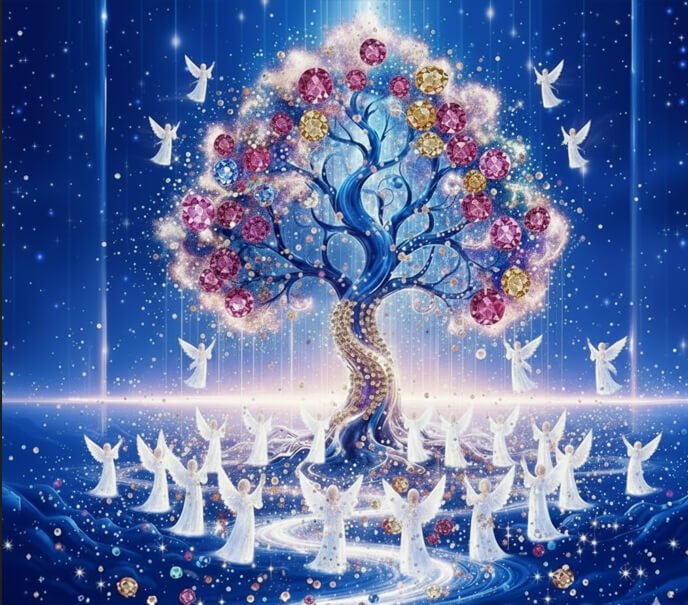
This does not mean that Sidrat al-Muntaha is a mechanical point or a physical apparatus within the cosmos. It is not a structure operating through material processes, nor a location that can be mapped in spatial terms. Rather, it represents a cosmic spiritual axis — a divinely appointed boundary within the unseen order that marks the limit of created capacity.
Your analogy of a conveyor system or final checkpoint can serve as a conceptual aid. Just as a traveler’s luggage reaches a designated station before proceeding onward according to an established order, so too does the Sidrah signify the ultimate station where ascending realities culminate and descending decrees enter the realm of created execution. The comparison helps illustrate movement and structure, though the true nature of this boundary transcends all mechanical imagery.Just as a traveler’s luggage reaches a final checkpoint before moving onward, the Sidrah is the ultimate station where movements from below end and decrees from above begin their journey downward.
Thus, Sidrat al-Muntaha is not an earthly tree rooted in soil — yet it remains profoundly connected to earthly existence. Every righteous deed that ascends, every supplication raised in humility, every angelic mission dispatched by divine command, and every decree unfolding within time interacts with this sacred limit within the cosmic hierarchy. It stands at the intersection of ascent and descent, of reception and transmission, within the unseen administration of the universe.
In theological terms, it embodies the principle of limitation: creation has a terminus. Knowledge, movement, and proximity all have an appointed boundary. Beyond that boundary lies not another created realm, but the exclusive domain of Allah’s will and knowledge.
Therefore, Sidrat al-Muntaha signifies more than a location; it signifies order. It is the station where creation reaches its furthest extent — and where the command of Allah manifests in supreme authority.
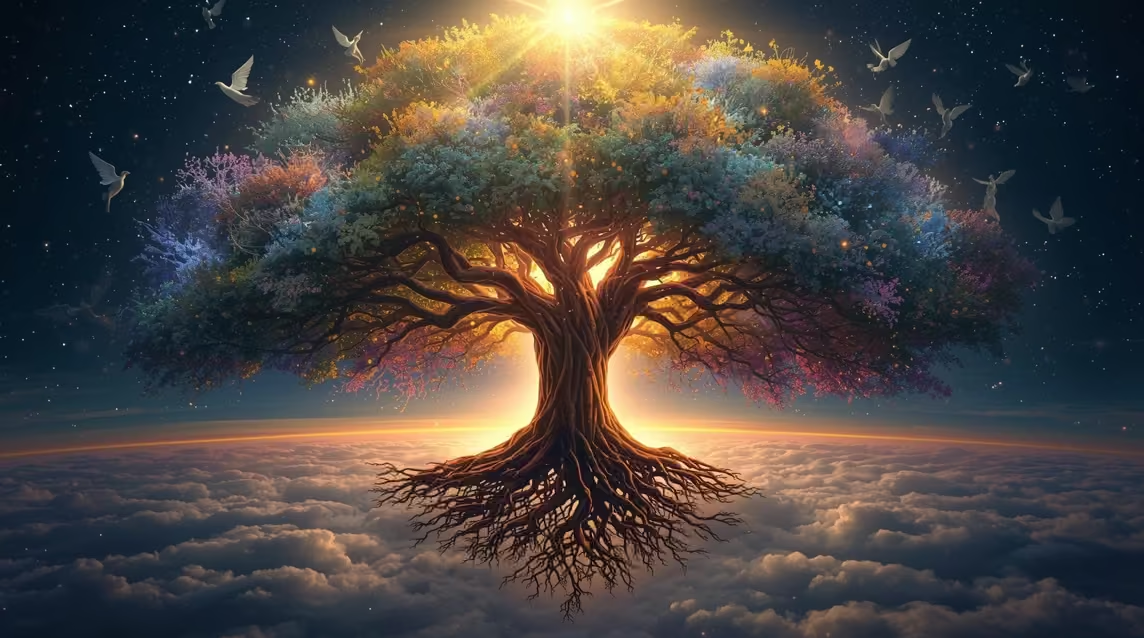
Yet it is intimately connected to the earth,
for every deed, every prayer, and every decree unfolds within an order that reaches toward this sacred and radiant boundary.
It stands at the summit of created existence, the furthest horizon granted to angels and realms alike. What rises from below culminates there in completion; what descends from above proceeds by divine command within the measured architecture of the cosmos.
It is not soil that roots it, nor seasons that shape it. Its foundation is decree, its atmosphere light, its function boundary. Though unseen by earthly eyes, its significance touches every human action and every unfolding moment of destiny.
It is where creation reaches its limit — and where the command of Allah manifests in absolute sovereignty.