
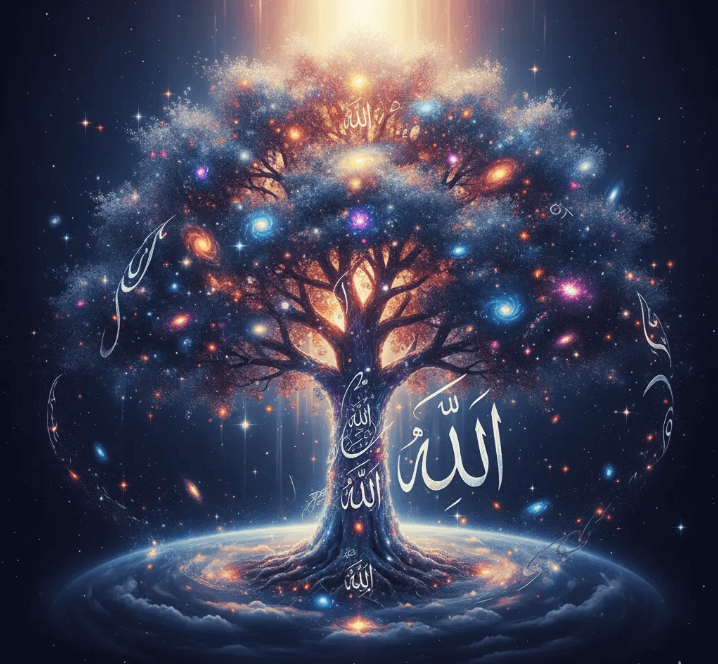
Part 2 — Qur’anic Reference and Meaning: Sidrat al-Muntaha in the Qur’an
And there is nothing except that it exalts (Allah) with His praise, but you do not understand their glorification.
The Sidrat al-Muntaha is mentioned in the Qur’an in Surah An-Najm (53:13–18) — one of the most sacred and mysterious passages describing the Prophet Muhammad ﷺ’s heavenly journey (Mi‘raj). These verses speak not with scientific detail but with language of awe and nearness, pointing to a reality that lies beyond human measure.
These verses reveal the sanctity of the Sidrah as a point where all created existence stops, and beyond which lies only the knowledge of Allah. The Prophet ﷺ saw this tree during his journey of Ascension as the final limit ofthe seventh heaven, beyond which lies infinity.
At this boundary stood the noble angel Jibril, who had accompanied the Prophet ﷺ throughout the ascent. Yet even Jibrīl, the mightiest of angels and the bearer of revelation, stopped at this point. He is reported to have said, “If I go beyond this point, I will burn.” This statement demonstrates the absolute limit placed upon creation. Despite his immense strength and proximity to divine revelation, Jibrīl could not surpass the boundary decreed by Allah. The Prophet ﷺ alone was granted the honor of proceeding further, highlighting his unique status and distinction among all creation.
Sidrat al-Muntahā thus represents the edge of the created cosmos — the ultimate frontier where the seen and unseen realms meet. Beyond it lies the realm of the Divine decree, the Preserved Tablet’s realities, and knowledge known only to Allah. It signifies that however vast the heavens and however elevated the ranks of angels, they remain confined within the limits set by their Creator.
This scene also teaches humility. Even the greatest of creation acknowledges limitation before the Majesty of Allah. It reminds believers that human intellect, spiritual experience, and even angelic capacity have boundaries. Only Allah possesses absolute knowledge and transcendence. Therefore, Sidrat al-Muntahā stands not only as a cosmic boundary but as a profound theological symbol — affirming Allah’s absolute supremacy and the finite nature of all created beings.
But what is deeply meaningful is that Allah chose a tree—not a mountain, not a star, nor even one of the majestic celestial bodies—to represent this cosmic limit. The Qur’an identifies it specifically as Sidrat al-Muntaha, the Lote Tree of the Utmost Boundary. A tree is among the most profound symbols in revelation: it embodies life, growth, order, nourishment, and connection between realms. Unlike a mountain, which is static, or a star, which is distant and unreachable, a tree is organic and living. It grows, extends, and connects what is below with what is above.
The structure of the Sidrah itself carries layered meaning. Its roots signify depth — hidden, unseen, and firmly established. Roots are not visible, yet they are the source of stability and life. This mirrors the unseen foundations of existence: the Divine decree (al-qadar), the Preserved Tablet, and the hidden realities known only to Allah. Just as roots anchor a tree and draw sustenance from beneath the earth, the unseen command of Allah sustains and governs the entire cosmos without being directly perceived by creation.
Its trunk represents strength and continuity. The trunk is singular and upright, symbolizing tawhid — the oneness and centrality of Allah’s authority. From one firm origin, everything branches outward in harmonious order. The trunk also conveys steadfastness; it does not waver despite storms. In this way, the Sidrah reflects the unwavering structure of divine governance over the heavens and the earth.
Then there are its branches, which stretch outward and upward. The scholars mention that all that ascends from the earth — deeds, souls, prayers — reaches this boundary, and all that descends — decrees, revelation, commands — passes through it. The branches therefore symbolize the channels of interaction between the created world and the higher realm. Just as branches spread widely, encompassing space and offering shelter, the Sidrah encompasses the limit of angelic knowledge and cosmic reach.
Its leaves and fruits further deepen the symbolism. Leaves absorb light, transforming it into nourishment. Likewise, revelation transforms divine light into guidance for humanity. The fruits represent the outcomes of obedience — reward, mercy, and nearness to Allah. The Prophet ﷺ described it as covered with indescribable splendor, its leaves vast, its beauty overwhelming — indicating abundance beyond imagination.
Thus, the structure of Sidrat al-Muntahā mirrors the architecture of existence itself: rooted in the unseen, upheld by divine unity, extending across the heavens, and marking the ultimate boundary where creation ends and the exclusive knowledge of Allah begins.
Every tree on our planet can be seen as a reflection — a faint echo — of Sidrat al-Muntaha. Though no earthly tree can compare to its majesty, beauty, or rank, the very existence of trees in our world points to a deeper metaphysical reality. They serve as living signs (ayat) scattered across the earth, reminding us of the harmony that binds creation from the highest heaven to the soil beneath our feet.
A tree is a bridge between realms. Its roots penetrate the hidden depths of the earth, unseen yet essential. Its trunk rises through the visible world, firm and balanced. Its branches stretch upward toward the sky, reaching for light. In this way, it mirrors the cosmic order: the unseen foundations of divine decree, the manifest world we inhabit, and the elevated realms above. The Sidrah stands at the utmost limit of that vertical ascent — the final created station before the Divine Presence — while earthly trees reflect that same pattern on a smaller scale.
The air we breathe, purified by forests; the rivers that flow, sustained by delicate ecosystems; the animals that dwell among branches; the fruits that nourish our bodies — all operate under the same divine command (kun fa-yakun). The command that sustains a leaf’s growth is the same command that sustains the heavens. The Lord who fashioned the Sidrat al-Muntahā is the Lord who causes a seed to split open in the darkness of soil. There is no separation in His governance; the macrocosm and the microcosm are upheld by the same will.
When we look at a tree, we witness dependence. It cannot grow without light, water, and soil — all provided through a perfectly measured system. Likewise, the universe itself is entirely dependent upon Allah. The Sidrah represents the furthest extent of created dependence, where even the greatest of angels halted in humility. Earthly trees quietly teach the same lesson: life is sustained, not self-generated.
Thus, every forest becomes a subtle reminder of transcendence. Every branch swaying in the wind whispers of a greater reality beyond sight. Creation is not fragmented; it is interconnected through divine wisdom. From the highest boundary of existence to the smallest sprouting leaf, all are sustained by one command, one Lord, and one sustaining mercy.
When Allah says in Sūrat al-Najm, “When there covered the Lote Tree that which covered it” (إِذْ يَغْشَى السِّدْرَةَ مَا يَغْشَىٰ) (53:16), the verse itself is wrapped in majesty and restraint. The Qur’an does not describe what covered the tree. It does not define its color, form, or intensity. Instead, it leaves the phrase open — ma(مَا) yaghsha (يَغْشَىٰ) (“that which covered it”) — as if language itself falls short before the reality. This deliberate ambiguity invites reflection: There exist realities beyond our science and imagination that no human vocabulary can fully express.
The tree mentioned is Sidrat al-Muntaha, the ultimate limit of created knowledge. If even the Messenger ﷺ, who witnessed it, described scenes beyond expression, it shows that human perception has boundaries. The veiling of the Sidrah by divine light, angels, or realities unknown signifies that beyond a certain point, the unseen (al-ghayb) overtakes the seen. Creation reaches its edge, and what lies beyond belongs solely to Allah.
This verse gently humbles human intellect. Modern science uncovers layers of the universe — galaxies beyond counting, particles beyond sight — yet each discovery only reveals how much remains unknown. The Qur’anic expression reminds us that the unseen is not empty; it is filled with realities veiled by divine wisdom. Just as the Sidrah was enveloped in something indescribable, the cosmos itself is layered with mysteries beyond current comprehension.
The same principle applies to the natural world around us. A tree we see in a forest appears simple: bark, leaves, roots. Yet beneath that simplicity lies an intricate system of cellular processes, unseen networks of communication between roots and soil, and precise balances of light and water. The deeper wisdom sustaining it is hidden from casual sight. If the earthly tree holds unseen marvels, how much more so the heavenly one?
Thus, the covering of the Sidrah symbolizes more than a moment in the Mi‘rāj; it symbolizes epistemological humility. Our vision is limited, our tools finite, our language constrained. Divine light can veil as much as it reveals. What is hidden is not absent — it is simply beyond the scope granted to creation.
In this way, the verse nurtures awe. It teaches that faith is not opposed to knowledge, but aware of its limits. Just as the Sidrat al-Muntahā was veiled in splendor beyond description, so too the deeper realities of existence remain veiled — inviting reverence, reflection, and humility before the One whose knowledge encompasses all things.
The Sidrat al-Muntaha is therefore not only a location in the highest heavens; it is also a symbol planted within the human heart. It marks a boundary in the cosmos, and it teaches us about boundaries within ourselves — the limits of knowledge, the etiquette of reverence, and the humility required before the Creator. Just as it stands at the edge of created existence, it reminds the believer that every soul must recognize where its understanding ends and surrender begins.
This awareness transforms how we see the world around us. A tree is no longer merely wood and leaves; it becomes a sign (ayah). The earth is no longer just soil and stone; it becomes a trust (amanah). When we understand that the same divine command sustaining the Sidrah sustains every seed that splits open in the ground, we begin to treat creation with dignity. Honoring the natural world is not sentimentality — it is reverence for the artistry of the One who fashioned it.
In the Qur’an, Allah draws our attention repeatedly to elements of creation through sacred oaths. In Surat al-Tīn, He swears “By the fig and the olive.” In Surat al-Shams, “By the sun and its brightness.” In Surat al-Layl, “By the night when it covers.” These are not casual references; they elevate the physical world into signs of metaphysical truth. When Allah swears by aspects of creation, He is teaching us that the material world carries spiritual meaning for those who reflect.
In this sense, the Sidrat al-Muntaha itself stands as a cosmic testimony. It is as if it silently declares that all existence has a limit, and that beyond every limit is Allah. It gathers the ascending deeds of creation and witnesses the descending decrees of the Divine. It represents the harmony between the visible and the unseen, the earthly and the celestial.
So when we look at a tree on this earth — its roots hidden, its trunk firm, its branches lifted toward the sky — we should remember the Tree beyond all measure. The Tree before which even Jibril halted. The Tree that was veiled in indescribable light. It teaches us that the ecology of the earth and the spiritual order of the heavens are not separate realities, but reflections of one unified design.
Both are sustained by the same Lord — Rabb al-‘Alamin — the One who nurtures galaxies and leaves alike, who governs the highest boundary and the smallest seed with equal wisdom and mercy.