
Soil as Skin & Microbiome — Atmosphere as Breath & Immune Shield
 Soil as Skin & Microbiome — Atmosphere as Breath & Immune Shield
📑 Table of Contents
| 1. Introduction: Rethinking the Living Planet |
2. Part I – Soil and Land: The Planet’s Living Skin
|
3. Part II – Atmosphere: Breath, Aura, and Immune Defense
|
| 4. Conclusion: We Are Cells Within a Living System |
| 5.Further Reading & Scientific Resources |
Introduction: Rethinking the Living Planet
For much of modern history, Earth was viewed as an inert resource depot—soil as exploitable dirt, atmosphere as boundless void. Yet Earth system science reveals a profoundly different reality: our planet functions as a dynamic, self-regulating entity where biological and geophysical processes intertwine.
Inspired by the Gaia framework, we see soils cycling nutrients like a digestive tract, the atmosphere regulating temperature and shielding against radiation like skin and lungs, forests exchanging gases akin to respiration, and oceans circulating heat like blood. Damage to these systems triggers cascading “symptoms”—declining biodiversity, disrupted cycles, and instability—mirroring organismal illness.
This exploration grounds the metaphor in rigorous ecology, soil science, and atmospheric physics, emphasizing two foundational systems: soil and atmosphere.
Part I – Soil and Land: The Planet’s Living Skin
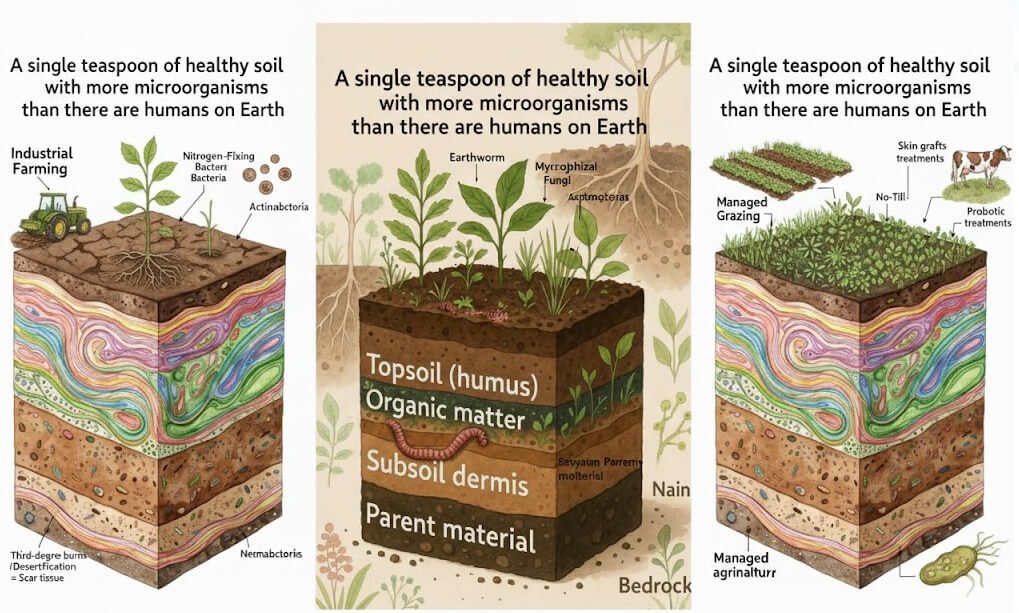
➤ 2.1 Soil Is a Thriving Ecosystem, Not Mere Dirt:Far from inert mineral matter, soil is a vibrant, biologically active medium comprising minerals (~45–50%), organic matter (~5%), water (~25%), air (~25%), and a vast living community. A single teaspoon (~5 grams) of healthy topsoil harbors billions of microorganisms—more than the human population on Earth—including up to a billion bacterial cells, thousands of fungal species, protozoa, nematodes, arthropods, and algae. These form intricate food webs that decompose organic material, cycle nutrients, structure soil aggregates, and suppress pathogens. Without this life, even nutrient-rich amendments fail to sustain plant growth effectively. |
➤ 2.2 Soil Formation: A Millennia-Long Biological Process:Soil emerges through the slow interplay of physical weathering, chemical processes, and profound biological activity. Pioneer lichens and microbes colonize bare rock, acids break down minerals, roots fracture substrates, and decomposing biomass adds organic content. Forming just 1 cm of fertile topsoil typically requires 100–1,000 years (often cited as 500–1,000 years for productive layers), depending on climate, parent material, and biota. In contrast, intensive agriculture can erode or degrade equivalent depths in mere decades through tillage, overgrazing, and exposure. |
➤ 2.3 Soil Horizons and Anatomical Parallels:Soil profiles reveal distinct layers (horizons) with functional analogies to skin:
Intact horizons protect subsurface integrity, much as healthy skin safeguards internal systems. |
➤ 2.4 The Soil Microbiome: Earth’s Digestive and Immune Network:The microbiome drives essential processes:
Plants supply sugars to mycorrhizae in exchange for nutrients and water—a ancient mutualism. The microbiome also detoxifies pollutants, stabilizes aggregates against erosion, and regulates carbon dynamics. Disruption (e.g., via fungicides or excessive tillage) impairs planetary nutrient and carbon cycles. |
➤ 2.5 Soil as the Primary Terrestrial Carbon Reservoir:Soils hold more organic carbon than the atmosphere (~800 Gt) and vegetation (~500–600 Gt) combined—estimates place global soil carbon at ~1,500–2,500 Gt. Healthy soils sequester CO₂ via organic matter incorporation; degraded soils (plowed, eroded, deforested) oxidize and release it as CO₂, exacerbating atmospheric greenhouse gases. Restoring soil carbon ranks among the most scalable, natural climate mitigation strategies. |
➤ 2.6 Erosion: A Wounding of the Planetary Skin:Industrial practices accelerate erosion: topsoil loss, compaction (reducing porosity and root aeration), biodiversity collapse, nutrient mining. Machinery compacts, monocultures diminish diversity, bare fields invite wind/water removal. Consequences include plummeting yields, heightened flooding, sediment-choked waterways, and marine dead zones—an ecological wound with systemic repercussions. |
➤ 2.7 Desertification: Formation of Scar Tissue:Desertification represents advanced degradation: biological collapse, structural breakdown, vegetation loss, hydrological disruption. Rain becomes runoff, soils harden, dust storms escalate. Recovery demands vegetation reestablishment, but prevention through sustainable management is far more effective. |
➤ 2.8 Regenerative Agriculture: Regenerative Medicine for the Skin:Regenerative approaches rebuild vitality via cover crops, rotations, composting, reduced tillage, holistic grazing, and agroforestry. Outcomes include enhanced biodiversity, superior water infiltration/retention, amplified carbon sequestration, lowered input needs, and resilience to climate extremes—reducing vulnerability to drought and flood. |
➤ 2.9 No-Till Practices: Minimizing Trauma to Preserve Integrity:Tillage shatters fungal networks, exposes organic matter to oxidation, and accelerates erosion. No-till preserves structure, maintains microbial habitats, builds organic matter, and sustains long-term fertility—analogous to protecting skin integrity to enable natural healing. |
Part II – Atmosphere: Breath, Aura, and Immune Defense
The atmosphere serves as Earth’s vital respiratory system, protective aura, and immune shield. This thin gaseous envelope—barely 0.1% of the planet’s diameter—sustains life by regulating temperature, enabling respiration, distributing water and heat, filtering harmful radiation, and maintaining chemical balance. From space, it appears as a delicate blue veil; yet within it, dynamic processes mirror the breathing, circulation, and defense mechanisms of a living organism.
When viewed through the lens of Earth system science and the refined Gaia perspective, the atmosphere actively self-regulates. It “inhales” solar energy, “exhales” heat to space, circulates nutrients and moisture like blood, and deploys chemical defenses (e.g., ozone) against ultraviolet threats. Human activities have disrupted this balance, introducing chronic toxins and excess heat-trapping gases—analogous to pollution overload and fever in a biological body. Restoration requires rapid intervention to reduce stressors and bolster natural recovery mechanisms.
➤ 3.1 The Thin Blue Veil of Life: |
Earth’s atmosphere is extraordinarily thin yet indispensable. Extending roughly 10,000 km from the surface (though 99% of its mass lies within the first ~100 km), it comprises primarily nitrogen (78%), oxygen (21%), argon (~0.93%), and trace gases including carbon dioxide (~0.042%), methane, water vapor, and others. This envelope makes Earth habitable:
Compare Earth to Mars: a thin CO₂ atmosphere failed to retain heat or water, resulting in a frozen, barren world. Earth’s atmosphere is the critical difference between a living planet and a desolate one. |
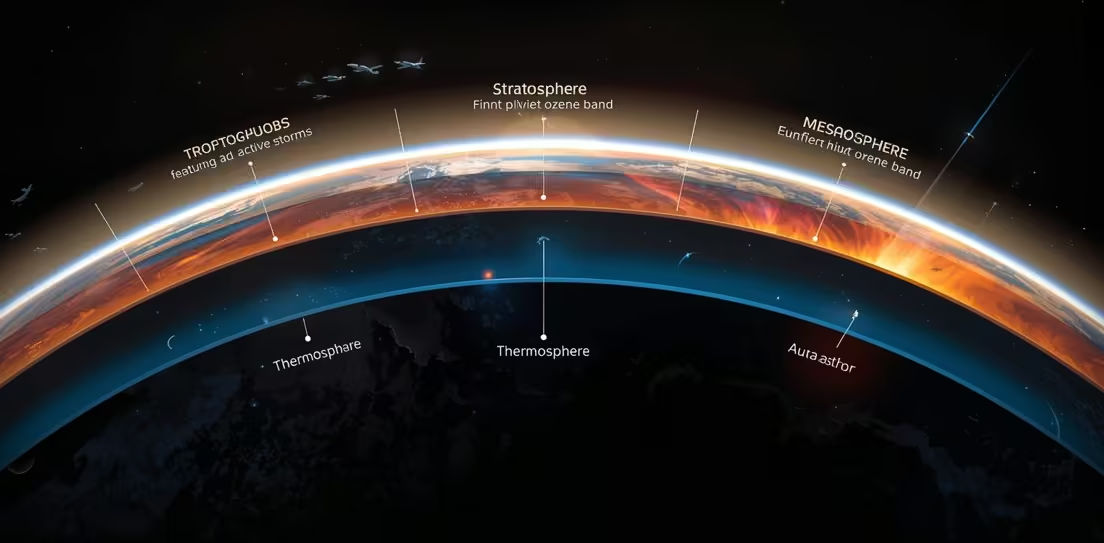
➤ 3.2 Layers of the Atmosphere and Their Vital Roles: |
The atmosphere is stratified by temperature gradients, each layer performing specialized regulatory and protective functions:
These layers interlink: tropospheric weather influences stratospheric chemistry, while stratospheric stability protects lower layers. |
➤ 3.3 The Ozone Layer: Critical Ultraviolet Shield: |
Concentrated in the lower stratosphere (~15–35 km), the ozone (O₃) layer absorbs 97–99% of harmful UV-B and UV-C radiation. Without it, DNA damage would surge, increasing skin cancer, cataracts, crop failure, and marine plankton disruption (plankton form the base of oceanic food webs and produce ~50–80% of Earth’s oxygen). Human activity nearly destroyed this shield in the 20th century via chlorofluorocarbons (CFCs) and other ozone-depleting substances (ODS). The Antarctic “ozone hole” peaked in the 1990s–2000s. Global cooperation through the Montreal Protocol (1987, universally ratified) phased out ODS. Recent data (2025) shows remarkable progress: the 2025 Antarctic ozone hole was the fifth smallest since 1992, short-lived, and closed early. Levels of ODS have declined ~one-third from peak. Full recovery to 1980 values is projected by ~2040 globally, ~2045 in the Arctic, and ~2066 over Antarctica if policies hold. This stands as humanity’s greatest environmental success story—proof that collective action can heal planetary “immune” systems. |
➤ 3.4 The Greenhouse Effect: Essential Thermal Blanket: |
The natural greenhouse effect keeps Earth ~33°C warmer than it would be otherwise (average surface temperature ~15°C instead of -18°C). Greenhouse gases (GHGs)—water vapor (dominant), CO₂, methane (CH₄), nitrous oxide (N₂O), and others—absorb outgoing infrared radiation from the surface, re-emitting it in all directions, including downward. This balanced process maintains habitability. Anthropogenic enhancement—primarily from fossil fuel combustion, deforestation, agriculture, and industry—has increased CO₂ by ~50% since pre-industrial levels, methane by ~160%, driving an “enhanced” greenhouse effect. Result: excess heat retention, planetary “fever.” The difference between natural stability and dangerous warming hinges on GHG concentrations. |
➤ 3.5 Winds and Weather Patterns: Circulatory Flows: |
Atmospheric circulation redistributes solar energy like a circulatory system:
This prevents equatorial overheating and polar freezing, sustaining biodiversity and agriculture. Disruptions (e.g., weakened jet streams from Arctic amplification) stall patterns, prolonging extremes. |
➤ 3.6 Air Pollution: Chronic Toxic Exposure: |
Air pollution acts as “toxic inhalation,” with major culprits:
Impacts (per 2025 reports): ~7.9 million premature deaths annually (2023 data), mostly noncommunicable diseases (heart disease, stroke, COPD, lung cancer, diabetes). Ecosystems suffer acidification, eutrophication, reduced photosynthesis. Nearly 9 in 10 pollution deaths link to NCDs; PM2.5 drives the largest burden. |
➤ 3.7 Climate Change: Planetary Fever: |
Rising GHGs cause systemic hyperthermia: ~1.1–1.2°C warming since pre-industrial, accelerating. Cascading effects:
Positive feedback loops amplify:
These create self-reinforcing cycles, risking tipping points. |
➤ 3.8 Extreme Weather Events: Acute Systemic Distress: |
Warming intensifies:
These manifest as acute “distress signals”—economic losses, displacement, food insecurity. |
➤ 3.9 Pathways to Atmospheric Restoration: |
Restoration demands urgent, multifaceted action (aligned with IPCC, UNEP, recent 2025 assessments):
Pathways exist to limit warming, potentially return to safer levels with net-negative emissions. Success requires global equity, finance for developing nations, and viewing humanity as stewards of the planetary organism. |
Conclusion: We Are Cells Within a Living System
In the grand architecture of Gaia—the self-regulating planetary superorganism first envisioned by James Lovelock and Lynn Margulis—soil and atmosphere stand as two of the most vital, interconnected organs. Soil functions as the living skin: a dynamic interface teeming with billions of microorganisms per teaspoon, cycling nutrients, storing vast reservoirs of carbon (more than the atmosphere and vegetation combined), and anchoring the foundation of terrestrial life. The atmosphere serves as breath and immune shield: a thin blue veil that moderates temperature through the essential greenhouse effect, circulates heat and moisture via winds and weather patterns, and deploys the ozone layer to block lethal UV radiation. Together, these systems regulate planetary homeostasis, supporting biodiversity, hydrological cycles, and the delicate chemical balance that makes complex life possible.
Yet, like any living body under stress, Earth now exhibits clear symptoms of systemic imbalance. Soil degradation—through erosion, compaction, monocultures, and desertification—manifests as ecological wounds: declining fertility, reduced water retention, and accelerated carbon release that exacerbates atmospheric warming. Air pollution and elevated greenhouse gases act as chronic toxins and fever, driving rising temperatures (~1.1–1.2°C above pre-industrial levels as of recent assessments), intensified extreme weather, ocean acidification, and feedback loops such as permafrost thaw and ice-albedo loss that amplify the distress.
Humanity occupies a unique position: we are not mere external agents but conscious cells embedded within this living system. Our actions—industrial exploitation, deforestation, fossil fuel combustion—have inflicted wounds, but our capacity for reflection, innovation, and collective action grants us unparalleled agency to heal. The Montreal Protocol’s success offers compelling evidence: by phasing out ozone-depleting substances, humanity has driven measurable recovery of the ozone layer. The 2025 Antarctic ozone hole was among the smallest and shortest-lived since 1992, with full global recovery projected to 1980 levels by around 2040 (and over Antarctica by ~2066), according to ongoing WMO, NASA, NOAA, and UNEP assessments. This triumph demonstrates that coordinated global intervention can reverse planetary damage.
Similar pathways exist for broader restoration. Regenerative agriculture—through no-till practices, cover cropping, agroforestry, and holistic grazing—rebuilds soil health, enhances microbial diversity, and sequesters carbon at rates potentially 20–30% higher than conventional methods, as emerging studies affirm. Transitioning to renewables, slashing methane emissions, reforesting landscapes, and restoring ecosystems amplify natural sinks while bolstering resilience against climate extremes.
This is not romantic idealism; it is grounded scientific necessity. Recent refinements to the Gaia hypothesis—integrating thermodynamic principles, symbiotic cooperation, and even emerging concepts of planetary intelligence—underscore that Earth’s systems evolve toward greater persistence and complexity when life and environment co-evolve beneficially. As conscious participants, we can shift from exploitation to symbiosis: fostering regeneration, equity, and harmony.
The health of Earth’s skin and breath directly determines our own survival and flourishing. By healing these vital systems—reducing emissions, restoring soils, protecting the atmosphere—we not only mitigate crisis but actively contribute to the planet’s self-regulation. The choice is ours: to act as destructive pathogens or as healing, adaptive cells within the living whole. The window for decisive stewardship remains open, but it narrows with each passing year. Let us choose regeneration—for the body of Earth, and for all life it sustains.