
Harut and Marut Magic Explained: What Quran Says About Sihr
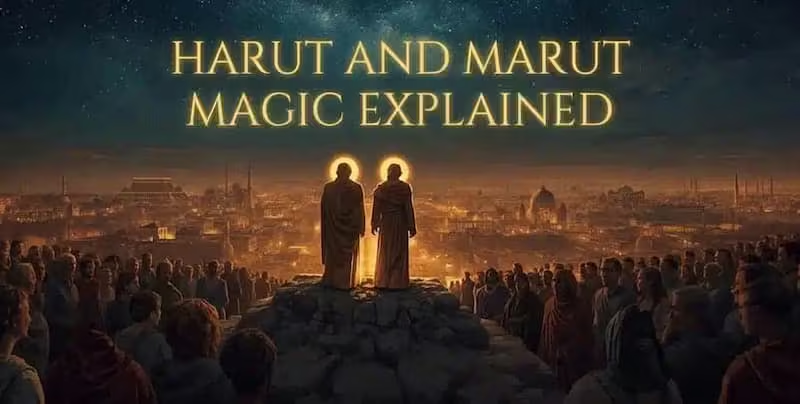
Harut and Marut — the mysterious angels whose magic changed history.
Harut and Marut Magic Explained: Many people hear dramatic stories about two angels named Harut and Marut and wonder what is true. Social media and storytelling spread exciting details quickly, but these can sometimes create confusion or unnecessary fear. This article answers the questions that often come to mind by starting with the Quran (the most reliable source) and then discussing what scholars have said about extra stories. The goal is simple: to help us distinguish clear truth from added details so our faith stays strong and protected.
Harut and Marut Magic Explained: What does the Quran actually say about them?
The only place they are mentioned is in Surah Al-Baqarah, verse 102:
“And they followed [instead] what the devils had recited during the reign of Solomon. It was not Solomon who disbelieved, but the devils disbelieved, teaching people magic and that which was revealed to the two angels at Babylon, Harut and Marut. But the two [angels] do not teach anyone unless they say, ‘We are only a trial, so do not disbelieve [by practicing magic].’ And [yet] they learn from them that by which they cause separation between a man and his wife. But they do not harm anyone through it except by permission of Allah. And the people learn what harms them and does not benefit them. And they knew that the buyer of [magic] would have no share in the Hereafter. And wretched is that for which they sold themselves, if they only knew.”
Harut and Marut Magic Explained: This verse defends Prophet Sulaiman (peace be upon him) against false accusations of magic. It clarifies that devils taught harmful sorcery (sihr). The mention of Harut and Marut links to knowledge sent down in ancient Babylon (in present-day Iraq) as a trial for people. The angels always gave this warning: “We are only a trial, so do not disbelieve.”
➤ Key lessons from the Quran:
✦ Magic is real but harmful and brings no real benefit. |
✦ It can only affect someone by Allah’s permission — it has no power on its own. |
✦ Practicing it for worldly gain leads to loss in the Hereafter. |
✦ The main message is to stay away from sorcery and hold firmly to tawhid (pure belief in Allah). |
Harut and Marut Magic Explained: The Popular Story vs. Scholarly Views
Harut and Marut Magic Explained: Islamic tradition includes many extra-Quranic stories (from tafsir commentaries, Isra’iliyyat narratives influenced by Jewish/Christian tales, and folklore) about Harut and Marut. These are not part of the Quran itself and vary widely. In the most common narrative:
- Angels in heaven criticized humans for sinning on Earth.
- Allah sent Harut and Marut (chosen by the angels) to Earth as a test for humanity, in human form, in ancient Babylon (in modern-day Iraq, near what is now Hillah or related ruins).
- They were given human desires and tested with temptations (wine, a beautiful woman named sometimes “Zuhra,” murder, etc.).
- They supposedly failed in some versions (committing sins), chose earthly punishment over Hell, and were suspended upside down (or hanged by their feet) in a well or pit as punishment until the Day of Judgment.
- While there, they continued teaching magic as a trial, always with the warning.
➤ Scholarly Caution and Criticisms:
Harut and Marut Magic Explained: Many respected Muslim scholars across Sunni and Shia traditions treat the dramatic details as weak, fabricated (mawdu’), or incompatible with core Islamic beliefs:
Angels are sinless and obedient — The Quran describes angels as beings who “do not disobey Allah in what He commands them.”
“O you who have believed, protect yourselves and your families from a Fire whose fuel is people and stones, over which are [appointed] angels, harsh and severe; they do not disobey Allah in what He commands them but do what they are commanded.”
(Surah At-Tahrim 66:6)
Harut and Marut Magic Explained: They lack free will in the human sense, do not eat, drink, or experience bodily lusts.
No strong authentic hadith supports the “fallen angels” version. Most details come from Isra’iliyyat, similar to tales of fallen angels in the Book of Enoch or Genesis 6.
Prominent critics include Ibn Hazm, some Ash’ari and Maturidi scholars, Salafi scholars, and modern reformers like Muhammad Abduh and Rashid Rida. They argue the stories contradict angelic infallibility.
Ibn Kathir and others noted that early commentators collected various reports (including weak ones), but urged sticking strictly to what the Quran states without adding unsubstantiated details.
A safer, widely accepted view: Harut and Marut were sent as a test to expose the dangers of sorcery (sihr). The “teaching” distinguishes true believers from those who fall into disbelief. Magic is ultimately linked more to devils (shayatin) than to any angelic sin.
Are Harut and Marut still alive today? Where are they now?
Harut and Marut Magic Explained: The Quran provides no information suggesting that Harut and Marut remain alive today, are imprisoned, or continue actively teaching magic. The brief mention in Surah Al-Baqarah (2:102) ties their role strictly to a past event in ancient Babylon (located in present-day Iraq), where they served as a trial for humanity by demonstrating the difference between miraculous signs from Allah and forbidden sorcery (sihr). The verse emphasizes that they warned learners: “We are only a trial, so do not disbelieve,” highlighting magic’s potential to sow discord, such as separating spouses, while underscoring that no harm occurs without Allah’s permission.
Popular folklore and extra-Quranic narrations, often found in tafsirs (Quranic commentaries) and Isra’iliyyat (stories influenced by Jewish or other traditions), expand dramatically on this. These tales claim the two angels descended to test human weakness, succumbed to temptations (involving a beautiful woman sometimes identified as “Zahra,” later linked to the planet Venus in some versions), committed sins like drinking wine, adultery, and murder, and chose earthly punishment over eternal torment.
Harut and Marut Magic Explained: As a result, they were allegedly suspended upside down by their feet in a well or cave in Babylon, where they supposedly remain until the Day of Judgment, still imparting magical knowledge to those who seek them out. Some Persian and later Islamic legends place this well on a hill or in an underground site near ancient Babylon, with dramatic accounts of seekers witnessing massive, chained figures trembling at the mention of Allah. In certain Sufi or ruhaniya (occult) practices, their names appear in talismans and rituals for contacting them to learn secrets of magic.
Harut and Marut Magic Explained: However, mainstream Islamic scholarship largely rejects these elaborate details as weak, fabricated (mawdu’), or inauthentic. Scholars like Qadi Iyad in Ash-Shifa, Al-Qurtubi, and others note that no sound hadith traces back reliably to Prophet Muhammad (peace be upon him) supporting the sin, temptation by Venus, or ongoing imprisonment. Ibn Kathir and others classify much of the narrative—especially elements from Ka’b al-Ahbar or similar sources—as unreliable or contradictory to the established Islamic belief in angels’ infallibility (‘isma). Angels do not possess human-like carnal desires in the same way; any “sin” was perhaps only in intention or as part of a divine test, and they may have returned to the heavens after their role. Some exegetes even argue Harut and Marut were not literal angels but two pious men, or that the verse simply counters Jewish claims about magic being revealed to figures like Gabriel and Michael.
Most orthodox scholars advise against speculating on their current “location” or state, as the Quran and authentic Sunnah provide no clear proof.
Harut and Marut Magic Explained: However, Angels fulfill divine commands as Allah wills, and the story’s core lesson warns against black magic, superstition, and anything that leads to disbelief or harm. Believers are encouraged to focus on tawhid (monotheism), righteous deeds, and seeking protection through the Quran (e.g., Ayat al-Kursi or Surah Al-Falaq and An-Nas) rather than chasing unverified legends that risk promoting shirk or occult practices. Engaging with such folklore can distract from the verse’s intent: magic is a trial that divides people and offers no real power independent of Allah’s decree. In summary, while cultural stories persist in folklore, especially in regions near historical Babylon, they hold no binding religious authority. True guidance lies in the Quran’s clear message, not in speculative tales about suspended angels in hidden wells.
Is their magic still working : What are affecting people today?
Is Harut and Marut’s magic still influencing us today?
The battle between darkness and light continues.
Harut and Marut Magic Explained: The Quran affirms that magic (sihr) is real and can cause tangible harm, such as sowing discord between spouses, inducing illness, or altering behavior — but only with Allah’s explicit permission (Quran 2:102). This serves as a profound trial for humanity, testing faith, and the warning holds timeless relevance. In today’s world, manifestations of sihr appear in various cultural forms: traditional sorcery involving jinn invocation, talismans, knots, spells, voodoo-like rituals, or even modern “spiritual” practices that blend occult elements with New Age ideas. Reports of black magic affecting marriages, businesses, or mental health persist across Muslim and non-Muslim societies, often linked to envy, revenge, or greed.
However, this does not imply that Harut and Marut are personally or actively “working” or teaching magic in the present day. The Quranic account situates their involvement in ancient Babylon as a specific historical test: they (or the knowledge associated with them) demonstrated sorcery’s dangers while warning seekers against disbelief. Mainstream scholars emphasize that the devils (shayatin) — not the angels themselves in an ongoing capacity — primarily propagated harmful magic, often by teaching humans deceptive arts that mix illusion, jinn assistance, and psychological manipulation. Any initial knowledge from the Babylonian episode has long been transmitted through generations of misguided humans, occult practitioners, and demonic influences, rather than direct angelic instruction today. Elaborate folk tales of the angels remaining suspended in a well or cave in Iraq (or Mount Damavand in Persian lore), still dispensing secrets to visitors, stem from weak or fabricated narrations (Isra’iliyyat) and lack support in authentic hadith or the Quran. Many orthodox scholars, including figures like Qadi Iyad and Ibn Kathir, dismiss such details as unreliable or contradictory to angels’ obedient nature.
Harut and Marut Magic Explained: The core Quranic message is clear: sihr harms the practitioner spiritually more than the victim physically, offering no benefit in the Hereafter and constituting a form of disbelief when it involves shirk (associating partners with Allah through jinn or hidden forces). It cannot override Allah’s decree. Contemporary scholars stress that while sihr exists and may affect vulnerable individuals (those with weak faith, neglecting prayers, or engaging in sins), its power is limited and illusory compared to divine will. Cases of affliction are often addressed through ruqyah (Quranic recitation for healing) rather than counter-magic, which itself risks further entanglement in the forbidden.
True Protection from Magic: Tawhid and the Sunnah
Harut and Marut Magic Explained: True protection against sihr (magic) and all forms of evil lies exclusively in strengthening tawhid (pure monotheism), consistent worship, and full adherence to the Sunnah of Prophet Muhammad (peace be upon him). These acts create an unbreakable spiritual shield that no sorcery can penetrate without Allah’s permission.
➤ Key Defenses Include:
★ Regular recitation of Ayat al-Kursi (Quran 2:255)
This verse is one of the greatest protections in Islam. The Prophet (peace be upon him) described it as the most powerful verse in the Quran, and reciting it before sleep ensures angelic guardianship throughout the night.
★ Sahih International Translation:
“Allah – there is no deity except Him, the Ever-Living, the Sustainer of [all] existence. Neither drowsiness overtakes Him nor sleep. To Him belongs whatever is in the heavens and whatever is on the earth. Who is it that can intercede with Him except by His permission? He knows what is [presently] before them and what will be after them, and they encompass not a thing of His knowledge except for what He wills. His Kursi extends over the heavens and the earth, and their preservation tires Him not. And He is the Most High, the Most Great.”
➤ The last two surahs: Surah Al-Falaq (113) and Surah An-Nas (114)
Harut and Marut Magic Explained: These were specifically revealed for protection against magic, evil eye, envy, and the whispers of shaytan (including jinn and human agents of sihr). The Prophet (peace be upon him) would recite them every night before sleep and blow over his hands, passing them over his body. It is recommended to recite each three times in the morning and evening.
★ Surah Al-Falaq (The Daybreak)
“Say, ‘I seek refuge in the Lord of daybreak from the evil of that which He created, and from the evil of darkness when it settles, and from the evil of the blowers on knots [witches who practice magic by tying knots and blowing on them], and from the evil of an envier when he envies.’”
★ Surah An-Nas (Mankind)
“Say, ‘I seek refuge in the Lord of mankind, the Sovereign of mankind, the God of mankind, from the evil of the retreating whisperer [shaytan] – who whispers into the breasts of mankind – from among the jinn and mankind.’”
★ Daily adhkar (remembrances of Allah)
Harut and Marut Magic Explained: The best practice is to establish a consistent routine of authentic morning and evening adhkar, ideally after Fajr (between Fajr and sunrise) and after Asr (between Asr and Maghrib). These include phrases such as:
“Bismillahilladhi la yadurru ma’asmihi shay’un fil-ardi wa la fis-sama’i wa huwas-sami’ul-‘aleem” (recited three times) — which grants protection from sudden harm by Allah’s leave. |
Other powerful supplications from the Sunnah that seek refuge from evil, jinn, magic, and calamity. Combined with the Three Quls (Al-Ikhlas, Al-Falaq, An-Nas) recited three times each, these adhkar form a comprehensive daily shield recommended by scholars for ongoing protection against sihr and all harms. |
Harut and Marut Magic Explained: Additional essential defenses are the five daily prayers performed on time with concentration, giving charity regularly (which extinguishes sins and repels calamity), and righteous living — avoiding sins, maintaining good character, and fulfilling obligations.
Believers should avoid fear-mongering around magic, consulting “spiritual healers” who may secretly practice sihr, or chasing hidden occult knowledge, as these can lead to greater spiritual harm or shirk. Instead, recognize sihr as a trial designed to distract from Allah and respond with complete reliance on Him (tawakkul).
Harut and Marut Magic Explained: In today’s world, where occult content, tarot, spells, and “energy work” proliferate online and in popular culture, the Quranic and Prophetic guidance remains the clearest beacon. Magic’s influence persists only as long as people neglect divine remembrance, but sincere faith, paired with these protective practices, renders it powerless. By embedding Ayat al-Kursi, Al-Falaq, An-Nas, and daily adhkar into one’s routine, a Muslim builds an impenetrable fortress of faith that no external force can breach except by Allah’s will. Focus on these proven means, seek knowledge from authentic sources, and trust that Allah is the best Protector.
Final Thought: Harut and Marut Magic Explained
Harut and Marut Magic Explained: The story of Harut and Marut in the Quran (Surah Al-Baqarah 2:102) stands as a timeless and clear warning: magic (sihr) is a severe trial for humanity. It can harm relationships, faith, and society, yet it holds no independent power — harm occurs only by Allah’s permission. The two angels were sent in ancient Babylon not to promote sorcery, but to expose its reality, distinguish it from prophetic miracles, and caution people: “We are only a trial, so do not disbelieve.” Those who pursued it knowingly traded their share in the Hereafter for temporary worldly gain.
Harut and Marut Magic Explained: Extra dramatic details found in popular folklore — such as the angels committing sins, being suspended in a well in Iraq, or still teaching magic today — add color and intrigue but are not part of the revealed Quranic text. These narratives mostly stem from weak reports, Isra’iliyyat, or cultural additions and should not be treated as authentic truth. Relying on them risks confusion, especially for those whose faith is still developing.
Harut and Marut Magic Explained: The safest and most beneficial path is to hold firmly to what the Quran explicitly states, learn its profound lessons, and turn away from all forms of sorcery and superstition. Strengthen your connection with the Quran — it is the ultimate truth that protects against deception and misguidance.
May Allah guide us all to beneficial knowledge, protect us from the trial of magic, false narratives, and every form of fitnah, and strengthen the faith of every Muslim — especially those who are still learning. Ameen.
The final revelation of Harut and Marut’s magic.
Knowledge descends from the heavens.
O Allah, we seek refuge in You from the evil of fitnah — the apparent and the hidden — from the trial of magic, and from everything that distracts us from Your remembrance. Guide us to the straight path and make the Quran a light and shield for our hearts. Ameen. 🤲
Page 15