
Free Will of Jinn

Born of smokeless fire, bound by choice alone
| Table of Content |
| ➤ Information about Jinn |
| ➤ Key Points About the Free Will of Jinn |
| ➤ Conclusion: About jinn |
| ➤ Summarize Key Points |
Information about Jinn
A central characteristic of jinn, which distinguishes them from angels and highlights the depth of Allah’s creation, is the **Free Will of Jinn**. In Islamic theology, the **Free Will of Jinn** refers to the ability to make conscious choices between obedience and disobedience, belief and disbelief. Unlike angels, who are inherently obedient and created without the capacity to sin, jinn possess the autonomy to choose their actions. This **Free Will of Jinn** is fundamental to their nature, and it is closely tied to moral responsibility and accountability before Allah.
| The Qur’an explicitly affirms the free will of jinn in several verses. For example, in Surah Al-Jinn (72:11), it states: |
| “And among us are the righteous, and among us are [others] not so; we were [of] divided ways.” |
A central characteristic of jinn, which distinguishes them from angels and highlights the depth of Allah’s creation, is their **free will of jinn**. In Islamic theology, **free will of jinn** refers to the ability to make conscious choices between obedience and disobedience, belief and disbelief. Unlike angels, who are inherently obedient and created without the capacity to sin, jinn possess the autonomy to choose their actions. This capacity for choice is fundamental to their nature, and it is closely tied to moral responsibility and accountability before Allah.
This verse demonstrates that jinn, like humans, are capable of distinguishing between right and wrong, and they make independent decisions that shape their spiritual and moral standing. Some jinn submit to Allah, live righteously, and follow His guidance, while others reject divine commands, indulge in mischief, or obey Shaytan. The presence of **free will of jinn** emphasizes the concept of moral choice, showing that their actions are not predetermined but are a product of their conscious decisions.
The creation of jinn with **free will of jinn** also highlights a key distinction in the hierarchy of creation. Angels, created from light, do not possess free will in the human sense; they are designed solely to obey Allah without deviation. Humans, created from clay, and jinn, created from smokeless fire, share the unique attribute of moral autonomy through the **free will of jinn**. This design allows both humans and jinn to be tested in their faith, judged by their actions, and rewarded or punished according to their choices. The Qur’an underscores this principle by stating that jinn, like humans, will face judgment on the Day of Reckoning for their deeds (Surah Al-Jinn 72:14).
**Free will of jinn** is not merely an abstract concept but has practical implications for the interaction between jinn and humans. Because jinn can choose to obey or disobey, some jinn act righteously, while others may seek to mislead or harm humans. Instances of whispers (waswasah) or temptations are examples of how disobedient jinn exercise their **free will of jinn**. However, their ability to act does not override divine authority; Allah alone determines the limits of their power and the framework within which they operate. This balance between autonomy and divine control reflects the wisdom and justice of Allah’s creation.
Furthermore, **free will of jinn** underscores the moral dimension of jinn existence. Just as humans are held accountable for their choices, jinn are morally responsible for how they use their abilities. Their actions, whether good or evil, are intentional and deliberate. Some jinn seek knowledge, worship Allah, and follow righteous paths, while others rebel, follow Shaytan, or engage in sinful behavior. This moral agency in the **free will of jinn** reinforces the universal principle in Islam that accountability is tied to conscious choice, not mere existence.
The concept of **free will of jinn** also has a profound spiritual significance. It teaches humans that strength, ability, or supernatural power does not determine righteousness. A jinn’s creation from fire grants them speed, energy, and extraordinary abilities, yet these attributes do not guarantee obedience to Allah. Similarly, humans are judged not by physical power or status but by their faith, intentions, and actions. The parallel between humans and jinn in exercising **free will of jinn** highlights the universal moral framework within which all sentient beings operate.
Finally, acknowledging **free will of jinn** encourages believers to approach the unseen world with knowledge, humility, and ethical awareness. It reminds humans that jinn are not mindless forces but intelligent beings capable of choice and moral reasoning. Their existence challenges humans to recognize the complexity of Allah’s creation and the significance of accountability, moral guidance, and the consequences of one’s decisions.
In conclusion, the **free will of jinn** is a cornerstone of Islamic understanding about their nature. It distinguishes them from angels, aligns them with humans in terms of moral responsibility, and underscores the principles of choice, accountability, and divine justice. **Free will of jinn** allows jinn to be righteous or rebellious, obedient or disobedient, and ensures that their actions carry spiritual weight. Understanding this concept deepens appreciation for the wisdom and balance in Allah’s creation and reinforces the broader Islamic teaching that all sentient beings are responsible for their choices in the pursuit of righteousness.
Key Points About the Free Will of Jinn
| Independent Moral Choice: Jinn can choose to obey or disobey Allah, unlike angels who are inherently obedient. |
| Accountable for Actions: Their decisions carry spiritual consequences; they will be judged by Allah on the Day of Reckoning. |
| Righteous and Rebellious Jinn: Some jinn follow Allah’s guidance, while others rebel or obey Shaytan. |
| Parallel to Humans: Both humans and jinn share the ability to exercise free will, making moral choice central to their existence. |
| Influence on Humans: Disobedient jinn may attempt to mislead humans (waswasah), reflecting the use of their free will. |
| Bounded by Divine Will: While autonomous, jinn cannot act beyond the limits set by Allah. |
| Moral Significance: **Free will of jinn** emphasizes that power or abilities do not determine righteousness; moral responsibility is key. |
| Spiritual Lessons: Their free will reminds humans of the importance of conscious choices, accountability, and ethical behavior. |
| Wisdom in Creation: Highlights Allah’s justice and the complexity of creation, showing that all sentient beings are tested by their choices. |
Conclusion: About jinn
Jinn are a fascinating and unique part of Allah’s creation, distinguished by their invisible nature, fiery origin, and moral autonomy. Unlike humans, who were created from clay, or angels, who were created from light, jinn were created from smokeless fire, giving them abilities and characteristics distinct from other creatures. This origin shapes their essence, allowing them to move swiftly, interact with the world invisibly, and, in some cases, shape-shift or influence human perception. Their creation from fire, however, does not inherently determine their morality; rather, their choices and actions define their spiritual standing.
One of the most remarkable aspects of jinn is that they were created before humans. This chronological precedence illustrates the diversity of Allah’s creation and highlights the unseen dimensions of existence. Jinn inhabit a parallel realm, capable of living in communities, establishing social structures, and exercising free will. Some are righteous, obeying Allah and striving for good, while others rebel and follow Shaytan. The existence of Iblis, a jinn who refused to bow to Adam, emphasizes the principle that free will is central to moral responsibility and accountability in Islam. Jinn, like humans, are tested in their choices and will ultimately face judgment for their deeds.
The invisibility of jinn further adds to the depth and mystique of their existence. Humans cannot perceive jinn naturally, yet their presence is acknowledged in the Qur’an and Hadith. This invisibility is a reminder that the universe is vast and multifaceted, containing realities beyond ordinary human perception. While some jinn may interact with humans, subtly influencing thoughts or emotions, their unseen nature does not diminish their accountability. Rather, it reinforces the importance of faith, ethical conduct, and awareness of the unseen world in Islam.
At the core of jinn existence is free will, which allows them to make independent choices between obedience and rebellion. This freedom to choose places moral and spiritual responsibility squarely on their shoulders. Unlike angels, jinn are not compelled to obey; they are tested in their faith and actions. Some jinn embrace righteousness, worship Allah, and live harmoniously, while others misuse their abilities, causing harm or leading humans astray. Their free will demonstrates that power or extraordinary abilities do not guarantee righteousness; moral responsibility is determined by conscious choice, not physical origin or supernatural potential.
Understanding jinn in Islam requires balancing knowledge with reverence. They are neither inherently evil nor magical in the sense of folklore myths; they are intelligent, autonomous beings created to worship Allah. Their existence teaches believers important spiritual lessons: that Allah’s creation is vast and diverse, that moral accountability extends to all sentient beings with free will, and that faith and knowledge are essential to navigating the seen and unseen worlds.
In conclusion, the study of jinn offers profound insights into the wisdom, justice, and intricacy of Allah’s creation. From their fiery origin and existence before humans to their invisible presence and exercise of free will, jinn exemplify the diversity and complexity of the universe. By understanding these aspects, believers can approach the subject with knowledge, balance, and spiritual awareness, avoiding fear, superstition, or exaggeration. Ultimately, the story of jinn reminds humanity of the universal principles of faith, moral responsibility, and accountability, reinforcing the idea that all creatures, seen or unseen, are bound by divine law and the pursuit of righteousness.
Summarize Key Points
| Definition of Jinn: Beings created by Allah from smokeless fire, with intelligence, free will, and moral responsibility, invisible in their natural form. |
| Created from Fire: Their origin from smokeless fire gives them unique abilities such as speed, movement, and sometimes shape-shifting, but their powers are limited by Allah’s will. |
| Created Before Humans: Jinn existed prior to humans, highlighting the diversity of Allah’s creation and the concept of moral accountability from the beginning. |
| Invisible Nature: Jinn inhabit a hidden realm parallel to humans, remaining unseen, yet capable of influencing the world under specific circumstances. |
| Free Will of Jinn: They possess moral autonomy, allowing them to choose between obedience and disobedience, with corresponding spiritual consequences. |
| Righteous and Rebellious Jinn: Some jinn submit to Allah and follow guidance, while others rebel and follow Shaytan, demonstrating the duality of their nature. |
| Moral and Spiritual Lessons: Their existence teaches humans about accountability, the unseen world, the diversity of creation, and the importance of faith and ethical conduct. |
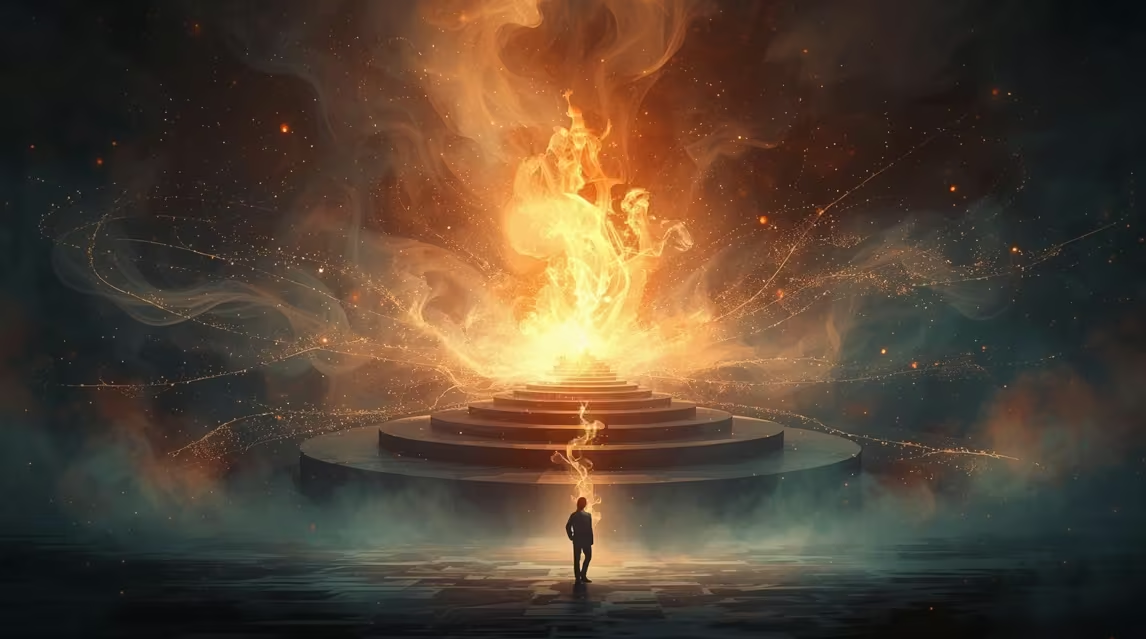
Ignited by choice, unbound by fate
Page 3