
Created Before Humans
One of the most intriguing aspects of jinn in Islamic theology is that they were created before humans. This concept is explicitly mentioned in the Qur’an and in authentic Hadith literature, highlighting that jinn existed long before the creation of Adam (peace be upon him), the first human. The chronological precedence of jinn emphasizes the diversity and complexity of Allah’s creation, illustrating that the universe contains multiple forms of sentient beings, each with their own nature, purpose, and responsibilities.
Islamic scholars explain that jinn were created from a smokeless flame of fire, a subtle and invisible substance, while humans were created later from clay. This difference in origin is not just a matter of physical composition; it reflects the distinct characteristics, abilities, and limitations of each creation. Jinn, being created earlier, had a different kind of existence that allowed them to live in realms invisible to humans. They had the capacity for movement, speed, and interaction with the environment in ways that humans could not perceive. Their creation from fire also endowed them with intelligence, free will, and moral responsibility, making them accountable to Allah just like humans.
The precedence of jinn also carries theological significance. According to Islamic teachings, Iblis, who later became Shaytan (Satan), was one of the jinn. When Allah commanded the angels and Iblis to bow to Adam, Iblis refused, citing that he was created from fire while Adam was created from clay (Surah Al-A’raf, 7:12). This historical account underscores that jinn existed before humans and had already been granted free will and moral judgment. It also highlights that the creation of humans introduced a new category of beings with distinct characteristics and that moral accountability is tied to the capacity for choice, not merely to the sequence of creation.
Being created before humans does not mean jinn are superior in all aspects. In fact, while jinn may possess certain physical or supernatural abilities due to their fiery origin, they do not have the innate moral and spiritual guidance granted to humans. Humans are given a soul (ruh) of a special nature and are endowed with the potential for reason, conscience, and closeness to Allah in ways that transcend the physical advantages of jinn. The Qur’an emphasizes that both humans and jinn are responsible for worshiping Allah and obeying His commands, showing that spiritual rank is determined by faith and action rather than the order of creation or inherent strength.
The fact that jinn were created before humans also has implications for understanding Islamic cosmology and the unseen world. Jinn have inhabited the earth and its surroundings long before humans arrived, and their existence runs parallel to human life. They occupy spaces that humans may rarely perceive, from desolate areas to remote natural landscapes, yet they are part of Allah’s plan and have their own communities, social structures, and ways of life. Some jinn are believers and obedient to Allah, while others are rebellious, showcasing the diversity within their own creation.
This early creation of jinn emphasizes the universality of divine guidance. Just as Allah sent prophets to humans, He also sent guidance to jinn, as mentioned in the Qur’an (Surah Al-Jinn, 72:1–2). They were given the knowledge of right and wrong, the ability to understand revelation, and the responsibility to follow Allah’s commands. Thus, their precedence before humans demonstrates that moral and spiritual accountability is a central principle in Islamic theology, extending beyond humanity to all sentient beings capable of choice.
In conclusion, the creation of jinn before humans is a profound concept that highlights the depth and diversity of Allah’s creation. It shows that the universe contains multiple forms of intelligent life, each with unique qualities and responsibilities. While jinn may have existed earlier and possess abilities beyond human capacity, spiritual value is determined by obedience, faith, and moral action. Understanding this precedence helps Muslims appreciate the unseen world, the significance of free will, and the wisdom behind Allah’s plan for all sentient beings. The early creation of jinn ultimately serves as a reminder of Allah’s infinite knowledge, power, and the intricate balance in His creation.
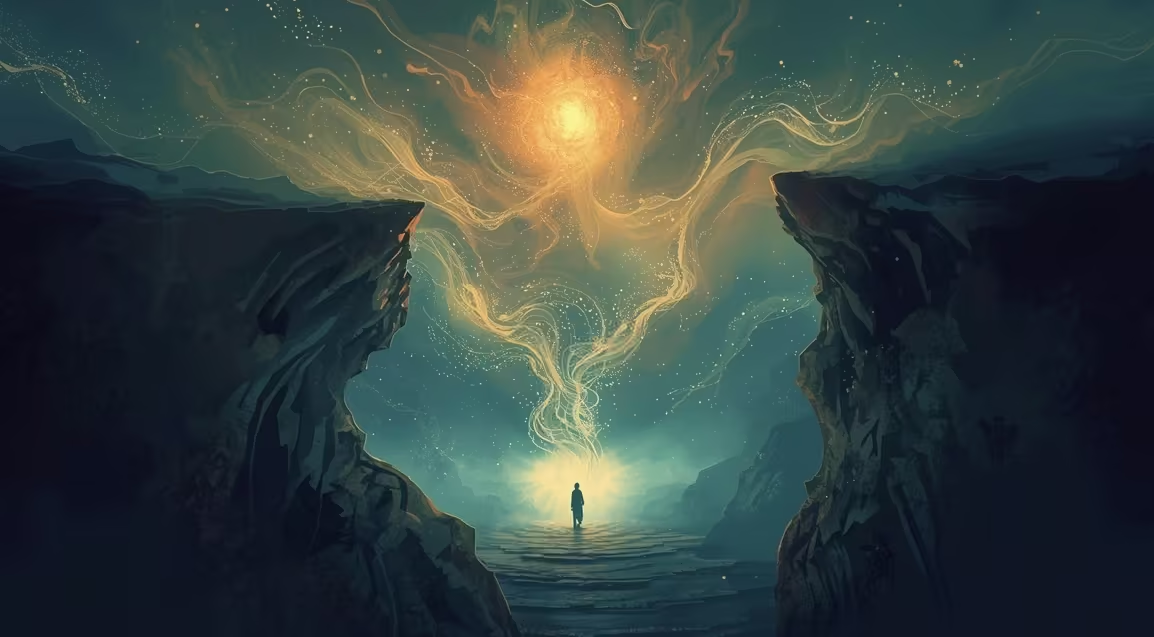
Key Points About Jinn Being Created Before Humans
| Chronologically First: Jinn were created before humans, as mentioned in the Qur’an and Hadith. |
| Different Origins: Jinn were made from smokeless fire, while humans were made from clay. |
| Possess Free Will: Like humans, jinn can choose to obey or disobey Allah and are morally accountable. |
| Iblis Was a Jinn: The refusal of Iblis to bow to Adam highlights that jinn existed prior to humans and had independent moral judgment. |
| Distinct Abilities: Their fiery nature gives them speed, mobility, and shape-shifting abilities, but spiritual guidance depends on faith, not power. |
| Spiritual Responsibility: Both jinn and humans are responsible for worshiping Allah and following His commands. |
| Parallel Existence: Jinn inhabit a hidden realm alongside humans, with their own communities and social structures. |
| Diversity Among Jinn: Some are righteous, while others are rebellious, reflecting moral choice within their creation. |
| Divine Wisdom: Their early creation demonstrates Allah’s knowledge, planning, and the universality of moral accountability. |
Invisible Quality of Jinn
One of the defining characteristics of jinn in Islamic theology is that they are invisible to humans in their natural form. This invisibility is not merely a physical trait but an essential part of their existence, distinguishing them from humans and angels. The Qur’an, which provides the most authentic source of knowledge about jinn, repeatedly emphasizes that these beings inhabit a parallel realm that is largely hidden from human perception. Surah Al-Jinn (72:1) opens with a direct acknowledgment of the jinn’s unseen nature:
“Say, [O Muhammad], ‘It has been revealed to me that a group of the jinn listened and said, ‘Indeed, we have heard an amazing Qur’an.”‘
The verse illustrates that jinn were aware of divine guidance, yet their existence remained invisible to humans. Their invisibility does not imply nonexistence; rather, it reflects the unique substance from which they were created. Unlike humans, who have dense physical bodies of clay, jinn are created from smokeless fire, a subtle and energetic element that can exist without being perceived by the human eye. This ethereal composition enables them to move across vast spaces instantaneously, traverse different realms, and interact with the world in ways humans cannot detect.
Islamic scholars explain that the invisibility of jinn serves multiple purposes. First, it emphasizes the limitations of human perception. The human senses are designed to interact with the physical world, yet Allah’s creation encompasses dimensions beyond ordinary perception. Jinn occupy a hidden dimension, reminding humans that the universe is far more complex than what is immediately observable. Second, their unseen nature ensures that humans focus on spiritual understanding rather than relying solely on physical evidence. This aligns with the Qur’anic emphasis on faith, moral responsibility, and awareness of the unseen (al-ghayb).
Despite being invisible, jinn can interact with humans under certain circumstances. Islamic texts and traditions describe instances where jinn may influence thoughts, emotions, or perceptions. This is often referred to as waswasah, or subtle whispering, and is typically associated with Satanic influence. In rare cases, jinn may manifest in forms perceivable to humans, though this requires special conditions and permission from Allah. These interactions demonstrate that invisibility does not equate to impotence; rather, it highlights that jinn can operate beyond the human sensory spectrum.
The concept of invisibility also underscores the diversity and autonomy of jinn communities. Like humans, jinn form societies with social structures, cultures, and governance. They may live in remote, desolate places such as ruins, deserts, and forests, or even in areas close to human habitation. Their ability to remain hidden allows them to coexist alongside humans without immediate detection, maintaining their own lives while respecting the limits set by Allah.
Moreover, invisibility reflects the spiritual and moral dimension of jinn. Humans are judged based on faith, intentions, and actions, and jinn are similarly accountable. Their unseen nature does not exempt them from divine judgment; instead, it places greater emphasis on moral choice rather than physical visibility. Jinn can be believers or disbelievers, righteous or rebellious, and their spiritual state determines their ultimate fate. Allah’s judgment applies equally to both visible and invisible creations, reinforcing the principle that accountability is tied to free will and conscious choice, not physical form.
Invisibility has also contributed to the mystique surrounding jinn in human culture. Across centuries, folklore and cultural stories have amplified the idea of jinn as mysterious or supernatural beings. While some narratives exaggerate their abilities, Islamic teachings clarify that invisibility is simply a natural trait of their existence. It is neither inherently dangerous nor inherently magical; it is a feature of Allah’s diverse creation. By understanding jinn’s invisibility within the framework of Islamic theology, believers can approach the topic with knowledge and balanced awareness, avoiding superstition or fear.
In conclusion, the invisibility of jinn is a fundamental aspect of their nature, reflecting their unique creation from smokeless fire, their hidden realm, and the limits of human perception. It serves as a reminder of the unseen dimensions of Allah’s creation, the importance of faith, and the moral accountability that applies to all sentient beings with free will. While humans cannot naturally perceive jinn, Islamic teachings provide insight into their existence, their interactions, and their responsibilities. Recognizing the invisible nature of jinn encourages believers to appreciate the spiritual complexity of the universe and to seek knowledge and protection through Allah, who encompasses both the seen and the unseen.
Key Points About the Invisibility of Jinn
| Unseen by Humans: Jinn exist in a realm invisible to human perception in their natural form. |
| Created from Smokeless Fire: Their ethereal, subtle composition allows them to remain hidden. |
| Reminder of Human Limitations: Their invisibility emphasizes that the universe contains dimensions beyond ordinary perception. |
| Interactions with Humans: Jinn can influence thoughts, emotions, or perceptions (e.g., waswasah) and sometimes manifest under special circumstances. |
| Parallel Societies: Jinn form their own communities, social structures, and cultures, coexisting alongside humans while remaining unseen. |
| Moral Accountability: Invisibility does not exempt them from judgment; their spiritual and moral actions determine their reward or punishment. |
| Believers and Disbelievers: Some jinn obey Allah, while others rebel, demonstrating that moral choice is independent of physical visibility. |
| Spiritual Significance: Their unseen nature encourages humans to focus on faith, moral responsibility, and the unseen world rather than physical evidence. |
| Cultural Perceptions: Folklore may exaggerate their abilities, but Islamic teachings clarify that invisibility is a natural, non-magical trait of their creation. |