
Interpreting the Survival of Prophet Nuh (Noah A.S.) After the Flood
Islamic, Biblical, and Archaeological Perspectives
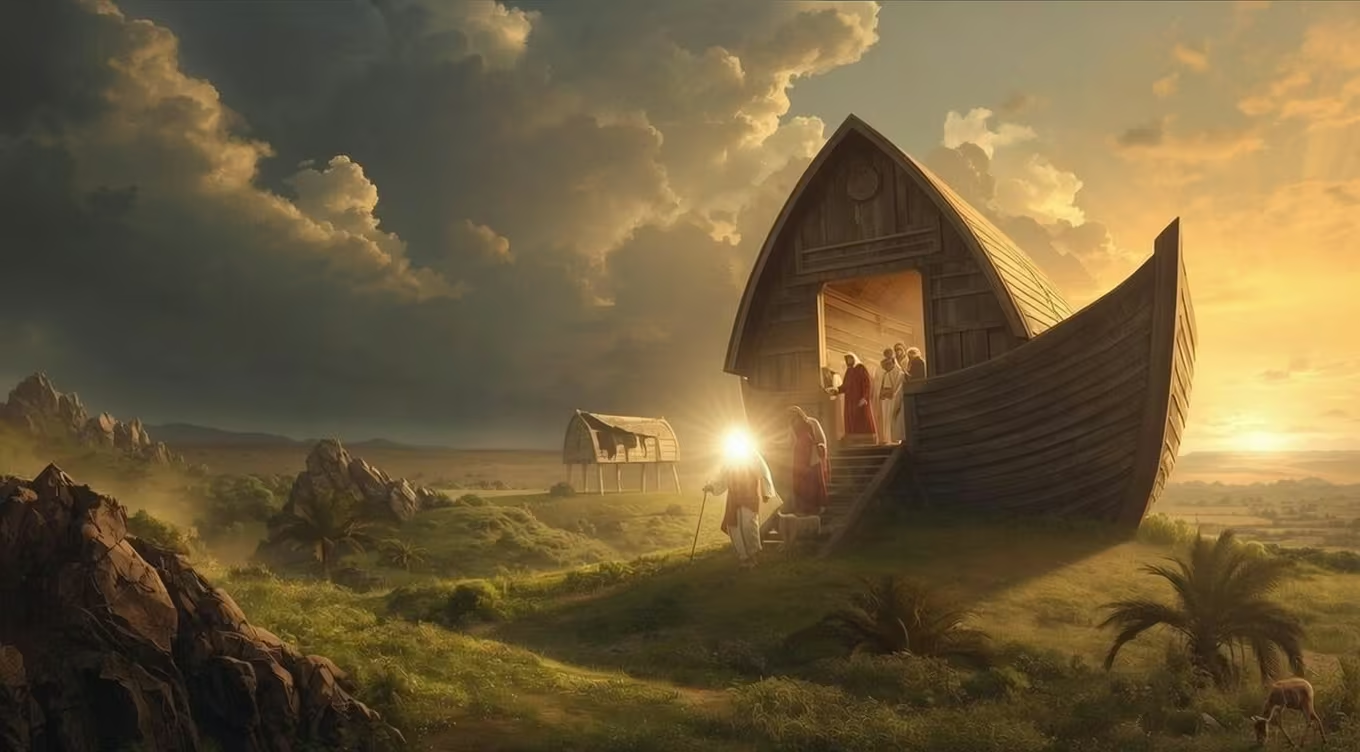
Prophet Nuh (A.S.) standing at the entrance of the Ark at sunset
Abstract
The narrative of the Flood and the survival of Prophet Nuh (Noah, peace be upon him) transcends religious boundaries, appearing in Islamic, Biblical, and ancient cultural traditions. In Islam, it is viewed as a divine historical event rooted in revelation. Non-Muslims, however, often interpret it through Biblical lenses, archaeological evidence, or environmental history. This article explores how Nuh’s (A.S.) post-flood survival can be understood by non-Muslims. It compares Islamic explanations with Biblical accounts and archaeological findings, while emphasizing shared themes of renewal and interpretive variances.
Introduction
The Flood story holds a pivotal place in human religious and cultural heritage. In Islam, the account of Prophet Nuh (A.S.) is detailed in the Qur’an as a factual event underscoring divine justice and mercy. For non-Muslims, engagement with this narrative may be academic, symbolic, or comparative, rather than faith-based. This exploration focuses on Nuh’s (A.S.) survival after the deluge. It draws from Islamic sources while facilitating understanding through Biblical parallels and archaeological insights. By doing so, it bridges theological and secular perspectives, allowing readers to appreciate the story’s universal resonance.
The Islamic Account: Survival Through Divine Command and Practical Means
In Islamic tradition, Nuh’s (A.S.) survival post-flood is framed as an act of Allah‘s will, executed through preparation and blessing. The Qur’an (Surah Hud 11:36–49) describes the Ark’s construction under divine guidance, the gathering of believers and animals, and the Flood‘s subsidence by Allah‘s command. The vessel rests on Mount Judi (in modern-day Turkey), symbolizing a new beginning. Survival is ensured not merely by miracle but through tangible elements: stored provisions, paired animals for repopulation, and gradual environmental restoration.
The Qur’an notes the earth’s recovery, with waters receding and skies clearing (Surah Hud 11:44), implying a return to habitable conditions. Barakah (divine blessing) plays a central role, enhancing meager resources for sustenance. Post-flood, Nuh (A.S.) and his followers engage in agriculture and community rebuilding, aligning with human resilience. For non-Muslims, this narrative resonates rationally—it mirrors disaster preparedness strategies, such as stockpiling and ecological adaptation—without requiring belief in the supernatural.
Surah Hud (Chapter 11), Verses 36–49: The Account of Prophet Nuh (Noah, peace be upon him)
| 36 | And it was revealed to Noah that, “No one will believe from your people except those who have already believed, so do not be distressed by what they have been doing. |
37 | And construct the ship under Our observation and Our inspiration and do not address Me concerning those who have wronged; indeed, they are [to be] drowned. |
| 38 | And he constructed the ship, and whenever an assembly of the eminent of his people passed by him, they ridiculed him. He said, “If you ridicule us, then we will ridicule you just as you ridicule. |
| 39 | And you are going to know who will get a punishment that will disgrace him [on earth] and upon whom will descend an enduring punishment [in the Hereafter]. |
| 40 | [So it was] until when Our command came and the oven overflowed, We said, “Load upon the ship of each [creature] two mates and your family, except those about whom the word has preceded, and [include] whoever has believed.” But none had believed with him, except a few. |
| 41 | And [Noah] said, “Embark therein; in the name of Allah is its course and its anchorage. Indeed, my Lord is Forgiving and Merciful.” |
| 42 | And it sailed with them through waves like mountains, and Noah called out to his son who was apart [from them], “O my son, embark with us and do not be with the disbelievers.” |
| 43 | [The son] said, “I will take refuge on a mountain to protect me from the water.” Noah said, “There is no protector today from the decree of Allah, except for whom He gives mercy.” And the waves came between them, and he was among the drowned. |
| 44 | And it was said, “O earth, swallow your water, and O sky, withhold [your rain].” And the water subsided, and the matter was accomplished, and the ship came to rest on the [mountain of] Judiyy. And it was said, “Away with the wrongdoing people.” |
| 45 | And Noah called to his Lord and said, “My Lord, indeed my son is of my family; and indeed, Your promise is true; and You are the most just of judges!” |
| 46 | He said, “O Noah, indeed he is not of your family; indeed, he is [one whose] work was other than righteous, so ask Me not for that about which you have no knowledge. Indeed, I advise you, lest you be among the ignorant.” |
| 47 | [Noah] said, “My Lord, I seek refuge in You from asking that of which I have no knowledge. And unless You forgive me and have mercy upon me, I will be among the losers.” |
| 48 | It was said, “O Noah, disembark in peace from Us and blessings upon you and upon nations [descending] from those with you. But other nations [of them] – We will grant them enjoyment; then there will touch them from Us a painful punishment.” |
| 49 | That is from the news of the unseen which We reveal to you, [O Muhammad]. You were not with them when they put together their plan while they conspired. |
Page 4