
Part 1 — Earth as a Living Body
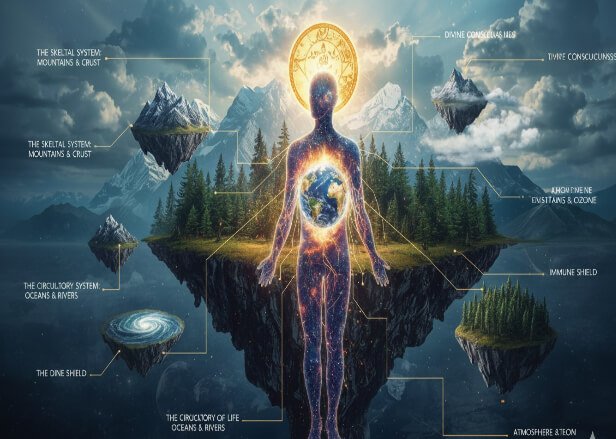
Gaia 🌿Biosphere🌿 Planetary Consciousness 🌍
A Deep Symbolic, 💚 Scientific, 💚 and 💚 Spiritual Exploration
Introduction: 🫁 A Planet That Breathes, Bleeds, and Feels
For thousands of years, poets, philosophers, indigenous elders, and mystics have referred to Earth as Mother, as Gaia, as a living being. Today, modern science quietly confirms what ancient wisdom always knew: our planet is not a dead rock with life stuck on it like moss. It is a single, self-regulating, interconnected super-organism.
When we dare to imagine Earth as one vast living body, something magical happens. Mountains suddenly become bones. Oceans pulse like blood. Forests breathe in and out exactly like lungs. Rivers carry nourishment through veins and arteries. The atmosphere becomes both skin and immune system. The Sun beats as the external heart, the Moon keeps the inner clock, and the fiery core burns as the hidden furnace of life itself.
This is not mere poetry. It is a powerful lens that helps us understand ecology, climate, and our own place in the web of life more deeply than ever before.
Let us walk slowly through every “organ” of this planetary body,
exploring the science, the symbolism, and the urgent message
each part whispers to humanity today.
🌍💚🩸😔
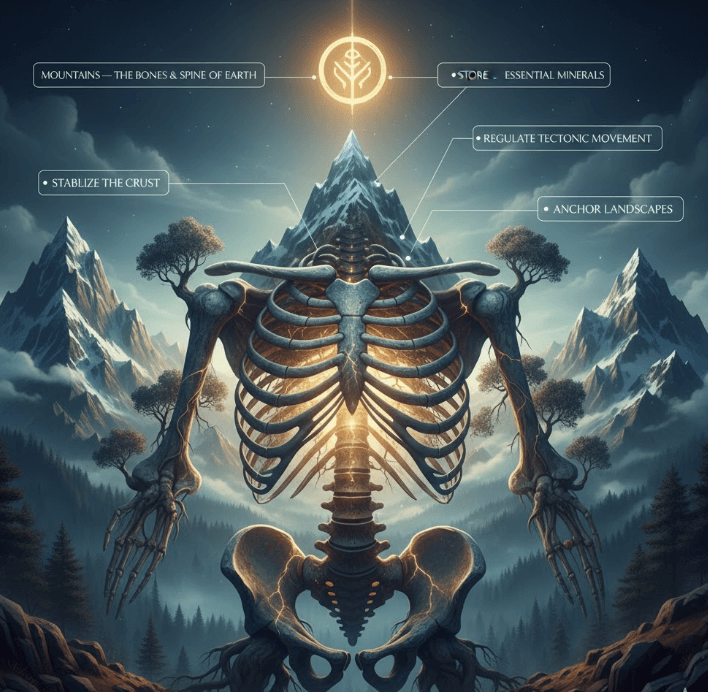
1. Mountains — The Bones and Spine of Earth
🌄 The Himalayas, Andes, Rockies, and Alps are the ridges of Earth’s spine.
🌄 Ancient shield regions like the Canadian Shield or the African Craton are the thick skull and pelvis.
🌄 Mid-ocean ridges are the growing bones, where new crust is born.
🏔️ Scientific roles of mountains (Earth’s skeleton):
🏕️ They lock tectonic plates in position and control the speed of their movement.
🏕️ They store enormous quantities of minerals — calcium, phosphorus, iron — slowly released into rivers and eventually into our own bodies.
🏕️ They create orographic rainfall: moist air rises over peaks, condenses, and waters entire continents.
🏕️ They prevent the planet from wobbling too violently on its axis.
When we mine mountains, blast them for roads, or strip them bare,
💥we are breaking the planet’s bones.💥
Fractured spines do not heal quickly.
Landslides, earthquakes, and loss of water sources are the planet’s pain signals telling us:
💔
“Stop. This hurts the entire body.” 💔
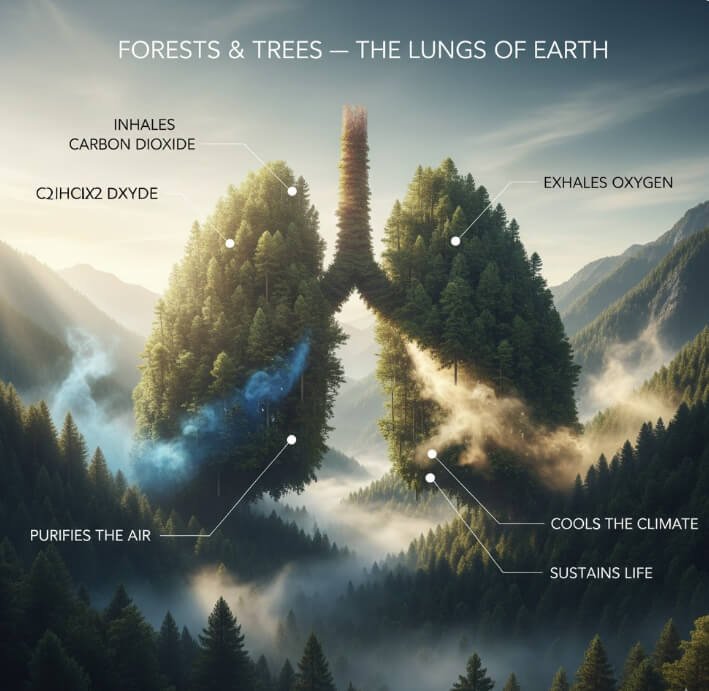
2. Forests and Trees — The Lungs of the Planet
Every schoolchild learns that trees produce oxygen.
Few realise how literal the lung comparison truly is.
The Amazon rainforest alone releases roughly 20 % of Earth’s oxygen — a single green lung the size of the United States. The Congo Basin and the boreal forests of Canada and Russia form the other lung.
How forests breathe:
🌳 Billions of leaf stomata open and close like tiny mouths, inhaling CO₂ and exhaling O₂.
🌳 At night, forests gently exhale CO₂ — exactly like a sleeping body.
🌳 Transpiration from leaves pumps massive amounts of water vapour into the atmosphere, forming “flying rivers” that travel thousands of kilometres and bring rain to distant farmlands.
When we burn or clear forests,
Earth develops emphysema and asthma.
Carbon builds up in the “bloodstream” (atmosphere), temperatures rise, and the planetary lungs wheeze.
Reforestation and protection of old-growth forests
are not environmental luxury —
🌳they are planetary respiratory therapy.🌳