
Let Us Understand Stars: What are Stars? 🌟
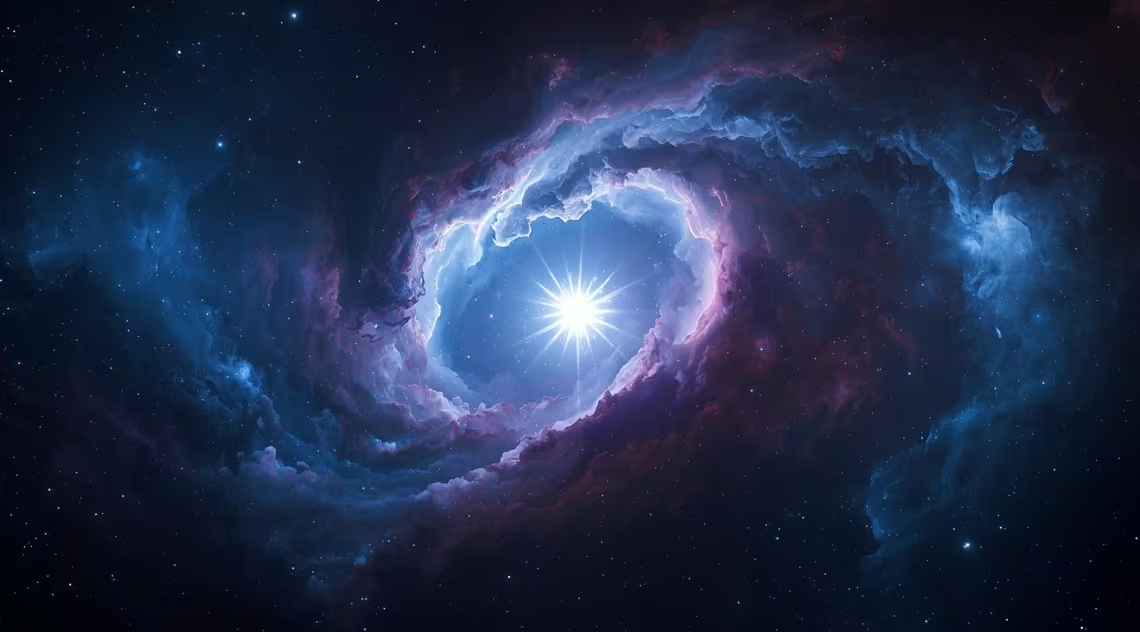
luminous spheres of plasma
Stars are massive, luminous spheres of plasma held together by their own gravity. They are born within the dense regions of molecular clouds—vast areas of space containing gas and dust. These clouds collapse under their own gravity, forming dense cores that eventually ignite nuclear fusion in their centre, giving birth to a star.
The energy produced by stars comes from nuclear fusion, primarily the fusion of hydrogen atoms into helium. This process releases immense amounts of energy in the form of light and heat, which radiate outward into space. Our Sun is a typical star, providing the Earth with the energy needed to sustain life.
The Life Cycle of a Star: The Stellar Journey
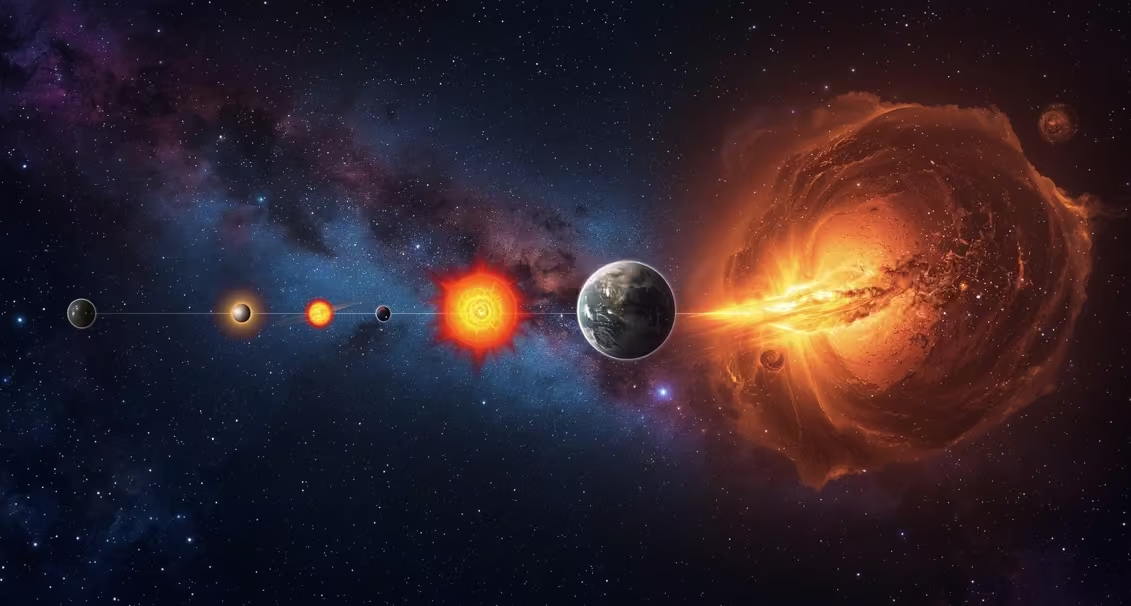
Nebula stars formed from vast clouds of gas and dust
Stars are born from vast clouds of gas and dust known as nebulae. Over millions of years, gravity pulls these materials together, forming a dense core that ignites nuclear fusion—the process that makes a star shine. As stars evolve, they pass through several stages depending on their mass. Smaller stars, like our Sun, eventually expand into red giants and then shrink into white dwarfs. More massive stars end their lives in spectacular supernova explosions, leaving behind either neutron stars or black holes.
Fascinating Star Facts
Stars are massive, glowing balls of plasma powered by nuclear fusion, lighting up the universe with mind-blowing diversity and scale.
|
|
|
|
|
|
|
|
|
|
|
|
|
|
|
|
|
|
Stars in Culture and History
Throughout history, stars have inspired myths, served as guides for navigation and agriculture, marked divine symbols, and preserved cultural stories across civilizations worldwide.
Throughout human history, stars have held deep cultural, spiritual, and practical significance. Long before modern astronomy, ancient civilizations looked to the night sky for guidance, inspiration, and meaning.
The Ancient Egyptians associated stars with their gods and believed they represented the souls of the departed, guiding them in the afterlife. In Greek mythology, constellations were seen as celestial depictions of heroes, gods, and mythical creatures, immortalized among the stars. Across the world, Indigenous cultures developed their own rich traditions of star lore—using the heavens for navigation, marking the changing seasons, and preserving stories that connected communities to the natural world.
Even today, stars continue to capture human imagination. They inspire scientific discovery, artistic expression, and philosophical reflection. Whether through the study of astronomy, the symbolism of astrology, or simply the quiet act of stargazing, the stars remind us of our connection to the vast universe and our enduring curiosity about the mysteries beyond our world.