
The Moment of Sacrifice and the Divine Intervention (The Appearance of the Ram 🐏)
Chapter Third
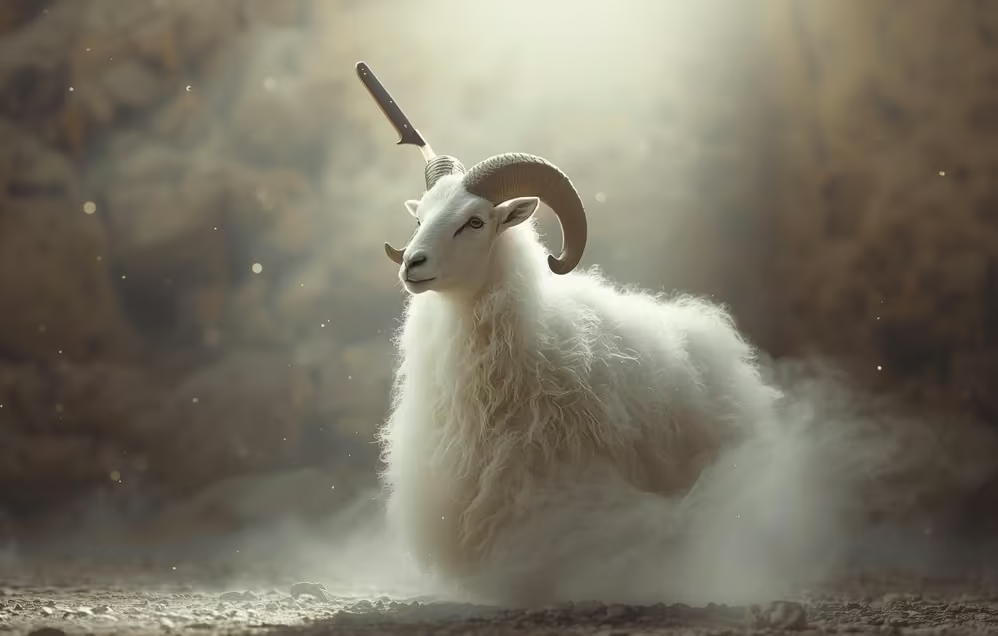
As Hazrat Ibrahim (عليه السلام) and his son Hazrat Ismail (عليه السلام) reached the designated place in Mina, they prepared for the ultimate act of submission to Allah‘s command. Ismail, ever obedient and faithful, lay down on the ground, facing the Qibla, with his forehead on the earth. Ibrahim (عليه السلام), with a heavy heart but unwavering resolve, blindfolded himself to avoid seeing his beloved son’s face in that moment, and raised the knife to fulfill the divine order.
In that split second, as the knife descended toward Ismail (عليه السلام)‘s neck, a miraculous intervention occurred. The blade, sharp as it was, did not cut—Allah had rendered it harmless, protecting Ismail (عليه السلام) completely. At the exact instant the knife touched but failed to harm, the angel Jibril (Gabriel (عليه السلام)) descended from the heavens by Allah‘s command, bringing a majestic ram (a sheep-like animal) from Paradise itself. This ram appeared suddenly, as if materialized out of thin air, right beside them, replacing Ismail (عليه السلام) in the act of sacrifice. Allah‘s voice echoed through Jibril (عليه السلام): “O Ibrahim (عليه السلام)! You have fulfilled the vision!” (Quran 37:105), confirming their test of faith was complete.
Hazrat Ibrahim (عليه السلام) immediately released Ismail (عليه السلام), who was unharmed and safe, and turned to the ram. He slaughtered it then and there as the ransom sacrifice in place of his son, offering it to Allah in gratitude. The meat was distributed as charity to the needy, symbolizing the ongoing tradition of Qurbani during Eid al-Adha, where Muslims commemorate this event by sacrificing animals and sharing with others. This divine swap not only spared Ismail (عليه السلام) but established a eternal lesson in trust, obedience, and Allah’s mercy.
🤲 Conclusion with Key Lessons 🤲
🕋 Key Lesson: Tests are not punishments but elevations of faith. Allah tests believers by both giving (e.g., wealth or children) and requiring sacrifice (to purify and strengthen their iman).
🕋 Link to Broader Tests: This event mirrors the fire incident: both involved apparent destruction (his body in the fire, his son in sacrifice) but led to divine salvation and a lasting legacy. The fire became “coolness and safety” for him (Quran 21:69); the sacrifice was replaced with a ram and became an eternal commemoration in Hajj and Eid al-Adha.
🕋 Theological Significance: It underscores that true faith requires action, not just belief. Allah does not need sacrifices—He owns everything—but they demonstrate sincerity and complete submission.
2 — All praise be to Allah, Lord of all the worlds/universe. 3 — The Most Compassionate, the Most Merciful. 4 — Master/Owner of the Day of Judgment/Recompense. 5 — You alone we worship, and You alone we ask for help. 6 — Guide us to the Straight Path. 7 — The path of those You have blessed, not of those who have earned Your anger, nor of those who go astray.
The complete submission of both Hazrat Ibrahim and Hazrat Ismail (عليهما السلام) to the will of Allah should be a profound lesson for the Ummah of Muhammad (ﷺ) — to remain steadfastly connected to Allah with deep faith and firm certainty.
May Allah grant us all — young and old — the strength and tawfiq to succeed in our exams, trials, and every test of life with the same unshakeable faith and obedience.
آمين يا رب العالمين 🤲✨
Ameen 🤲🌟
Discover the full beauty of this trial of faith...