
Abraham Among the Nations: Echoes of the Fire in Abrahamic Memory 🔥
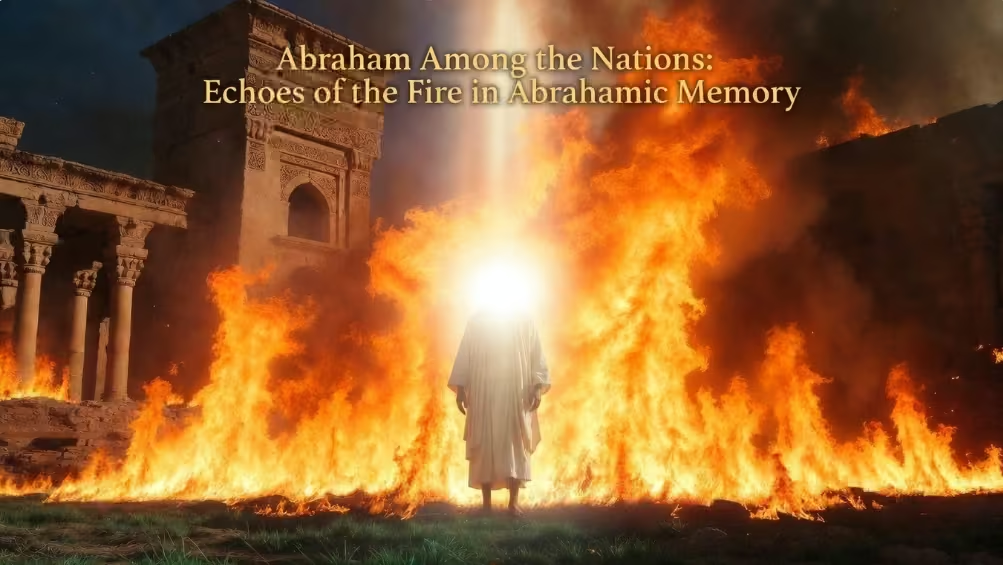
“Amid roaring flames meant for destruction, divine light descends — the fire turns cool and peaceful. A timeless miracle shared by Judaism, Christianity, and Islam: the story of Abraham / Ibrahim (peace be upon him), standing unshaken in the heart of tyranny’s blaze. 🔥🕊️”
Introduction
In the luminous narrative of Prophet Ibrahim (peace be upon him), the miracle of the fire stands as a pinnacle of divine intervention—a testament to tawhid’s unassailable strength against the flames of tyranny and falsehood. As recounted in the Qur’an with crystalline clarity, the fire that was meant to consume him became a sanctuary of coolness and peace (Surah Al-Anbiyaʾ 21:69). Yet this episode, so vividly preserved in Islamic revelation, resonates beyond the confines of one tradition. Echoes of the same story—Abraham’s defiant stand against idolatry and his miraculous deliverance from a furnace—appear in the oral and interpretive legacies of Judaism and Christianity, though not always enshrined in their canonical scriptures.
This exploration invites reflection on these shared threads, honoring the profound unity of the Abrahamic faiths while gently illuminating their distinct emphases. Drawing from classical sources, we trace how Ibrahim/Abraham emerges as a universal archetype: the hanīf who shatters idols, the faithful servant tested by fire, and the spiritual forefather whose legacy binds humanity in a covenant of monotheism. In an age of division, these converging narratives remind us that truth, like fire, can refine rather than destroy, calling us to a common pursuit of the Divine.
The Furnace in Jewish Tradition: Midrashic Flames of Defiance
In Islam, the story of Prophet Ibrahim’s trial by fire is not merely a historical anecdote but a cornerstone of faith, emphasizing unwavering submission to Allah and the futility of idolatry. The Qur’an presents this episode as a direct divine intervention, underscoring the power of tawhid (the oneness of God) to overcome worldly oppression.
Born in a society steeped in polytheism, Ibrahim grew up in ancient Mesopotamia, where his father, Azar, was an idol-maker (Surah Al-Anʿam 6:74). From a young age, Ibrahim questioned the worship of lifeless statues, embarking on a rational and spiritual journey to recognize the true Creator. The Qur’an recounts how he observed the stars, moon, and sun, dismissing each as transient and unworthy of devotion, ultimately affirming, “I have turned my face towards Him Who created the heavens and the earth, as one by nature upright, and I am not of the idolaters” (Surah Al-Anʿam 6:79).
This monotheistic conviction led to confrontation. Ibrahim publicly challenged his people’s idols, smashing all but the largest in their temple and mockingly suggesting it had destroyed the others (Surah Al-Anbiyāʾ 21:58-63). Enraged, the community, led by the tyrannical ruler Nimrod (though not named in the Qur’an, he features in Islamic traditions), decreed his execution by fire. They built a massive pyre, so intense that birds flying overhead were scorched, and catapulted Ibrahim into the flames to avoid the heat themselves.
At this critical moment, Allah commanded, “O fire! Be coolness and peace upon Ibrahim” (Surah Al-Anbiyāʾ 21:69). The fire obeyed, transforming into a cool, safe haven—some traditions describe it as a blooming garden—while only Ibrahim’s bonds were burned. This miracle not only saved Ibrahim but humiliated his persecutors, affirming divine sovereignty over creation. Hadith literature elaborates: Ibrahim’s trust in Allah was absolute; as he was hurled in, he uttered, “Allah is sufficient for us, and He is the best Disposer of affairs” (Sahih Bukhari).
Islamic scholars like Ibn Kathir interpret this as a test of faith, paralleling Ibrahim’s later trials, such as leaving Hajar and Ismail in the desert. The fire symbolizes the trials believers face, refined by adversity into stronger faith. Bediüzzaman Said Nursi notes that fire, like all elements, acts under divine command, not blindly—illustrating that natural laws are subservient to Allah’s will. This narrative inspires Muslims during Eid al-Adha, linking it to Ibrahim’s ultimate sacrifice and the theme of submission.
In essence, Islam’s version canonizes the event, making it a vivid reminder of tawhid’s victory and Allah’s mercy, where fire becomes a tool of protection rather than destruction.
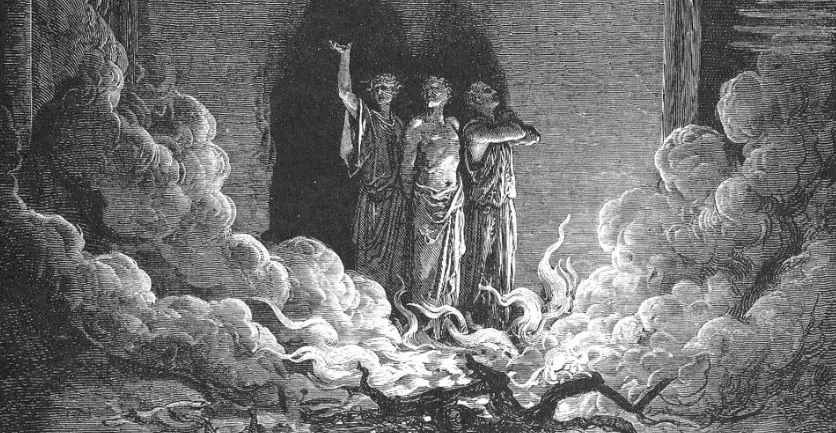
“Faith defies flames: Shadrach, Meshach, and Abednego stand untouched in the blazing furnace, protected by divine power. (Daniel 3)”
The Furnace in Jewish Tradition: Midrashic Flames of Defiance
Judaism reveres Abraham (Avraham Avinu, “our father Abraham”) not merely as a historical figure, but as the foundational patriarch whose unyielding faith birthed the covenantal nation of Israel. While the written Torah (the Five Books of Moses) omits the dramatic tale of the fiery trial—focusing instead on his call from Ur of the Chaldeans (Genesis 12:1–3) and the covenants of promise and circumcision (Genesis 15 and 17)—the story flourishes in the rich soil of Jewish oral traditions, known as Midrash. These interpretive expansions, compiled in texts like Midrash Bereishit Rabbah and the ancient Book of Jubilees (a second-century BCE retelling of Genesis), fill the scriptural gaps with vivid narratives that underscore Abraham’s role as the first monotheist.
In these accounts, a young Abraham confronts the polytheism of his Mesopotamian homeland. His father, Terah, is depicted as a prominent idol-maker, crafting statues for the marketplace—a detail echoing the Qur’anic reference to Azar (Surah Al-Anʿam 6:74). Disgusted by the lifelessness of these creations, Abraham smashes the idols in Terah’s workshop, leaving the largest one intact with the hammer in its grasp. When confronted, he facetiously blames the largest idol, exposing the absurdity of idol worship. Enraged, King Nimrod—portrayed as a tyrannical ruler claiming divine status—sentences him to death by fire in the furnace of Ur Kasdim, “the fire of the Chaldeans.”
The deliverance is miraculous: the flames part like water, or transform into a verdant garden where Abraham emerges unscathed, sometimes aided by an angel. Midrash Rabbah elaborates a debate between Abraham and Nimrod, where Abraham logically dismantles idolatry, arguing that if fire is to be worshiped, why not water that extinguishes it, or wind that scatters clouds? Nimrod’s retort leads to the furnace, but God intervenes, saving Abraham while his brother Haran, who wavers in faith, perishes in the flames (Genesis Rabbah 38:13).
This narrative emphasizes Abraham’s intellectual rebellion against idolatry—reasoning that a created object cannot create harm—and his divine election as the progenitor of Israel through Isaac. Though not canonical, this story permeates Jewish liturgy and folklore, reinforcing Abraham as the archetype of emunah (faith) that withstands trial. It draws from Genesis 15:7, where God says, “I am the Lord who brought you out from Ur of the Chaldeans,” interpreted midrashically as “out from the fire of the Chaldeans.”
Scholars like those in TheTorah.com suggest the midrash borrows motifs from Zoroastrian traditions, where fire tests prophets, adapting them to affirm Jewish monotheism. In Jewish thought, the furnace prefigures later trials, like the Akedah (binding of Isaac), symbolizing resilience amid persecution. It inspires themes of martyrdom, linking to stories like Hananiah, Mishael, and Azariah in Daniel’s fiery furnace.
Thus, Jewish tradition uses the fire to highlight Abraham’s rational faith and God’s protective covenant, transforming potential destruction into affirmation of divine election.
Echoes in Christian Sources: Apocryphal Flames and Martyrdom Motifs
In Christianity, the story of Abraham’s fiery trial is less central than in Islam or Judaism, absent from the canonical New Testament but preserved in apocryphal texts and early Christian writings. It serves as a bridge between Old Testament patriarchs and New Testament themes of faith, resurrection, and martyrdom, often drawing from Jewish midrashic traditions.
The Apocalypse of Abraham, a Jewish pseudepigraphic work from the first or second century CE with possible Christian interpolations, vividly depicts Abraham’s early life. Here, Abraham rejects his father Terah’s idols, burning them in a fire that consumes the house. An angel, Yahoel, reveals God’s command to set the idols ablaze, symbolizing purification from idolatry. Though not explicitly a furnace trial, the text explores fiery ordeals as tests, linking to apocalyptic visions where fire refines the righteous.
The Book of Jasher, an apocryphal narrative cited in the Hebrew Bible (Joshua 10:13, 2 Samuel 1:18) and expanded in later versions, details Abraham’s confrontation with Nimrod. Abraham smashes idols, debates Nimrod, and is cast into a furnace for three days, emerging unharmed while his brother Haran dies. This text, influential in early Christian circles, parallels Daniel’s story of Shadrach, Meshach, and Abednego (Daniel 3), where faith defies a tyrannical king’s fire.
Early Church Fathers like Tertullian and Origen reference Abraham’s trials indirectly, using them to illustrate faith’s endurance. In Against Marcion, Tertullian cites apocryphal stories to affirm God’s consistency from Old to New Testament. The Testament of Abraham, another apocryphon, employs fire metaphorically in judgment scenes, where souls are tested by flames, echoing Abraham’s ordeal as a prototype for Christian suffering.
Christian interpretations often tie the fire to Christological themes: Abraham’s salvation prefigures Christ’s resurrection and the believer’s baptism by fire (Matthew 3:11). In martyrdom literature, like the Acts of the Martyrs, Abraham’s story inspires endurance, paralleling the fiery deaths of early Christians. Armenian apocrypha, blending Jewish and Christian elements, describe Abraham setting fire to idols, leading to his peril and divine rescue.
Overall, Christianity adopts the narrative as extra-canonical lore, emphasizing faith amid persecution and linking it to New Testament eschatology, where fire purifies rather than consumes.
Shared Threads and Distinct Emphases: A Comparative Reflection
Across the Abrahamic faiths, the fire narrative weaves a tapestry of unity, with common motifs of idolatry’s rejection, tyrannical opposition, and miraculous salvation. Yet each tradition infuses it with unique emphases, reflecting theological priorities.
Comparatively, all portray Abraham/Ibrahim as the first monotheist, smashing idols in a defiant act that provokes execution by fire. Nimrod emerges as the antagonist in Jewish and Islamic sources, symbolizing hubris against God. Divine intervention—flames turning cool, parting, or becoming a garden—affirms God’s sovereignty. Haran’s death in Jewish and some Christian apocrypha adds a cautionary note on wavering faith.
Islam canonizes the event in the Qur’an, focusing on tawhid and submission, with fire as a submissive element under Allah’s command. Judaism, through midrash, stresses intellectual reasoning and covenantal election, interpreting “Ur” as “fire” to fill Torah gaps. Christianity, via apocrypha, links it to martyrdom and purification, prefiguring Christ’s trials.
Differences arise in canonicity and symbolism: Islamic emphasis on miracle as proof of prophethood; Jewish on faith’s rationality; Christian on eschatological refinement. Scholars note influences, like Zoroastrian fire tests in midrash, or shared Mesopotamian roots. In interfaith dialogue, this story fosters unity, reminding that Abraham’s legacy transcends divisions, refining believers through trials.
Conclusion: Fire as a Beacon of Unity
The echoes of Abraham’s fire across Judaism, Christianity, and Islam illuminate a shared heritage of monotheism and resilience. In an era of fragmentation, these narratives call for reflection on common values: faith’s triumph over falsehood, divine protection in adversity, and the refining power of truth. As Abraham emerged unscathed, so may the Abrahamic peoples find peace in their intertwined legacies, pursuing the Divine together.
Page 5