
The Echo in Christian Tradition: A Foreshadowing Through Faith 🕌
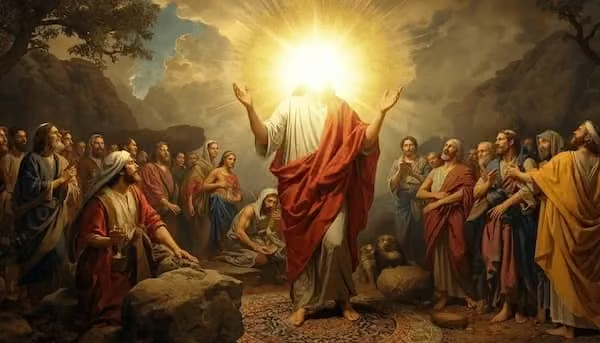
The Echo in Christian tradition — foreshadowing through faith in this powerful biblical scene.
The Echo in Christian Tradition: Abraham in the Fiery Furnace – A Foreshadowing Through Faith
The story of Abraham in the fiery furnace stands as one of the most powerful extra-biblical narratives in the Abrahamic traditions. Although absent from the canonical pages of the Hebrew Bible and the New Testament, it still carries deep meaning across Jewish midrash, early Christian writings, and later theological reflection.
In Christian thought, Abraham is revered as the spiritual forefather of all who are justified by faith (Romans 4:16–17). His trust in God’s promises of countless descendants and blessing to all nations (Genesis 12:2–3) serves as a prototype for salvation through Christ.
The ordeal of Abraham in the fiery furnace illustrates unwavering monotheism confronting idolatrous tyranny. It also shows divine protection of the faithful who refuse to compromise.
This narrative did not arise in a vacuum. It developed from creative exegesis of “Ur of the Chaldeans,” sometimes interpreted as “fire of the Chaldeans.” It was further shaped by the canonical precedent of Daniel 3.
Early Christians, familiar with these Jewish interpretive traditions, found profound resonance in the story. For them, Abraham in the fiery furnace became a clear picture of faith tested and refined by fire.
Jewish Midrashic Foundations of the Abraham in the Fiery Furnace Tale
The Echo in Christian Tradition: A Foreshadowing Through Faith
The classic version of Abraham in the fiery furnace appears in Genesis Rabbah 38:13. Terah, Abraham’s father and an idol-maker, hands his son over to the tyrant Nimrod.
Nimrod commands Abraham to worship fire. Abraham cleverly responds by proposing worship of water, which extinguishes fire. He then suggests clouds that carry water, wind that scatters clouds, and finally human beings who withstand wind.
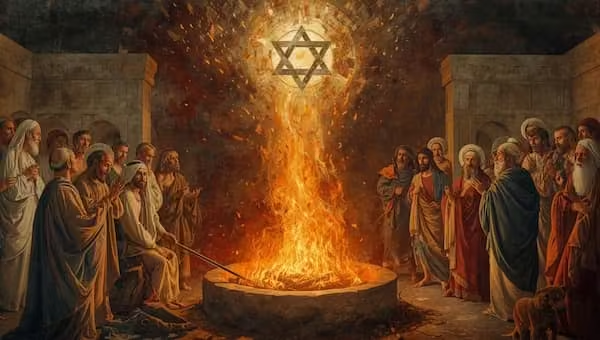
Abraham in the fiery furnace: miraculous salvation from Jewish Midrashic tradition.
Exasperated, Nimrod declares he will worship only fire. He casts Abraham into the blazing furnace and challenges Abraham’s God to save him. Miraculously, Abraham emerges unharmed.
His brother Haran hedges his bets. When asked whose side he is on, Haran waits to see the outcome. After Abraham’s survival, Haran claims allegiance to Abraham and is thrown into the furnace. His innards are scorched, and he dies before his father Terah. This explains Genesis 11:28.
This midrash portrays Abraham as the bold iconoclast who exposes the absurdity of idolatry through reason and faith.
A parallel but distinct account appears in the first- or second-century CE text Liber Antiquitatum Biblicarum (Biblical Antiquities) of Pseudo-Philo. Here the story ties to the Tower of Babel.
Abram refuses to participate in the idolatrous brick-making project. Along with a small group of resisters, he is thrown into the furnace by the leader Joktan, not Nimrod.
Abram declares his trust in God: if there is sin deserving burning, let God’s will be done. God sends a great earthquake. The fire leaps forth from the furnace, killing 83,500 bystanders while leaving Abram completely unharmed.
Immediately afterward, God promises to establish His covenant with Abram and bless his seed forever.
These versions, though differing in details, share a core message. When a servant of the one true God stands firm against idolatry and tyranny, divine intervention transforms apparent defeat into victory. The story of Abraham in the fiery furnace thus became a template for faithful resistance in times of persecution. This foundation creates The Echo in Christian Tradition through shared themes of unwavering faith under trial.
Transmission and Adaptation: Abraham in the Fiery Furnace in Early Christian Sources
The Echo in Christian Tradition: A Foreshadowing Through Faith
Early Christians encountered the story of Abraham in the fiery furnace mainly through Jewish interpretive traditions. Texts like Pseudo-Philo circulated widely in Christian communities. Although the narrative is not part of the New Testament canon, Church Fathers and biblical scholars still engaged with its themes.
St. Jerome (c. 347–420 CE), in his Hebrew Questions on Genesis, explicitly discusses the Hebrew tradition. He explains that “Ur of the Chaldeans” was understood as “the fire of the Chaldeans.” According to this view, Abraham was cast into the fire for refusing to worship it, yet God rescued him. His brother Haran perished in the flames.
St. Augustine also refers to Abraham being “delivered from the fire of the Chaldeans.” He uses the event as a chronological marker for the patriarch’s life and journey.
Direct quotations from Tertullian or Origen on this exact episode remain limited. Still, these Fathers and others were deeply familiar with the broader Jewish exegetical world that produced such stories. They frequently invoked Abraham as the exemplar of faith.
They also used fire imagery—drawn from both canonical texts like Daniel 3 and extra-biblical traditions—to illustrate divine providence and the refining power of trial. The preservation of the faithful amid flames paralleled the experience of Christian martyrs. These believers faced literal and metaphorical fires for refusing to worship idols or emperors.
In this way, the story of Abraham in the fiery furnace entered Christian reflection not as a competing narrative. It served as a supportive echo that amplified the biblical portrait of Abraham as the man of faith.
Symbolic Foreshadowing: Abraham in the Fiery Furnace and Christian Theology
Abraham in the fiery furnace adapted in early Christian sources as a symbol of faith and divine deliverance.
The Echo in Christian Tradition: A Foreshadowing Through Faith
The Echo in Christian Tradition shows how Christian theology shifts the emphasis from the historical details of Abraham in the fiery furnace to its profound symbolic resonance. The trial prefigures the ultimate sacrifice of Jesus Christ, the true “seed” through whom all nations are blessed (Galatians 3:16).
Just as Abraham trusted God’s promises despite overwhelming opposition, so Christ trusted the Father through the agony of the Cross.
The fire itself carries rich typological meaning. In Scripture, fire often represents both judgment and purification (Malachi 3:2–3; 1 Peter 1:7). Abraham’s emergence unscathed from the furnace symbolizes the refining crucible of faith—trials that burn away dross but leave the believer stronger and purer. The Echo in Christian Tradition highlights this purifying power of trial.
This motif connects naturally to the Binding of Isaac (Akedah, Genesis 22). Early Church Fathers such as Origen interpreted that event as a prefiguration of the Cross. In both stories, a beloved son faces death, yet divine provision or resurrection hope prevails. The Echo in Christian Tradition draws a clear parallel between these two accounts.
The story also underscores the triumph of monotheism over tyrannical idolatry. Nimrod, like Pharaoh or later persecuting emperors, embodies the arrogant power that demands worship of created things.
Abraham’s refusal—and later the three youths’ and the martyrs’—proclaims that no earthly force can ultimately prevail against those who trust the living God. For early Christians facing Roman persecution, the account of Abraham in the fiery furnace offered both encouragement and a clear theological framework: God preserves His people through trials, and apparent defeat becomes the seed of greater victory. The Echo in Christian Tradition continues to inspire this same hope today.
Convergence and Distinction: The Enduring Legacy of Prophet Ibrahim (peace be upon him)
The Echo in Christian Tradition: A Foreshadowing Through Faith
The Echo in Christian Tradition reveals Prophet Ibrahim (peace be upon him) as the bold iconoclast who shatters idols. He is the tested servant preserved by divine command and the bearer of a covenant whose legacy transcends bloodlines.
In Islamic tradition the account of Ibrahim in the fire is explicitly Qur’anic. Surah al-Anbiya (21:51–71) and Surah as-Saffat (37:83–98) describe how Ibrahim smashed the idols of his people, was condemned, and was thrown into a blazing fire.
Allah commanded, “O fire, be coolness and safety upon Ibrahim” (Quran 21:69). The flames became harmless, and Ibrahim emerged victorious. The Echo in Christian Tradition continues to highlight this powerful moment of divine protection.
This shared reverence for the story of Abraham in the fiery furnace—known across Jewish midrash, Christian interpretive tradition, and direct Qur’anic revelation—affirms the ultimate triumph of tawhid (monotheism) over tyranny. Yet distinctions remain beautiful. The Echo in Christian Tradition helps us appreciate both the common ground and the unique insights of each faith.
In Christianity the event foreshadows Christological themes and justification by faith. In Islam it exemplifies the hanif’s pure submission and Allah’s direct protection of His prophets.
The narrative does not end with the furnace. Prophet Ibrahim (peace be upon him) faced successive trials: arduous migrations, the heart-wrenching separation from Hazrat Hajra (رضي الله عنها) and young Ismail (peace be upon him) in the desert, and the supreme test of the commanded sacrifice. The Echo in Christian Tradition reminds us that these trials were part of a greater divine plan.
These ordeals reflect the relentless challenges faced by those granted true spiritual insight. As the philosopher-poet Allama Iqbal poignantly expresses: For thousands of years the narcissus weeps over its own lack of light; With great difficulty is a seer (a person of true vision) born in the garden of the world. The Echo in Christian Tradition ultimately points to the rarity and value of such unwavering faith.
For thousands of years the narcissus weeps over its own lack of light; With great difficulty is a seer (a person of true vision) born in the garden of the world.
In essence, it is extraordinarily rare for a discerning, enlightened soul to emerge amid a blind and heedless society—much like a visionary prophet rising against the darkness of tyranny and falsehood.
Concluding Reflection: Timeless Lessons from the Fiery Trial of Abraham in the Fiery Furnace
Powerful image of a figure standing with arms wide in descending divine fire. Illustrates the timeless lessons of faith from the story of Abraham in the fiery furnace.
The Echo in Christian Tradition: A Foreshadowing Through Faith
The Echo in Christian Tradition: A Foreshadowing Through Faith
Prophet Ibrahim (peace be upon him) stands as the spiritual lodestar for billions. His furnace becomes a metaphor for every trial that tempers and proves faith.
The story of Abraham in the fiery furnace teaches a timeless truth: when a believer stands firmly upon tawhid, armed only with sincerity and trust in Allah, no force on earth can prevail against him.
The idols we face today are rarely carved from stone. They take the form of ego, materialism, societal pressure, and falsehoods disguised as truth. Like Ibrahim, we are called to shatter them with reasoned courage, knowing that pride blinds hearts while humility opens them to guidance.
As we conclude this journey through the emergence of the hanif, the breaking of the idols, and their echoes across traditions, let us remember the unifying Qur’anic declaration:
📖 “Say, ‘We believe in Allah; and in what was revealed to us; and in what was revealed to Ibrahim (peace be upon him), and Ismail (peace be upon him), and Ishaq (peace be upon him), and Yaqub (peace be upon him), and the Patriarchs; and in what was given to Musa (peace be upon him) and Isa (peace be upon him) and in what was given to the prophets from their Lord. We make no distinction between any of them, and to Him we surrender.’”
(Quran 2:136)
The Echo in Christian Tradition: A Foreshadowing Through Faith
Above all, this episode reminds us that Allah’s protection is absolute. When we place our reliance solely in Him, even the fiercest trials become places of peace, and apparent defeat is transformed into eternal victory.
The Echo in Christian Tradition shows us the lasting power of unwavering faith. May we inherit even a fraction of Ibrahim’s unshakeable certainty and fearless devotion. So let us consider ourselves very lucky.
In The Echo in Christian Tradition, we find a clear call to trust. And pray to Allah: It is You we worship, and upon You we call for help. Guide us to the straight path— the path of those You have blessed, not of those against whom there is anger, nor of those who are misguided.
🤲 Ameen 🤲
Page 6