
Unveiling Earth’s Secrets
Earth: Our Life-Sustaining Planet — It is the quest to understand how this miraculous blue world works, how it nurtures life, and how humanity is eternally connected to its sacred rhythm.
Secrets Beneath Our Feet

Beneath our feet lies a world of breathtaking complexity on Earth: Our Life-Sustaining Planet. This dynamic living world is composed of intricate layers, each playing an irreplaceable role in maintaining life as we know it.
From shifting tectonic plates to fertile soils that feed billions, every part of Earth: Our Life-Sustaining Planet works in perfect harmony. Its oceans regulate climate, its atmosphere protects us from cosmic radiation, and its land cradles all known life in the universe.a harmonious system that allows life to thrive in endless forms.
To truly appreciate Earth: Our Life-Sustaining Planet, This shared home connects every species, ecosystem, and human endeavor into a single, living network. To understand Earth is to recognize the profound interdependence that binds all creation. Beneath its surface, we uncover not only geological mysteries but also the deeper truth that humanity’s survival is inseparable from the health of the planet itself. we must understand this profound interdependence. Because our survival is not separate from nature — it is nature.
Learn more in our article about Why Earth Is the Only Known Life-Supporting Planet.
The Living Layers of Earth
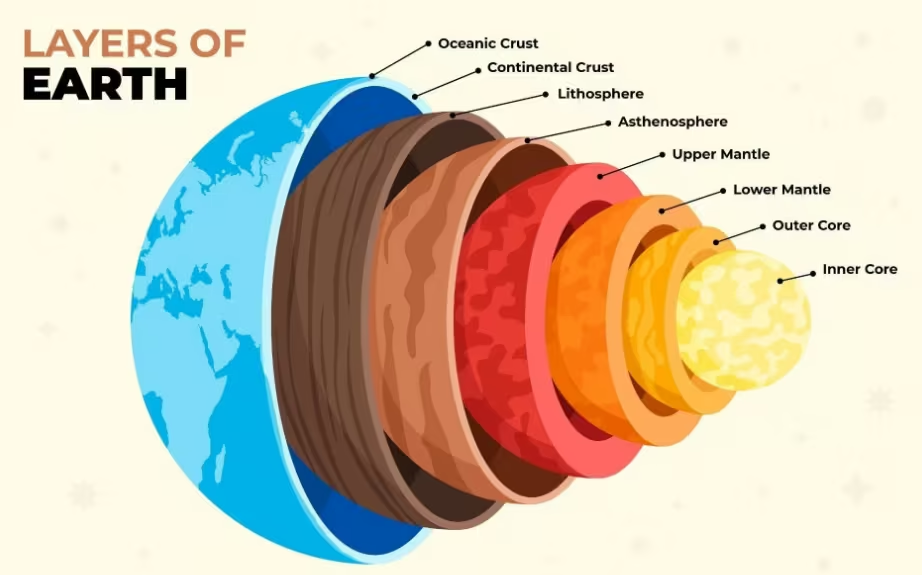
Earth functions like a living engine with four main layers:
- Earth: Our Life-Sustaining Planet is alive and breathing beneath the surface. Its four main layers — crust, mantle, outer core, and inner core — work together like a cosmic engine that protects and sustains all life..
- Crust : The Crust forms the planet’s outer shell, a mosaic of tectonic plates that drift, collide, and reshape continents. These movements give rise to earthquakes, volcanoes, and mountain ranges—natural processes that renew the surface and enrich the soil.
- Mantle: The Mantle composed of semi-molten rock, circulates heat and energy from deep within the Earth, driving the slow but powerful motion of the plates above it.
- Core : The Core divided into liquid and solid layers, generates the planet’s magnetic field, a protective shield that deflects harmful solar radiation and preserves the atmosphere that makes life possible.
Above these layers, Earth’s biosphere, hydrosphere, and atmosphere weave an intricate web of interdependence. Oceans regulate climate and store vast amounts of carbon; forests produce oxygen and sustain biodiversity; and the thin veil of air surrounding our planet moderates temperature and filters sunlight. Yet this balance is delicate. Human activity—deforestation, pollution, and the overuse of resources—has begun to alter the planet’s natural systems. Climate change, soil degradation, and the loss of biodiversity remind us that Earth’s resilience, though remarkable, is not infinite. To unveil the secrets beneath our feet is to understand this unity: that the stability of human civilization depends on the health of the very ground we walk upon.
Read the full scientific explanation at USGS Official Guide or our post on How Earth's Magnetic Field Protects Life .
Or explore our detailed article: How Earth's Magnetic Field Protects Life
The Importance of Understanding Our Planet


The study of Earth is not merely a scientific endeavor—it is an exploration of life’s origin, purpose, and future. Every rock, current, and gust of wind tells a story of transformation. The Earth sciences —geology, meteorology, oceanography, and environmental science—reveal how intricately connected every natural system is.
Through geology, we read the history written in stone, tracing the rise and fall of mountains and continents. Meteorology helps us predict storms, understand weather patterns, and prepare for environmental change. Oceanography uncovers the mysteries of the deep, where unseen currents regulate global climate. Environmental science unites these disciplines, guiding humanity toward sustainability and balance.
Modern technology—satellite imaging, climate modeling, and deep-sea exploration—has transformed our understanding of the planet. Scientists can now track melting glaciers, observe deforestation, and analyze atmospheric shifts in real time, helping humanity make informed choices about its collective future. Beyond data, studying Earth cultivates awareness and responsibility. It reminds us that every breath, every drop of water, and every grain of soil is part of a shared inheritance. Protecting the Earth is not an act of preservation alone—it is an act of foresight and gratitude, ensuring that future generations inherit a world capable of sustaining life’s endless promise.
Forever Grateful to Our Planet
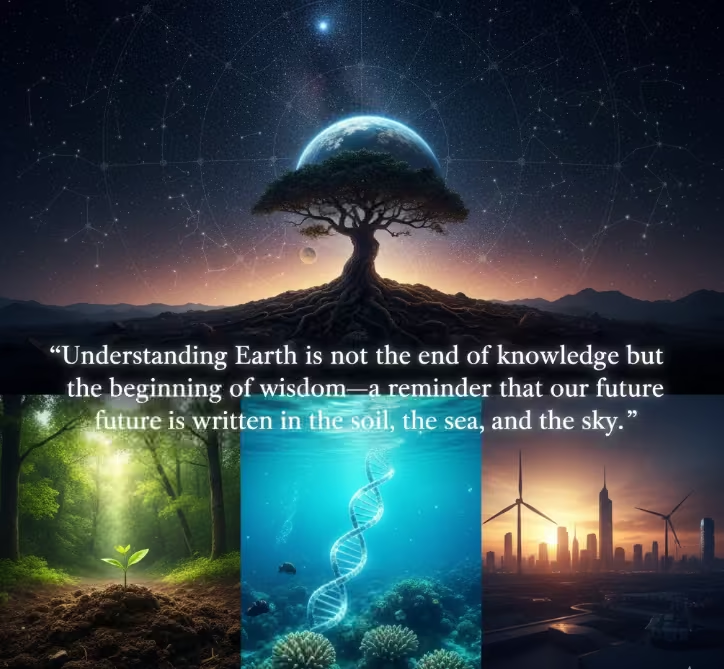
Understanding Earth: Our Life-Sustaining Planet is not the end of knowledge — it is the beginning of wisdom, gratitude, and responsibility.
This is the only known oasis of life in the vast cosmic desert. Let us cherish, protect, and celebrate Earth: Our Life-Sustaining Planet — today and every day.