
The Throne of Queen Bilqis: A Sign of Power Revealed in the Time of Hazrat Sulayman (A.S.)
Part A
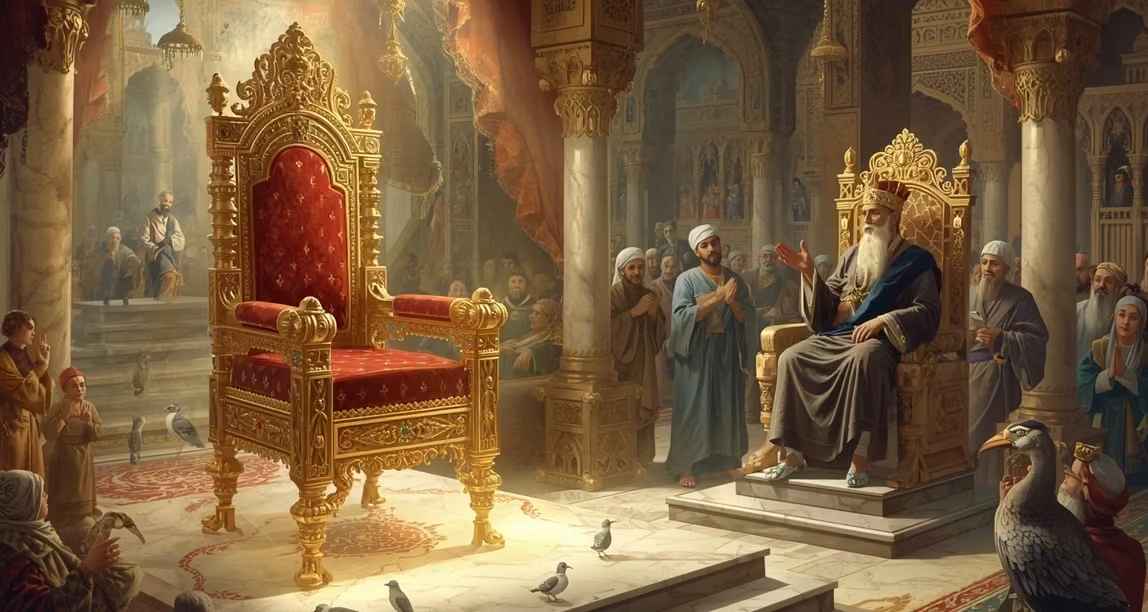
The Throne Miracle: Transported from Sheba to Sulayman (A.S.) in an Instant)
Among the many extraordinary events during the era of Hazrat Sulayman (A.S.), the story of Queen Bilqis—known as the Queen of Sheba—stands out as a profound demonstration of divine authority, prophetic wisdom, and the supremacy of monotheism. Allah granted Sulayman (A.S.) immense blessings, including control over the winds, jinn, animals, and birds, along with unparalleled knowledge and a vast kingdom. This narrative, detailed in Surah An-Naml (27:15–44) of the Holy Quran, highlights how worldly power and splendor pale before Allah’s might.
Allah says: {And We had certainly given to David and Solomon knowledge, and they said, “Praise [is due] to Allah, who has favored us over many of His believing servants.” And Solomon inherited David. He said, “O people, we have been taught the language of birds, and we have been given from all things. Indeed, this is evident bounty.” And gathered for Solomon were his soldiers of the jinn and men and birds, and they were [marching] in rows. Until, when they came upon the valley of the ants, an ant said, “O ants, enter your dwellings that you not be crushed by Solomon and his soldiers while they perceive not.” So [Solomon] smiled, amused at her speech, and said, “My Lord, enable me to be grateful for Your favor which You have bestowed upon me and upon my parents and to do righteousness of which You approve. And admit me by Your mercy into [the ranks of] Your righteous servants.” And he took attendance of the birds and said, “Why do I not see the hoopoe – or is he among the absent? I will surely punish him with a severe punishment or slaughter him unless he brings me clear authorization.”} (27:15–20)
The story begins when the hoopoe bird, part of Sulayman’s assembly, returns from a distant land called Saba (Sheba) and reports: {But the hoopoe stayed not long and said, “I have encompassed [in knowledge] that which you have not encompassed, and I have come to you from Sheba with certain news. Indeed, I found [there] a woman ruling them, and she has been given of all things, and she has a great throne. And I found her and her people prostrating to the sun instead of Allah, and Satan has made their deeds pleasing to them and averted them from [His] way, so they are not [rightly] guided, [And] so they do not prostrate to Allah, who brings forth what is hidden within the heavens and the earth and knows what you conceal and what you declare. Allah – there is no deity except Him, Lord of the Great Throne.”} (27:22–26)
Deeply concerned by their idolatry, Sulayman (A.S.) sent a letter inviting Queen Bilqis and her people to submit to Allah alone, warning against arrogance.
Bilqis, a wise and powerful ruler, consulted her advisors upon receiving the letter. They offered military support, but she chose diplomacy, sending lavish gifts to test Sulayman (A.S.). He rejected the gifts, declaring that what Allah had given him was far superior, and threatened to send an unstoppable army if they did not submit.
To demonstrate Allah’s power, Sulayman (A.S.) asked his assembly: “Which of you can bring me her throne before they come to me in submission?” A mighty jinn offered to fetch it before Sulayman rose from his seat. But one endowed with knowledge of the Scripture declared: {Said one who had knowledge from the Scripture, “I will bring it to you before your glance returns to you.” And when [Solomon] saw it placed before him, he said, “This is from the favor of my Lord to test me whether I will be grateful or ungrateful. And whoever is grateful – his gratitude is only for [the benefit of] himself. And whoever is ungrateful – then indeed, my Lord is Free of need and Generous.”} (27:40)
Instantly, by Allah’s permission and through this servant’s supplication (often identified in tafsir as Asif bin Barkhiya), the throne—renowned for its exquisite craftsmanship, jewels, gold, and grandeur—was transported from Sheba (Yemen) to Sulayman’s court in Jerusalem, covering vast distances in a mere moment.
Sulayman (A.S.) praised Allah for this miracle. He then ordered the throne disguised slightly to test Bilqis’s perception. When she arrived, she was asked: {So when she arrived, it was said [to her], “Is your throne like this?” She said, “[It is] as though it was it. And we were given knowledge before her, and we have been Muslims [in submission to Allah].”} (27:42)
Further humbled by entering a palace with a crystal floor resembling water—causing her to lift her skirts—Bilqis recognized the truth: {It was said to her, “Enter the palace.” But when she saw it, she thought it was a body of water and uncovered her shins [to wade through]. He said, “Indeed, it is a palace [whose floor is] made smooth with glass.” She said, “My Lord, indeed I have wronged myself, and I submit with Solomon to Allah, Lord of the worlds.”} (27:44)
The throne episode vividly showcased Allah’s limitless power, enabling the impossible through His chosen servant. It humbled a proud queen, leading her from sun worship to tawhid (monotheism), and affirmed Sulayman’s prophethood. This miracle serves as an eternal reminder: true authority belongs to Allah alone, and wisdom lies in submitting to Him, transcending material grandeur.
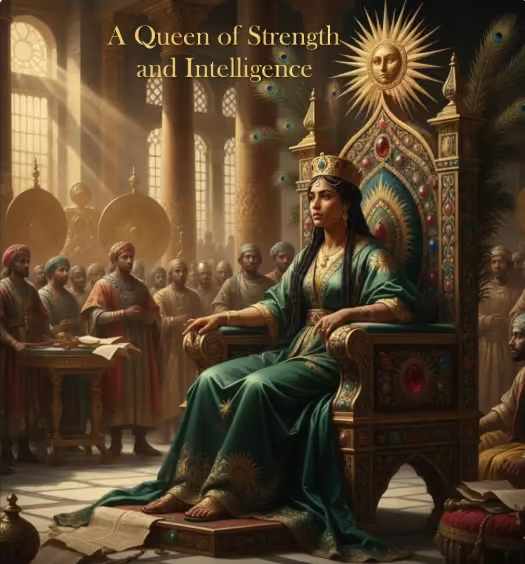
A Queen of Strength and Intelligence
Caption:
“I will bring it to you before your glance returns to you” – The splendid throne of the Queen of Sheba arrives in an instant by Allah’s grace, a supreme sign of divine power and tawhid in the presence of Prophet Sulayman (A.S.). (Inspired by Surah An-Naml 27:40)
Queen Bilqis, known as the Queen of Sheba, was renowned for her exceptional intelligence, remarkable leadership, and the prosperous kingdom she governed with wisdom and stability. The Holy Quran portrays her as a powerful female ruler endowed with “everything” (Surah An-Naml 27:23), including vast resources, advanced civilization, and a magnificent throne that symbolized her supreme authority, dignity, and the grandeur of her nation. This throne—described as splendid and great (‘arshun ‘azim)—was crafted from precious materials like gold, inlaid with rubies, pearls, chrysolite, and other jewels, reflecting the artistic mastery, architectural prowess, and economic wealth of her people in ancient Saba (Sheba), a land blessed with fertile gardens, advanced irrigation, and thriving trade.
Despite these worldly blessings and her evident capabilities, Queen Bilqis and her subjects remained devoted to sun worship, prostrating to the sun instead of Allah, as Satan had beautified their misguided deeds and diverted them from the straight path (Surah An-Naml 27:24). This idolatry persisted amid their material success, highlighting how even the most intelligent and accomplished individuals can stray without divine guidance.
Hazrat Sulayman (A.S.), a prophet granted immense wisdom, kingdom, and control over creation, did not approach her with conquest or force. Instead, moved by compassion and prophetic duty, he sought to invite her to the truth of tawhid—the oneness of Allah. Through the hoopoe’s report and his gracious letter, he aimed to awaken her discerning heart and sharp mind to recognize the Creator beyond earthly splendor. Bilqis’s consultative style—always seeking counsel from her advisors yet retaining final authority—demonstrated her prudence and maturity as a leader. Her diplomatic response, rejecting hasty war and opting for gifts to test Sulayman (A.S.), further revealed her political acumen and preference for negotiation over conflict.
In this encounter, the Quran presents Bilqis as a model of feminine leadership: wise, consultative (practicing shura), intelligent, and open to truth. Her eventual submission to Allah underscores that true strength lies not in worldly power alone but in humility before the Divine. This narrative celebrates her qualities while reminding us that genuine wisdom leads to recognizing and embracing monotheism, transcending even the most magnificent thrones and kingdoms.
Hazrat Sulaiman (A.S.) and Queen Bilqis by Quranic references
Surah An-Naml (27:15–44) |
A Throne Chosen as a Test of Insight
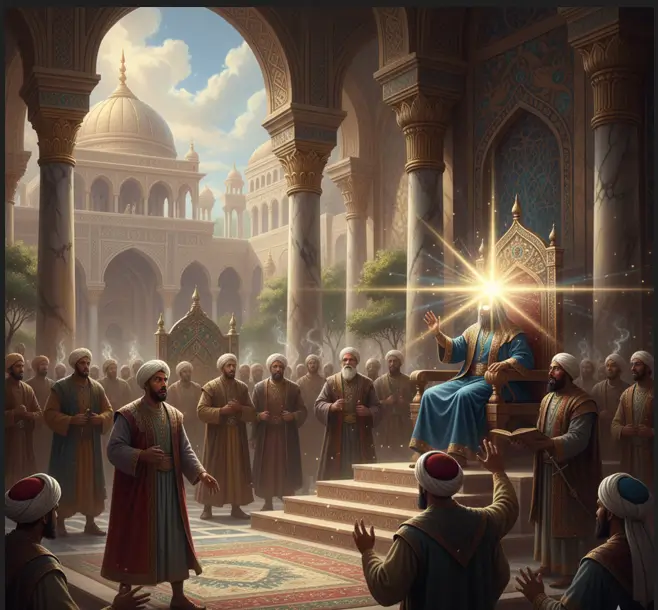
In the heart of an ancient palace of knowledge and justice, a revered leader receives divine illumination, guiding his people through an era of enlightenment and harmony.
When Hazrat Sulayman (A.S.) was informed of Queen Bilqis’s approaching delegation, he wisely chose her throne—not as a trophy of conquest, but as a gentle instrument for spiritual awakening. This throne, the ultimate emblem of her power, wealth, and identity, was selected to serve as a living sign: a reminder that no earthly splendor can withstand or match Allah’s absolute authority.
His question to the assembled court—“Who among you can bring me her throne before they come to me in submission?”—was never an act of boastfulness. It was an invitation to witness a miracle that would reveal divine knowledge surpassing all human or jinn capability. The swift response from a mighty jinn offered speed and strength, yet the true marvel came through the servant granted knowledge from the Scripture, who fulfilled the request in the blink of an eye by Allah’s permission and through sincere supplication.
Sulayman (A.S.) then subtly altered the throne’s appearance—not to deceive, but to prompt reflection and test Bilqis’s insight. When she arrived and saw it, her immediate recognition (“It seems the very same”) combined with her growing awareness of a greater reality opened the door to her heartfelt submission.
Note: This episode beautifully illustrates prophetic wisdom: Sulayman (A.S.) used the throne not for personal glory, but to guide a discerning queen toward tawhid. The miracle was never about overpowering her kingdom; it was about humbling hearts before Allah’s limitless power. By bringing what she treasured most into his presence effortlessly, he demonstrated that true dominion belongs only to the Creator. Bilqis’s eventual declaration—“My Lord, indeed I have wronged myself, and I submit with Solomon to Allah, Lord of the worlds”—shows how a single, divinely enabled sign can transform even the most accomplished ruler from idol-worship to pure monotheism. The throne, once a symbol of worldly pride, became a bridge to eternal truth.
Page 1