
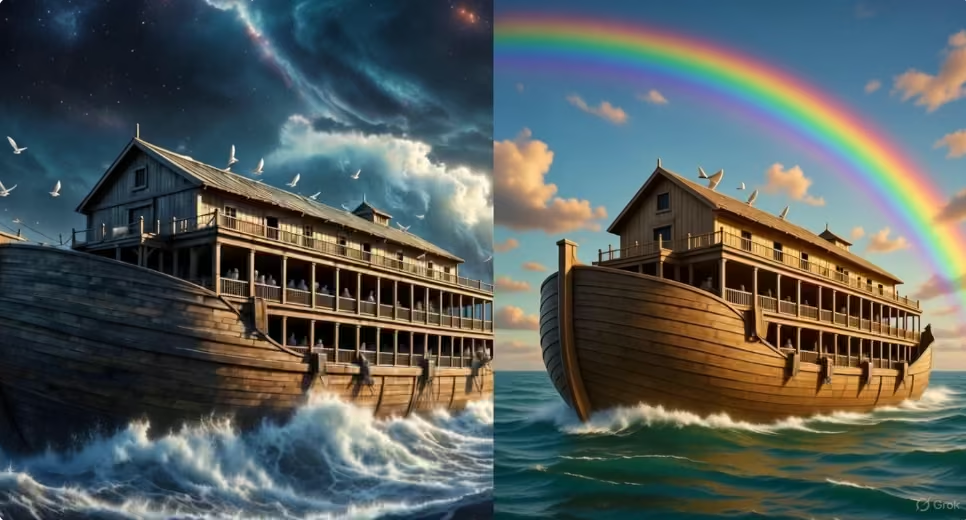
The Ark of Nuh (ʿalayhi al-salam) in the Light of Classical Tafsir
Historical Details, Theological Depth, and Enduring Lessons from al-Ṭabari, Ibn Kathir, and al-Qurtubi
Introduction: From Narrative to Exegetical Depth
The Qur’anic account of Prophet Nuh (ʿalayhi al-salam) is the longest continuous prophetic story in the Muslim scripture, spanning four major surahs and offering a profound meditation on faith, rejection, and divine justice. While the broad outlines are universally known, the classical tafsir tradition transforms the narrative into a rich repository of historical, linguistic, and theological insight. This article examines the episode of the Ark through the authoritative lenses of three seminal works: al-Ṭabari’s Jamiʿ al-Bayan, Ibn Kathir’s Tafsir al-Qur’an al-ʿAzim, and al-Qurtubi’s al-Jamiʿ li-Aḥkam al-Qur’an, revealing dimensions that remain strikingly relevant to contemporary Islamic thought.
The Unprecedented Duration of Prophetic Mission
The Qur’an declares that Nuh (A.S.) remained amongst his people “a thousand years less fifty” (29:14). Classical exegetes unanimously interpret this literally as 950 solar years of active daʿwah. Al-Tabari cites chains of transmission reaching back to the Ṣaḥābah confirming that Nūḥ was 480 years old when he received prophethood and lived another 950 years preaching, making him 1,430 years old at the time of the Flood. Ibn Kathīr emphasises that this extraordinary span was a divine grace, allowing multiple generations to witness the same living proof of tawhid. The sheer length of the mission underscores a central theological principle: Allah’s mercy precedes His wrath, and the door of repentance is kept open far beyond ordinary human patience.
Divine Supervision in the Construction of the Ark
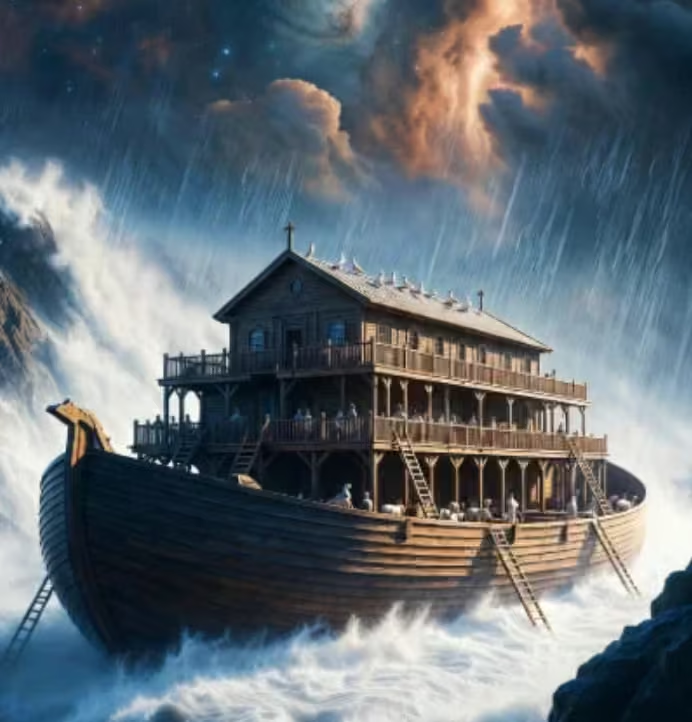
The command “And construct the ship under Our eyes and Our revelation” (11:37) is interpreted by all three scholars as direct, continuous divine guidance. Al-Qurtubi explains that “Our eyes” denotes divine protection from sabotage and “Our revelation” indicates precise technical instruction. Ibn Kathīr transmits reports that Jibrīl (ʿalayhi al-salam) personally taught Nuh (A.S.) the measurements and the method of joining planks with wooden pegs rather than iron nails, ensuring the vessel could withstand centuries of subsequent exposure. Al-Tabai records that the Ark measured 300 cubits in length, 50 in width, and 30 in height, with three distinct decks: the lowest for animals, the middle for human beings, and the uppermost for birds and provisions.
The Three-Tiered Symbolism of the Ark
Beyond its physical specifications, the Ark functions as a multi-layered symbol in classical exegesis:
- Al-Tabari views the vertical stratification as a microcosm of divine order: animals (instinct), humans (intellect), and birds (aspiration toward the heavens).
- Ibn Kathīr highlights its role as the sole locus of legitimate authority once divine decree was sealed.
- Al-Qurtubī adds a juridical dimension: boarding the Ark constituted an act of obedience equivalent to entering the fold of salvation, prefiguring the covenant of the final Prophet.
The Cosmic Nature of the Deluge
The Qur’anic description “We opened the gates of the heaven with pouring water, and caused the earth to gush forth springs” (54:11–12) is universally understood as a supra-natural event. Al-Ṭabarī cites early authorities stating that the rain fell with such force that it penetrated roofs of stone, while subterranean waters erupted simultaneously, creating a total planetary submersion. Ibn Kathīr records that the water level exceeded the highest mountains by fifteen cubits, rendering any attempt at refuge futile. The dual source of water, celestial and terrestrial, symbolises the complete overturning of creation itself.
The Tragedy of a Prophet’s (A.S.) Son: Faith, Lineage, and Individual Responsibility
The drowning of Nuh’s (A.S.) son (11:42–43) constitutes one of the most poignant theological moments in the Qur’an. Al-Qurṭubī stresses that the son was biologically legitimate yet spiritually disaffiliated, establishing the principle that prophethood confers no automatic immunity upon offspring. Ibn Kathīr cites the divine response “He is not of your family; verily his work was unrighteous” (11:46) as definitive proof that spiritual kinship supersedes biological ties, a cornerstone of Islamic soteriology.
Mount Judi and the First Post-Diluvian Covenant
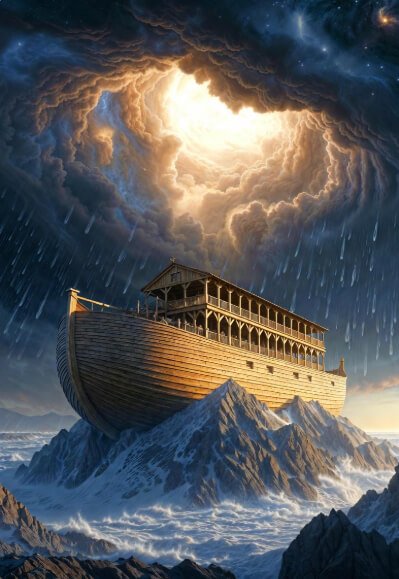
The Ark’s final resting place on Mount Judi (11:44) is identified by Ibn Kathir as a mountain in the region of modern-day south-eastern Turkey near Cizre. Al-Tabari records variant narrations placing it within the ancient Mesopotamian cultural sphere. The divine benediction pronounced upon Nuh (A.S.) and his companions, “Peace be upon Nuh (A.S.) among the worlds” (37:79), marks the establishment of a renewed covenant: humanity henceforth descends from believers rather than from a single primordial couple.
Contemporary Resonance
The classical tafsir tradition presents the episode of Nuh (A.S.) not merely as ancient history but as a perennial paradigm. The 950-year mission exemplifies the obligation of daʿwah in the face of systemic rejection. The Ark stands as a metaphor for the Muslim community itself, an embattled minority preserved by divine command amidst a sea of disbelief. Finally, the principle that salvation is contingent upon personal faith rather than inherited privilege remains a powerful corrective to ethno-religious exclusivism.
Conclusion
Through the meticulous scholarship of al-Tabari, Ibn Kathir, and al-Qurtubi, the narrative of Nuh (A.S.) transcends its historical particularity to become a timeless exposition of divine justice, prophetic resilience, and the primacy of faith over lineage. The Ark, far from being an archaic relic, emerges as an enduring archetype: a divinely ordained refuge for those who anchor themselves to revelation when the floods of falsehood rise.