
Sulayman (A.S.): Knowledge Applied Justly in Ruling

Sulayman (A.S.), known in English as Solomon, stands among the greatest prophets and kings granted to mankind. The Qur’an presents him as a ruler whose strength did not come from military power or wealth, but from knowledge, wisdom, and unwavering justice. His leadership represents a model where authority is guided not by desire, but by divine understanding and moral clarity. Through his story, believers learn how knowledge becomes a powerful tool when it is used with fairness, humility, and gratitude.
A Kingdom Built on Divine Gifts

Allah blessed Sulayman (A.S.) with extraordinary abilities: understanding the speech of animals, command over the winds, and authority over beings from the jinn. But the Qur’an makes it clear that these extraordinary gifts were not sources of pride. Instead, they were tools he used responsibly and thanked Allah for. His famous supplication, filled with humility, reflects his character:
“My Lord, inspire me to be grateful for Your favor…”
(Qur’an 27:19)
His immense blessings never distracted him from truth. They strengthened his awareness that leadership is a trust, not a throne.
Wisdom in Judgment

One of the characteristics that made Sulayman (A.S.) an exemplary ruler was the way he delivered justice. He approached disputes calmly, listening carefully, and applying insight that went deeper than appearances. His judgments were not merely legal decisions; they were lessons showing how fairness requires both knowledge and thoughtful understanding.
The Qur’an highlights an example where he offered a judgment differing from his father, Dawid (A.S.), demonstrating that wisdom grows through reflection and insight. His ability to examine issues from multiple angles reveals why he became a symbol of thoughtful leadership.
Knowledge as a Guide, Not an Ornament
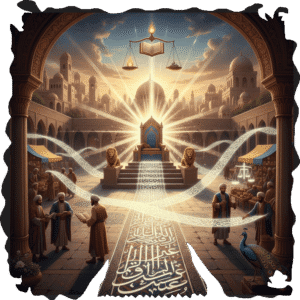
Sulayman (A.S.) understood that knowledge carries responsibility. He did not use his learning to impress people or elevate himself. Instead, he applied it to solve problems, maintain peace, resolve disagreements, and uplift society. His knowledge was active — not stored, not theoretical, but constantly applied for benefit.
He taught that leadership without wisdom becomes tyranny, and wisdom without justice becomes empty philosophy. By uniting the two, he created a model for righteous governance.
Justice Beyond Power

What truly distinguished Sulayman (A.S.) was the fairness he showed even when no one could challenge him. With unmatched authority, he maintained humility. He recognized that fear of Allah is a ruler’s greatest protection against injustice.
Even in interactions with the smallest creatures — such as the well-known story of the ant who warned its colony — he showed compassion. His smile at the ant’s words demonstrated how deeply he valued the life and rights of all beings, not just humans.
This gentle sense of justice reflects a heart that understands leadership as service.
Humility in the Presence of Power

Despite controlling armies, winds, and resources, Sulayman (A.S.) remained grounded. He constantly reminded himself that greatness belongs to Allah alone. The famous incident of the Queen of Sheba (Bilqis), mentioned in the Qur’an, shows his method of inviting others to truth: respectful, wise, and free from arrogance.
He never used his power to force belief; he used reasoning, signs from Allah, and patience. This approach transformed hearts more effectively than force ever could.
Legacy of a Knowledge-Based Leader

The legacy of Sulayman (A.S.) endures as a blueprint for those in positions of authority. His life teaches that:
Knowledge must lead to justice
Power is safest in the hands of the humble
Wisdom grows through gratitude to Allah
Leadership is a trust, not an entitlement
True justice considers the weak as much as the powerful
Sulayman (A.S.) left behind a model that transcends time: a leader whose mind was sharp, whose heart was sincere, and whose actions reflected divine guidance.
Conclusion

Sulayman (A.S.) represents the highest form of leadership — one where knowledge is not only possessed but applied with integrity and compassion. His life shows that wisdom reaches its fullest purpose when used to uphold justice, protect the vulnerable, and serve humanity for the sake of Allah. In every era, his example stands as a reminder that the most powerful ruler is the one who rules with fairness, humility, and gratitude.