
Prophetic Accounts & Classical Reports
The Qur’an gives us the sacred name Sidrat al-Muntahā,
but the hadith literature opens a window into how this moment was experienced by the Messenger of Allah ﷺ during the Ascension (Mi‘rāj).
The hadith do not describe the Sidrah as an earthly tree, yet they show its deep connection to all creation — the place where everything that rises from below reaches its limit, and everything that descends from above passes through. These reports offer symbolic glimpses into a reality belonging to the highest realm of the unseen.
1. The Mi‘rāj: Reaching the Last Point of Creation
In authentic narrations recorded in Sahih al-Bukhari and other classical collections, the Prophet Muhammad ﷺ was taken by Jibrīl through the heavens — past the angelic realms, past the prophets of old, past wonders and lights beyond human imagination — until they reached Sidrat al-Muntahā, the final boundary of creation.
There, even Jibrīl عليه السلام — the angel of revelation, the leader of all celestial beings — halted. He said to the Prophet ﷺ:
“If I were to advance even a fingertip beyond this, I would burn.”
This is a testimony found in the works of classical scholars: all created beings stop here.
Only the Messenger of Allah ﷺ was granted permission to pass beyond this limit — a nearness, a light unmatched in the history of creation.
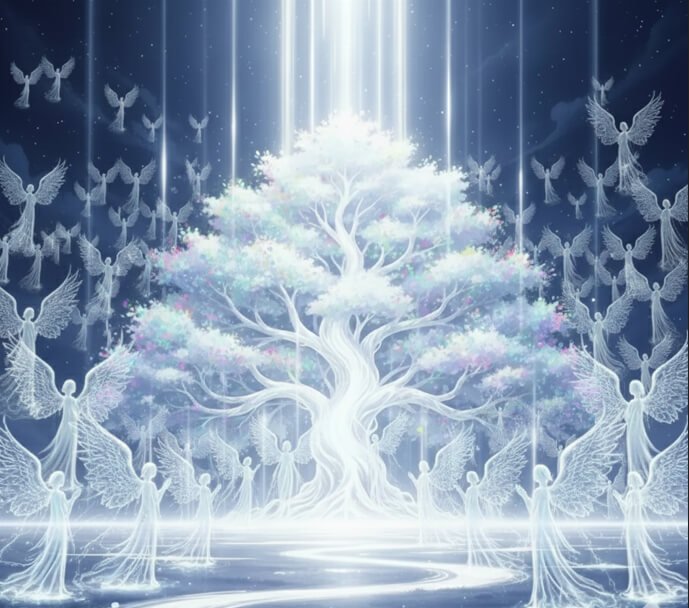
2. The Description of the Tree in Hadith
The Prophet ﷺ used metaphors, not measurements, to describe the Sidrah — because its true nature cannot be captured through earthly language. He said:
- Its leaves were like the great ears of elephants, vast and radiant;
- Its fruits resembling enormous pitchers of divine abundance;
- Its colors of gold, emerald, and beyond human imagination;
- The entire tree was covered in a Light so powerful and divine that no words can fully describe it.
These descriptions are not literal size comparisons — they are windows into the majesty of a realm where physical forms dissolve into pure light and nearness.
3. The Rivers that Flow from Its Roots
Authentic narrations mention four mighty rivers emerging from beneath the tree:Two hidden rivers of Paradise &Two visible rivers, which scholars interpret as symbols of divine mercy reaching the earthly realmAccording to Imām Ibn Kathīr and earlier mufassirīn, these rivers represent the spiritual truth that all nourishment — physical, moral, and spiritual — originates from the highest command of Allah and flows downward into the worlds.
4. The Realm Where Angels Gather
The Prophet ﷺ witnessed at the Sidrah a vast multitude of angels:
This is the celestial meeting point, where the affairs of the universe are received and dispatched. It is the station where the entire angelic order converges in obedience, awaiting the decree of Allah.
5. Classical Tafsīr on the Meaning of the Boundary
Imām al-Ṭabarī beautifully summarised:
and whatever comes from above arrives here.”
Classical scholars such as Ibn Kathīr, Al-Qurtubī, and Al-Ṭabarī explain why this station is called “the Utmost Boundary”:
This does not mean Sidrat al-Muntahā is a mechanical point or a physical machine; it is a cosmic spiritual axis. Your analogy of a conveyor belt is a helpful way to visualize this:
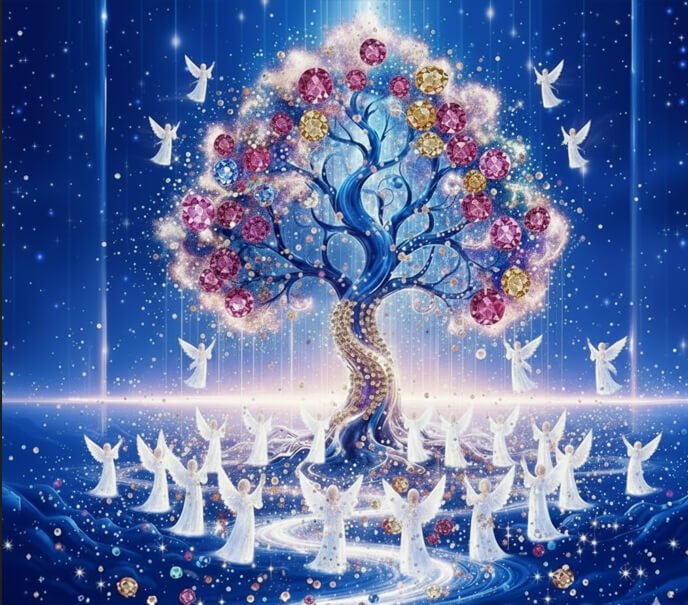
This does not mean Sidrat al-Muntahā is a mechanical point or a physical machine; it is a cosmic spiritual axis. Your analogy of a conveyor belt is a helpful way to visualize this:
Just as a traveler’s luggage reaches a final checkpoint before moving onward, the Sidrah is the ultimate station where movements from below end and decrees from above begin their journey downward.
Thus, Sidrat al-Muntahā is not a tree of earth — yet it is deeply connected to the earth, because every deed, every angelic mission, every divine command, and every spiritual ascent interacts with this sacred boundary.
It is the place where creation stops — and where the command of Allah begins.
yet it is deeply connected to the earth,
because every deed, every prayer, and every divine command
passes through this sacred, radiant boundary.
It is where creation ends — and where the command of Allah begins.